
Tents & Trees
At a campsite, every family pitches its tent beside its own tree, and nobody wants a neighbor's tent touching theirs. These grids follow the same manners. Rule out the squares that can't work and the right spots appear.
Free sets by level, ages 6–12:
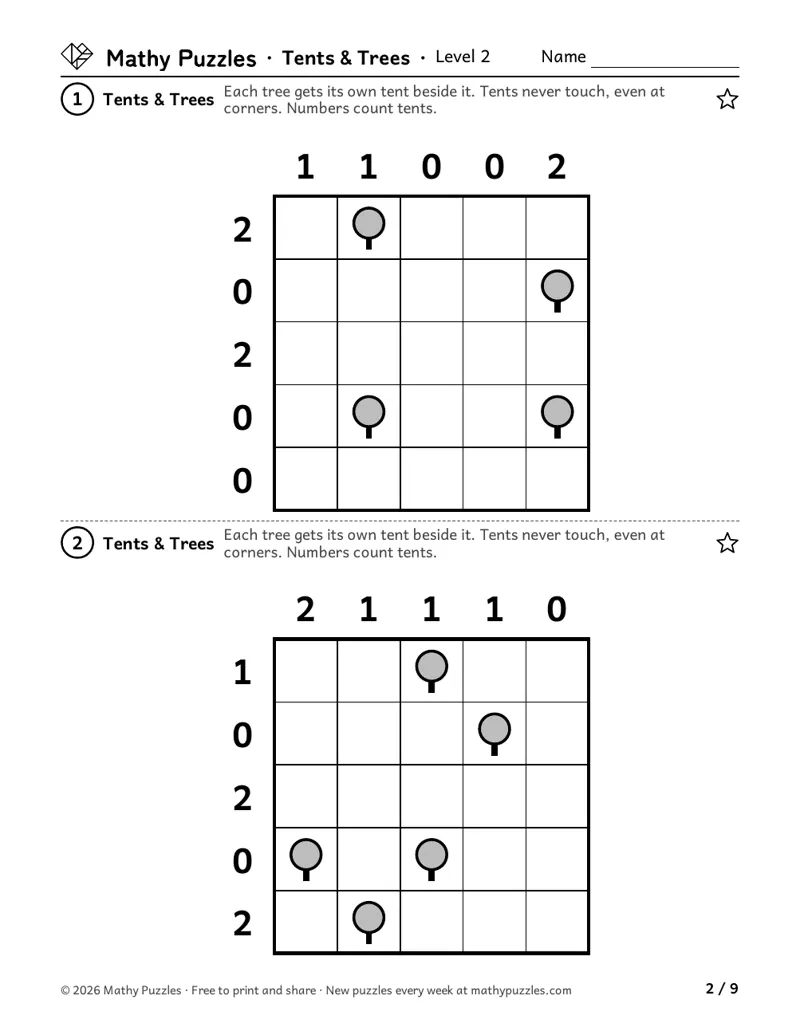 Level 2: a page from the free set
Before starting
- Count to 5
- Tell beside (up, down, left, right) from corner to corner
- Know rows and columns
- Level 4: comfortable with Level 3 grids
Free puzzles to print
Each set: a Learn sheet with a worked example, 10 puzzles from easiest to hardest, and the answers.
Level 2
Ages 6–8 · Grades 1–2
5 × 5 grids with 4 or 5 trees, then 6 or 7, then a 6 × 6 grid with 7 or 8 trees. Every row and column shows its number.
On the sheet: “Each tree gets its own tent beside it. Tents never touch, even at corners. Numbers count tents.”
Print Level 2 (Letter)Other paper size: A4Level 3
Ages 8–10 · Grades 3–4
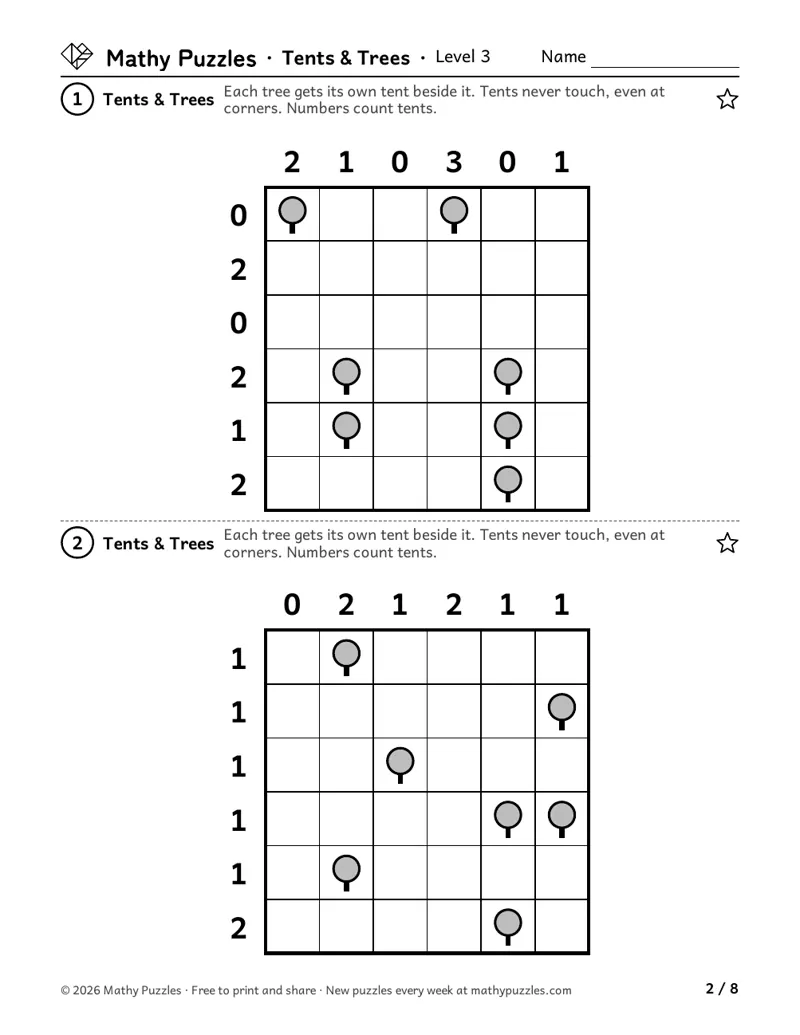
6 × 6 and 7 × 7 grids that bring in the "shared spot" idea; the hardest have 10 to 12 trees and leave a few numbers blank.
On the sheet: “Each tree gets its own tent beside it. Tents never touch, even at corners. Numbers count tents.”
Print Level 3 (Letter)Other paper size: A4Level 4
Ages 10–12 · Grades 5–6
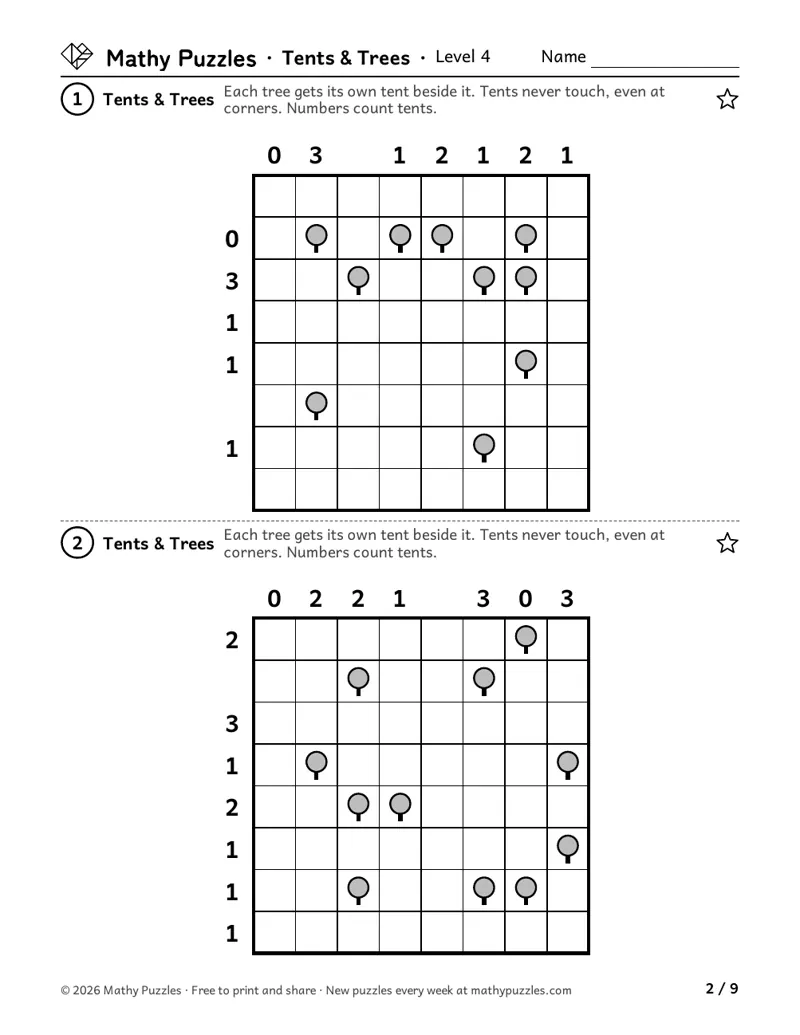
8 × 8 to 10 × 10 grids, often with some numbers blank. From the middle puzzles on, trees that share spots must be paired up, and the hardest need one "what if" test.
On the sheet: “Each tree gets its own tent beside it. Tents never touch, even at corners. Numbers count tents.”
Print Level 4 (Letter)Other paper size: A4
How it works
Each puzzle is a grid with trees in some squares and numbers along the top and side. The child draws a tent for every tree. Each tree gets its own tent right beside it: up, down, left or right. Tents never touch, not even at the corners. Each number says how many tents are in its row or column.
How to play
- Dot every square with no tree beside it. Those squares are grass.
- Find a tree with only one free side. Draw its tent there.
- Tents never touch, even at corners. Dot all eight squares around each tent.
- Use the numbers: a row with all its tents gets dots in the rest.
When it gets hard
Letting two tents touch at a corner.
Hint: Each time you draw a tent, dot all eight squares around it.
Using one tent for two trees.
Hint: Each tree needs its own tent. Draw a little line from each tent to its tree.
Putting a tent corner to corner from its tree.
Hint: A tent must be straight up, down, left or right of its tree.
Tip for grown-ups: At the end, ask your child to point to each tree and then its tent. Pairing them aloud catches most slips.
Frequently asked questions
- Can a tent sit beside two trees?
- Yes, but it belongs to only one of them. The other tree still needs its own tent.
- Why are some row numbers blank at the higher levels?
- In the hardest Level 3 and most Level 4 puzzles, a few numbers are left blank on purpose. The other clues are meant to be enough, and your child can work out what the blank would be.
- Is this a good first grid puzzle for a grade 1 class?
- It makes a good one. Level 2 starts with a 5 × 5 grid and a few trees, and the rules are concrete. Model one puzzle on the board, especially the "not even at the corners" rule.
Questions about printing, levels, answers or membership: see all questions.
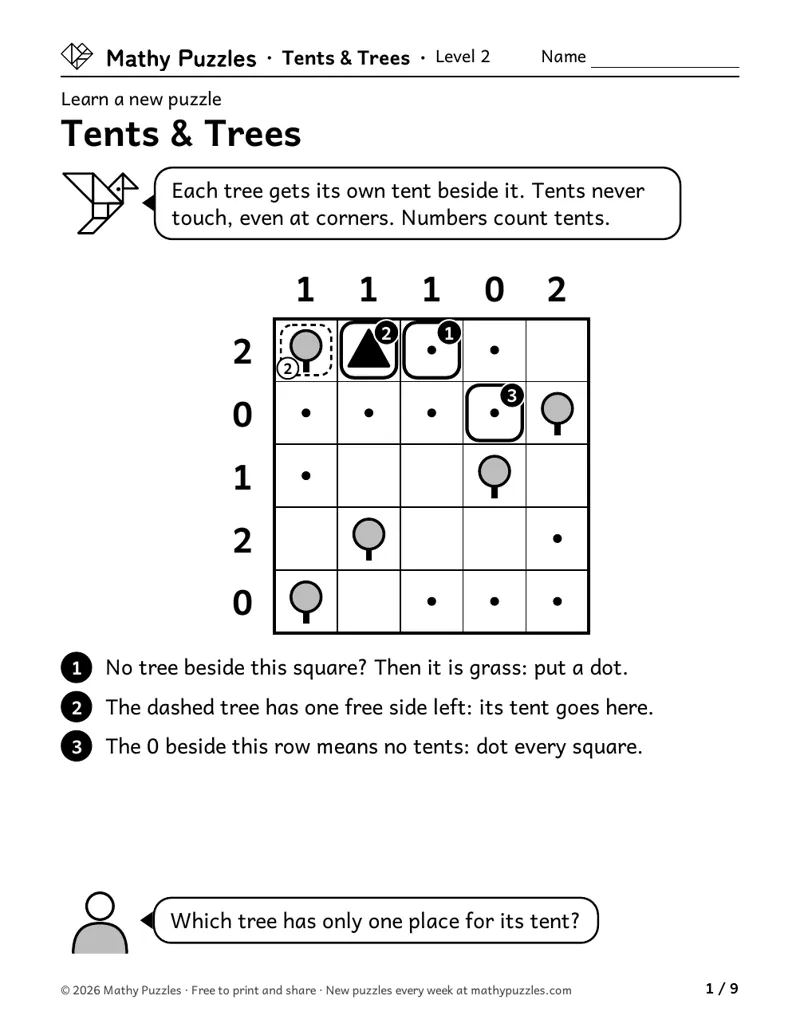
Worked example
From the Level 2 Learn sheet
- Each tree gets its own tent beside it. Tents never touch, even at corners. Numbers count tents.
- No tree beside this square? Then it is grass: put a dot.
- A tree with one free side left: its tent goes there.
- A row whose number of tents is all in: dot the rest.
A question to ask: “Which tree has only one place for its tent?”
Free every Sunday A mixed bag of 20 new puzzles, all four levels. Get them by email
The thinking it works on
One-to-one matching
Pairs each tree with exactly one tent.
Seeing neighbors
Tells side-by-side squares from corner squares.
Reasoning by elimination
When a tree has one free side left, the tent goes there.
Janveau-Brennan and Markovits (1999) found that from grade 1 to grade 6, children grew steadily more ready to hold back when an if-then rule left the answer open. Source
Counting in rows and columns
Compares a row's number with the tents in it and the squares left.
Outhred and Mitchelmore (2000) watched 115 children in grades 1 to 4 cover rectangles with squares. Seeing the squares as rows and columns came in stages. Source
Looking ahead
Sees that a tent in one square would block a tree.
In Luciana and colleagues' (2009) study of 9- to 20-year-olds, accuracy on a planning puzzle that needs look-ahead went on rising until 15 to 17. Source
Testing a "what if"
Pitches a trial tent and checks whether every tree can still have one.
Rafetseder, Schwitalla and Perner (2013) found that 'suppose it had been otherwise' reasoning was not yet secure in all children before 12. The 12- to 14-year-olds were close to adults. Source
Where is this thinking used?
- Parking: Each car gets its own space, with room between cars.
- Seating at a party: Each guest gets a seat beside their own name card.
- Spacing plants: No plant may crowd its neighbor, even at a corner.
- Camping: Each family pitches its tent next to its own picnic table.
For teachers
Curriculum areas
- Common Core
- No direct curricular match.
- NCERT
- No direct curricular match.
- National Curriculum (England)
- No direct curricular match.
- Cambridge Primary Mathematics
- No direct curricular match.
Math practices: see the box below.
Math practices this puzzle uses
- Uses: MP1 Make sense of problems and persevere in solving them
- Not used: MP2 Reason abstractly and quantitatively
- Not used: MP3 Construct viable arguments and critique the reasoning of others
- Not used: MP4 Model with mathematics
- Not used: MP5 Use appropriate tools strategically
- Uses: MP6 Attend to precision
- Uses: MP7 Look for and make use of structure
- Not used: MP8 Look for and express regularity in repeated reasoning
From the Common Core Standards for Mathematical Practice.
More Tents & Trees puzzles for members
Members get at least 5 more worksheets at each difficulty for every puzzle, 80 new puzzles every Sunday, and the whole archive. $39 a year or $25 for 6 months.
See membershipNot ready yet?
One email, all four levels: 20 puzzles, 5 for each level.
For grown-ups (18+). One email every Sunday with the puzzles and the odd note about membership; unsubscribe any time. We never ask about your child. How we use your email