
Sum Cages
Ask for two numbers that make 7 and there are several answers: 1 and 6, 2 and 5, 3 and 4. Sum Cages is full of choices like that, and the rules of the grid narrow them down, so list the options and let the rules choose.
Free sets by level, ages 6–12:
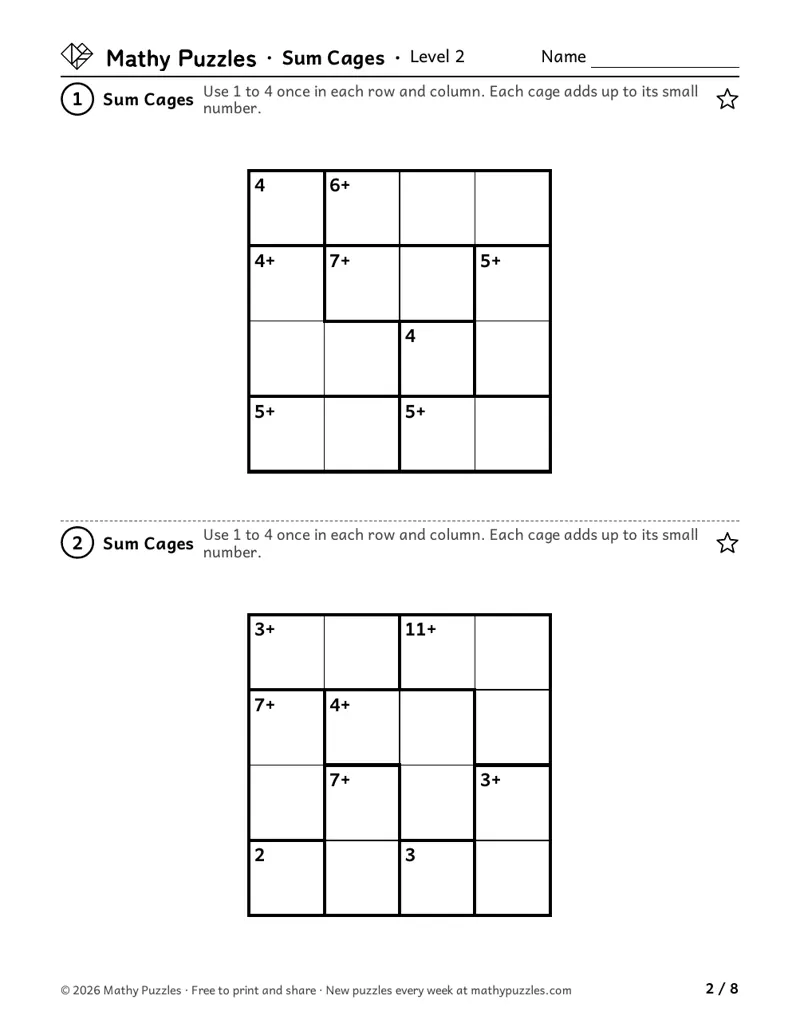 Level 2: a page from the free set
Before starting
- Level 2: add up to four numbers from 1 to 4 (totals to about 15)
- Level 3: multiplication facts to 5 × 5
- Level 4: multiplication and division facts to 6 × 6
Free puzzles to print
Each set: a Learn sheet with a worked example, 10 puzzles from easiest to hardest, and the answers.
Level 2
Ages 6–8 · Grades 1–2
4 × 4 grids, adding cages only, with bigger cages in the hardest puzzles.
On the sheet: “Use 1 to 4 once in each row and column. Each cage adds up to its small number.”
Print Level 2 (Letter)Other paper size: A4Level 3
Ages 8–10 · Grades 3–4
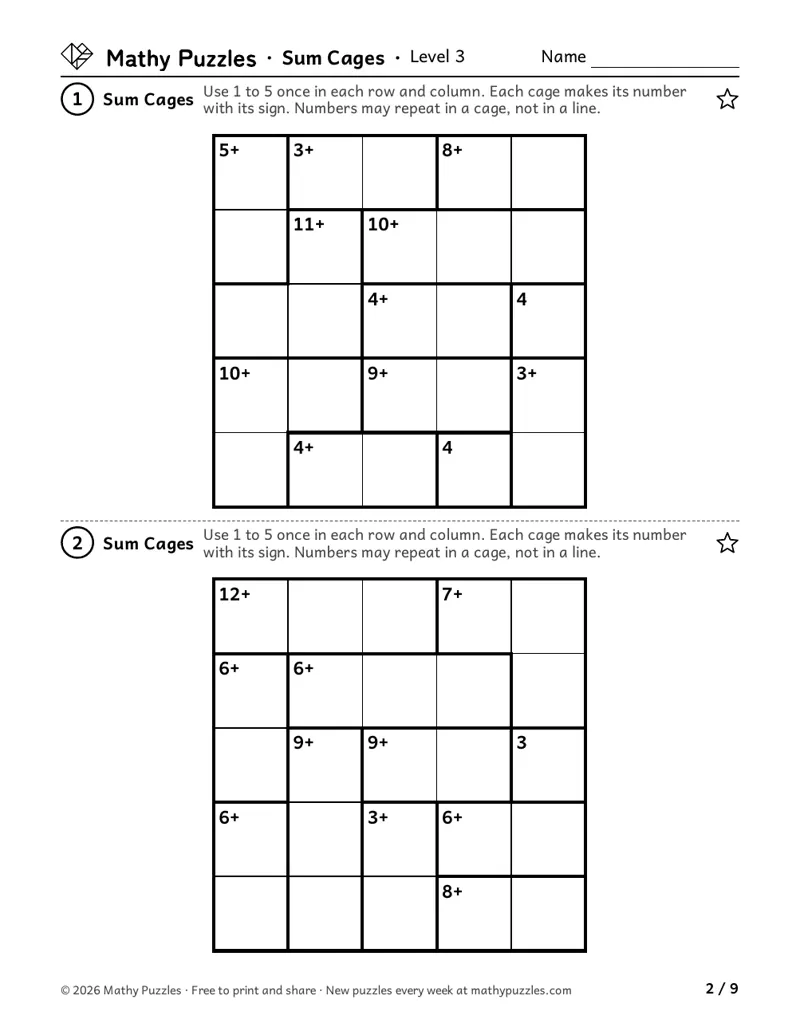
5 × 5; adding, then subtracting, then multiplication cages; the hardest puzzles use the row total (1 to 5 adds to 15).
On the sheet: “Use 1 to 5 once in each row and column. Each cage makes its number with its sign. Numbers may repeat in a cage, not in a line.”
Print Level 3 (Letter)Other paper size: A4Level 4
Ages 10–12 · Grades 5–6
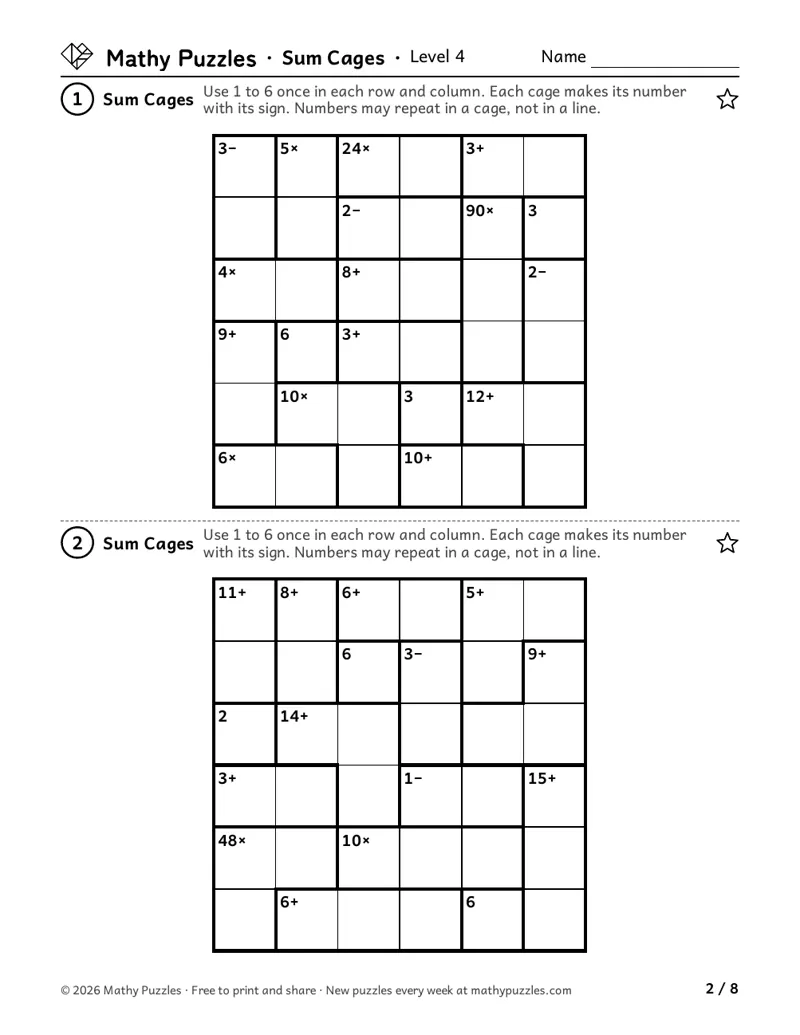
6 × 6; first +, − and × cages, then division joins, then the row total (1 to 6 adds to 21) is needed; the hardest have bigger cages.
On the sheet: “Use 1 to 6 once in each row and column. Each cage makes its number with its sign. Numbers may repeat in a cage, not in a line.”
Print Level 4 (Letter)Other paper size: A4
How it works
Each puzzle is a square grid split into outlined groups called cages. Each row and column uses every number once, like a sudoku with no boxes. Each cage has a small target, such as "7+", and its numbers must make that target. A number may repeat inside a cage, as long as it is not twice in the same row or column. At higher levels cages can also subtract, multiply or divide.
How to play
- Fill any one-square cage first: its number is its target.
- For a two-square cage, list the pairs that make the target. "3+" can only be 1 and 2.
- Remember each row and column has every number once. Cross off numbers already used. A number can repeat inside a cage if the two squares are not in the same row or column.
- Keep going, cage by cage, until the grid is full.
When it gets hard
Repeating a number in a row because the cage sum works.
Hint: Each row and column uses each number once. Check both before writing.
Treating a subtraction cage as "first minus second" in reading order.
Hint: Take the smaller number away from the bigger one, whichever square it is in.
Picking one pair for a cage too early.
Hint: Write all the possible pairs small in the corner, then cross them off.
Ruling out a pair like 2 and 2 because a cage "can't repeat".
Hint: A number can repeat in a cage if the two squares are not in the same row or column. An L-shaped "4×" cage can hold 2, 1 and 2.
Tip for grown-ups: Encourage pencil notes in the corners of squares; listing the options is the skill, not a crutch.
Frequently asked questions
- Does my child need to know multiplication?
- Not at Level 2, which uses adding only. Level 3 adds subtracting and multiplying cages with facts to 5 × 5; Level 4 adds dividing.
- How can my child check a finished grid?
- Check every cage against its target, then every row and column for repeats. A grid that keeps all the rules is right, and the answers show an example. If one rule breaks, the square where it breaks is the place to start again.
Questions about printing, levels, answers or membership: see all questions.
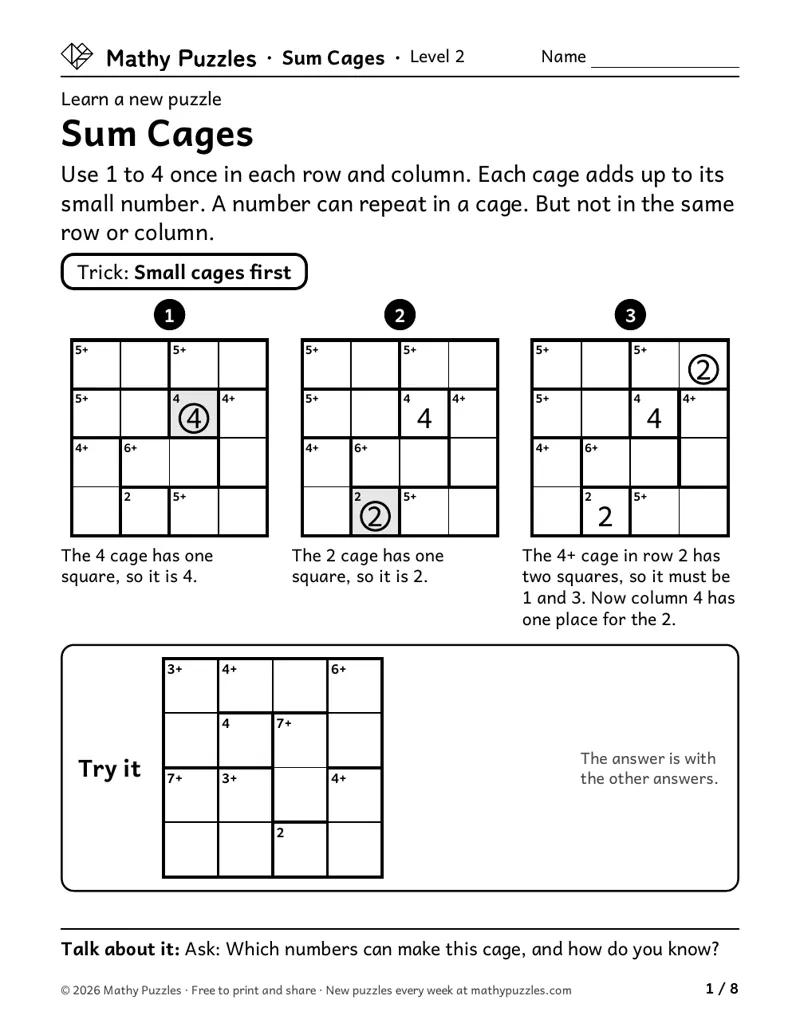
Worked example
From the Level 2 Learn sheet
- Use 1 to 4 once in each row and column. Each cage adds up to its small number.
- A cage with one square is just its number. Fill those first.
- A two-square cage has only a few pairs that add up: a 7+ in a 1-to-4 grid must be 3 and 4.
- Now look along a row. If only one square is left for a number, write it there.
A question to ask: “Which numbers can make this cage, and how do you know?”
Free every Sunday A mixed bag of 20 new puzzles, all four levels. Get them by email
The thinking it works on
Finding many ways to make a number
Lists every pair or set of numbers that can make a cage's target.
Geary, Hoard and Nugent (2012) followed 275 children from grade 1 to 4. They moved from counting to remembering facts and breaking numbers apart (6 + 7 as 6 + 4 + 3). Those with stronger working memory took up breaking numbers apart sooner. Source
Checking the cage and the row together
Writes a number only when the cage rule and the row-and-column rule both allow it.
Crone and colleagues (2004) found that 8- and 9-year-olds stuck to an old sorting rule more often than 11- and 12-year-olds. Keeping to a rule steadily took until 13 to 15. Source
Pencil notes for every option
Pencils the options in the corner of each square and crosses them off.
English (1991) saw children aged 4½ to 9 move by themselves from picking at random toward an orderly way of listing every combination. Source
Number facts: adding, then all four operations
Uses adding facts, then subtracting, multiplying and dividing facts.
Kouba (1989) found that children in grades 1 to 3 solving multiplying and dividing word problems used methods from acting them out with objects to recalling the fact. Source
Using the structure of the whole row
Uses the fixed row total (1 to 5 makes 15) to find a last square.
Keeping track of options
Holds several open options at once and updates them as squares fill.
Lee, Bull and Ho (2013) tested 688 children aged 6 to 15 each year and found that tasks for updating and working memory developed in different patterns. Source
Where is this thinking used?
- Budgeting: Several amounts must add to a fixed total.
- Scheduling: No one can be in two places at once.
- Splitting a bill: The parts must make the whole.
- Seating and teams: A few fixed rules decide who goes where.
For teachers
Curriculum areas
- Common Core
- Operations and algebraic thinking: adding and subtracting within 20 (Grades 1–2); multiplying and dividing within 100 and finding factor pairs (Grades 3–4)
- NCERT
- Joyful Mathematics (Class 1): addition facts, and a grid with each shape once in every row and column (the puzzle pages); Maths Mela (Classes 3–4): multiplication, division and equal groupsLevel 4: No direct curricular match.
- National Curriculum (England)
- Number: addition facts to 20 (Year 2); times tables to 12 × 12 (Year 4)
- Cambridge Primary Mathematics
- Number: adding within 20 (Stage 1); times tables and how multiplication and division are linked (Stages 3–4)
Math practices: see the box below.
Math practices this puzzle uses
- Uses: MP1 Make sense of problems and persevere in solving them
- Not used: MP2 Reason abstractly and quantitatively
- Not used: MP3 Construct viable arguments and critique the reasoning of others
- Not used: MP4 Model with mathematics
- Not used: MP5 Use appropriate tools strategically
- Not used: MP6 Attend to precision
- Uses: MP7 Look for and make use of structure
- Not used: MP8 Look for and express regularity in repeated reasoning
From the Common Core Standards for Mathematical Practice.
More Sum Cages puzzles for members
Members get at least 5 more worksheets at each difficulty for every puzzle, 80 new puzzles every Sunday, and the whole archive. $39 a year or $25 for 6 months.
See membershipNot ready yet?
One email, all four levels: 20 puzzles, 5 for each level.
For grown-ups (18+). One email every Sunday with the puzzles and the odd note about membership; unsubscribe any time. We never ask about your child. How we use your email