
Tower View
Stand at the end of a street and the tall houses hide the short ones behind them. Each number around this grid says how many towers you can see from that side, and that is a clue about the towers you can't see.
Free sets by level, ages 6–12:
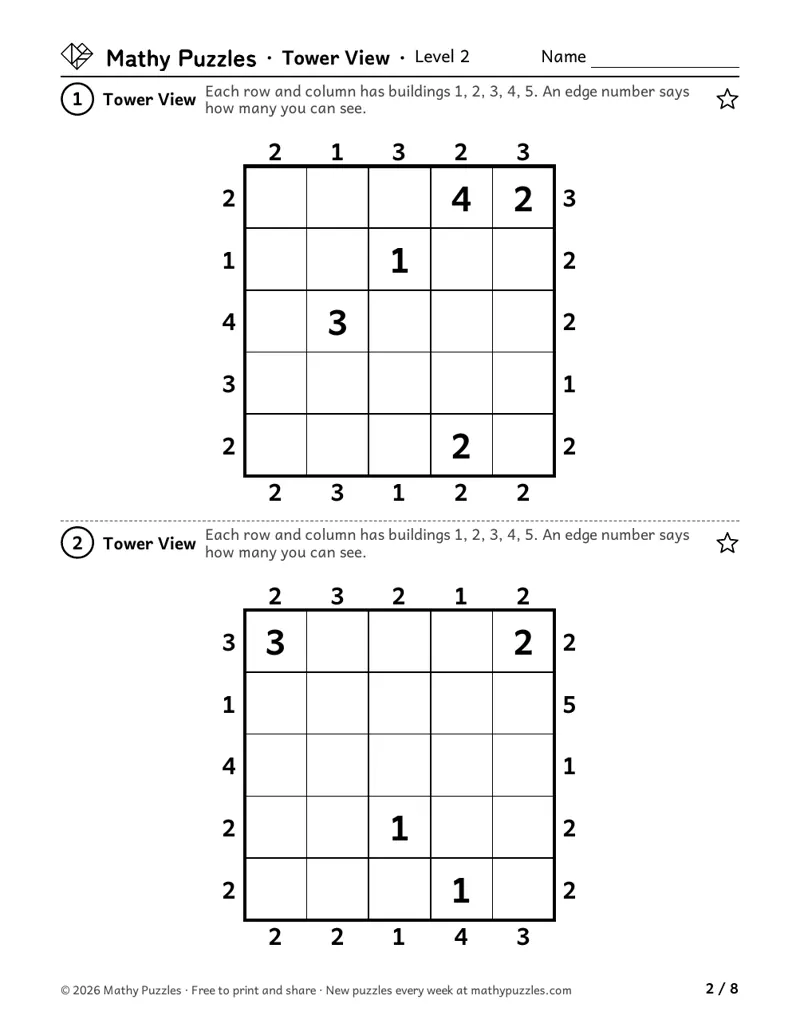 Level 2: a page from the free set
Before starting
- Order the numbers 1 to 6
- Understand that a tall thing can hide a short thing behind it
- Count along a line and compare heights
What you need
A few stacking blocks for towers of 1 to 4, and a pencil with an eraser.
Free puzzles to print
Each set: a Learn sheet with a worked example, 10 puzzles from easiest to hardest, and the answers.
Level 2
Ages 6–8 · Grades 1–2
First 4 × 4 grids with every edge number and one or two towers filled in. Then a 4 × 4 with no towers and a few edge numbers missing. Then 5 × 5 with a few towers filled in; the hardest also hide a few edge numbers.
On the sheet: “Each row and column has buildings 1, 2, 3, 4. An edge number says how many you can see.”
On the sheet: “Each row and column has buildings 1, 2, 3, 4, 5. An edge number says how many you can see.”
Print Level 2 (Letter)Other paper size: A4Level 3
Ages 8–10 · Grades 3–4
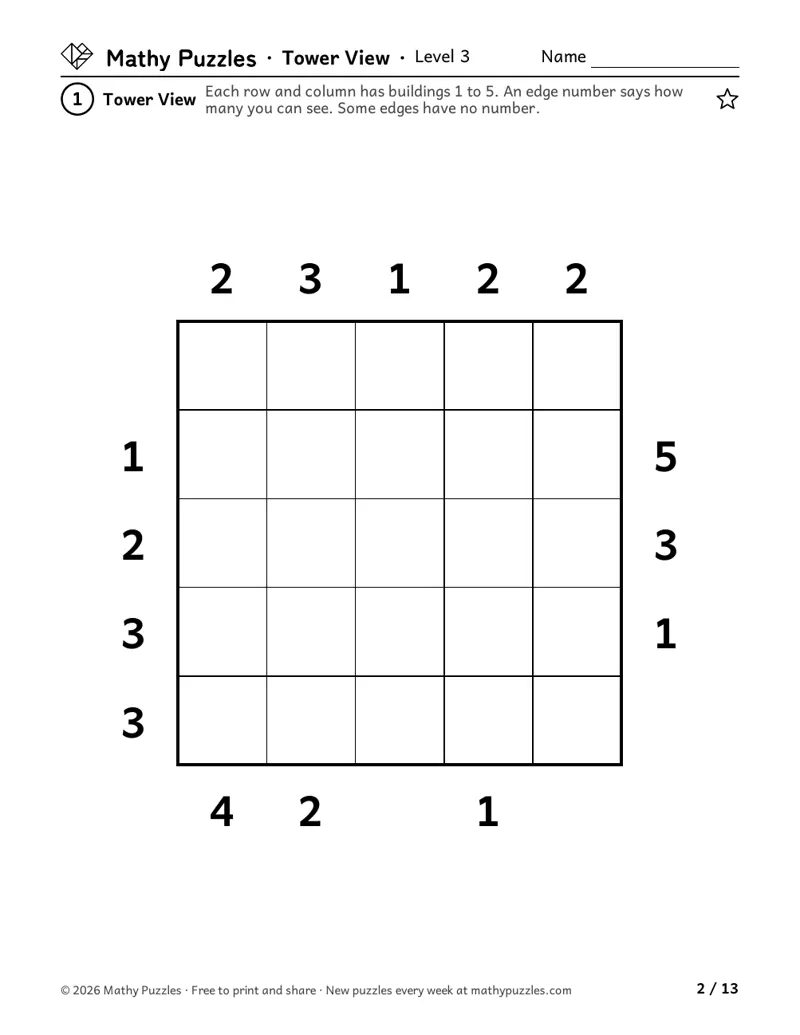
5 × 5 with no towers given and fewer edge numbers; children list the orders that fit a row.
On the sheet: “Each row and column has buildings 1 to 5. An edge number says how many you can see.”
Print Level 3 (Letter)Other paper size: A4Level 4
Ages 10–12 · Grades 5–6
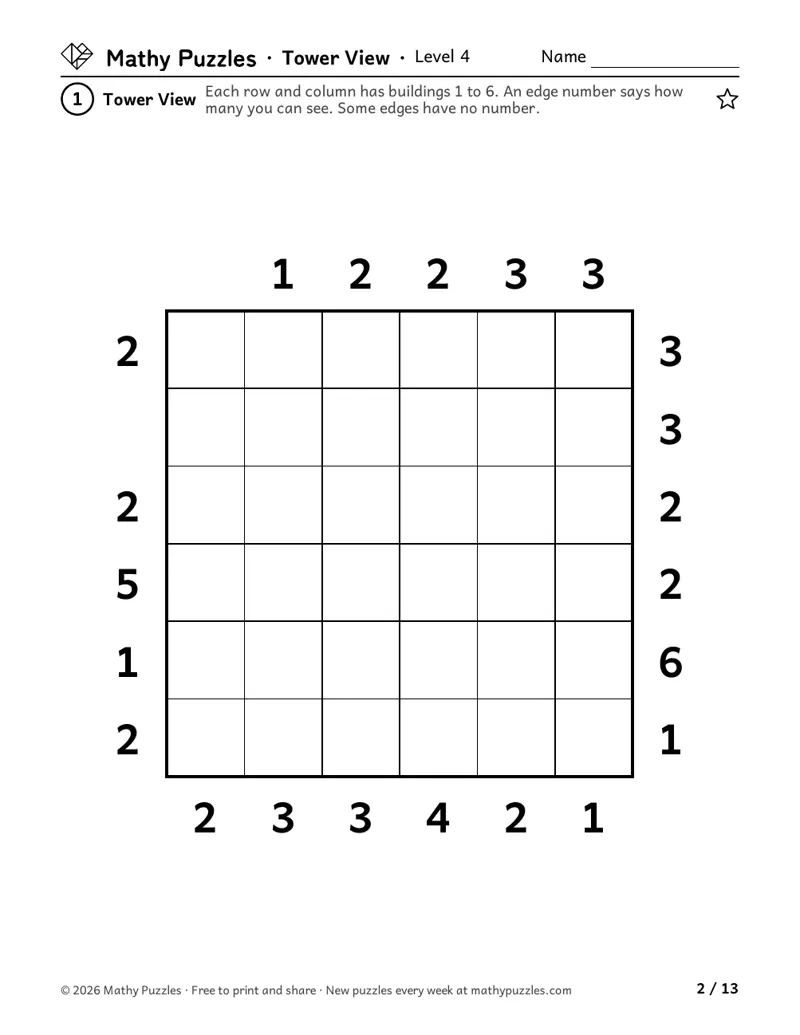
6 × 6, from nearly all edge numbers down to only 7 to 9.
On the sheet: “Each row and column has buildings 1 to 6. An edge number says how many you can see.”
Print Level 4 (Letter)Other paper size: A4
How it works
Each grid is seen from above, like a tiny city. Each square holds a tower of height 1 to 4 (or more), and each row and column has each height once. Numbers around the edge say how many towers you would see looking in from that side, because tall towers hide shorter ones behind them.
How to play
- Look for a 1 on the edge. The tallest tower must be right next to it.
- Look for the biggest edge number (4 in a 4 × 4). The towers go 1, 2, 3, 4 in order from that side.
- Fill in what you know, then use "each height once" in every row and column.
- Some edges have no number. Work them out from the other clues and "each height once".
- Check each edge number by looking along the line: count only towers taller than all before them.
When it gets hard
Counting every tower in the line, not just the ones you can see.
Hint: Walk your eyes along from the edge. Only count a tower if it is taller than every tower before it.
Forgetting that each height appears once in a row.
Hint: Write the heights still missing beside the row.
Reading the edge number from the wrong side.
Hint: An edge number looks into the grid from where it is written.
Tip for grown-ups: Stack building blocks into towers of 1 to 4 and look along a row at eye level; seeing the hidden towers makes the rule click.
Questions about printing, levels, answers or membership: see all questions.
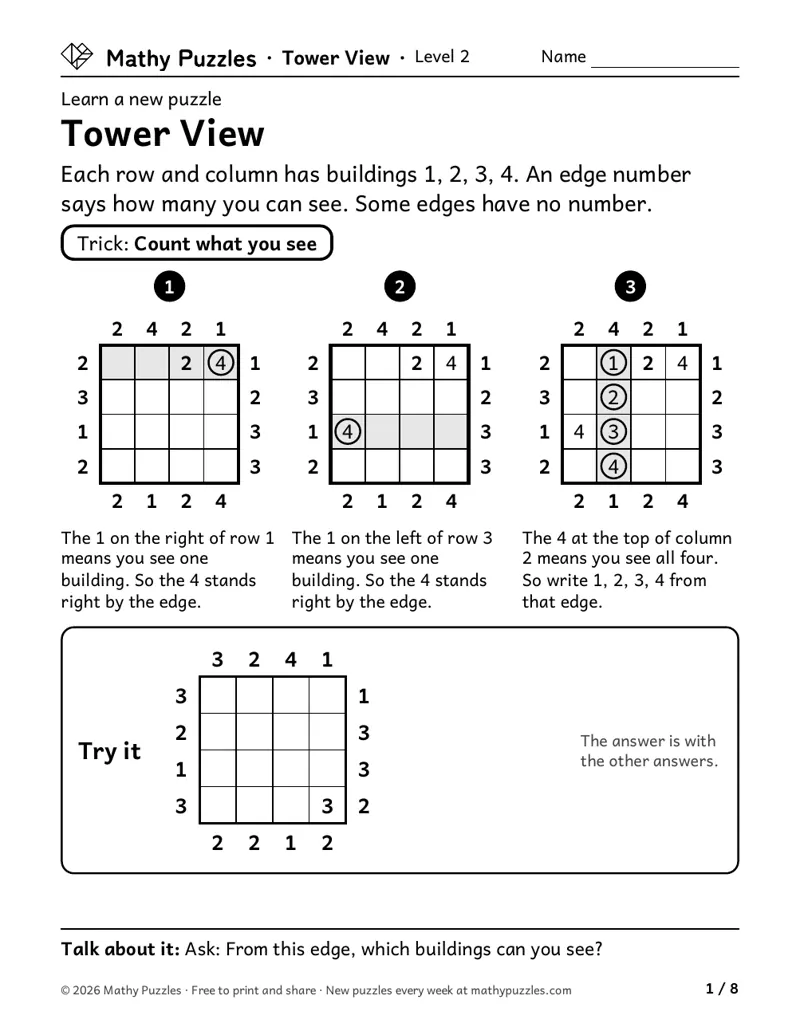
Worked example
From the Level 2 Learn sheet
- Each row and column has buildings 1, 2, 3, 4. An edge number says how many you can see.
- A 1 on the edge means you see one building: the tallest stands right by the edge.
- The biggest edge number (4 in a 4 × 4) means you see every building, so that line goes 1, 2, 3, 4 in order.
- A 2 on the edge means the tallest can't be right by the edge, or it would hide the rest.
A question to ask: “From this edge, which buildings can you see?”
Free every Sunday A mixed bag of 20 new puzzles, all four levels. Get them by email
The thinking it works on
Picturing the view from an edge
Stands at an edge number in the mind and counts only the towers that show.
Frick, Möhring and Newcombe (2014) asked children what a scene looks like from someone else's spot. The 4-year-olds mostly guessed; from about 6 the skill grows, with big differences between children still at 8. Source
Turning a clue into a sure fact
Turns each edge number into something certain, like 'the tallest is first'.
Barrouillet and Lecas (1999) studied third, sixth and ninth graders reading 'if… then' rules. Older students took more possible cases into account, in line with their working memory. Source
Comparing and ordering numbers
Keeps asking which tower is taller and what order fits a clue.
Girelli, Lucangeli and Butterworth (2000) found that older schoolchildren, unlike first graders, could not help noticing which digit was bigger even when asked only which was printed larger. Source
Picturing a skyline from numbers
Turns a row of digits into a skyline and back again.
Listing the orders that fit
Writes out the few orders that fit a row's clues and crosses out what none allow.
English (1991) found that some children as young as 7 found every combination by holding one item fixed while changing each of the others. Source
Keeping track of what each row still needs
Keeps a note of the heights each row and column still needs.
Luciana and colleagues (2005) found that holding and rearranging several places in mind kept developing until 13 to 15, in a study of 9- to 20-year-olds. Source
Where is this thinking used?
- Displays: Arranging a class photo, a shop window or a bookshelf so everything can be seen.
- Floor plans and maps: Picturing the view from a spot on the plan.
- Engineering drawings: A whole part is rebuilt from a few side views.
- Science: A shadow or a cross-section tells you about the whole object.
For teachers
Curriculum areas
- Common Core
- No direct curricular match.
- NCERT
- No direct curricular match.
- National Curriculum (England)
- No direct curricular match.
- Cambridge Primary Mathematics
- No direct curricular match.
Math practices: see the box below.
Math practices this puzzle uses
- Not used: MP1 Make sense of problems and persevere in solving them
- Not used: MP2 Reason abstractly and quantitatively
- Uses: MP3 Construct viable arguments and critique the reasoning of others
- Not used: MP4 Model with mathematics
- Not used: MP5 Use appropriate tools strategically
- Not used: MP6 Attend to precision
- Uses: MP7 Look for and make use of structure
- Not used: MP8 Look for and express regularity in repeated reasoning
From the Common Core Standards for Mathematical Practice.
More Tower View puzzles for members
Members get at least 5 more worksheets at each difficulty for every puzzle, 80 new puzzles every Sunday, and the whole archive. $39 a year or $25 for 6 months.
See membershipNot ready yet?
One email, all four levels: 20 puzzles, 5 for each level.
For grown-ups (18+). One email every Sunday with the puzzles and the odd note about membership; unsubscribe any time. We never ask about your child. How we use your email