
Spot the Flip
A magic trick: lay out coins, look away while someone flips one, then find it at a glance. The secret is a few extra coins that make every row and column even. This puzzle shows how the trick works.
Free sets by level, ages 8–12:
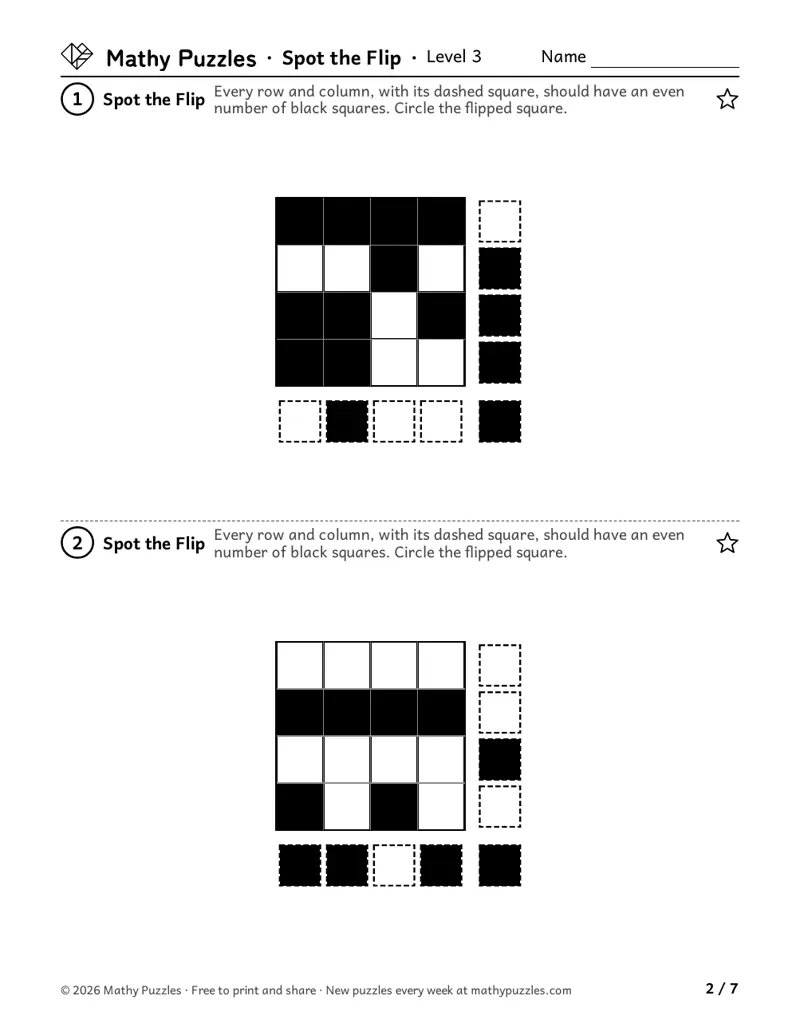 Level 3: a page from the free set
Before starting
- Count up to 7 by pairing
- Know what even and odd mean (or learn it from the Learn sheet: count in pairs, look for one left over)
- Find a row and a column on a grid
What you need
A ruler to slide under each row of the bigger grids, and a pencil.
Free puzzles to print
Each set: a Learn sheet with a worked example, 10 puzzles from easiest to hardest, and the answers.
Level 3
Ages 8–10 · Grades 3–4
A 4 × 4 grid plus its dashed squares, with one square flipped inside the grid; then 5 × 5. The hardest puzzles ask the child to color the dashed squares so every row and column comes out even.
On the sheet: “Every row and column, with its dashed square, should have an even number of black squares. Circle the flipped square.”
Print Level 3 (Letter)Other paper size: A4Level 4
Ages 10–12 · Grades 5–6
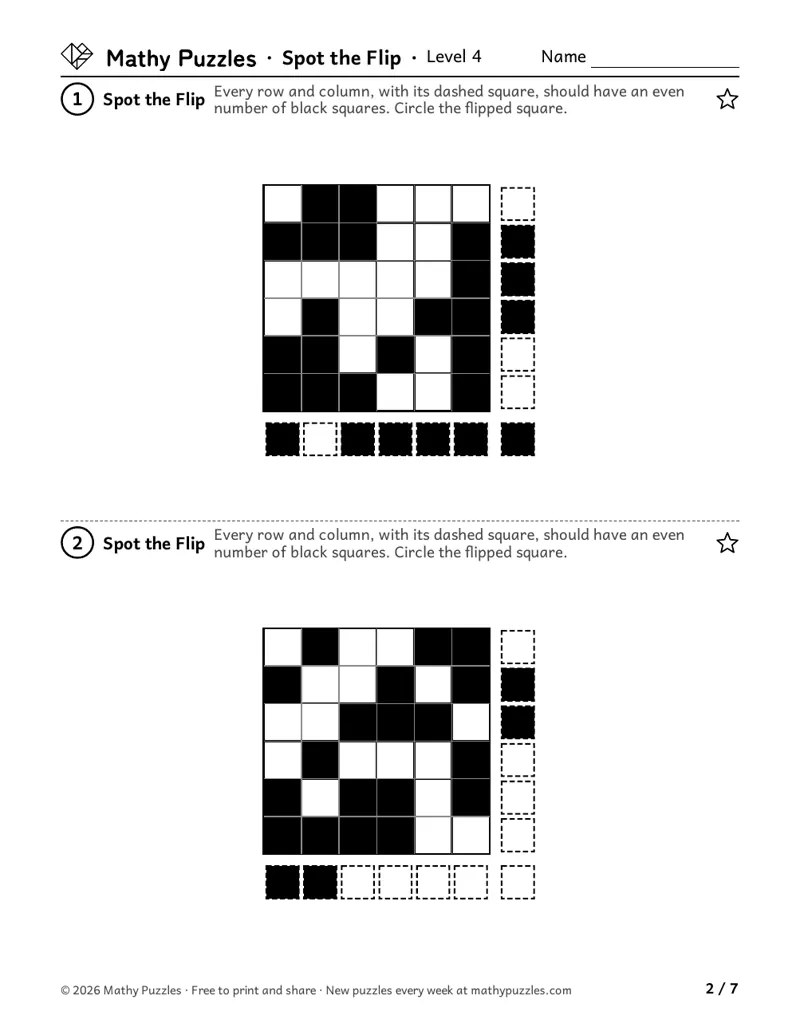
A 6 × 6 grid; then the flipped square may be one of the dashed squares. Next come two grids, one safe and one with a flip, and the child finds which. The hardest may have one or two flips. With two flips, two rows and two columns are odd. The child circles all four squares where the flips could be, because the checks can't tell which pair it was.
On the sheet: “Every row and column, with its dashed square, should have an even number of black squares. Circle the flipped square.”
Print Level 4 (Letter)Other paper size: A4
How it works
Each puzzle is a grid of black and white squares, with an extra dashed square at the end of every row and column. The dashed squares were colored so that every row and every column has an even number of black squares. Then one square was flipped, black to white or white to black. The child counts in pairs, finds the one odd row and the one odd column, and circles the square where they meet. The hardest Level 4 puzzles show two grids, where only one has a flip, or one grid where one or two squares may have flipped.
How to play
- Count the black squares in the first row, including its dashed square, in pairs.
- One left over? That row is odd. Mark it.
- Do every row, then every column the same way.
- Circle the square where the odd row and the odd column cross.
When it gets hard
Leaving out the dashed square when counting.
Hint: The dashed square belongs to its row and its column. Count it every time.
Counting one by one and losing track.
Hint: Count in pairs and only ask: is one left over?
Stopping after finding the odd row.
Hint: A row alone isn't enough. Find the odd column too; the flip is where they meet.
Tip for grown-ups: Try it as a trick. Lay out coins in a 4 × 4 grid, then add a row and a column that make every line even. Look away while your child flips one coin, then find it. Then let your child be the magician. Sliding a ruler under each row helps on the bigger grids.
Frequently asked questions
- What does "flipped" mean here?
- A square changed color: black to white, or white to black. Everything else stayed the same. Most puzzles have one flip; in the hardest Level 4 puzzles, one or two squares may have flipped.
- Why do the dashed squares help?
- They were colored so every row and column started even. One flip makes one row and one column odd, and the flipped square sits where they cross. Computers use the same kind of check, called parity, to catch errors.
- Could I teach odd and even with this in class?
- Yes. Start with the coin trick in the grown-up tip, then hand out Level 3. It reviews odd and even (a grade 2 idea) in a grade 3–4 puzzle.
Questions about printing, levels, answers or membership: see all questions.
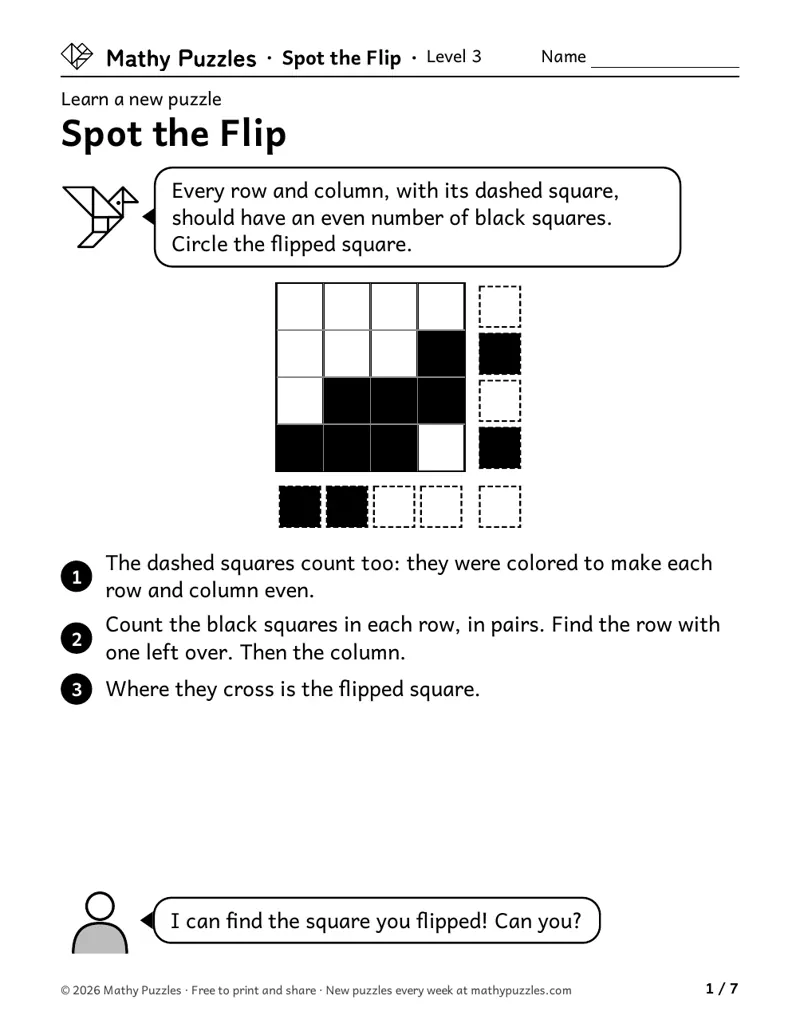
Worked example
From the Level 3 Learn sheet
- The dashed squares count too: they were colored to make each row and column even.
- Count the black squares in each row, in pairs. Find the row with one left over. Then the column.
- Where they cross is the flipped square.
A question to ask: “I can find the square you flipped! Can you?”
Free every Sunday A mixed bag of 20 new puzzles, all four levels. Get them by email
The thinking it works on
Odd or even?
Tells odd from even by pairing.
Checking every line in order
Checks every row, then every column, without skipping.
Finding a square by row and column
Finds the square where one row and one column cross.
Somerville and Bryant (1985) asked 4- to 6-year-olds to find the one point in a set of points that lined up with two markers, one on each edge. Even the youngest could follow both lines to the crossing point. The 5- and 6-year-olds did very well with 16 points. Source
Reasoning about cause
Works backward from the odd lines to the one change.
Building a check
Colors the dashed squares to make every line even.
Holding attention on a large grid
Keeps the place in a 6 × 6 grid with its extra squares.
In a touchscreen search game, Gil-Gómez de Liaño and colleagues (2020) found that children of 9 or 10 were nearly as accurate as adults. But they were only about halfway to adult search speed. Source
Knowing what a check can't tell
Sees when the odd lines can't say which squares flipped.
Where is this thinking used?
- Computers: Extra check digits catch a 0 that turned into a 1.
- Barcodes and card numbers: A last check digit catches a mistyped number.
- Magic tricks: The "I can find the card you flipped" trick works this way.
- Checking work: Totals at the end of rows and columns show where a mistake is.
For teachers
Curriculum areas
- Common Core
- Operations and algebraic thinking: odd and even by pairing (Grade 2), used as review at both levels
- NCERT
- Maths Mela (Class 4): even and odd numbers by pairing; Ganita Prakash (Class 6): odd and even numbers as sequences
- National Curriculum (England)
- Number: odd and even numbers (Year 2), used as review
- Cambridge Primary Mathematics
- Number: odd and even numbers (Stage 3)
Math practices: see the box below.
Math practices this puzzle uses
- Not used: MP1 Make sense of problems and persevere in solving them
- Not used: MP2 Reason abstractly and quantitatively
- Not used: MP3 Construct viable arguments and critique the reasoning of others
- Not used: MP4 Model with mathematics
- Not used: MP5 Use appropriate tools strategically
- Uses: MP6 Attend to precision
- Uses: MP7 Look for and make use of structure
- Not used: MP8 Look for and express regularity in repeated reasoning
From the Common Core Standards for Mathematical Practice.
More Spot the Flip puzzles for members
Members get at least 5 more worksheets at each difficulty for every puzzle, 80 new puzzles every Sunday, and the whole archive. $39 a year or $25 for 6 months.
See membershipNot ready yet?
One email, all four levels: 20 puzzles, 5 for each level.
For grown-ups (18+). One email every Sunday with the puzzles and the odd note about membership; unsubscribe any time. We never ask about your child. How we use your email