
Shape Codes
Imagine learning a new language from a few labeled pictures and nothing else. Shape Codes works that way: each letter of a code stands for one feature, and comparing shapes that share a letter tells you what it means.
Free sets by level, ages 8–12:
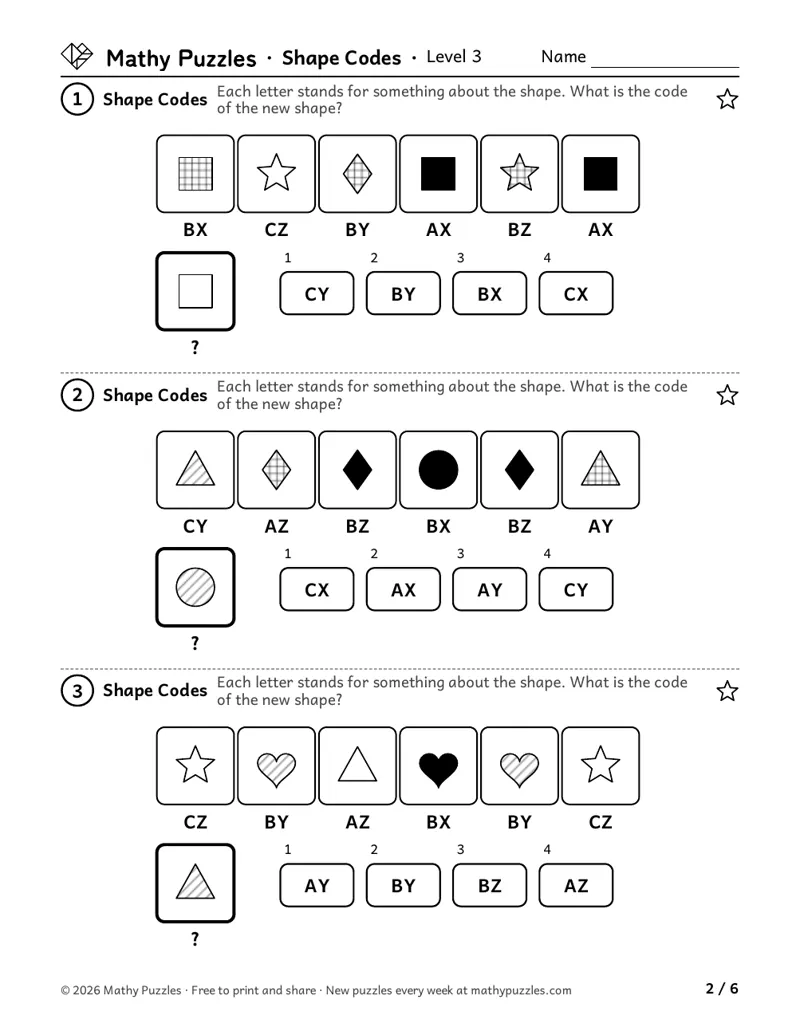 Level 3: a page from the free set
Before starting
- Name common shapes and fills (white, black, striped, checked)
- Read capital letters
- Level 4: notice size and which way a shape points
Free puzzles to print
Each set: a Learn sheet with a worked example, 10 puzzles from easiest to hardest, and the answers.
Level 3
Ages 8–10 · Grades 3–4
Two-letter codes (the kind of shape and its fill), with 6 examples. Then come 5 examples and one feature that changes but has no letter. The hardest puzzles give 4 examples, and each feature the new shape needs is shown only once.
On the sheet: “Each letter stands for something about the shape. What is the code of the new shape?”
Print Level 3 (Letter)Other paper size: A4Level 4
Ages 10–12 · Grades 5–6
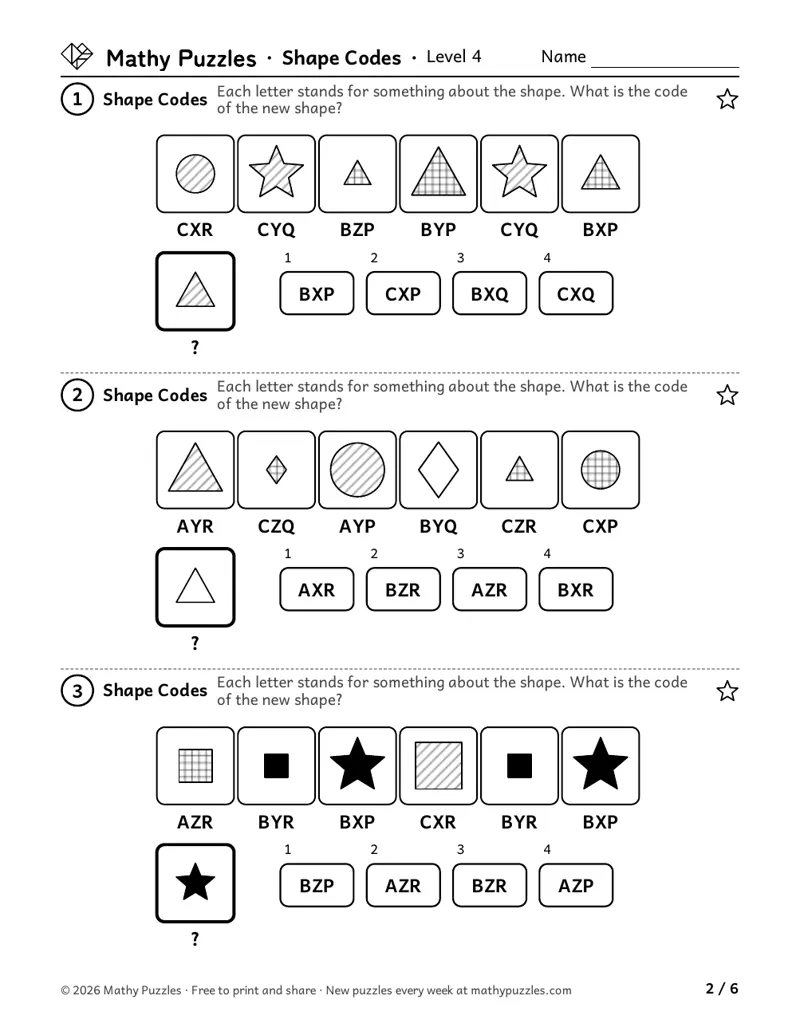
Three-letter codes (shape, fill and size), with 6 examples. Then come 5 examples and an extra feature with no letter. The hardest puzzles code which way a shape points, with fill and size.
On the sheet: “Each letter stands for something about the shape. What is the code of the new shape?”
Print Level 4 (Letter)Other paper size: A4
How it works
Each shape in the row has a letter code under it, such as "AX" or "CZ". Each letter stands for one feature: the first letter might be the kind of shape and the second the fill. Nobody says which letter means what. The child compares the shapes, works out the meaning of each letter, then picks the code of a new shape from four numbered choices.
How to play
- Circle all the shapes whose first letter is the same.
- Find the one feature they all share, and that the others don't have. That is what the first letter means.
- Do the same for the next letter.
- Look at the new shape. Write its code letter by letter, then pick that code.
When it gets hard
Matching a letter to a feature that only some of its shapes share.
Hint: Every shape with that letter must share the feature, and no other shape may have it.
Being fooled by a feature that changes but has no letter.
Hint: If a feature changes when the letters don't, it isn't coded. Ignore it.
Picking a choice that is right in one letter only.
Hint: Check each letter of the choice against your meanings.
Tip for grown-ups: Ask "How do you know?" for each letter. Saying "all the A shapes are circles, and no other shape is" is the thinking this puzzle asks for.
Frequently asked questions
- Why are the choices numbered, not lettered?
- So the choice labels never mix with the code letters. The answers mark the right choice with a check.
- Can a letter stand for two things?
- No. Each letter place stands for one feature, and each letter for one value of it. If a letter seems to fit two features, look at more shapes. The examples are built so that every way of reading them gives the new shape the same code.
- How can I use this in a grade 4 geometry lesson?
- Use it after naming shape attributes. Ask students to explain each letter in a full sentence ("Every A shape is a triangle, and no other shape is"). Level 3 suits grades 3–4 and Level 4 grades 5–6.
Questions about printing, levels, answers or membership: see all questions.
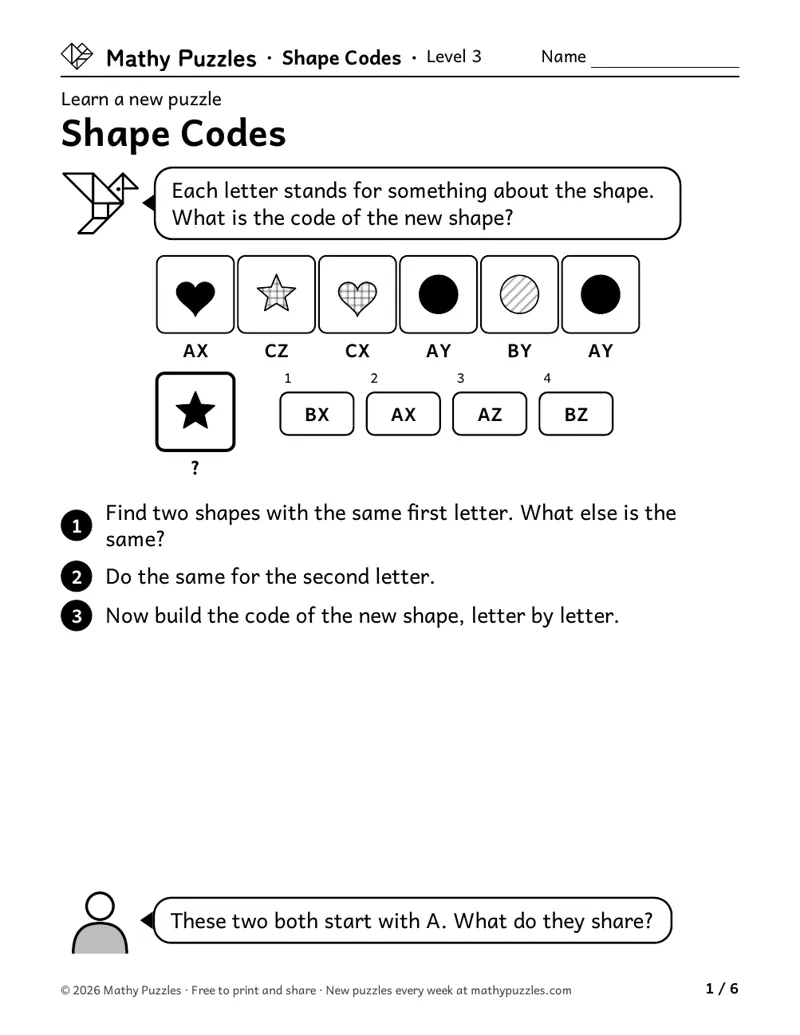
Worked example
From the Level 3 Learn sheet
- Find two shapes with the same first letter. What else is the same?
- Do the same for the second letter.
- Now build the code of the new shape, letter by letter.
A question to ask: “These two both start with A. What do they share?”
Free every Sunday A mixed bag of 20 new puzzles, all four levels. Get them by email
The thinking it works on
Comparing by attributes
Compares shapes feature by feature.
Working out what a letter means
Works out what a letter means from examples.
Csapó (1997) tested more than 2,000 students in grades 3 to 11 on series, analogy and coding tasks. Working out a rule from examples developed most quickly between grades 5 and 9. Source
Ignoring a distraction
Sets aside a feature that changes but is not coded.
Holding several rules at once
Keeps two or three letter meanings in mind together.
Alloway, Gathercole and Pickering (2006) tested children aged 4 to 11 on memory tasks. Holding words and holding a picture's layout used separate parts of working memory, while working on either used a shared part. All the parts were already in place by age 4. Source
Seeing direction
Notices which way a shape points.
Where is this thinking used?
- Product codes: Letters in a code stand for size, color and style.
- Sorting collections: Grouping cards, stickers or shells by one feature at a time.
- Labels and tags: Reading a short label to know what is inside a box.
- Learning new words: Working out a word's meaning from the examples around it.
For teachers
Curriculum areas
- Common Core
- Geometry: telling a shape's kind apart from its fill, size and direction (Grade 1), used as review
- NCERT
- No direct curricular match.
- Computer science (CSTA)
- Letters that stand for features of a shape (algorithms and programming, ages 5–7, used as review)
- National Curriculum (England)
- No direct curricular match.
- Cambridge Primary Mathematics
- No direct curricular match.
Math practices: see the box below.
Math practices this puzzle uses
- Not used: MP1 Make sense of problems and persevere in solving them
- Not used: MP2 Reason abstractly and quantitatively
- Not used: MP3 Construct viable arguments and critique the reasoning of others
- Not used: MP4 Model with mathematics
- Not used: MP5 Use appropriate tools strategically
- Uses: MP6 Attend to precision
- Uses: MP7 Look for and make use of structure
- Not used: MP8 Look for and express regularity in repeated reasoning
From the Common Core Standards for Mathematical Practice.
More Shape Codes puzzles for members
Members get at least 5 more worksheets at each difficulty for every puzzle, 80 new puzzles every Sunday, and the whole archive. $39 a year or $25 for 6 months.
See membershipNot ready yet?
One email, all four levels: 20 puzzles, 5 for each level.
For grown-ups (18+). One email every Sunday with the puzzles and the odd note about membership; unsubscribe any time. We never ask about your child. How we use your email