
Shade the Repeats
Every row and column here has a few repeats, and each one has to go. But a shaded square keeps its neighbors white, so every choice sets up the next one, like a row of dominoes.
Free sets by level, ages 6–12:
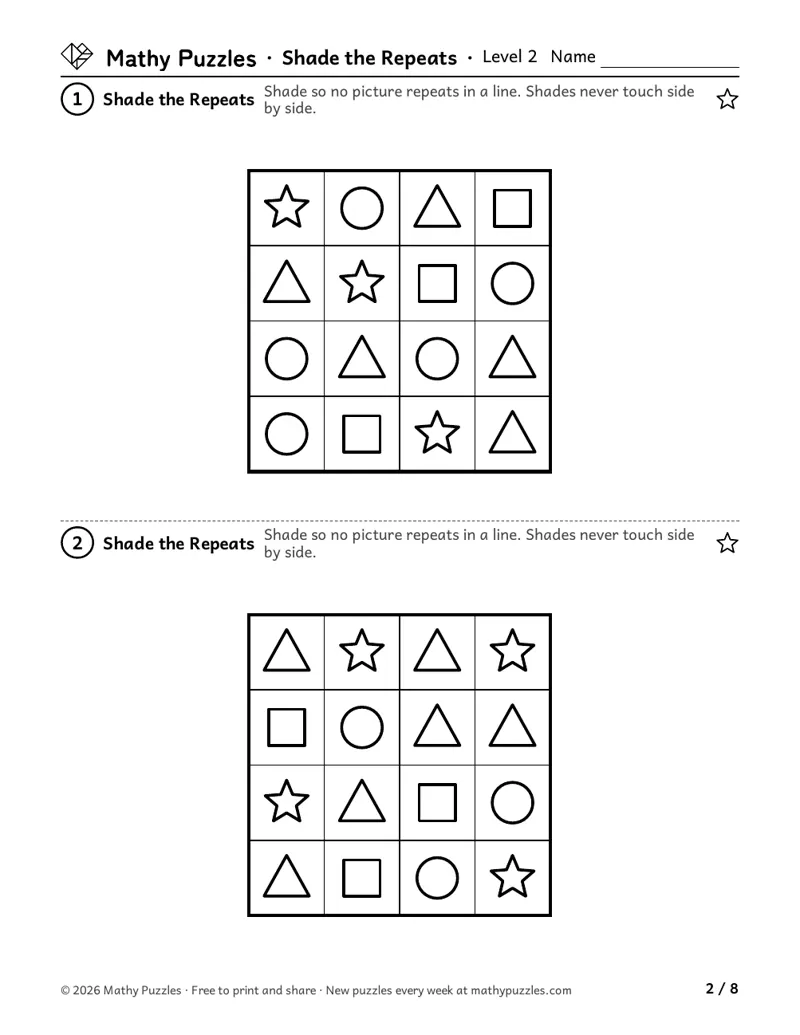 Level 2: a page from the free set
Before starting
- Spot the same picture twice in a row or column
- Tell side by side from corner to corner
- Level 3 and up: know what "joined" means (you can walk from any white square to any other)
- Level 4: read numbers 1 to 8 (no adding)
Free puzzles to print
Each set: a Learn sheet with a worked example, 10 puzzles from easiest to hardest, and the answers.
Level 2
Ages 6–8 · Grades 1–2
Pictures on a 4 × 4 grid, then 5 × 5, with only a few squares to shade; there is no "keep the white squares joined" rule yet.
On the sheet: “Shade so no picture repeats in a line. Shades never touch side by side.”
Print Level 2 (Letter)Other paper size: A4Level 3
Ages 8–10 · Grades 3–4
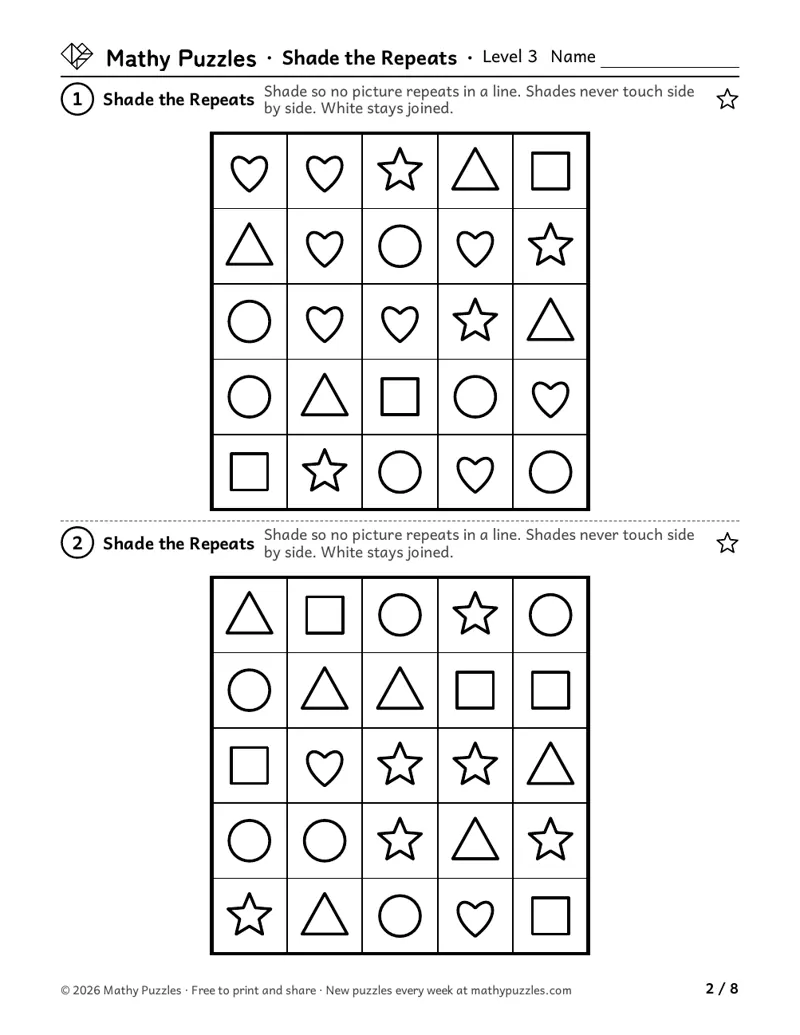
Pictures on a 5 × 5 grid, then 6 × 6; the hardest puzzles need the "keep the white squares joined" rule.
On the sheet: “Shade so no picture repeats in a line. Shades never touch side by side. White stays joined.”
Print Level 3 (Letter)Other paper size: A4Level 4
Ages 10–12 · Grades 5–6
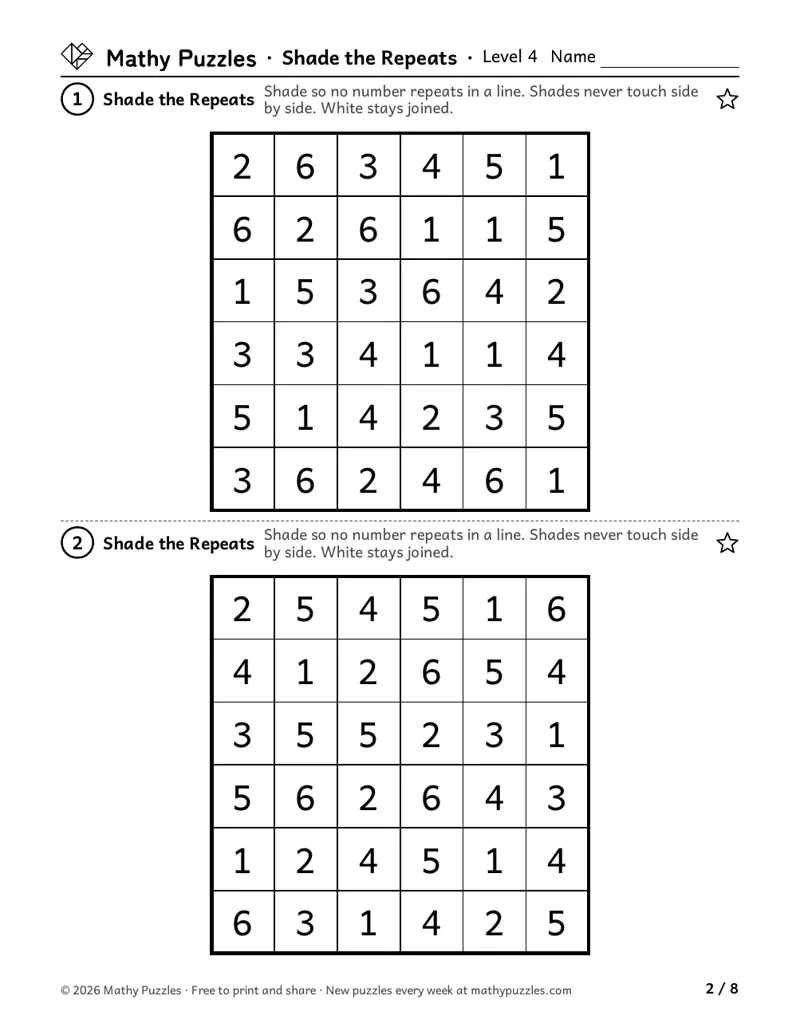
Numbers on a 6 × 6 grid, then 8 × 8; the hardest need one "what if" test.
On the sheet: “Shade so no number repeats in a line. Shades never touch side by side. White stays joined.”
Print Level 4 (Letter)Other paper size: A4
How it works
Each puzzle is a square grid filled with pictures (Levels 2 and 3) or numbers (Level 4). Some pictures repeat in a row or column. The child shades squares so that no picture shows twice in any row or column among the white squares. Shaded squares never touch side by side, and a square is shaded only if its twin stays white in the same line. From Level 3, all the white squares must also stay joined in one piece. At Level 4 the numbers are just labels; nothing is added.
How to play
- Look for a sandwich: a picture between two of the same picture (A B A). The middle one stays white; dot it.
- Look for twins side by side (A A). One of them must be shaded, so any other copy in that line gets shaded.
- Each time you shade a square, dot the squares beside it. Shaded squares never touch side by side.
- Shade only to fix a repeat. From Level 3, never cut the white squares into two pieces.
When it gets hard
Shading so dark the picture disappears.
Hint: Shade lightly or draw a slanted line, so you can still read the square.
Shading two squares side by side.
Hint: After each shade, dot the four squares beside it straight away.
Level 3 and up: cutting off a white square in a corner.
Hint: Before shading, check that the white squares around it can still reach the rest.
Tip for grown-ups: Ask your child to say each sandwich or pair aloud ("heart, star, heart"). Naming the pattern makes the next step clear.
Frequently asked questions
- Do the Level 4 numbers need adding?
- No. They work like pictures: labels that tell squares apart. The puzzle is about repeats, not sums.
- Why must the white squares stay joined?
- From Level 3 it is one of the rules, and it gives a strong clue. A square whose shading would cut off part of the grid must stay white. The small Level 2 grids leave it out.
- How does this fit with Sudoku work in class?
- It uses the same "once in each row and column" idea from the other side: instead of filling gaps, the child removes extras. It pairs well with Sudoku.
Questions about printing, levels, answers or membership: see all questions.
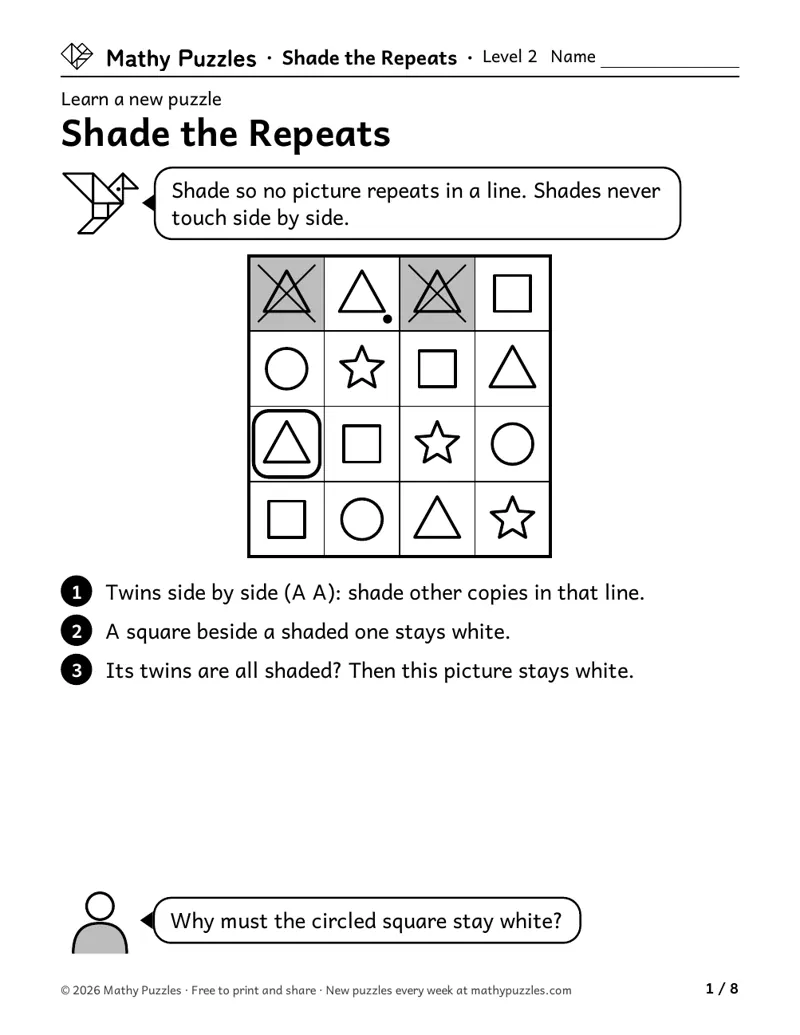
Worked example
From the Level 2 Learn sheet
- Shade so no picture repeats in a line. Shades never touch side by side.
- Twins side by side (A A): shade other copies in that line.
- A square beside a shaded one stays white.
- Its twins are all shaded? Then this picture stays white.
A question to ask: “Why must the circled square stay white?”
Free every Sunday A mixed bag of 20 new puzzles, all four levels. Get them by email
The thinking it works on
Scanning for repeats
Finds pictures that appear twice in a line.
Gil-Gómez de Liaño and colleagues (2020) tested 293 people aged 4 to 25 on finding a target among many pictures. Accuracy was near adult level by 9 to 10, though search speed was not. Source
Using patterns
Recognizes sandwiches and side-by-side twins.
Reasoning by elimination
Rules squares in or out from the shading already done.
Galotti, Komatsu and Voelz (1997) tested students in grades 2 to 5. They explained a conclusion that had to follow differently from one that was only likely, and gave it with more confidence. Source
Seeing how areas join
Keeps all the white squares in one piece.
Holding several rules at once
Keeps every rule true with each shade.
Davidson and colleagues (2006) tested children from 4 to 13. Even young children could keep a rule in mind and hold back a first reaction when the rules stayed fixed. Switching between rules was still developing at 13. Source
Testing a "what if"
Shades one square as a test and follows the rules it sets off.
Rafetseder, Schwitalla and Perner (2013) studied reasoning from a 'what if' that differs from what really happened. It was much stronger at 12 to 14 than at 9 to 11. Source
Where is this thinking used?
- Booking a schedule: Nobody can be booked twice in the same time slot.
- Proofreading: Spotting a word that appears twice by mistake and removing one.
- Planning a floor: Every room must still be reachable after a new wall goes up.
- Tidying a list: Removing the extra copies of an entry so each appears once.
For teachers
Curriculum areas
- Common Core
- No direct curricular match.
- NCERT
- No direct curricular match.
- National Curriculum (England)
- No direct curricular match.
- Cambridge Primary Mathematics
- No direct curricular match.
Math practices: see the box below.
Math practices this puzzle uses
- Uses: MP1 Make sense of problems and persevere in solving them
- Not used: MP2 Reason abstractly and quantitatively
- Not used: MP3 Construct viable arguments and critique the reasoning of others
- Not used: MP4 Model with mathematics
- Not used: MP5 Use appropriate tools strategically
- Not used: MP6 Attend to precision
- Uses: MP7 Look for and make use of structure
- Not used: MP8 Look for and express regularity in repeated reasoning
From the Common Core Standards for Mathematical Practice.
More Shade the Repeats puzzles for members
Members get at least 5 more worksheets at each difficulty for every puzzle, 80 new puzzles every Sunday, and the whole archive. $39 a year or $25 for 6 months.
See membershipNot ready yet?
One email, all four levels: 20 puzzles, 5 for each level.
For grown-ups (18+). One email every Sunday with the puzzles and the odd note about membership; unsubscribe any time. We never ask about your child. How we use your email