
Number Series
When someone counts 5, 10, 15 out loud, you know what comes next before they say it. Number Series asks for that next number, and when the jumps between numbers change, the jumps themselves follow a rule.
Free sets by level, ages 6–12:
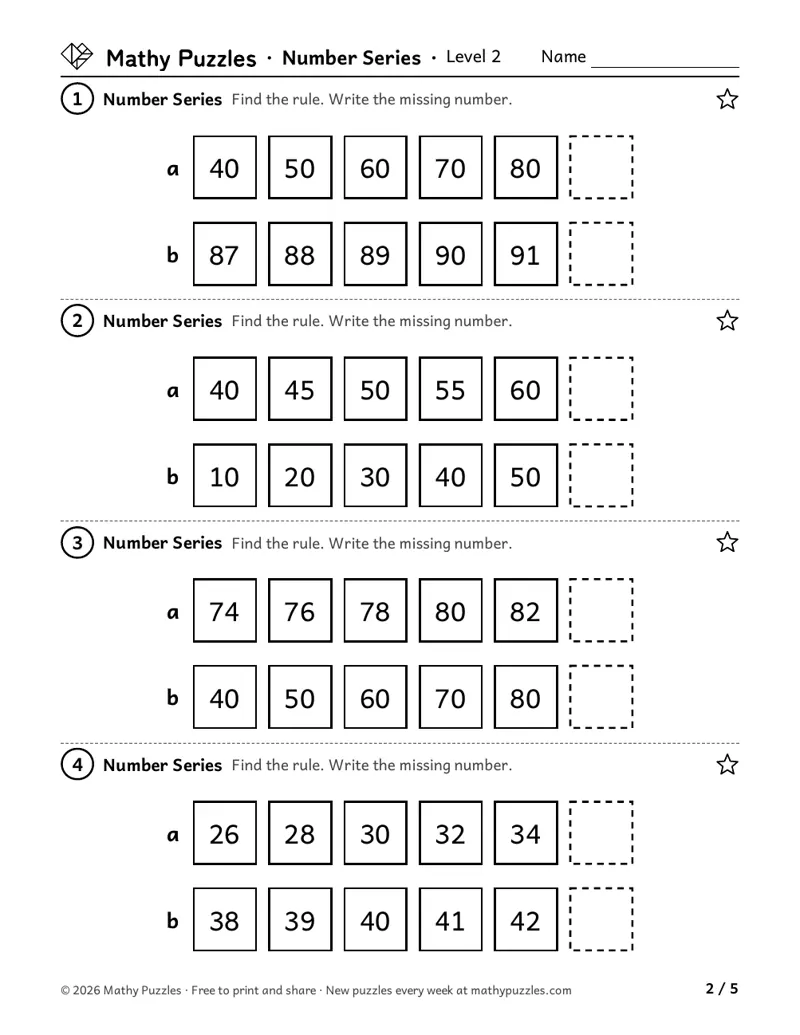 Level 2: a page from the free set
Before starting
- Level 2: count on and back by 1s, 2s, 5s and 10s within 100; by 25s and 100s for the harder lines
- Level 3: add and subtract within 100; times 2 and times 3 facts
- Level 4: multiplication facts to 10 × 10; square numbers help; tenths and hundredths for the hardest lines
Free puzzles to print
Each set: a Learn sheet with a worked example, 10 puzzles from easiest to hardest, and the answers.
Level 2
Ages 6–8 · Grades 1–2
First, count on by 1s, 2s, 5s or 10s, with the blank at the end. Then count back, or count on from an off-number start (3, 8, 13…). Then the blank moves to the middle or the start, and some lines count by 100s to 1,000. The hardest have two blanks in one line, adding or taking away 3, 4 or 25 within 200. No number goes below zero.
On the sheet: “Find the rule. Write the missing number.”
Print Level 2 (Letter)Other paper size: A4Level 3
Ages 8–10 · Grades 3–4
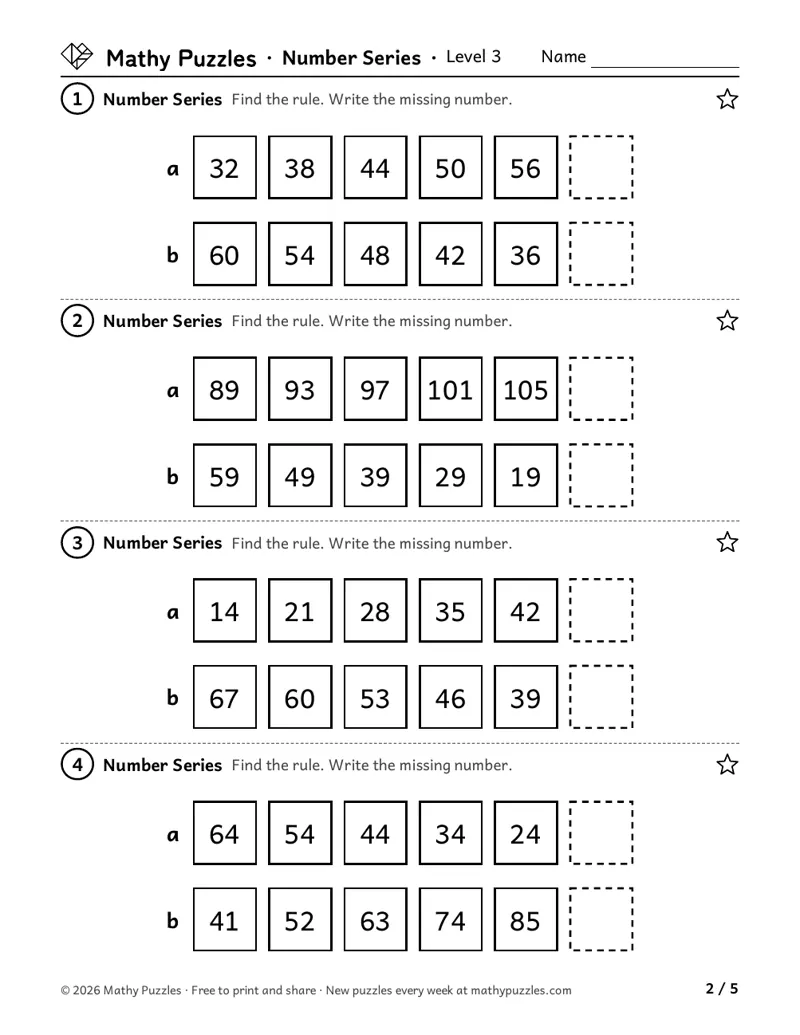
First, add or take away the same number (3 to 12), with the blank at the end. Then one line that goes times 2 or times 3 and one that adds then takes away (+5, −2) again and again. Then one line with jumps that grow or shrink (+2, +3, +4…) and one with two series taking turns. The hardest put the blank in the middle, with a two-step rule like times 2, then add 1.
On the sheet: “Find the rule. Write the missing number.”
Print Level 3 (Letter)Other paper size: A4Level 4
Ages 10–12 · Grades 5–6
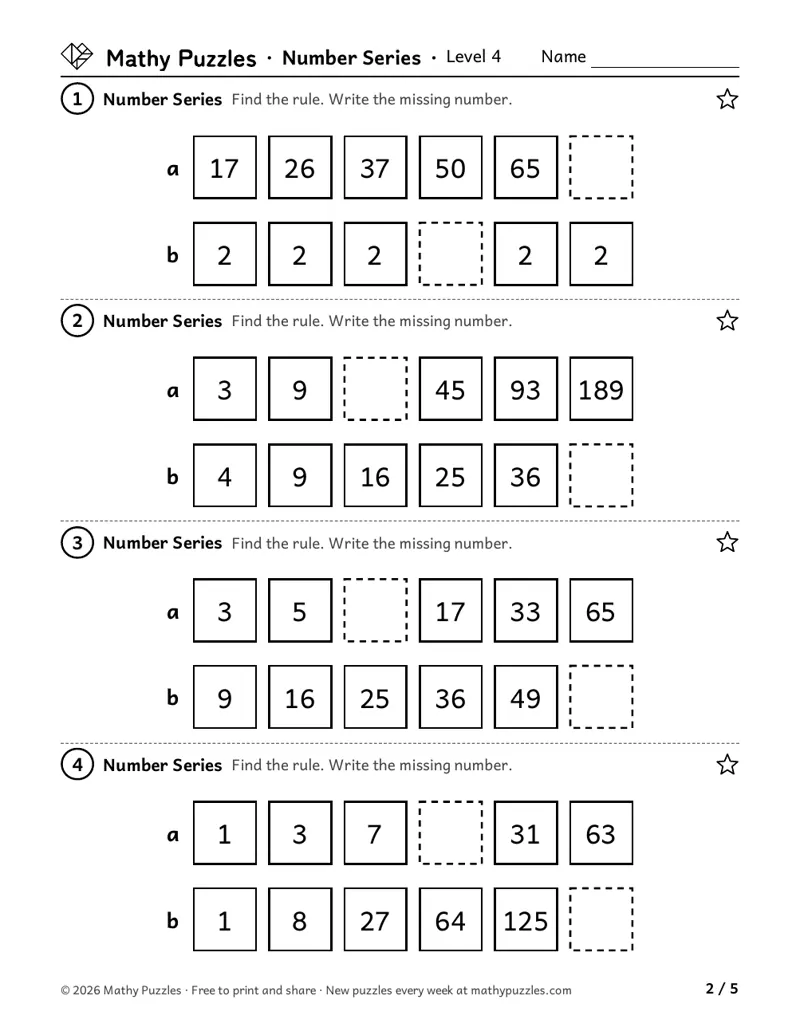
First, square and cube numbers, and two-step rules with the blank in the middle. Then jumps that double or triple, and two series taking turns. Then add-the-two-before lines, and jumps that grow by a growing amount. The hardest pair a line with decimals and a line with numbers below zero.
On the sheet: “Find the rule. Write the missing number.”
Print Level 4 (Letter)Other paper size: A4
How it works
Each line of numbers follows a rule, with a number missing. The child finds the rule and writes the missing number. Each puzzle has two lines. At Level 2 the rules are counting on or back by the same amount, such as by 1s, 2s, 5s, 10s, 25s or 100s. Later levels grow to jumps that change, two series taking turns, and, at Level 4, square numbers, decimals and numbers below zero.
How to play
- Write the jump between each pair of numbers underneath.
- If the jumps are all the same, use that jump.
- If they change, look for a rule in the jumps: growing by 1, doubling, or taking turns.
- Check that your answer fits every number in the line, not just the last few. If there are two blanks, fill the one you can reach first.
When it gets hard
Level 2: counting on when the line counts back.
Hint: Look at the first two numbers. If the second is smaller, the jump is a take-away.
Using only the last two numbers.
Hint: Check the rule works all the way along the line.
Missing that every other number is its own series.
Hint: Cover every second number and look again.
Looking only at the jumps when the rule is "times".
Hint: If the jumps keep doubling, try times 2 on the numbers themselves.
Tip for grown-ups: If your child is stuck, ask "What's the jump?" and nothing more. Writing the jumps solves most lines.
Frequently asked questions
- Could a line fit more than one rule?
- Sometimes, yes. Each line is checked against the rules we use, and the answers show the missing number those rules give. If your child finds a different rule that fits every number shown, that counts too: talk it through together.
- Can I use one line as a quick warm-up in class?
- Yes. Each puzzle is two short lines, so one fits easily on the board. Ask students to explain the rule, not just give the number.
- How is this different from Growing Patterns?
- Growing Patterns shows pictures of square tiles, so the child can see the pattern grow. Number Series gives only the numbers. Both start at Level 2.
Questions about printing, levels, answers or membership: see all questions.
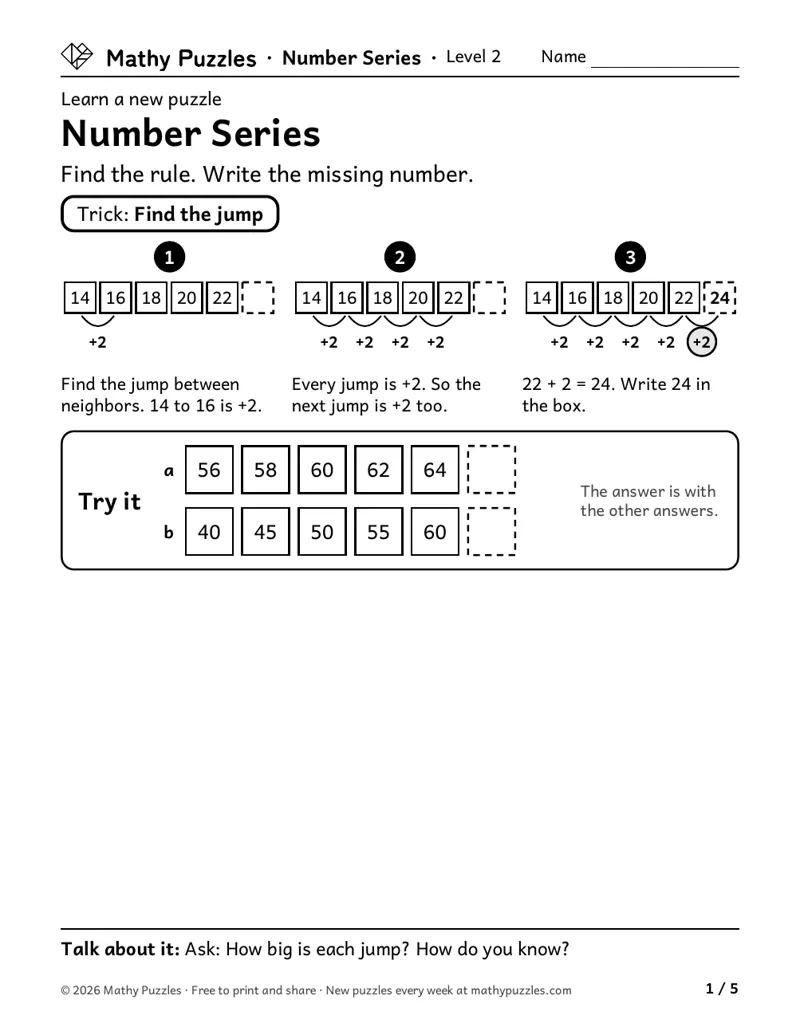
Worked example
From the Level 2 Learn sheet
- Find the jump between neighbors. Write it under the numbers.
- Every jump is the same, so the next jump is the same too.
- Add that jump to the last number and write the answer in the box.
A question to ask: “How big is each jump? How do you know?”
Free every Sunday A mixed bag of 20 new puzzles, all four levels. Get them by email
The thinking it works on
Finding a rule from examples
Finds a general rule from a few examples.
Looking at the jumps
Writes the jumps and studies them as a new line.
Testing a rule
Checks a guessed rule against every number shown.
Klahr, Fay and Dunbar (1993) found that third and sixth graders testing an unknown rule stuck to likely-sounding ideas and ran few tests. Adults, by contrast, uncovered unlikely but correct rules. Source
Tracking two patterns at once
Follows two series that take turns.
Mental arithmetic
Adds, takes away and multiplies quickly along a line.
Among 10- to 12-year-olds, remembering more facts and counting more efficiently cut the working memory that mental arithmetic needed. Strategy choice also varied with speed, skill and math anxiety. Source
Where is this thinking used?
- Saving: Seeing how a savings jar grows when a little more goes in each week.
- Calendars: Working out the date of every third Tuesday.
- Science: Spotting a trend in a table of measurements.
- Music: Following a rhythm that repeats with a change each time.
For teachers
Curriculum areas
- Common Core
- Number and operations in base ten: counting to 120 and skip counting by 5s, 10s and 100s (Grades 1–2); Operations and algebraic thinking: finding and explaining number patterns (Grades 3–4)
- NCERT
- Joyful Mathematics (Class 2): number patterns in Fun with Numbers; Maths Mela (Class 5): continuing sequences; Ganita Prakash (Class 6): Patterns in Mathematics, and sequences below zero in The Other Side of Zero
- National Curriculum (England)
- Number: counting in steps forward and back (Years 2–4); linear number sequences (Year 6); arithmetic, geometric and other sequences (Key Stage 3)
- Cambridge Primary Mathematics
- Number: counting in steps; steady and changing sequences; sequences with squares, decimals and numbers below zero (Stages 2–6)
Math practices: see the box below.
Math practices this puzzle uses
- Not used: MP1 Make sense of problems and persevere in solving them
- Not used: MP2 Reason abstractly and quantitatively
- Uses: MP3 Construct viable arguments and critique the reasoning of others
- Not used: MP4 Model with mathematics
- Not used: MP5 Use appropriate tools strategically
- Not used: MP6 Attend to precision
- Not used: MP7 Look for and make use of structure
- Uses: MP8 Look for and express regularity in repeated reasoning
From the Common Core Standards for Mathematical Practice.
More Number Series puzzles for members
Members get at least 5 more worksheets at each difficulty for every puzzle, 80 new puzzles every Sunday, and the whole archive. $39 a year or $25 for 6 months.
See membershipNot ready yet?
One email, all four levels: 20 puzzles, 5 for each level.
For grown-ups (18+). One email every Sunday with the puzzles and the odd note about membership; unsubscribe any time. We never ask about your child. How we use your email