
Integer Puzzles
On a thermometer, zero is just another mark: it can get colder than that. Numbers below zero follow the same rules as the rest, with plus going up the line and minus going down.
Free sets by level, ages 10–12:
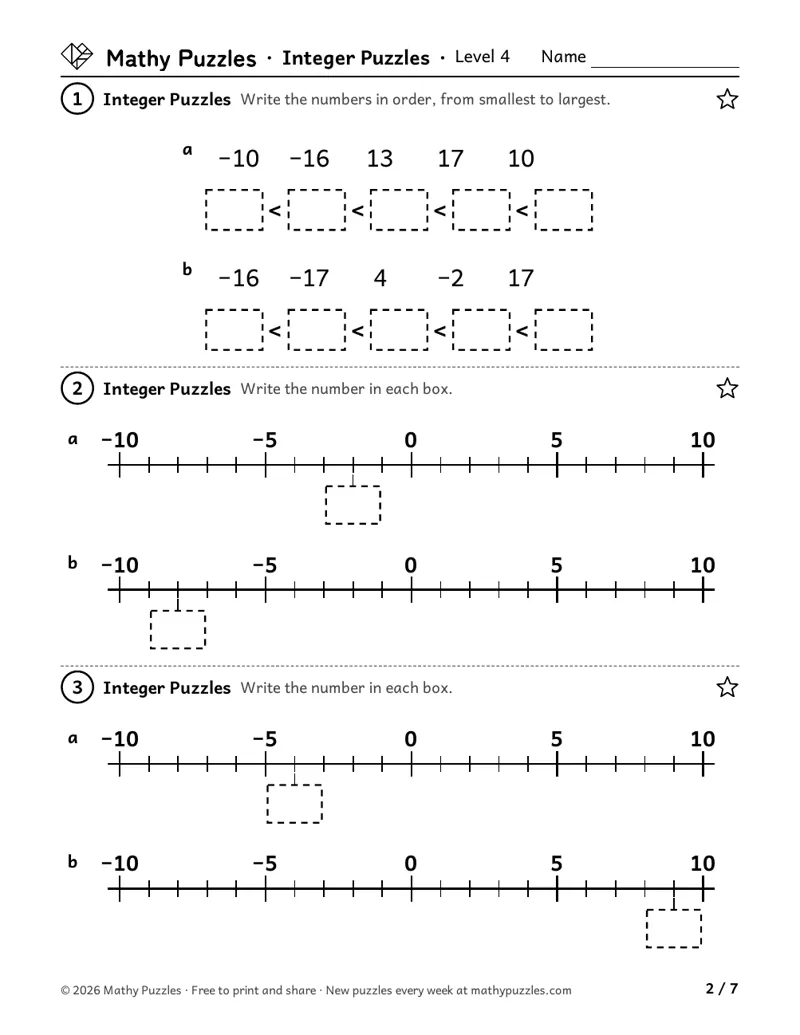 Level 4: a page from the free set
Before starting
- Adding and subtracting whole numbers within 40
- Multiplication facts for the grid puzzles
- Helpful: having seen a thermometer or a number line that goes below zero
What you need
Scrap paper with a number line from −10 to 10 to hop along, and a pencil.
Free puzzles to print
Each set: a Learn sheet with a worked example, 10 puzzles from easiest to hardest, and the answers.
Level 4
Ages 10–12 · Grades 5–6
First: write numbers on a −10 to 10 line, or put five numbers in order, some below zero.
Then: pyramids with the bottom row shown. Add up: −3 + 5 = 2.
Then: pyramids with bottom bricks missing. Take away, sometimes a number below zero: 3 − (−2) = 5.
Hardest: 4 × 4 grids using −2, −1, 1 and 2 once in each row and column; each cage adds or multiplies to its clue (−2 × 2 = −4).
On the sheet: “Use numbers below zero.”
Print Level 4 (Letter)Other paper size: A4
How it works
These are familiar puzzle types with numbers below zero. The child places numbers from −10 to 10 on a number line and puts numbers above and below zero in order. The child also fills pyramids where each brick is the sum of the two below. Last come small grids using −2, −1, 1 and 2, where each outlined cage adds or multiplies to its clue.
How to play
- Find the start number on the line.
- Plus: hop up. Minus: hop down.
- In a pyramid, add the two bricks below. To find a missing brick below, take the known one away from the brick above.
- In a grid, list which numbers can make each cage's clue, then use the once-per-row-and-column rule.
When it gets hard
Thinking −5 is bigger than −2 because 5 is bigger than 2.
Hint: Further below zero is smaller. Which is colder: −5 degrees or −2 degrees?
Counting the start number as a hop.
Hint: Put a finger on the start, then count each move.
Moving down when taking away a number below zero.
Hint: Taking away −2 moves up 2: 3 − (−2) = 5. Check by adding back: 5 + (−2) = 3.
Forgetting that two numbers below zero multiply to a number above zero.
Hint: −1 × (−2) = 2. Check the sign of each cage clue.
Tip for grown-ups: Point to an outdoor thermometer or an elevator with basement floors. Numbers below zero make sense faster once a child has seen them somewhere real.
Frequently asked questions
- Are numbers below zero taught at age 10?
- Common Core starts them in Grade 6 and adds and subtracts them in Grade 7. These puzzles start with the number line and ordering, then use hops for adding, so a 10- or 11-year-old can begin with the easiest ones.
- Would these work as a warm-up for an integers unit?
- Yes. The number-line and ordering puzzles suit the start of a unit, the pyramids practice adding and subtracting, and the grids add multiplying signs.
- Can my child use a number line the whole time?
- Of course. The Learn sheet uses a standing number line, like a thermometer, and hopping along it is how the early puzzles are meant to be solved.
Questions about printing, levels, answers or membership: see all questions.
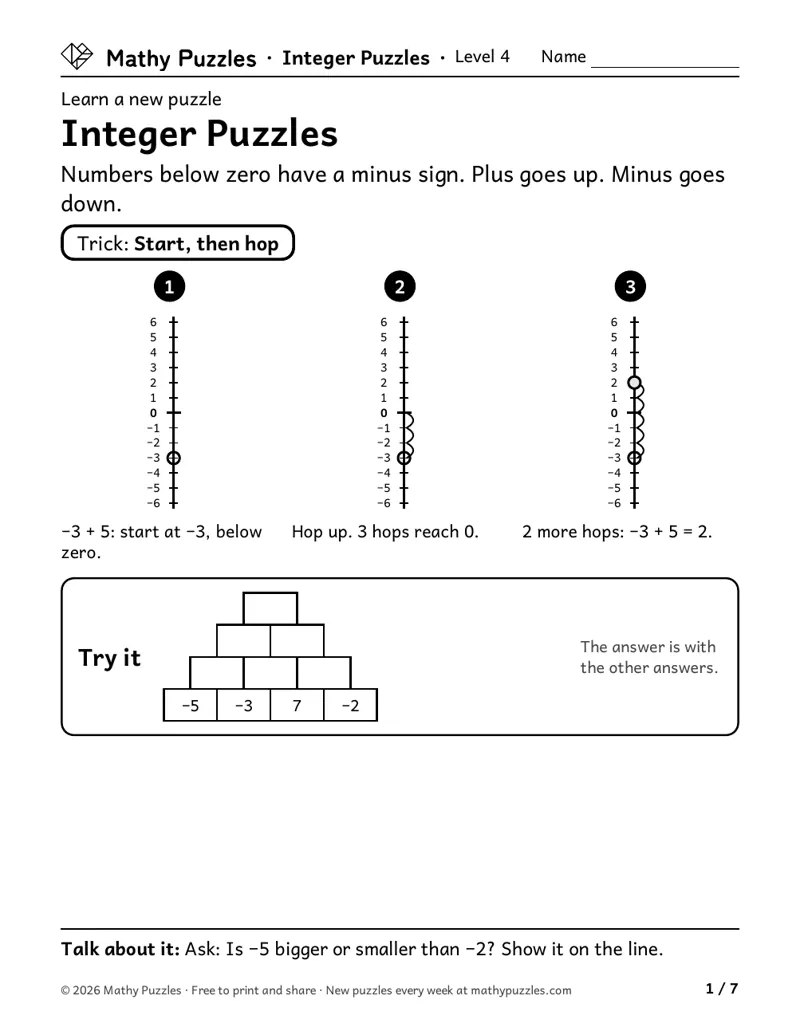
Worked example
From the Level 4 Learn sheet
- Numbers below zero have a minus sign. Plus goes up, minus goes down.
- −3 + 5: start at −3, below zero.
- Hop up. 3 hops reach 0.
- 2 more hops: −3 + 5 = 2.
A question to ask: “Is −5 bigger or smaller than −2? Show it on the line.”
Free every Sunday A mixed bag of 20 new puzzles, all four levels. Get them by email
The thinking it works on
The number line beyond zero
Pictures numbers below zero as a line that keeps going.
Young and Booth (2015) found that sixth and seventh graders placed negative numbers on a number line in an orderly way, but less accurately than positive numbers. Using the midpoint helped. Source
Comparing signed numbers
Knows that further below zero means smaller.
Varma and Schwartz (2011) found that children, unlike adults, compared negative numbers by applying rules rather than by sensing how big the numbers were. Source
Adding and subtracting as movement
Treats plus as a hop up and minus as a hop down.
Aqazade and Bofferding (2021) found that a common method among fifth graders was to add the numbers without their signs and put a minus sign on the total. Source
Undoing a step
Takes away to undo an addition.
Grade 6 and 8 students solving problems like a + b − b used the shortcut that subtraction undoes addition, older students more often. They used it most on addition and subtraction, less on multiplication and division. Source
Reasoning with two kinds of rule
Uses cage clues and the once-per-row rule together.
Crone, Bunge and van der Molen (2006) compared 7- to 8-year-olds, 10- to 12-year-olds and adults. The younger children lost the most time switching between two task rules. Source
Where is this thinking used?
- Weather: Reading a winter temperature that drops from 3 degrees to −4.
- Money: Keeping track of money saved and money owed.
- Buildings: Elevator buttons for floors below ground level.
- Sports scores: Golf scores below par, or game points that dip under zero.
For teachers
Curriculum areas
- Common Core
- The number system: understanding and ordering numbers below zero on the number line (Grade 6). The pyramids and grids look ahead to adding, subtracting and multiplying them (Grade 7).
- NCERT
- Ganita Prakash (Class 6): The Other Side of Zero
- National Curriculum (England)
- Number: negative numbers in context and across zero (Years 5–6); ordering and calculating with negative numbers (Key Stage 3)
- Cambridge Primary Mathematics
- Number: ordering, adding and subtracting numbers below zero (Stages 4–6)
Math practices: see the box below.
Math practices this puzzle uses
- Not used: MP1 Make sense of problems and persevere in solving them
- Not used: MP2 Reason abstractly and quantitatively
- Not used: MP3 Construct viable arguments and critique the reasoning of others
- Not used: MP4 Model with mathematics
- Not used: MP5 Use appropriate tools strategically
- Uses: MP6 Attend to precision
- Uses: MP7 Look for and make use of structure
- Not used: MP8 Look for and express regularity in repeated reasoning
From the Common Core Standards for Mathematical Practice.
More Integer Puzzles for members
Members get at least 5 more worksheets at each difficulty for every puzzle, 80 new puzzles every Sunday, and the whole archive. $39 a year or $25 for 6 months.
See membershipNot ready yet?
One email, all four levels: 20 puzzles, 5 for each level.
For grown-ups (18+). One email every Sunday with the puzzles and the odd note about membership; unsubscribe any time. We never ask about your child. How we use your email