
Number Bonds
Ten fingers can be held up as 5 and 5, or 7 and 3, and it is still ten. A number bond draws that idea: a whole split into parts, and when every number but one is known, the last one is decided.
Free sets by level, ages 4–8:
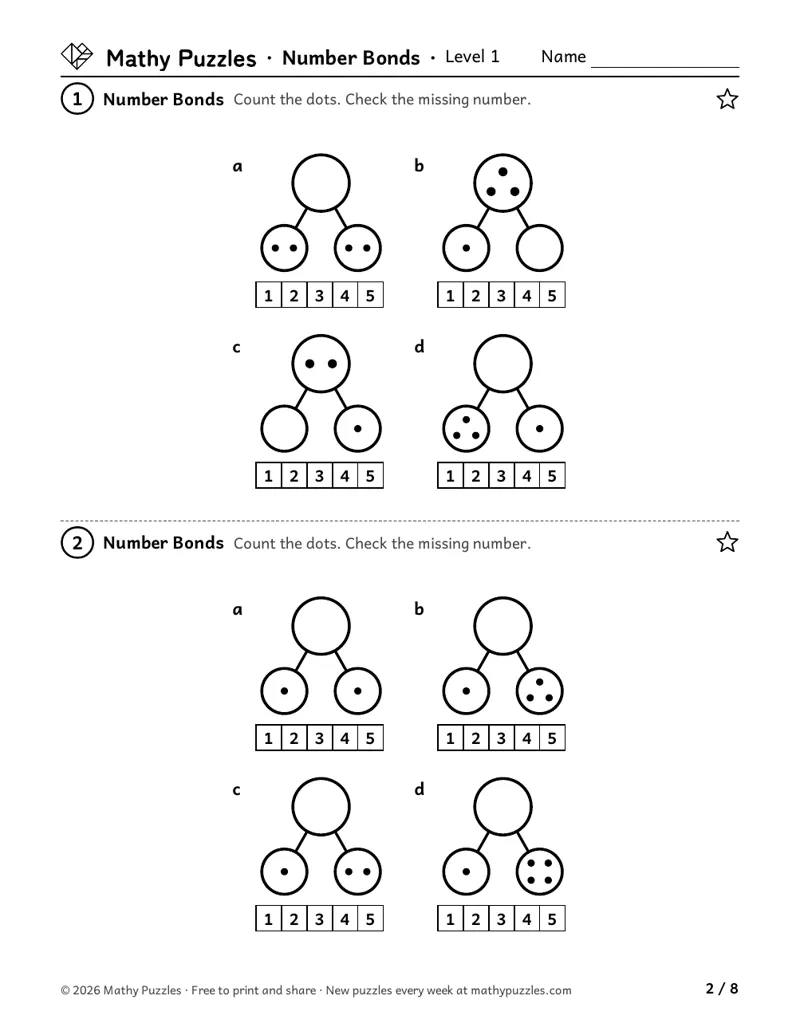 Level 1: a page from the free set
Before starting
- Level 1: count up to 10 dots
- Level 1: know the numbers to 10 (to 19 for the hardest)
- Level 2: add and take away within 20, and count by tens to 100
What you need
Small things to count, like buttons or beans, and a pencil.
Free puzzles to print
Each set: a Learn sheet with a worked example, 10 puzzles from easiest to hardest, and the answers.
Level 1
Ages 4–6 · Pre-K–K
The easiest puzzles have wholes from 2 to 5, shown as dots, and the child checks the missing number on a number strip. Then wholes from 6 to 10, shown as numbers. Then two linked bonds, where a part of the first bond is the whole of the second. The hardest split teen numbers: 13 is 10 and 3.
On the sheet: “The big circle is the whole. The small circles are its parts.”
Print Level 1 (Letter)Other paper size: A4Level 2
Ages 6–8 · Grades 1–2
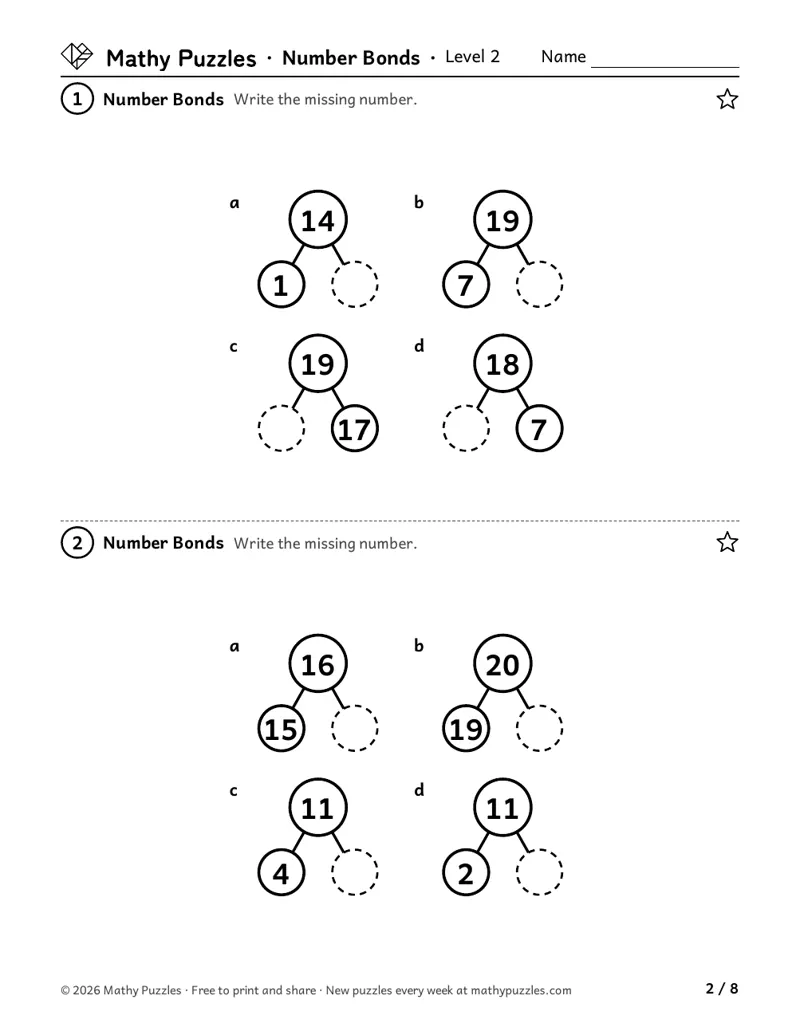
Wholes from 11 to 20 with a part or the whole missing. Then tens to 100 (70 is 30 and how many?), then bonds with three parts, wholes up to 20. The hardest are chains of two or three linked bonds, solved one bond at a time.
On the sheet: “The big circle is the whole. The small circles are its parts.”
Print Level 2 (Letter)Other paper size: A4
How it works
Each bond is a big circle joined to small circles. The big circle is the whole; the small circles are its parts. One circle is empty, and the child finds the missing number. The easiest puzzles show dots to count; later ones use numbers, link bonds together, or split teen numbers into 10 and some more. At Level 2 every answer is written: wholes go up to 20, tens go up to 100, and some bonds have three parts.
How to play
- Find the big circle. That is the whole.
- Find the small circles. Those are the parts.
- If a part is missing, start at the part you know and count up to the whole.
- If the whole is missing, put the parts together.
When it gets hard
Adding the whole and a part when a part is missing.
Hint: The whole is the biggest number. The missing part must be smaller.
Filling the second linked bond before the first.
Hint: The empty circle in the first bond is the whole of the second. Find it first.
Writing 31 for 10 and 3.
Hint: Ten comes first: 1 for the ten, then 3. Say "thirteen" while writing.
Level 2: in a three-part bond, using only one of the two parts given.
Hint: Add the two parts you know first, then find what is left to make the whole.
Tip for grown-ups: Act it out with real things: 5 buttons, hide some in one hand, show the rest. "How many are hiding?"
Frequently asked questions
- Is this the same as the number bonds my child's school uses?
- Very likely. Many US schools teach the big circle and small circles as "part-part-whole". In the UK, "number bonds" often means pairs that make 10 or 20; our puzzles cover numbers to 20, teen numbers and tens to 100.
- Why do some puzzles show dots instead of numbers?
- Dots let a child count the whole and the part before working with numbers alone. The dots stop once the wholes reach 6.
- Where do these fit in a kindergarten addition unit?
- Splitting numbers to 10 into pairs is a kindergarten goal in the US, and the teen-number puzzles match ten-and-some-more work.
Questions about printing, levels, answers or membership: see all questions.
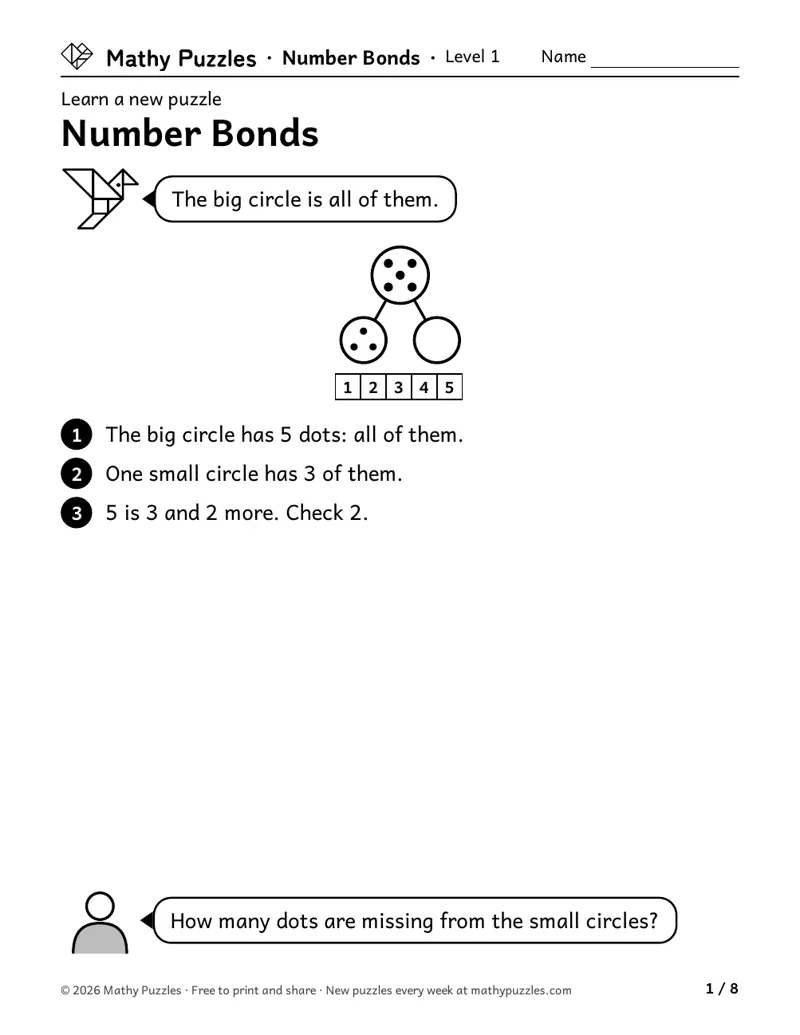
Worked example
From the Level 1 Learn sheet
- The big circle is all of them.
- The big circle has 5 dots: all of them.
- One small circle has 3 of them.
- 5 is 3 and 2 more. Check 2.
A question to ask: “How many dots are missing from the small circles?”
Free every Sunday A mixed bag of 20 new puzzles, all four levels. Get them by email
The thinking it works on
Part-whole thinking
Sees a number as a whole made of two parts.
Sophian and McCorgray (1994) found that 5- and 6-year-olds, but not 4-year-olds, used the part-whole structure of a problem. When a part was added they expected a bigger whole, and when a part was taken away, a smaller one. Source
Splitting numbers
Knows the pairs that make a number.
Canobi, Reeve and Pattison (2002) found that most 4- to 6-year-olds grasped, with groups of objects, how parts make up a whole. Schoolchildren judged this more accurately than preschoolers. Source
Finding a missing part
Works out an unknown part from the whole and the other part.
Levine, Jordan and Huttenlocher (1992) found that 4-year-olds could already work out how many were in a hidden set after items were added or taken away. The same problems in words were not solved until about 5½ to 6½. Source
Teen numbers as ten and more
Sees 13 as 10 and 3.
Ho and Fuson (1998) studied 5-year-olds in England and the United States, whose teen words hide the ten. They found no sign that these children saw a teen amount as ten and some ones. Source
Chaining steps
Uses each answer to solve the next.
Alloway and colleagues (2004) tested 633 children aged 4 to 6. The parts of working memory that store information and work on it were already distinct and measurable at these ages. Source
Where is this thinking used?
- Shopping and change: Knowing a price and what you paid tells you the change.
- Sharing between two: Ten crackers become 6 for one child and 4 for the other.
- Sorting into groups: A box of 9 toys holds 5 cars, so the rest are trucks.
- Keeping score: Knowing the total and one round's points tells you the other round.
For teachers
Curriculum areas
- Common Core
- Operations and algebraic thinking: splitting numbers to 10 into pairs (Kindergarten), adding and taking away within 20 and finding a missing number (Grades 1–2); Number and operations in base ten: teen numbers as ten and some ones (Kindergarten), adding and taking away tens (Grade 1)
- NCERT
- Joyful Mathematics: number pairs of 10 and teen numbers as 10 and some more (Class 1, Making 10), hidden and visible dots (Class 1, How Many?); tens that make 100 (Class 2, A Day at the Beach)
- National Curriculum (England)
- Early years number: the parts of numbers to 10 and number bonds (Reception); number bonds within 20 (Year 1); facts to 20 and related facts to 100 (Year 2)
- Cambridge Primary Mathematics
- Number: number pairs that make 10 and 20; splitting numbers into parts (Stages 1–2)
Math practices: see the box below.
Math practices this puzzle uses
- Not used: MP1 Make sense of problems and persevere in solving them
- Not used: MP2 Reason abstractly and quantitatively
- Not used: MP3 Construct viable arguments and critique the reasoning of others
- Not used: MP4 Model with mathematics
- Not used: MP5 Use appropriate tools strategically
- Not used: MP6 Attend to precision
- Uses: MP7 Look for and make use of structure
- Not used: MP8 Look for and express regularity in repeated reasoning
From the Common Core Standards for Mathematical Practice.
More Number Bonds puzzles for members
Members get at least 5 more worksheets at each difficulty for every puzzle, 80 new puzzles every Sunday, and the whole archive. $39 a year or $25 for 6 months.
See membershipNot ready yet?
One email, all four levels: 20 puzzles, 5 for each level.
For grown-ups (18+). One email every Sunday with the puzzles and the odd note about membership; unsubscribe any time. We never ask about your child. How we use your email