
Morse Code
Long before phones, ships at sea sent messages as beeps, short and long. Each letter was a little pattern of dots and dashes, and these puzzles use that real code, one pattern at a time.
Free sets by level, ages 8–10:
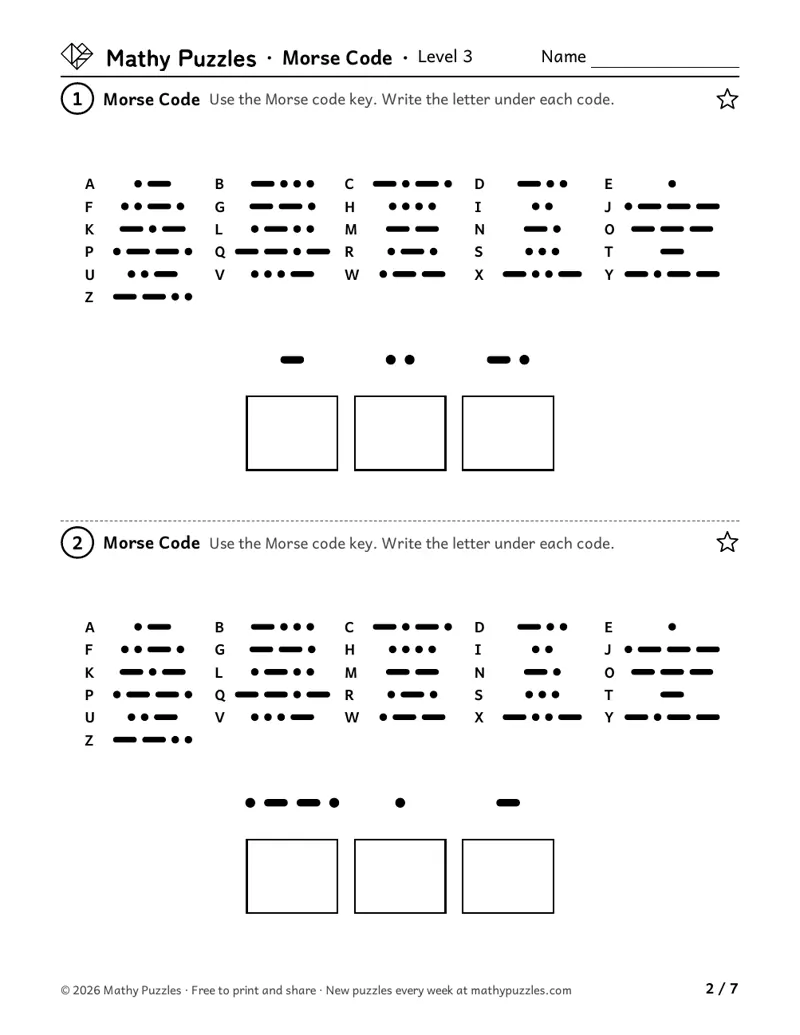 Level 3: a page from the free set
Before starting
- Know capital letters and write them
- Read and spell 3- to 5-letter words
- Tell a dot from a dash and count up to four marks
What you need
A ruler or a strip of paper to keep your place in the key, and a pencil.
Free printable: Morse code
Free puzzles to print
Each set: a Learn sheet with a worked example, 10 puzzles from easiest to hardest, and the answers.
Level 3
Ages 8–10 · Grades 3–4
Decode a 3-letter word with the Morse table, then a 4- or 5-letter word. Then write a word in Morse code. The hardest puzzles replace the table with the Morse tree, where a dot goes left and a dash goes right.
On the sheet: “Use the Morse code key. Write the letter under each code.”
Print Level 3 (Letter)Other paper size: A4
How it works
These puzzles use real International Morse code. Each letter is a short pattern of dots and dashes. The codes for a word's letters are printed in a row, each over its own box. The child finds each pattern in the key and writes its letter. Later the child writes a word in Morse code, and in the hardest puzzles reads the letters from a Morse tree instead of a table.
How to play
- Look at the first group of dots and dashes.
- Count its marks and say them: "dot, dash".
- Find the same pattern in the key and write the letter in the box below.
- Do every group, then read the word.
When it gets hard
Mixing up codes that are mirror images, such as dot-dash (A) and dash-dot (N).
Hint: Say the marks out loud from left to right before you look in the key.
Losing count in a long code.
Hint: Touch each mark with the pencil tip as you count it.
On the tree, turning the wrong way.
Hint: Start at the top every time: dot goes left, dash goes right.
Tip for grown-ups: Tap or hum a code (short and long sounds) and let your child write it as dots and dashes; then swap roles. A ruler under the key keeps your child's place.
Frequently asked questions
- Is this the real Morse code?
- Yes. The letters follow International Morse code, the version used around the world for radio. Only letters are used, no numbers or punctuation.
- What is the Morse tree?
- A chart that sorts every letter by its code. Start at the top; go left for a dot and right for a dash. Where you stop is the letter. It shows why short codes like E (one dot) and T (one dash) sit near the top.
- Does this fit a class lesson?
- It pairs well with a lesson on signals or inventions: students decode, then send each other a word by tapping.
Questions about printing, levels, answers or membership: see all questions.
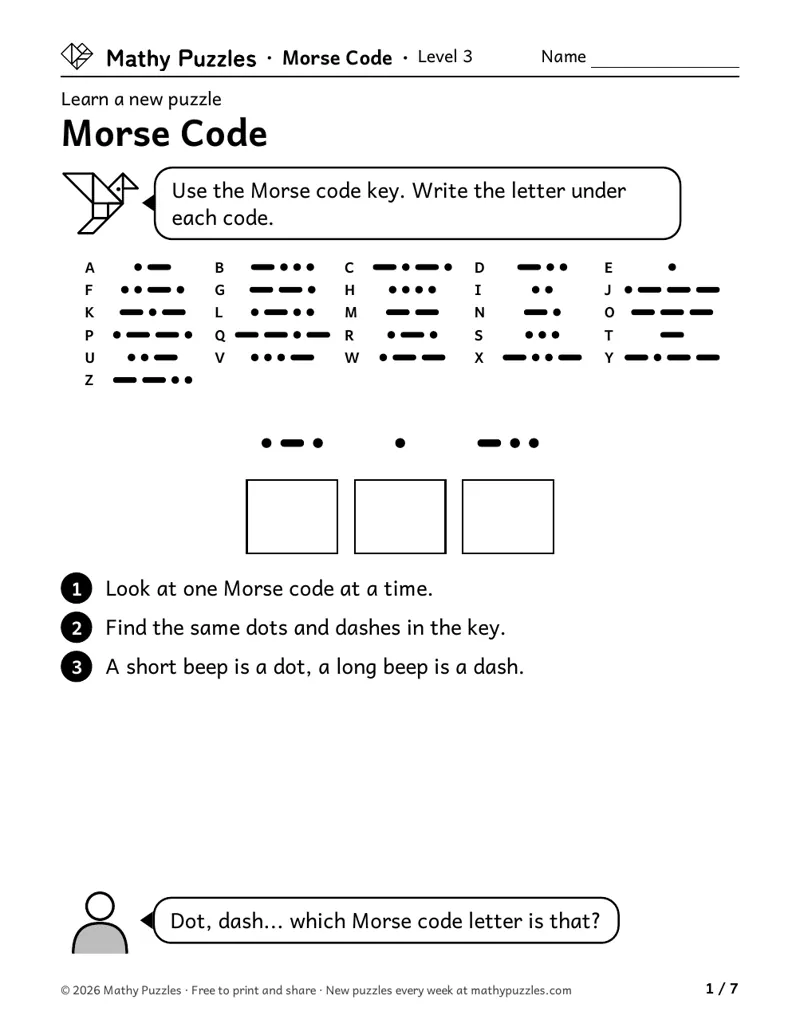
Worked example
From the Level 3 Learn sheet
- Look at one Morse code at a time.
- Find the same dots and dashes in the key.
- A short beep is a dot, a long beep is a dash.
A question to ask: “Dot, dash... which Morse code letter is that?”
Free every Sunday A mixed bag of 20 new puzzles, all four levels. Get them by email
The thinking it works on
Pattern matching by order
Matches each pattern of dots and dashes in the key, in the right order.
Holding a short pattern in mind
Holds a short dot-dash pattern while searching the key.
McCormack, Brown, Vousden and Henson (2000) had 7- to 11-year-olds recall lists of six letters in order. The younger children more often left letters out or added wrong ones; the older children's errors were more often letters in the wrong place. Source
Writing in code
Turns letters into dots and dashes using the key backward.
Following a branching path
Walks the Morse tree: dot goes left, dash goes right.
Careful visual scanning
Searches a full key systematically instead of at random.
Where is this thinking used?
- Signals: Light, sound and radio signals send messages as short and long pulses.
- Accessibility: Some people type with two switches, short and long, using Morse code.
- Decision trees: A branching chart where each answer sends you left or right.
- Scouting and camping: Signaling with a flashlight or a whistle.
For teachers
Curriculum areas
- Common Core
- No direct curricular match.
- NCERT
- No direct curricular match.
- Computer science (CSTA)
- Symbols that stand for information, and codes for writing letters (ages 5–14)
- National Curriculum (England)
- No direct curricular match.
- Cambridge Primary Mathematics
- No direct curricular match.
Math practices: see the box below.
Math practices this puzzle uses
- Not used: MP1 Make sense of problems and persevere in solving them
- Not used: MP2 Reason abstractly and quantitatively
- Not used: MP3 Construct viable arguments and critique the reasoning of others
- Not used: MP4 Model with mathematics
- Not used: MP5 Use appropriate tools strategically
- Uses: MP6 Attend to precision
- Uses: MP7 Look for and make use of structure
- Not used: MP8 Look for and express regularity in repeated reasoning
From the Common Core Standards for Mathematical Practice.
More Morse Code puzzles for members
Members get at least 5 more worksheets at each difficulty for every puzzle, 80 new puzzles every Sunday, and the whole archive. $39 a year or $25 for 6 months.
See membershipNot ready yet?
One email, all four levels: 20 puzzles, 5 for each level.
For grown-ups (18+). One email every Sunday with the puzzles and the odd note about membership; unsubscribe any time. We never ask about your child. How we use your email