
Missing Digits
A smudged receipt can often still be read: if the other numbers and the total are clear, the smudged digit can be worked out. Written math always has the same layout, so every column and row leaves a clue like that.
Free sets by level, ages 6–12:
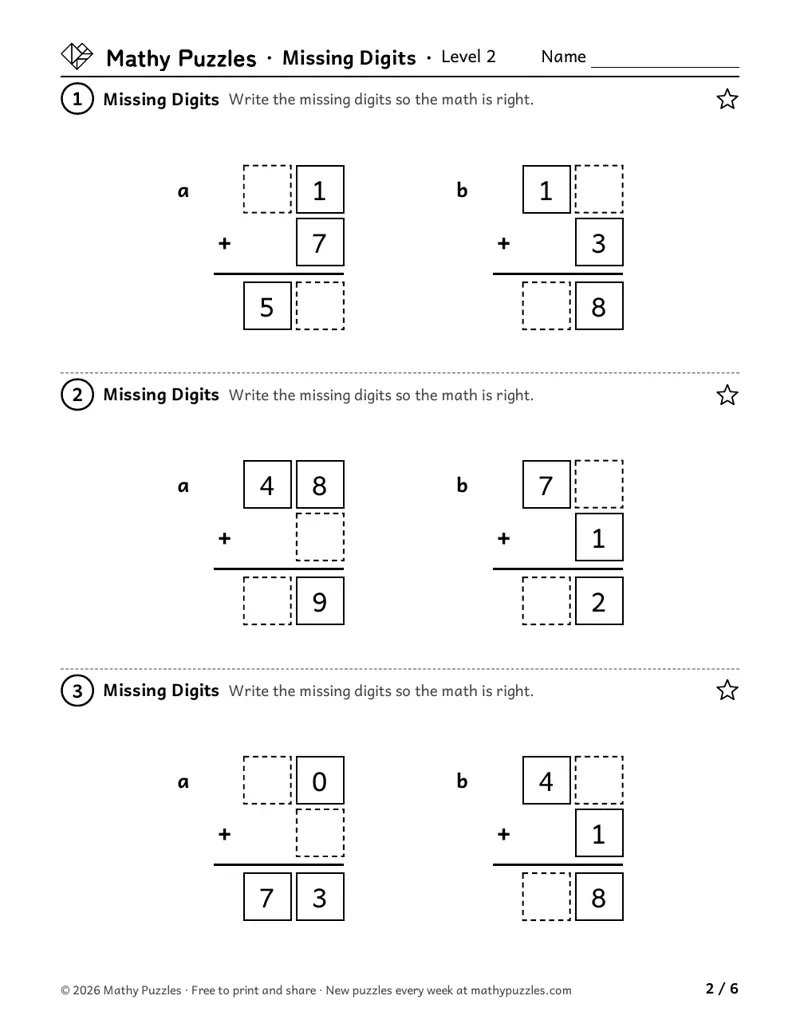 Level 2: a page from the free set
Before starting
- Level 2: add and subtract 2-digit numbers in columns, ones then tens
- Level 3: add and subtract 3-digit numbers in columns; multiplication facts to 10 × 10
- Level 4: long multiplication (2-digit × 2-digit) and short division
Free puzzles to print
Each set: a Learn sheet with a worked example, 10 puzzles from easiest to hardest, and the answers.
Level 2
Ages 6–8 · Grades 1–2
First, 2-digit + 1-digit with one blank in each column and no regrouping. Then 2-digit + 2-digit, then 2-digit − 2-digit, still with no regrouping. The hardest regroup into the tens column, which has a blank. Every answer is 99 or less.
On the sheet: “Write the missing digits so the math is right.”
Print Level 2 (Letter)Other paper size: A4Level 3
Ages 8–10 · Grades 3–4
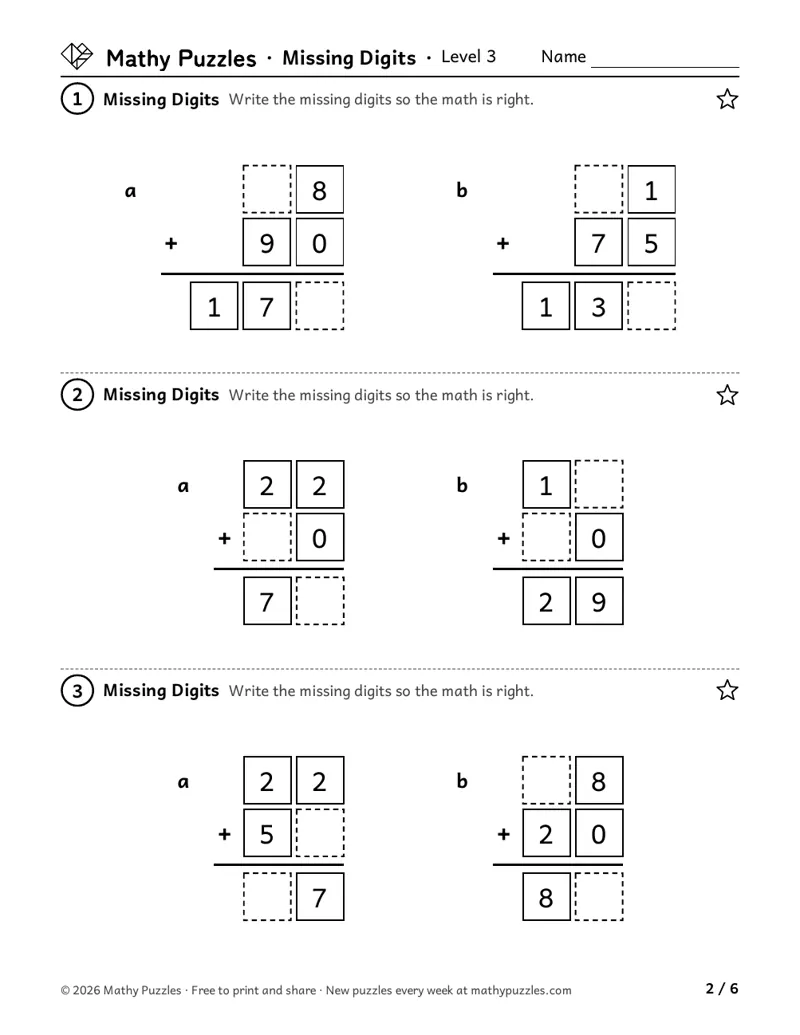
First, 2-digit + 2-digit with one blank in each column. Then 3-digit addition or subtraction with regrouping into a column that has a blank. Then 2- or 3-digit × 1-digit. The hardest have two blanks in one column, or a hidden one-digit multiplier.
On the sheet: “Write the missing digits so the math is right.”
Print Level 3 (Letter)Other paper size: A4Level 4
Ages 10–12 · Grades 5–6
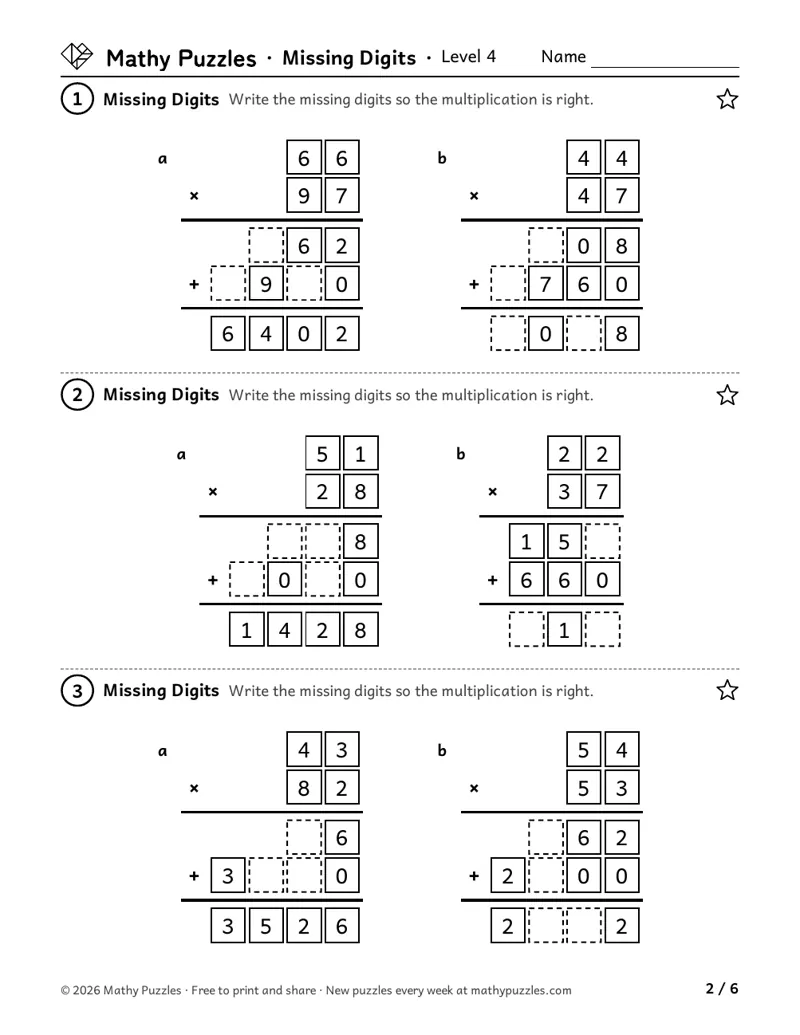
First, 2-digit × 2-digit long multiplication with blanks in the rows and the total. Then blanks in the numbers being multiplied too. Then division with nothing left over (3- or 4-digit ÷ 1 digit). The hardest are 3-digit × 2-digit, or division by a 2-digit number.
On the sheet: “Write the missing digits so the math is right.”
Print Level 4 (Letter)Other paper size: A4
How it works
Each puzzle is a written sum, difference or product with empty boxes where some digits should be. The child works out each missing digit so the math is right. Level 2 uses adding and subtracting 2-digit numbers, with answers up to 99. Level 3 uses adding, subtracting and multiplying by one digit. Level 4 uses long multiplication and long division.
How to play
- Start at the right, in the ones column.
- Ask which digit makes this column work. Write it, and write any carry above the next column.
- If a column has two blanks, come back to it once the column on its left helps.
- At Level 4, fill a long multiplication one row at a time: the ones row, the tens row (it ends in 0), then the total.
When it gets hard
Forgetting a carry coming in from the right (from the hardest Level 2 puzzles on).
Hint: Write every carry small above its column before you work that column.
In a subtraction, taking the smaller digit from the bigger one whatever its place.
Hint: Always take the bottom digit from the top one. If the top one is smaller, regroup a ten first.
Writing two digits in one box.
Hint: Each box holds one digit. Write the ones digit and carry the tens.
Leaving out the 0 at the end of the tens row in long multiplication.
Hint: The tens row is the top number times a tens digit, so it always ends in 0.
Tip for grown-ups: When a digit looks right, ask your child to check it by doing the whole calculation again. Checking is part of the puzzle, not extra work.
Frequently asked questions
- My child already knows column addition. Will this feel like a worksheet?
- It looks like one, but it runs in reverse. Instead of working out an answer, the child decides what a digit must be and why, which takes more thinking than the usual sum.
- Can Level 4 support teaching long division?
- Yes, as practice once it has been taught. The division puzzles never leave a remainder, and the easier ones divide by one digit.
- Can a missing digit be 0?
- Yes, any digit from 0 to 9, except that no number starts with 0. This holds at every level, from the 2-digit sums at Level 2 up.
Questions about printing, levels, answers or membership: see all questions.
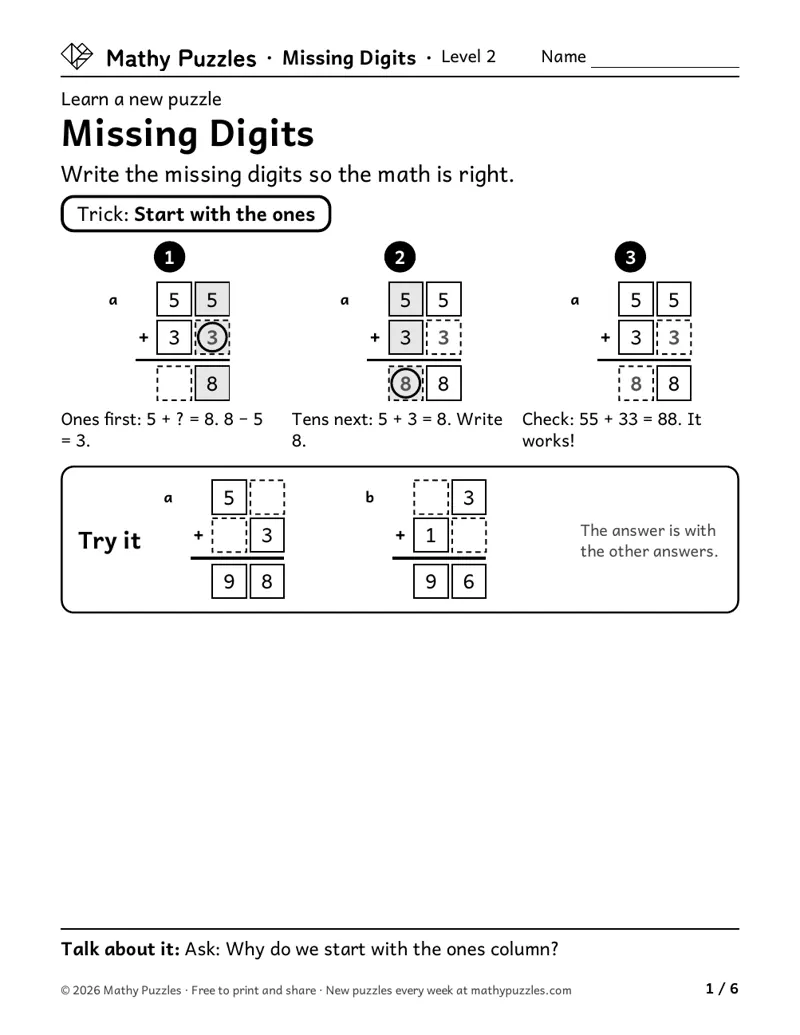
Worked example
From the Level 2 Learn sheet
- Start with the ones column. Which digit, added to the one above it, makes the answer's ones digit? Take away to find it.
- Tens next: add the two tens digits and write the total.
- Check: work the whole sum again. It works!
A question to ask: “Why do we start with the ones column?”
Free every Sunday A mixed bag of 20 new puzzles, all four levels. Get them by email
The thinking it works on
Place value
Treats each column as ones, tens or hundreds joined by the carry.
Undoing an operation
Uses subtraction to undo addition and division to undo multiplication.
Children in grades 2, 3 and 4 given problems like 3 + 26 − 26 differed widely in using the shortcut that subtraction undoes addition. There was little change from grade to grade. Source
Reasoning about the carry
Decides whether a carry came in from the column to the right.
Brown and Burton (1978) built a system that explains students' wrong answers as steady faulty steps ('bugs'), and used it with 1,300 school students. Source
Following a long layout
Works through long multiplication or division row by row.
Checking
Redoes the whole calculation to confirm every digit.
Where is this thinking used?
- Receipts: Working out a smudged price on a receipt from the total.
- Bookkeeping: Finding the missing figure that makes a column of numbers add up.
- Detective work: Filling a gap in a set of facts from what the rest must be.
- Homework checks: Spotting which digit in a long calculation went wrong.
For teachers
Curriculum areas
- Common Core
- Number and operations in base ten: adding and subtracting within 100 (Grades 1–2) and within 1,000 (Grade 3), multiplying and dividing by one digit (Grade 4), multi-digit multiplication and division (Grades 5–6)
- NCERT
- Joyful Mathematics: Decoration for Festival (Class 2, column adding and subtracting); Maths Mela: The Cleanest Village (Class 4, regrouping and missing digits), The Dairy Farm and Coconut Farm (Class 5, multiplication and division, with missing numbers)
- National Curriculum (England)
- Number: adding and subtracting two-digit numbers (Year 2); columnar methods and multiplying by one digit (Year 3); long multiplication and division (Years 5–6)
- Cambridge Primary Mathematics
- Number: adding and subtracting (Stages 2–3); multiplying and dividing, including by 2-digit numbers (Stages 4–6)
Math practices: see the box below.
Math practices this puzzle uses
- Not used: MP1 Make sense of problems and persevere in solving them
- Not used: MP2 Reason abstractly and quantitatively
- Not used: MP3 Construct viable arguments and critique the reasoning of others
- Not used: MP4 Model with mathematics
- Not used: MP5 Use appropriate tools strategically
- Uses: MP6 Attend to precision
- Uses: MP7 Look for and make use of structure
- Not used: MP8 Look for and express regularity in repeated reasoning
From the Common Core Standards for Mathematical Practice.
More Missing Digits puzzles for members
Members get at least 5 more worksheets at each difficulty for every puzzle, 80 new puzzles every Sunday, and the whole archive. $39 a year or $25 for 6 months.
See membershipNot ready yet?
One email, all four levels: 20 puzzles, 5 for each level.
For grown-ups (18+). One email every Sunday with the puzzles and the odd note about membership; unsubscribe any time. We never ask about your child. How we use your email