
Letter Sums
In the famous old puzzle SEND + MORE = MONEY, every letter hides a digit. The columns and the carries leave clues, and if you start with what must be true, the digits fall into place one at a time.
Free sets by level, ages 8–12:
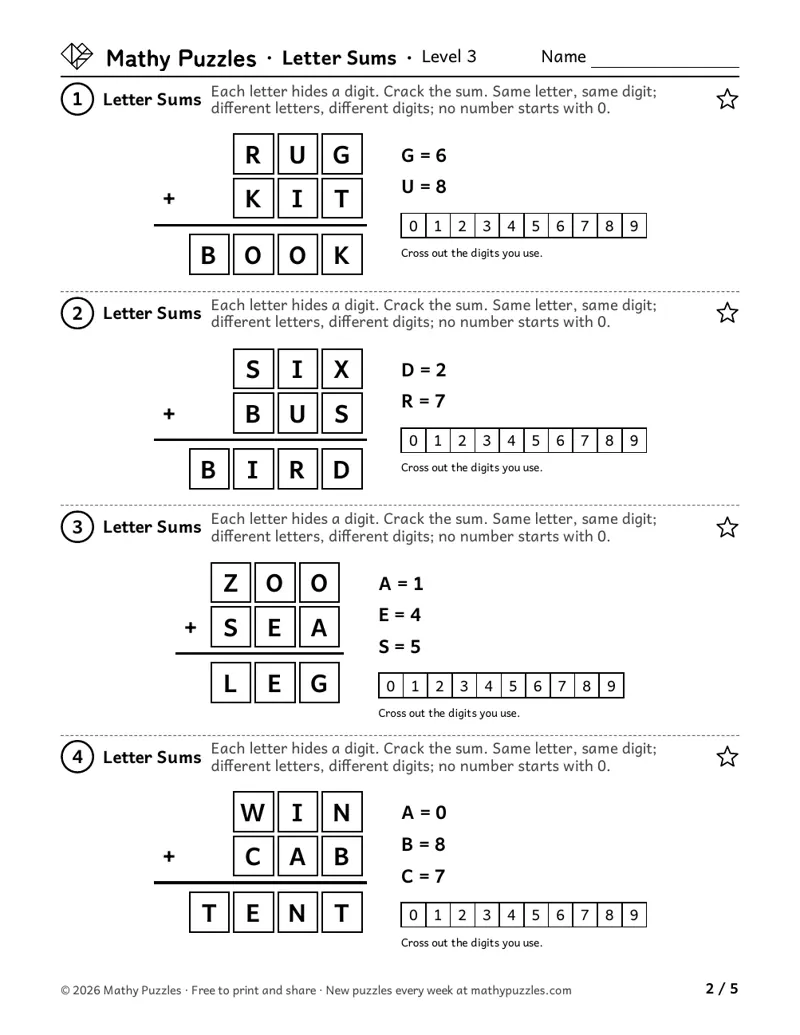 Level 3: a page from the free set
Before starting
- Level 3: add and subtract 3-digit numbers with regrouping (carrying)
- Level 4: add and subtract numbers up to 5 digits
What you need
Scrap paper with a 0 to 9 strip to cross off used digits, and a pencil with an eraser.
Free puzzles to print
Each set: a Learn sheet with a worked example, 10 puzzles from easiest to hardest, and the answers.
Level 3
Ages 8–10 · Grades 3–4
First, two 3-letter words with two or three letters given. Then one or two given. Then a 3-letter word added to itself, with at most one letter given. The hardest add a 4-letter word to itself, or subtract 3- and 4-letter words, with at most two letters given.
On the sheet: “Each letter hides a digit. Crack the sum. Same letter, same digit; different letters, different digits; no number starts with 0.”
Print Level 3 (Letter)Other paper size: A4Level 4
Ages 10–12 · Grades 5–6
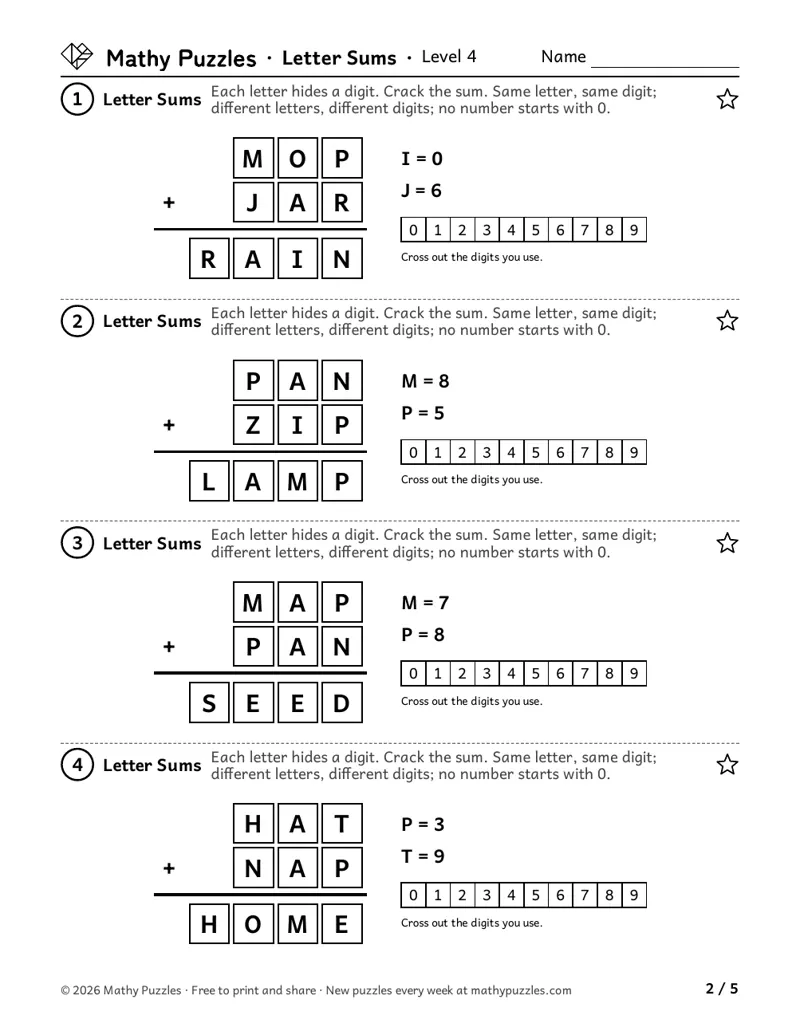
First, two 3-letter words with two letters given. Then a 3- or 4-letter word added to itself. Then two different 4- or 5-letter words, or a subtraction of them. The hardest add three words together or subtract 4- or 5-letter words. Some Level 4 puzzles need one "try both cases" check.
On the sheet: “Each letter hides a digit. Crack the sum. Same letter, same digit; different letters, different digits; no number starts with 0.”
Print Level 4 (Letter)Other paper size: A4
How it works
Each puzzle is an addition or subtraction written in words, such as a word added to itself. Each letter hides a digit. The same letter is always the same digit, different letters are different digits, and no number starts with 0. Some letters may be given. The child cracks the digit for every letter, column by column.
How to play
- Write a 0 to 9 strip and cross off any digits already given.
- When two words are added and the answer has an extra letter at the front, that letter is 1.
- Work from the ones column, writing each carry above the next column.
- Same letter, same digit. If two letters would need the same digit, go back and try another.
When it gets hard
Giving two different letters the same digit.
Hint: Cross each digit off the strip as soon as you use it.
Forgetting the carry into the next column.
Hint: Write a small 1 above the next column whenever a column makes 10 or more.
Starting a word with 0.
Hint: The first letter of any word can't be 0.
Tip for grown-ups: Let your child keep a written list of "letter = digit" as they go, and ask why each one must be true. The reasons are the real practice.
Frequently asked questions
- Is this a good extension for fast finishers in Grade 4?
- Yes. It practices column addition with carrying, but every digit has to be argued for. Level 3 suits Grades 3–4; Level 4 adds longer words, subtraction and three-word sums.
- Are the words safe for children?
- They are. The words come from a reviewed word list, and every printed sum passes a check for unsuitable words.
Questions about printing, levels, answers or membership: see all questions.
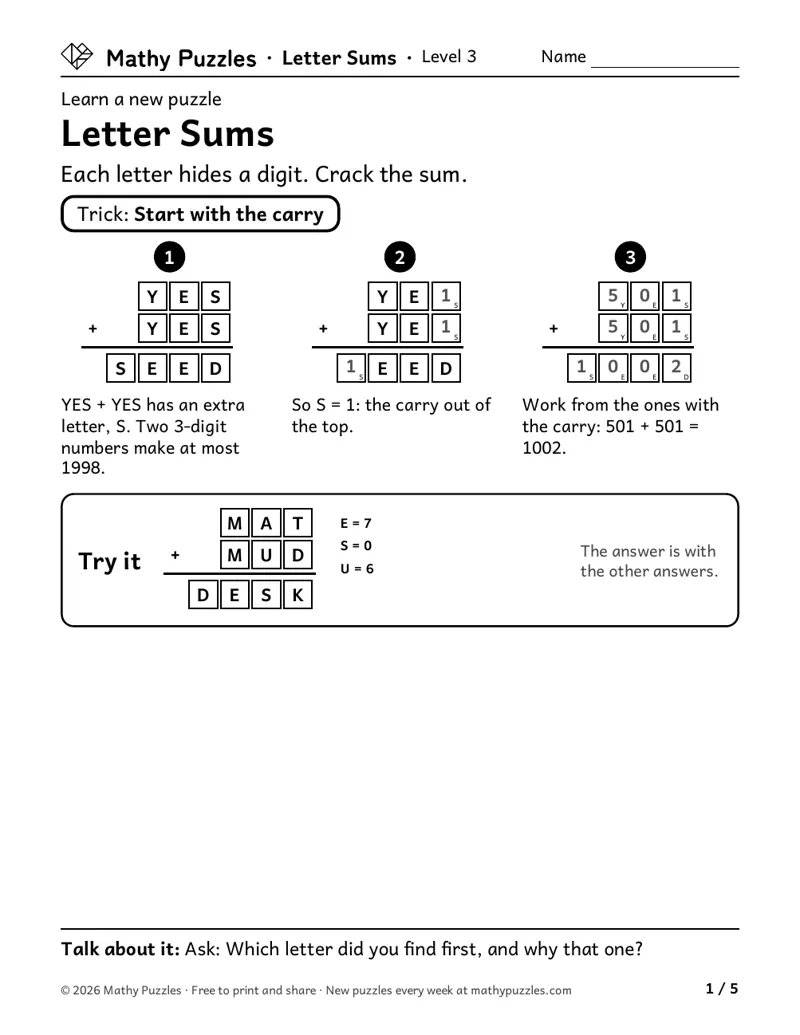
Worked example
From the Level 3 Learn sheet
- A 3-letter word added to itself makes a 4-letter word, so the answer has an extra letter at the front.
- Two 3-digit numbers make at most 999 + 999 = 1,998. So the extra letter is 1: the carry out of the top column.
- Now start at the ones. Double the ones digit: the answer's last letter is the ones digit of that total, and any carry goes to the next column.
- Work left one column at a time, adding the carry, and cross off each digit as you use it.
A question to ask: “Which letter did you find first, and why that one?”
Free every Sunday A mixed bag of 20 new puzzles, all four levels. Get them by email
The thinking it works on
Place value and the carry
Knows how much a column can carry into the next.
Herzog and Fritz (2026) followed 195 third and fourth graders through a school year and found that children took very different paths in understanding place value. Source
Working out what must be true
Finds a digit that must be true, then uses it to find the next.
Datsogianni and colleagues (2020) studied students in grades 2, 4 and 6. They drew if-then conclusions about math ideas about as well as about everyday ones, with skill growing by grade. Source
Holding several rules at once
Keeps three rules in mind while working.
A study tested 325 people aged 4 to 13, and adults. Even the youngest could hold a rule in mind and hold back a habit, as long as the rules stayed the same. Switching between rules kept maturing past age 13. Source
Even and odd
Notices that a doubled number always ends in an even digit.
Berch and colleagues (1999) found that from fourth grade on, children knew straight away whether a digit was odd or even, rather than working it out. Source
Testing cases
Tries both possible digits and keeps the one that works.
Where is this thinking used?
- Checking work: Finding the one wrong digit in a long addition by following the carries.
- Codes: Cracking a letter code by starting with the letters you are sure of.
- Mystery stories: Ruling out possibilities until what is left fits every fact.
- Data entry: Tracking down which number in a list was typed wrong.
For teachers
Curriculum areas
- Common Core
- Number and operations in base ten: adding and subtracting within 1,000 (Grade 3) and multi-digit numbers with the standard method (Grade 4)
- NCERT
- Maths Mela: "The Missing Digits" in The Cleanest Village (Class 4), adding and subtracting large numbers (Class 5)
- National Curriculum (England)
- Number – addition and subtraction: columnar addition and subtraction (Years 3–5)
- Cambridge Primary Mathematics
- Number: written addition and subtraction; place value (Stages 3–4)
Math practices: see the box below.
Math practices this puzzle uses
- Not used: MP1 Make sense of problems and persevere in solving them
- Not used: MP2 Reason abstractly and quantitatively
- Uses: MP3 Construct viable arguments and critique the reasoning of others
- Not used: MP4 Model with mathematics
- Not used: MP5 Use appropriate tools strategically
- Not used: MP6 Attend to precision
- Uses: MP7 Look for and make use of structure
- Not used: MP8 Look for and express regularity in repeated reasoning
From the Common Core Standards for Mathematical Practice.
More Letter Sums puzzles for members
Members get at least 5 more worksheets at each difficulty for every puzzle, 80 new puzzles every Sunday, and the whole archive. $39 a year or $25 for 6 months.
See membershipNot ready yet?
One email, all four levels: 20 puzzles, 5 for each level.
For grown-ups (18+). One email every Sunday with the puzzles and the odd note about membership; unsubscribe any time. We never ask about your child. How we use your email