
Mini Queens
Every queen on the board claims its whole row, its column and both diagonals, the way a cat claims a sofa. Cross out what each queen claims, and any row, column or region with one free square left must hold the next queen.
Free sets by level, ages 8–12:
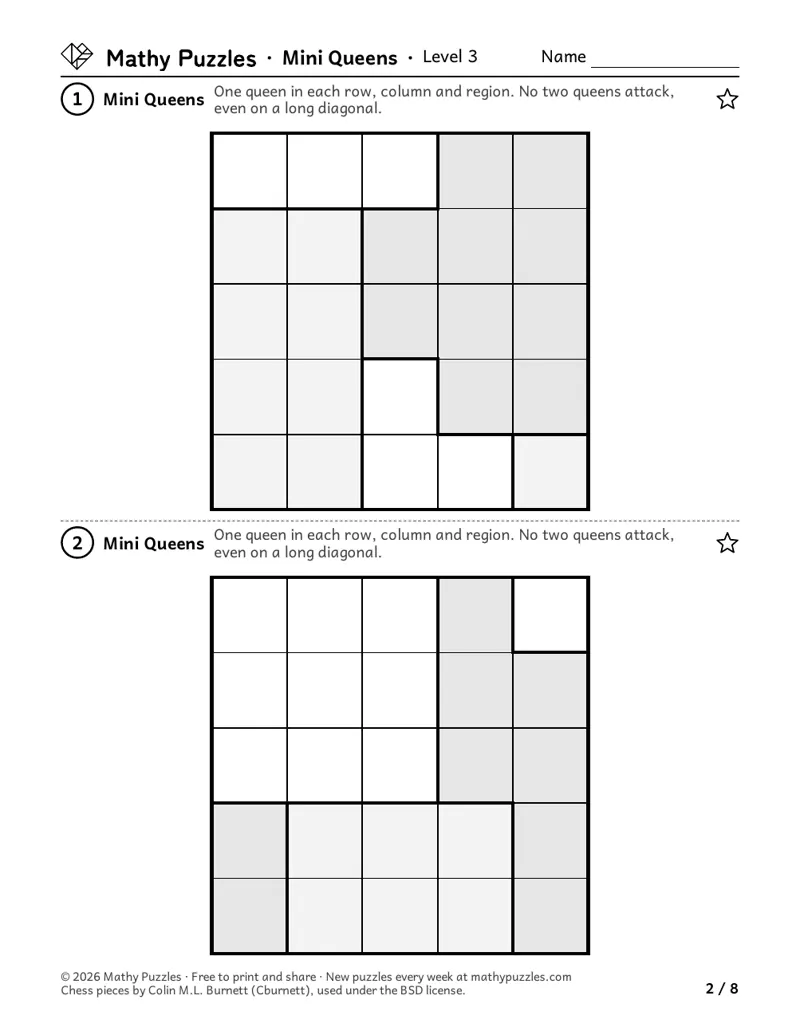 Level 3: a page from the free set
Before starting
- Know that a queen moves along rows, columns and diagonals (the rule is on the sheet; no other chess needed)
- Tell rows, columns and diagonals apart
- Level 4: comfortable with the Level 3 boards
Free puzzles to print
Each set: a Learn sheet with a worked example, 10 puzzles from easiest to hardest, and the answers.
Level 3
Ages 8–10 · Grades 3–4
The easiest puzzles use a 5 × 5 board, then 7 × 7.
The hardest puzzles: 7 × 7 boards that need a look-ahead. A queen on some square would leave a region with no free square, so that square is out.
On the sheet: “One queen in each row, column and region. No two queens attack, even on a long diagonal.”
Print Level 3 (Letter)Other paper size: A4Level 4
Ages 10–12 · Grades 5–6
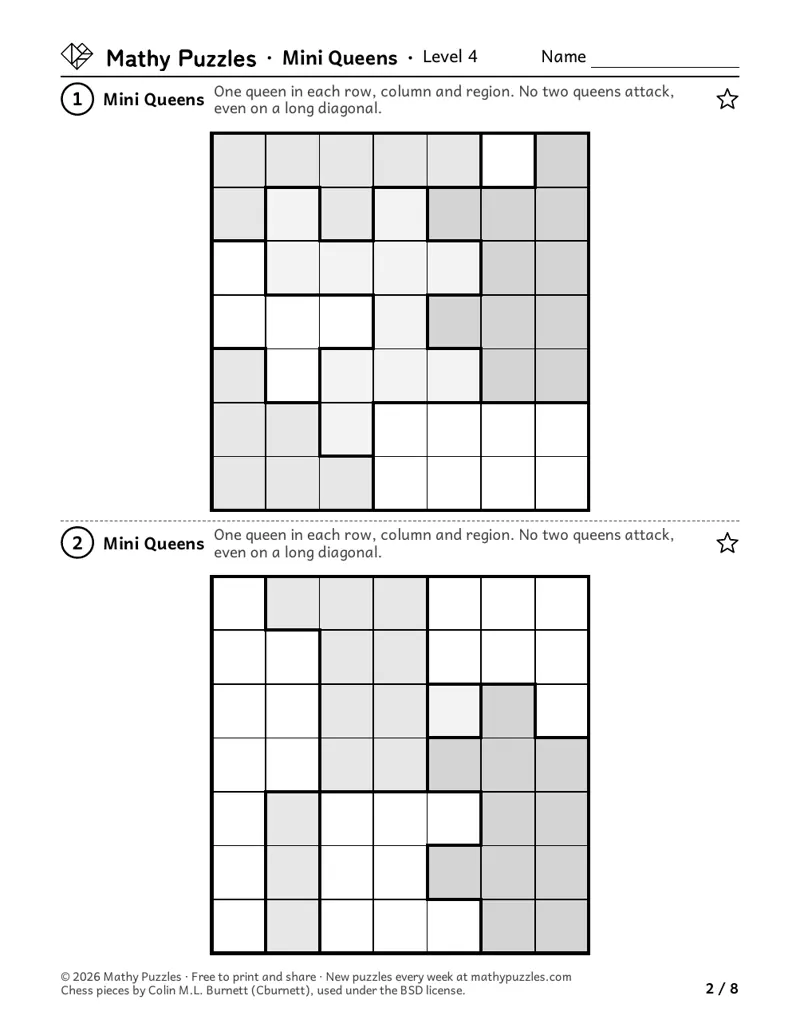
Starts with 7 × 7 boards that need the look-ahead, then moves to the full 8 × 8 board.
The hardest puzzles: 8 × 8 boards that need one what-if test: suppose a queen goes here, follow it, and see if it breaks.
On the sheet: “One queen in each row, column and region. No two queens attack, even on a long diagonal.”
Print Level 4 (Letter)Other paper size: A4
How it works
Each puzzle is a square board cut into outlined regions. The child places one queen in every row, every column and every region, so that no two queens attack each other. As in chess, a queen attacks along its whole row, column and both diagonals, however far, so no two queens may share a long diagonal either.
How to play
- Look for a region, row or column with only one square. Put a queen there.
- X every square that queen attacks: its row, column, region and diagonals, to the edge.
- Look again for a row, column or region with one free square left. That square gets the next queen.
- Keep going until every row, column and region has one queen.
When it gets hard
Only crossing out the squares touching a queen.
Hint: A queen attacks all the way along its diagonals. Follow each one to the edge.
Forgetting to X the rest of a queen's region.
Hint: One queen per region, so the whole region is done once it has its queen.
Guessing a queen when nothing is forced.
Hint: Look for a region that fits inside one row or column. It tells you something about that whole line.
Tip for grown-ups: Light Xs and dark queens keep the board easy to read. When two queens clash, go back to the last forced step together rather than erasing everything.
Frequently asked questions
- Is this like the queen puzzles we've seen online?
- It is close, with one difference. Some versions only stop queens from touching. Here a queen attacks the whole way along its diagonals, as in real chess, so look further.
- Why is there no 6 × 6 board?
- A plain 6 × 6 board allows only a few queen patterns, all the same shape turned or flipped, so every puzzle would end the same way. The 5 × 5, 7 × 7 and 8 × 8 boards give real variety.
Questions about printing, levels, answers or membership: see all questions.
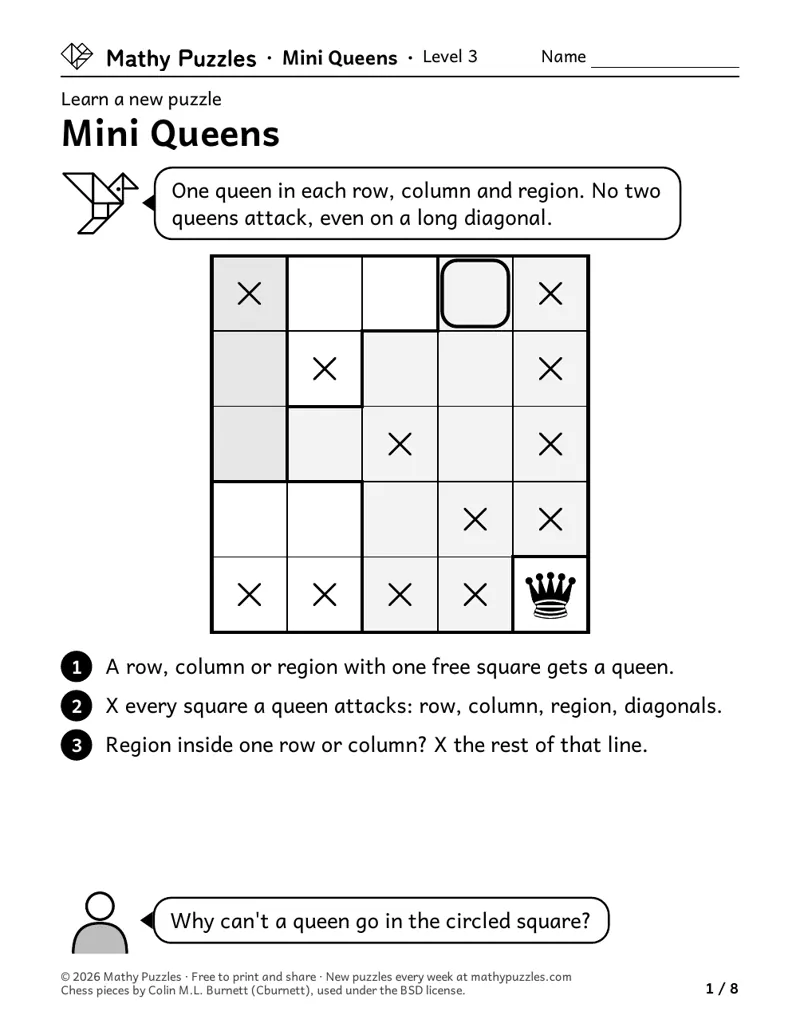
Worked example
From the Level 3 Learn sheet
- A row, column or region with one free square gets a queen.
- X every square that queen attacks: its row, its column, its region and both diagonals, all the way.
- A region that sits inside one row or column? X the rest of that line.
A question to ask: “Why can't a queen go in the circled square?”
Free every Sunday A mixed bag of 20 new puzzles, all four levels. Get them by email
The thinking it works on
Reasoning by elimination
Crosses out every square a queen rules out.
Galotti, Komatsu and Voelz (1997) gave children in kindergarten and grades 2, 4 and 6 problems whose answers either had to follow or were only likely. By fourth grade, children rated the answers that had to follow as more certain and gave them faster. Source
Spotting the only option
Finds the row, column or region with one free square.
Seeing long diagonals
Follows a diagonal across the whole board.
Reasoning about groups
Uses a region that fits inside one line.
Looking ahead
Rules out a square whose queen would block a region.
Luciana and colleagues (2009) found that accuracy on a tower puzzle that rewards looking ahead kept rising from age 9 until about 15 to 17. Source
Testing a what-if
Supposes a queen, follows it, and backs out if it breaks.
Where is this thinking used?
- Seating plans: Placing people so no two who clash share a table or a row.
- School schedules: Fitting one class per room per period, with no overlaps.
- Garden planting: Spacing plants so none crowds another in any direction.
- Placing cameras or lights: Covering every area while keeping lines from overlapping.
For teachers
Curriculum areas
- Common Core
- No direct curricular match.
- NCERT
- No direct curricular match.
- National Curriculum (England)
- No direct curricular match.
- Cambridge Primary Mathematics
- No direct curricular match.
Math practices: see the box below.
Math practices this puzzle uses
- Uses: MP1 Make sense of problems and persevere in solving them
- Not used: MP2 Reason abstractly and quantitatively
- Not used: MP3 Construct viable arguments and critique the reasoning of others
- Not used: MP4 Model with mathematics
- Not used: MP5 Use appropriate tools strategically
- Not used: MP6 Attend to precision
- Uses: MP7 Look for and make use of structure
- Not used: MP8 Look for and express regularity in repeated reasoning
From the Common Core Standards for Mathematical Practice.
More Mini Queens puzzles for members
Members get at least 5 more worksheets at each difficulty for every puzzle, 80 new puzzles every Sunday, and the whole archive. $39 a year or $25 for 6 months.
See membershipNot ready yet?
One email, all four levels: 20 puzzles, 5 for each level.
For grown-ups (18+). One email every Sunday with the puzzles and the odd note about membership; unsubscribe any time. We never ask about your child. How we use your email