
Knight Paths
A chess knight moves in an L, so two squares side by side can be three moves apart. Getting a knight to the star is like crossing a stream on stepping stones: count jumps, not distance, and search outward one jump at a time.
Free sets by level, ages 8–10:
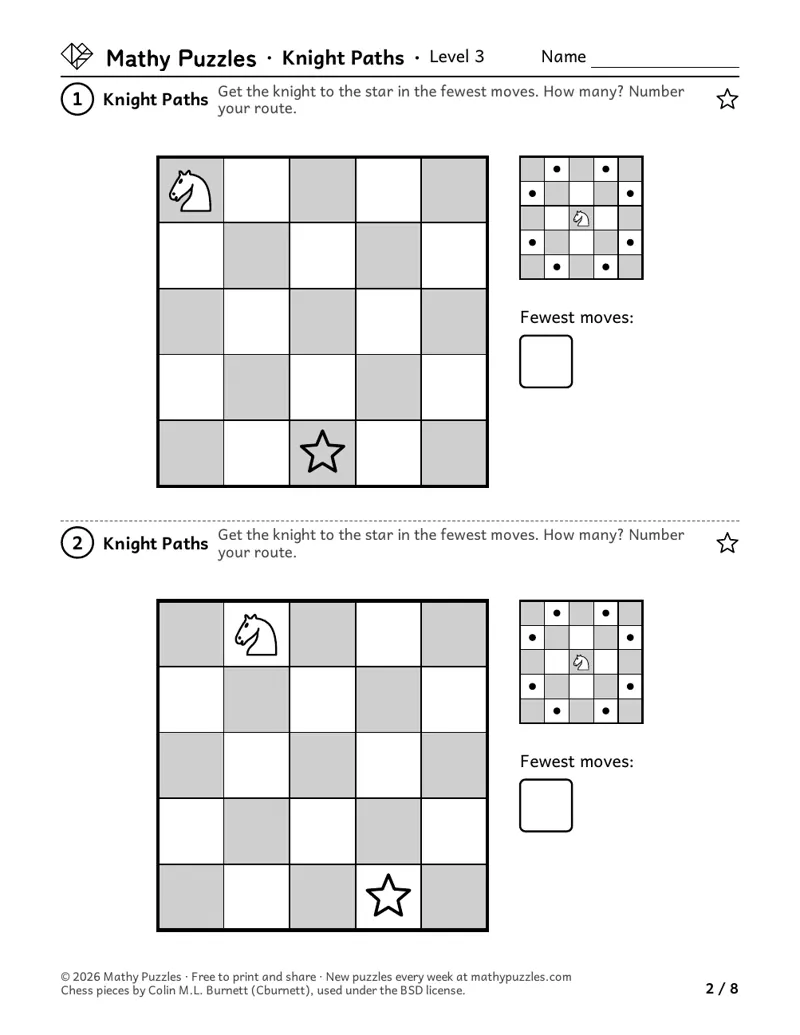 Level 3: a page from the free set
Before starting
- Know the knight's move: two squares, then one to the side (a card is on the sheet)
- For the 8 × 8 boards: know how the rook, bishop and knight attack
- Count to 4 and number squares in order
What you need
Scrap paper for trying routes before numbering the real one, and a pencil.
Free puzzles to print
Each set: a Learn sheet with a worked example, 10 puzzles from easiest to hardest, and the answers.
Level 3
Ages 8–10 · Grades 3–4
The easiest puzzles: a 5 × 5 board with nothing in the way, 2 or 3 moves.
Next: a 6 × 6 board with 3 to 5 rocks, 3 or 4 moves.
Then a full 8 × 8 board with one or two black pieces: X every square they attack first, then plan a 4-move route.
The hardest puzzles: a 6 × 6 board and 4 moves, with rocks placed on the other short routes, so the child has to test each route.
On the sheet: “Get the knight to the star in the fewest moves. How many? Number your route.”
Print Level 3 (Letter)Other paper size: A4
How it works
Each puzzle is a board with a knight and a star. The child gets the knight to the star in as few moves as possible, writes how many moves, and numbers each square it lands on. Some boards have rocks, which the knight may jump over but never land on. On the full 8 × 8 boards, black pieces stand guard, and the knight may not land on them or on any square they attack.
How to play
- On an 8 × 8 board, first X every square a black piece attacks. The knight may not land on those squares or on the black pieces.
- From the knight, find every square it can jump to. Is the star one of them?
- If not, think backward: which squares can jump onto the star? Try to link the two.
- When you have a route, number the squares 1, 2, 3 and write how many moves.
When it gets hard
Counting squares crossed instead of jumps.
Hint: One knight jump is one move, however far it looks.
Landing on a rock or a guarded square.
Hint: Jumping over is fine. Landing is not. Check each numbered square.
Stopping at the first route found.
Hint: Ask: is there a way with one fewer jump?
Tip for grown-ups: When a route won't come, ask which squares can jump onto the star. Working from both ends often joins up in the middle. Trying a route on scrap paper first keeps the sheet clean for the real one.
Frequently asked questions
- My child's route is different from the answer shown. Is it wrong?
- Not if it uses the same number of moves and keeps the rules. Any shortest route that keeps the rules is right; the answers show one example.
- Does a class need to know chess for these?
- Only the knight's move for most puzzles, and a card on the sheet shows it. The 8 × 8 boards add black rooks, bishops and knights, so the child also needs to know how a rook and a bishop move. Save those for children who know them.
- Is this the same as a knight's tour?
- No. A knight's tour visits every square once. Here the knight only has to reach the star, in as few moves as possible.
Questions about printing, levels, answers or membership: see all questions.
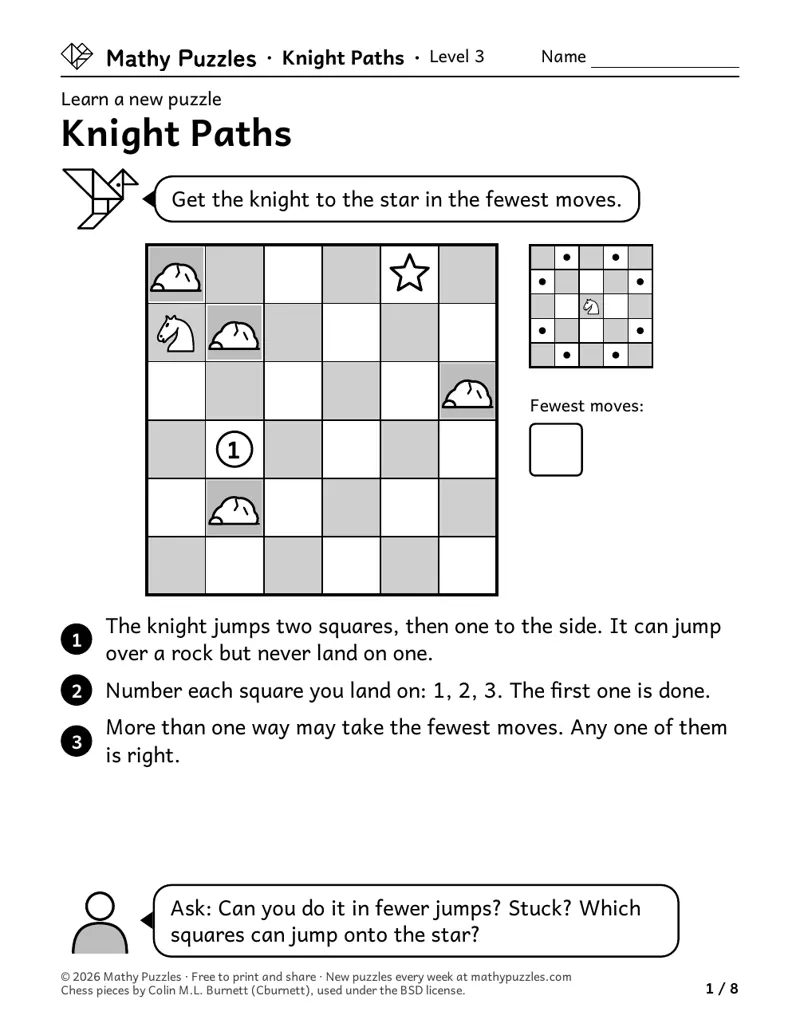
Worked example
From the Level 3 Learn sheet
- The knight jumps two squares, then one to the side. It can jump over a rock but never land on one.
- Number each square you land on: 1, 2, 3.
- More than one route may take the fewest moves. Any one of them is right.
A question to ask: “Can you do it in fewer jumps?”
Free every Sunday A mixed bag of 20 new puzzles, all four levels. Get them by email
The thinking it works on
Planning a route
Links the knight to the star in as few jumps as possible.
Asato, Sweeney and Luna (2006) tested 100 people aged 8 to 30 on a tower puzzle that needs a planned sequence of moves. Planning was still maturing through adolescence, and holding back a hasty move was most closely tied to it. Source
Working backward from the goal
Asks which squares can reach the star in one jump.
Checking for something better
Looks for a route with one fewer jump.
Keeping rules in mind
Never lands on a rock, a black piece or a guarded square.
Alloway, Gathercole and Pickering (2006) tested children aged 4 to 11. The parts of working memory that store and process verbal and visual-spatial information were all present by age 4, and kept the same structure through the primary years. Source
Seeing an unusual move pattern
Pictures the L-shaped jump without moving a piece.
Kosslyn and colleagues (1990) compared 5-, 8- and 14-year-olds and adults on mental imagery. Younger children were relatively poor at building, scanning and turning a picture in the mind, but relatively good at holding one steady. Source
Where is this thinking used?
- Trip planning: Finding the route with the fewest changes of bus or train.
- Video games and mazes: Getting to a goal while avoiding no-go spots.
- Delivery routes: Finding a short way between stops when some roads are closed.
- Board games: Counting how many turns a piece needs to reach a square.
For teachers
Curriculum areas
- Common Core
- No direct curricular match.
- NCERT
- No direct curricular match.
- National Curriculum (England)
- No direct curricular match.
- Cambridge Primary Mathematics
- No direct curricular match.
Math practices: see the box below.
Math practices this puzzle uses
- Uses: MP1 Make sense of problems and persevere in solving them
- Not used: MP2 Reason abstractly and quantitatively
- Not used: MP3 Construct viable arguments and critique the reasoning of others
- Not used: MP4 Model with mathematics
- Not used: MP5 Use appropriate tools strategically
- Not used: MP6 Attend to precision
- Uses: MP7 Look for and make use of structure
- Not used: MP8 Look for and express regularity in repeated reasoning
From the Common Core Standards for Mathematical Practice.
More Knight Paths puzzles for members
Members get at least 5 more worksheets at each difficulty for every puzzle, 80 new puzzles every Sunday, and the whole archive. $39 a year or $25 for 6 months.
See membershipNot ready yet?
One email, all four levels: 20 puzzles, 5 for each level.
For grown-ups (18+). One email every Sunday with the puzzles and the odd note about membership; unsubscribe any time. We never ask about your child. How we use your email