
Killer Sudoku
Here is a fact that does a lot of work: the numbers 1 to 9 always add to 45 (and 1 to 6 add to 21). So when you know what most of a row adds to, the rest is one subtraction away, and few or no numbers need to be printed.
Free sets by level, ages 10–12:
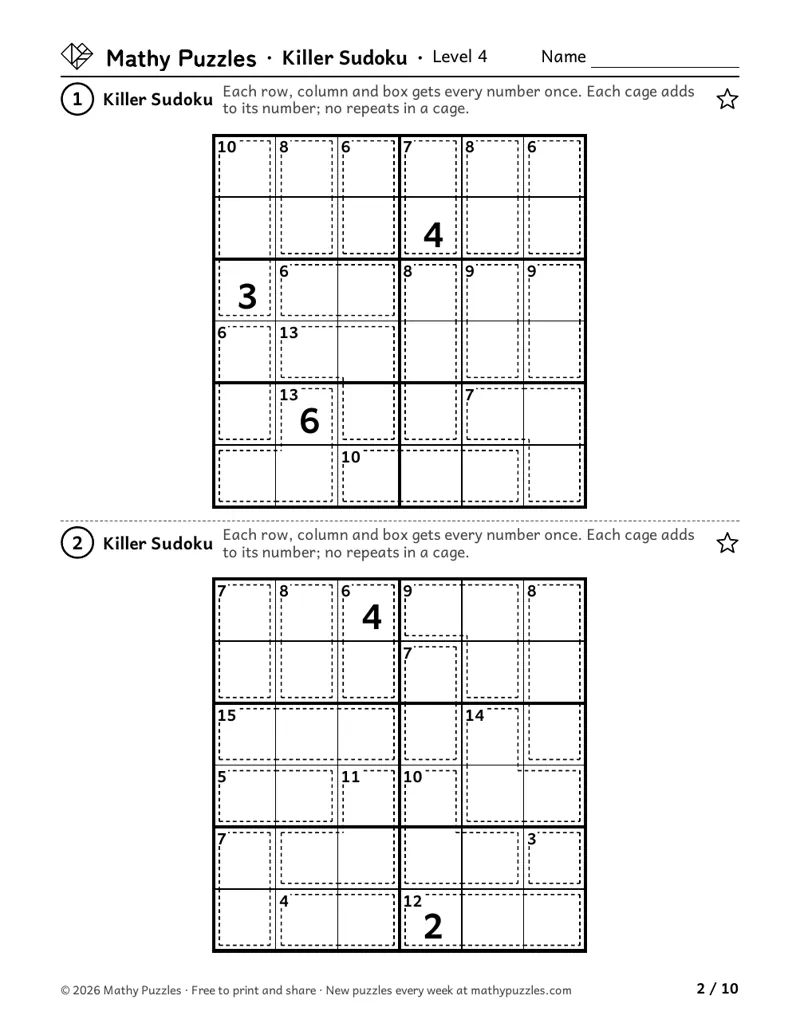 Level 4: a page from the free set
Before starting
- Has solved 6 × 6 and 9 × 9 sudoku
- Adds and subtracts within 50 in your head, and bigger totals (90, 135) on paper
- Knows a few one-way totals: 3 in two squares is 1 + 2, 17 in two squares is 8 + 9
What you need
Scrap paper for adding up cages, and a pencil with an eraser.
Free puzzles to print
Each set: a Learn sheet with a worked example, 10 puzzles from easiest to hardest, and the answers.
Level 4
Ages 10–12 · Grades 5–6
First, 6 × 6 grids with small cages and up to four printed numbers. Then no printed numbers, using the fact that a row of 1 to 6 makes 21. Then 9 × 9 grids, where a row, column or box makes 45. The hardest puzzles have cages of up to 4 squares and need a bigger move. That can be a cage that claims a number for its row, or a pair of squares that share two numbers. It can also be the total of two or three rows at once (90 or 135).
On the sheet: “Each row, column and box gets every number once. Each cage adds to its number; no repeats in a cage.”
Print Level 4 (Letter)Other paper size: A4
How it works
Each puzzle is a sudoku grid with dashed outlines called cages. Each row, column and box uses every number once. Each cage has a small total: its numbers add to that total and none repeats inside it. Few or no numbers are printed, so the cages are the clues.
How to play
- Fill any one-square cage: its number is its total.
- Find cages that can be made only one way, such as 3 in two squares (1 + 2).
- Use the row total (21 or 45): add the cages inside a row, column or box and find the square left over.
- Use the sudoku rule too: each number once in every row, column and box.
When it gets hard
Repeating a number inside a cage that crosses two boxes.
Hint: No number repeats inside a cage, even when the cage spans a box border.
Counting a cage that sticks out of the row.
Hint: Only add cages that sit fully inside the row, column or box. Mark them first.
Starting on the 9 × 9 grids.
Hint: Begin with the 6 × 6 ones; the moves are the same and the sums are smaller.
Tip for grown-ups: Ask "What does the whole row make?" whenever your child is stuck. That one question opens most of these grids. Adding up cages on scrap paper keeps the grid clear.
Frequently asked questions
- How is this different from Sum Cages?
- Sum Cages are small grids with no boxes, and cages can use all four operations. These grids have sudoku boxes, cages that only add, no repeats inside a cage, and few or no printed numbers. The row total of 45 is the key move here.
- My child is good at sudoku but finds this hard.
- That's normal; the cages are a new kind of clue. Start with the 6 × 6 grids (the easiest print a few numbers) and practice the row total of 21 before moving to 9 × 9.
- Can I use this as an enrichment task for grades 5 and 6?
- Yes. One 6 × 6 grid makes a good class task, and the row-total move is a neat talking point about using a whole to find a part.
Questions about printing, levels, answers or membership: see all questions.
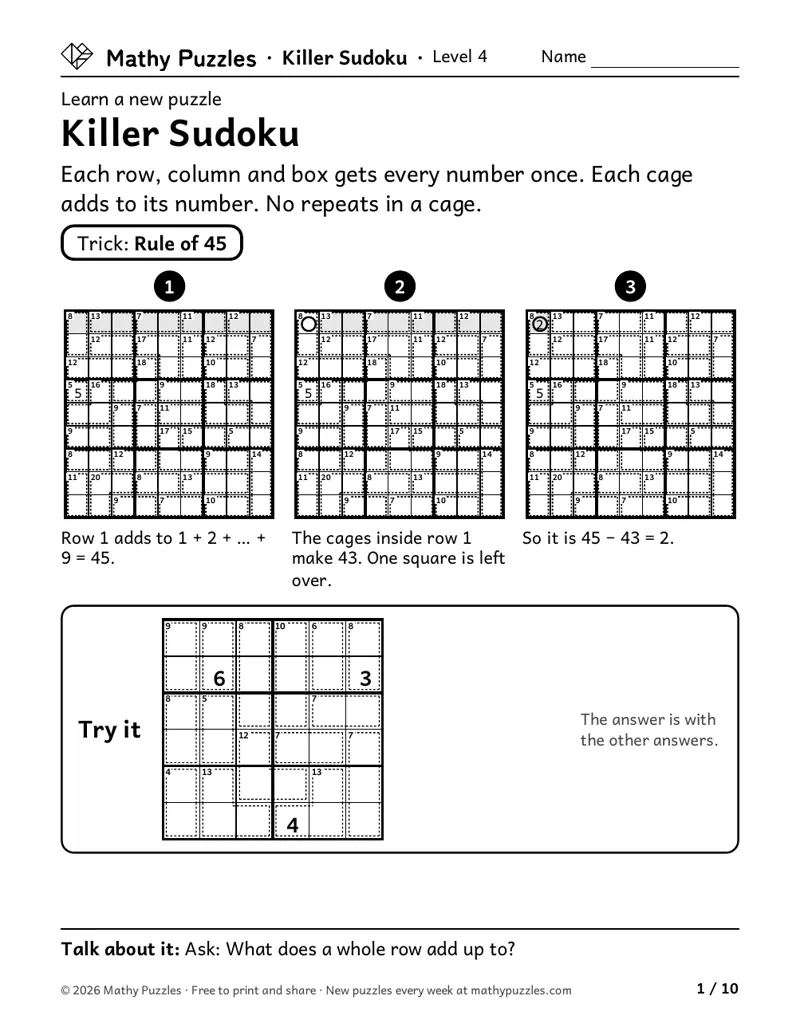
Worked example
From the Level 4 Learn sheet
- A whole row, column or box of 1 to 9 adds to 45.
- Add up the cages that sit fully inside it. One square is left over.
- That square is 45 minus the cages' total.
A question to ask: “What does a whole row add up to?”
Free every Sunday A mixed bag of 20 new puzzles, all four levels. Get them by email
The thinking it works on
Finding a missing part from the whole
Finds a missing part from a known whole.
Mental arithmetic
Adds and subtracts cage totals quickly.
Lemaire and Callies (2009) found that children in grades 3, 5 and 7 added two-digit numbers mostly by splitting both numbers into tens and ones. The method chosen depended on their age and on how the problem was laid out. Source
Listing every set a cage could hold
Writes every set of different numbers a cage could hold.
English (1993) found that 7- to 12-year-olds working on 'every possible outfit' problems carried the method that keeps one item fixed over from two-part to harder three-part problems. Source
Reasoning with several rules
Uses cages, rows, columns and boxes together.
Cepeda, Kramer and Gonzalez de Sather (2001) tested 152 people aged 7 to 82. Switching between two tasks cost the most time for young children and older adults. Source
Keeping track of options
Holds pencil notes across a large grid and updates them.
Luna and colleagues (2004) measured 245 people aged 8 to 30. Spatial working memory, holding positions in mind while acting, rose steeply through late childhood. It did not reach adult levels until about 19. Source
Where is this thinking used?
- Card games with fixed points: When each round's points always add to the same total, the last score is what's left.
- Taking attendance: The class total minus the children counted gives the number away.
- Inventory counts: Finding a missing amount from the total and the parts you've counted.
- Puzzle and strategy games: Several rules at once decide the only safe move.
For teachers
Curriculum areas
- Common Core
- Operations and algebraic thinking: sums of one-digit numbers known from memory (Grade 2), used many times, with totals to 45 and a known total to find a missing part
- NCERT
- No direct curricular match.
- National Curriculum (England)
- Number: addition facts to 20 and adding three one-digit numbers (Year 2); Algebra: pairs of numbers that make an equation true (Year 6)
- Cambridge Primary Mathematics
- Number: adding whole numbers, used many times (Stage 3)
Math practices: see the box below.
Math practices this puzzle uses
- Uses: MP1 Make sense of problems and persevere in solving them
- Not used: MP2 Reason abstractly and quantitatively
- Not used: MP3 Construct viable arguments and critique the reasoning of others
- Not used: MP4 Model with mathematics
- Not used: MP5 Use appropriate tools strategically
- Not used: MP6 Attend to precision
- Uses: MP7 Look for and make use of structure
- Not used: MP8 Look for and express regularity in repeated reasoning
From the Common Core Standards for Mathematical Practice.
More Killer Sudoku puzzles for members
Members get at least 5 more worksheets at each difficulty for every puzzle, 80 new puzzles every Sunday, and the whole archive. $39 a year or $25 for 6 months.
See membershipNot ready yet?
One email, all four levels: 20 puzzles, 5 for each level.
For grown-ups (18+). One email every Sunday with the puzzles and the odd note about membership; unsubscribe any time. We never ask about your child. How we use your email