
Greater-Than Grid
Hearing that one cousin is older than another doesn't tell you anyone's age, but it does rule some ages out. The signs in this grid work the same way, and a chain of them pushes numbers higher or lower.
Free sets by level, ages 6–12:
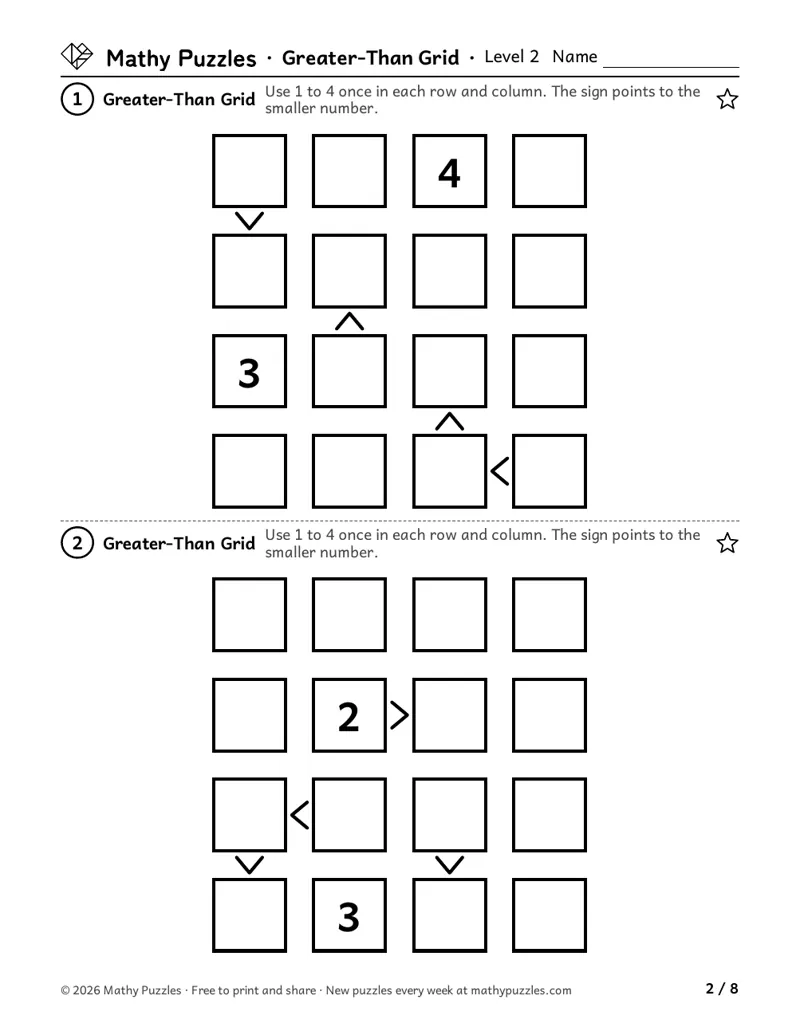 Level 2: a page from the free set
Before starting
- Level 2: know which of two numbers from 1 to 5 is bigger
- Know the signs < and > (or learn them here)
- Level 3: comfortable with the Level 2 grids
- Level 4: comfortable with the Level 3 grids and with keeping small notes in squares
Free puzzles to print
Each set: a Learn sheet with a worked example, 10 puzzles from easiest to hardest, and the answers.
Level 2
Ages 6–8 · Grades 1–2
4 × 4 grids; the easiest puzzles print two numbers, then one or two, then one or none, so the signs do more of the work. Only the signs needed to settle the grid are shown.
On the sheet: “Use 1 to 4 once in each row and column. The sign points to the smaller number.”
Print Level 2 (Letter)Other paper size: A4Level 3
Ages 8–10 · Grades 3–4
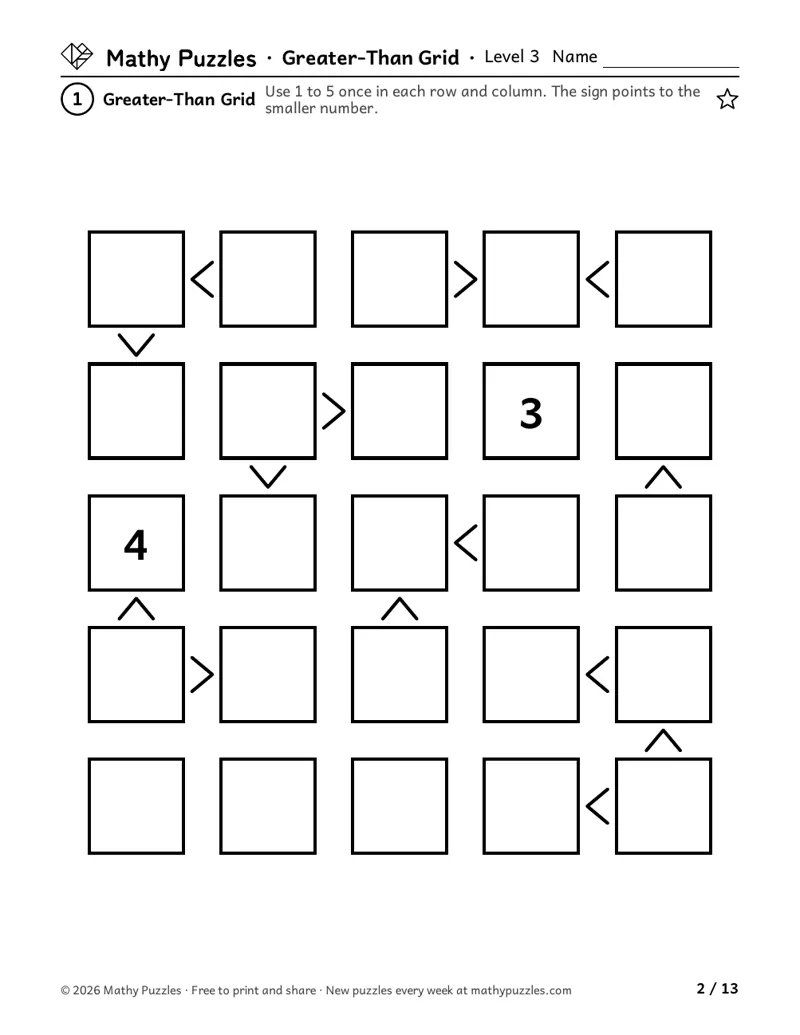
5 × 5 grids. They go from two printed numbers and plenty of signs down to no numbers and 10 signs or fewer, with a chain of four squares linked by signs.
On the sheet: “Use 1 to 5 once in each row and column. The sign points to the smaller number.”
Print Level 3 (Letter)Other paper size: A4Level 4
Ages 10–12 · Grades 5–6
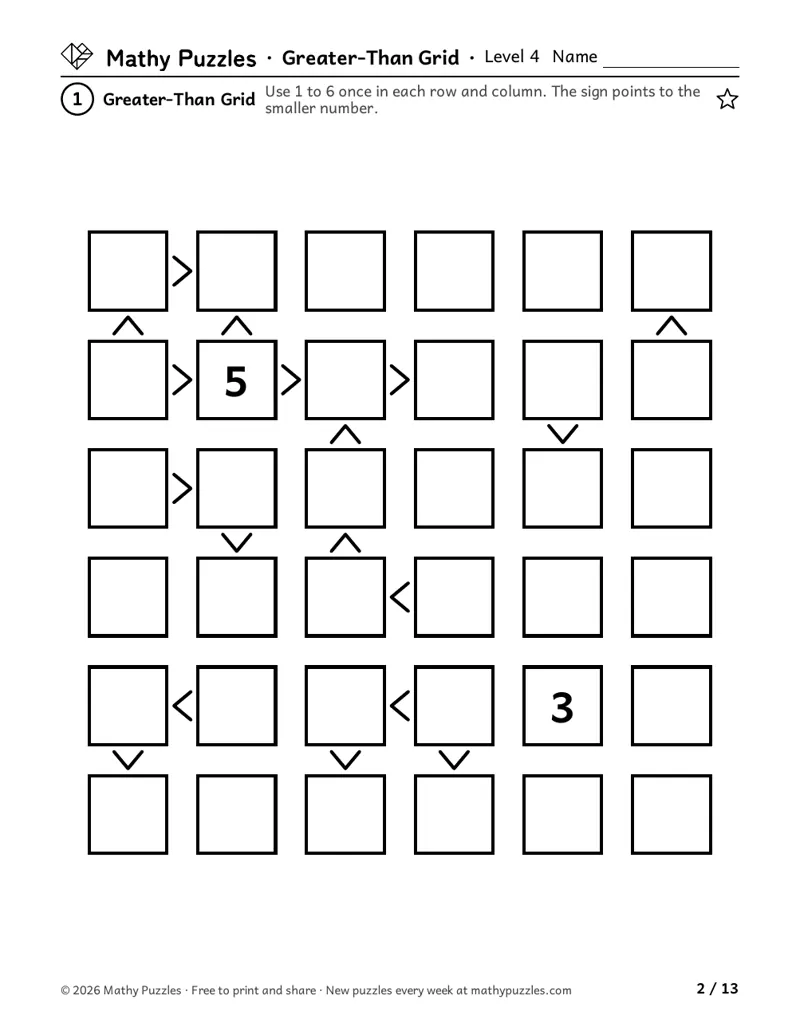
6 × 6 grids, one to a page. The easiest print two numbers and many signs, then one number, then none. The hardest have no numbers and fewer signs. They need a hidden pair: two numbers that can only go in the same two squares of a row or column. Many also use a chain of five squares, each smaller than the next.
On the sheet: “Use 1 to 6 once in each row and column. The sign points to the smaller number.”
Print Level 4 (Letter)Other paper size: A4
How it works
Each puzzle is a square grid with small signs between some neighboring squares. Each row and column uses every number once (1 to 4 at Level 2, 1 to 5 at Level 3, 1 to 6 at Level 4). Each sign is a less-than or greater-than mark, and its point faces the smaller number. A few squares may have a number printed.
How to play
- Find each sign. The point faces the smaller square; the open side faces the bigger one.
- Write small notes: the smaller side can't be the biggest number, and the bigger side can't be 1.
- Follow chains: if three squares in a row of signs each get smaller, the top one is at least 3.
- Fill a square when only one number fits, then check its row and column.
- In bigger grids, look for two numbers that can only go in the same two squares of a row. Those two squares are taken, so cross the other numbers out of them.
When it gets hard
Reading a sign backward.
Hint: The point is the small end. The open side faces the bigger number, like a mouth opening toward more.
Missing the up and down signs between rows.
Hint: Signs can sit between squares above and below too. Turn the page to read them if that helps.
Only using signs and forgetting the once-per-row rule.
Hint: After each number, cross it off the rest of its row and column.
Level 4: guessing when the notes stop changing.
Hint: Look along each row and column for two numbers that fit only the same two squares. That pair often opens the grid.
Tip for grown-ups: Have your child say each sign out loud as a sentence ("this square is smaller than that one") for the first few grids. It catches backward readings early.
Frequently asked questions
- My child keeps mixing up < and >.
- That's common at 6 to 8. Ask which end is small and pointy: that side is the smaller number. Saying each sign as a sentence for the first few grids keeps the direction clear.
- Does this fit what grade 1 learns about comparing numbers?
- It uses the same signs. Grade 1 compares two-digit numbers with <, = and >; these grids practice reading the signs with small numbers and adding logic on top.
- Why are so few numbers printed?
- The signs are the clues. As puzzles get harder, fewer numbers are printed and the signs do the work; the hardest Level 3 and 4 grids print none.
Questions about printing, levels, answers or membership: see all questions.
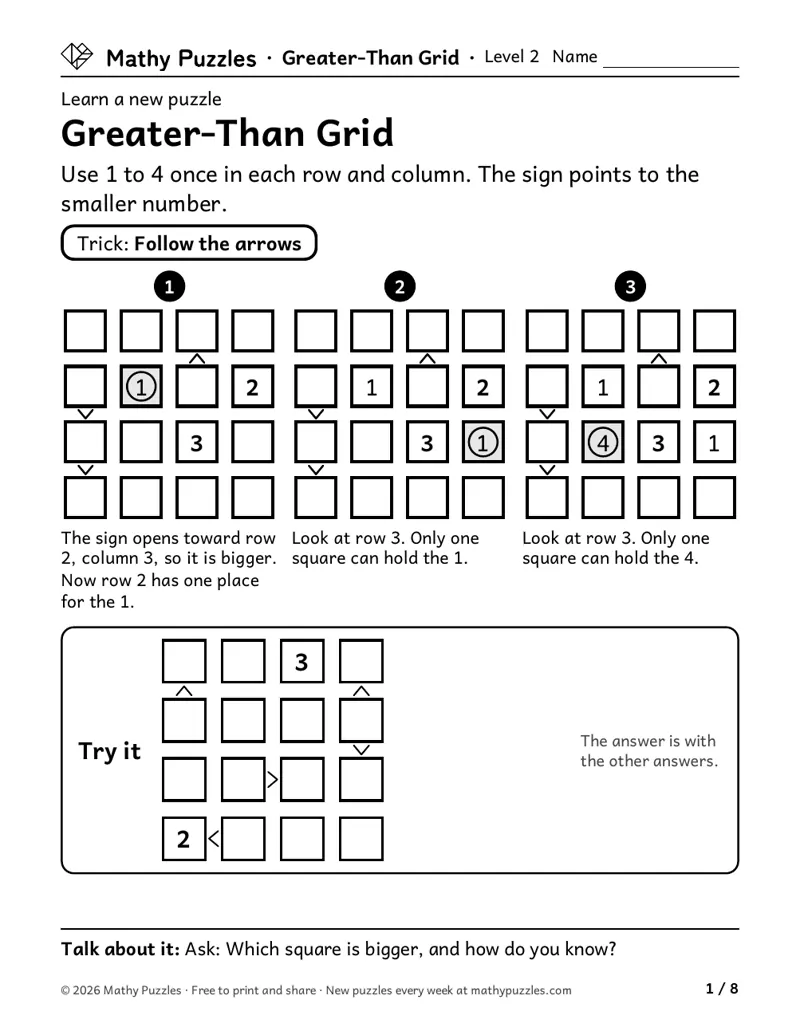
Worked example
From the Level 2 Learn sheet
- Use 1 to 4 once in each row and column. The sign points to the smaller number.
- The square at the point of a sign can't be 4. The square at the open side can't be 1.
- Cross out what each sign rules out, row by row.
- When a row or column has only one place left for a number, write it there.
A question to ask: “Which square is bigger, and how do you know?”
Free every Sunday A mixed bag of 20 new puzzles, all four levels. Get them by email
The thinking it works on
Comparing numbers
Reads a sign and says which square is bigger.
Holloway and Ansari (2009) found that 6- to 8-year-olds took longer to say which of two digits was bigger when the digits were close together. The size of this slowdown varied by child. Source
Reasoning by elimination
Crosses out what a square can't be until one number is left.
Galotti, Komatsu and Voelz (1997) found that children answered faster when the facts left only one possible conclusion than when the facts only made it likely. The gap was clear by grade 4. Source
Ordering in a chain
Uses a run of signs to set a smallest or biggest possible number.
Bryant and Trabasso (1971) found that young children can reason 'A is longer than B and B than C, so A is longer than C'. They could do it as long as they remembered the pairs they learned. Source
Reasoning with two kinds of rule
Uses signs and the once-per-row rule together.
Davidson, Amso, Anderson and Diamond (2006) tested 4- to 13-year-olds. Even the youngest could hold a rule in mind and resist a tempting response. Switching between two rules took longer to develop, and 13-year-olds were still short of adult levels. Source
Keeping track of options
Holds several small notes and updates them.
Bayliss and colleagues (2005) tested 120 children aged 6 to 10. The number of items a child can hold while also working on something grew across these ages. Both faster processing and more storage drove the growth. Source
Where is this thinking used?
- Lining up by height: Each "taller than" fact fixes part of the order.
- Ranking in sports: Results of single games set who must be above whom.
- Cooking: Ordering steps when some must come before others.
- Shopping: Comparing prices two at a time to find the cheapest.
For teachers
Curriculum areas
- Common Core
- Number and operations in base ten: the symbols <, = and > (Grade 1); Expressions and equations: which values from a set make an inequality true (Grade 6)
- NCERT
- No direct curricular match.
- National Curriculum (England)
- Number – number and place value: comparing numbers with <, > and = (Year 2)
- Cambridge Primary Mathematics
- Number: comparing and ordering numbers; the signs < and > (Stages 1–3)
Math practices: see the box below.
Math practices this puzzle uses
- Uses: MP1 Make sense of problems and persevere in solving them
- Not used: MP2 Reason abstractly and quantitatively
- Not used: MP3 Construct viable arguments and critique the reasoning of others
- Not used: MP4 Model with mathematics
- Not used: MP5 Use appropriate tools strategically
- Uses: MP6 Attend to precision
- Not used: MP7 Look for and make use of structure
- Not used: MP8 Look for and express regularity in repeated reasoning
From the Common Core Standards for Mathematical Practice.
More Greater-Than Grid puzzles for members
Members get at least 5 more worksheets at each difficulty for every puzzle, 80 new puzzles every Sunday, and the whole archive. $39 a year or $25 for 6 months.
See membershipNot ready yet?
One email, all four levels: 20 puzzles, 5 for each level.
For grown-ups (18+). One email every Sunday with the puzzles and the odd note about membership; unsubscribe any time. We never ask about your child. How we use your email