
Frog Hops
Watch a child hop along paving stones two at a time and they will tell you where the next hop lands. A number line works the same way: equal hops, forward or back, land in a pattern you can count and predict.
Free sets by level, ages 4–8:
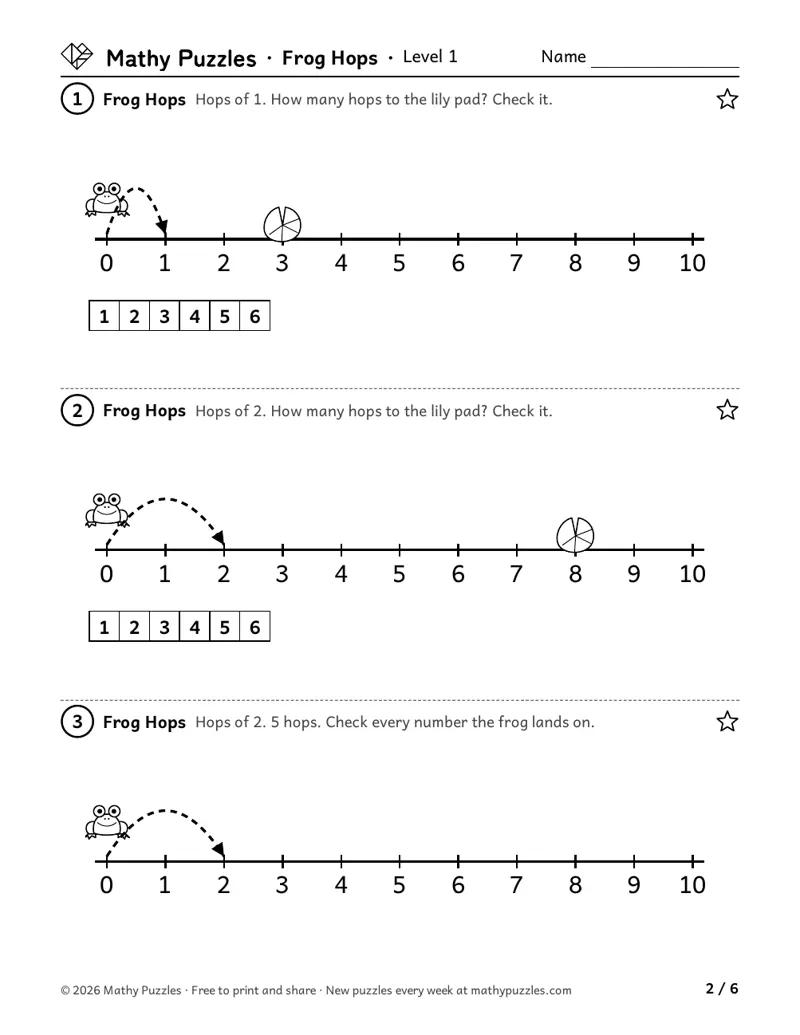 Level 1: a page from the free set
Before starting
- Level 1: count to 10 (to 20 for the harder puzzles)
- Level 1: point to each number on a line while counting
- Level 2: count by 2s, 5s and 10s, and read numbers to 100
Free puzzles to print
Each set: a Learn sheet with a worked example, 10 puzzles from easiest to hardest, and the answers.
Level 1
Ages 4–6 · Pre-K–K
The easiest puzzles use a line from 0 to 10, and the frog starts at 0 and hops by 1 or 2. Then it starts anywhere from 0 to 5 and hops by 2 or 3. Then it hops back on a line from 0 to 10, or forward on a line from 0 to 20. The hardest have three frogs hopping by 2, 3 and 5 on a line to 20, with rocks on some numbers.
On the sheet: “Hop the frog along the number line.”
Print Level 1 (Letter)Other paper size: A4Level 2
Ages 6–8 · Grades 1–2
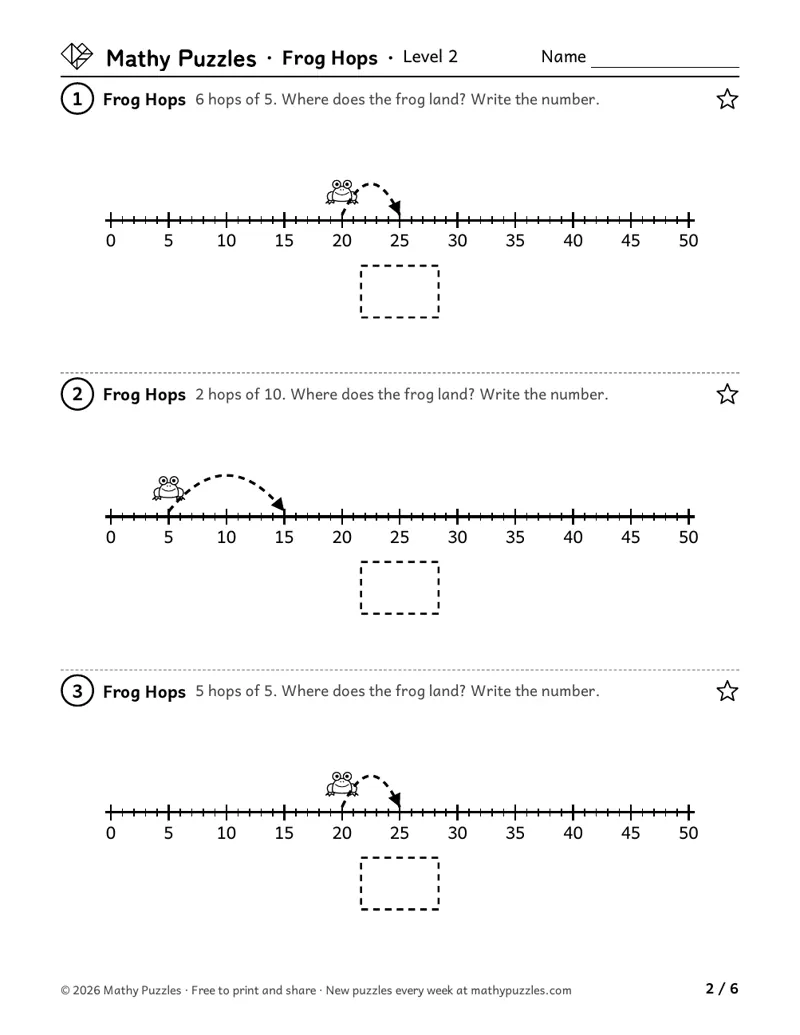
A line from 0 to 50 with hops of 5 or 10. Then a 21-number part of the line with hops of 2 or 5 from any start. Then a line from 0 to 100 labeled only at the tens, with hops of 10 forward or back from a number that is not a ten. The hardest have three frogs hopping by 2, 5 and 10 past rocks, or ask how big each of 4 same-size hops is.
On the sheet: “Hop the frog along the number line.”
Print Level 2 (Letter)Other paper size: A4
How it works
Each puzzle has a number line with a frog on it. The frog hops the same size every time, and its first hop is usually drawn. The child finds where it lands, how many hops reach the lily pad, or which numbers it lands on. In the hardest puzzles three frogs hop by different sizes, and the child finds the one that reaches the lily pad without landing on a rock. At Level 2 the lines run to 50 or 100, or show a part of the line, such as 35 to 55. Hops are 2, 5 or 10, and the child writes each answer in a box.
How to play
- Find the frog. That is where it starts.
- Read the hop size and how many hops. The first hop is usually drawn for you.
- Hop along the line with a finger, counting the hops, not the numbers in between.
- Draw each hop as an arc, then check or write where the frog lands.
When it gets hard
Counting the starting number as the first hop.
Hint: A hop is the jump. Start with your finger on the frog and say "one" when you land.
Counting every number on a hop of 2.
Hint: One hop jumps over a number. Say the landing numbers only: 2, 4, 6.
Hopping forward when the frog goes back.
Hint: Read the word "back". Back means toward 0.
Choosing the first frog that reaches the lily pad.
Hint: Check every landing for that frog. Did it land on a rock on the way?
Level 2: counting every little mark for a hop of 10 on the 0 to 100 line.
Hint: Only the tens are labeled. A hop of 10 from 37 lands on 47: the last digit stays the same.
Tip for grown-ups: Act it out first: a few big hops across the room, counting each landing. Then the line on paper makes sense.
Frequently asked questions
- Why is the first hop already drawn?
- It shows the size of a hop, so the child copies it instead of guessing. Drawing arcs is fiddly at 4, so one finished hop takes some of that load.
- My 4-year-old gets a different landing every time.
- Most often the start number is being counted as a hop. Put a finger on the frog, jump, and say "one" on landing. The easiest puzzles keep to hops of 1 and 2 on a line to 10.
- How does this fit kindergarten and first grade math?
- Hopping forward and back on a line to 10 is adding and taking away within 10. Hopping by 2, 3 and 5 on a line to 20 previews skip counting.
Questions about printing, levels, answers or membership: see all questions.
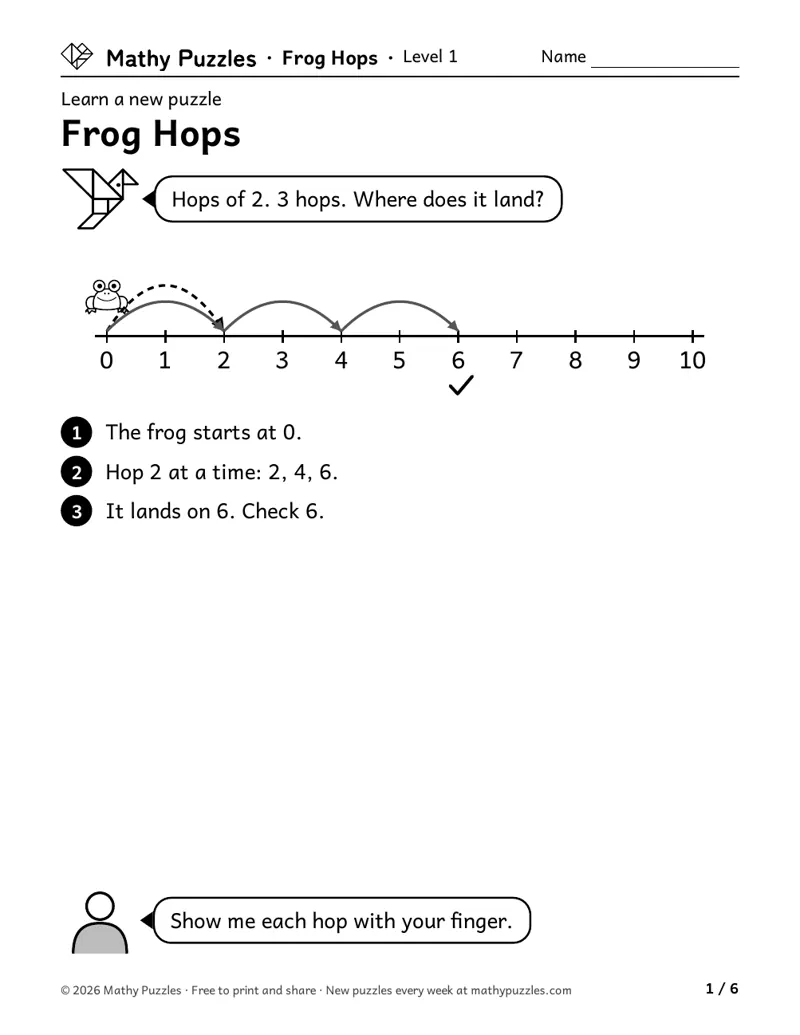
Worked example
From the Level 1 Learn sheet
- Hops of 2. 3 hops. Where does it land?
- The frog starts at 0.
- Hop 2 at a time: 2, 4, 6.
- It lands on 6. Check 6.
A question to ask: “Show me each hop with your finger.”
Free every Sunday A mixed bag of 20 new puzzles, all four levels. Get them by email
The thinking it works on
Knowing where numbers sit on a line
Knows where numbers sit in order along a line.
Siegler and Booth (2004) asked kindergartners, first graders and second graders to mark where numbers sit on a 0-to-100 line. Between ages 6 and 8, placements moved from bunched up at the low end toward evenly spaced. Source
Counting in equal steps
Counts in jumps of 2, 3, 4, 5 or 10.
Adding and taking away as moves
Sees forward hops as adding and back hops as taking away.
Carpenter and Moser (1984) followed 88 children from grade 1 to grade 3. Before any formal teaching, they solved simple adding and taking-away problems by modeling with objects, then by counting. They kept those strategies for years. Source
Keeping count of two things
Tracks the number of hops and the landing number together.
Kouba (1989) studied how children in grades 1 to 3 solved equal-groups problems. Their ways ranged from acting them out, to 'double counting' (keeping two counts going at once), to recalling facts. Source
Testing each option
Checks every frog against the rocks before choosing.
Bryce and Whitebread (2012) watched 5- to 7-year-olds solve problems and found that they showed more monitoring of their own work as they got older. Source
Working back to the hop size
Finds the size of a hop from where it starts and ends.
Where is this thinking used?
- Board games: Moving a piece 3 spaces is a hop along a number line.
- Rulers and tape measures: Lengths are read as steps along a line from 0.
- Counting coins: Nickels are counted by fives, the way a frog hops by 5.
- Clock faces: Minutes on a clock go around in jumps of five.
For teachers
Curriculum areas
- Common Core
- Counting and cardinality: counting on (Kindergarten); Operations and algebraic thinking: adding and taking away within 10, and relating counting to adding and subtracting (Kindergarten–Grade 1); Number and operations in base ten: ten more and ten less, skip counting (Grades 1–2); Measurement and data: the number line (Grade 2)
- NCERT
- Joyful Mathematics: hopping forward and back on a number strip (Class 1, How Many?); skip counting on a number line (Class 2, Fun with Numbers)
- National Curriculum (England)
- Number – number and place value: counting forward and back, in steps, on a number line (Years 1–2)
- Cambridge Primary Mathematics
- Number: counting on and back in steps (Stages 1–2); multiplication as repeated addition (Stage 2)
Math practices: see the box below.
Math practices this puzzle uses
- Not used: MP1 Make sense of problems and persevere in solving them
- Not used: MP2 Reason abstractly and quantitatively
- Not used: MP3 Construct viable arguments and critique the reasoning of others
- Not used: MP4 Model with mathematics
- Uses: MP5 Use appropriate tools strategically
- Not used: MP6 Attend to precision
- Uses: MP7 Look for and make use of structure
- Not used: MP8 Look for and express regularity in repeated reasoning
From the Common Core Standards for Mathematical Practice.
More Frog Hops puzzles for members
Members get at least 5 more worksheets at each difficulty for every puzzle, 80 new puzzles every Sunday, and the whole archive. $39 a year or $25 for 6 months.
See membershipNot ready yet?
One email, all four levels: 20 puzzles, 5 for each level.
For grown-ups (18+). One email every Sunday with the puzzles and the odd note about membership; unsubscribe any time. We never ask about your child. How we use your email