
Follow the Arrows
A robot does exactly what its cards say, nothing more and nothing less, which is why it so often ends up somewhere unexpected. Read every card in order and you can say where it will stop before it moves.
Free sets by level, ages 4–8:
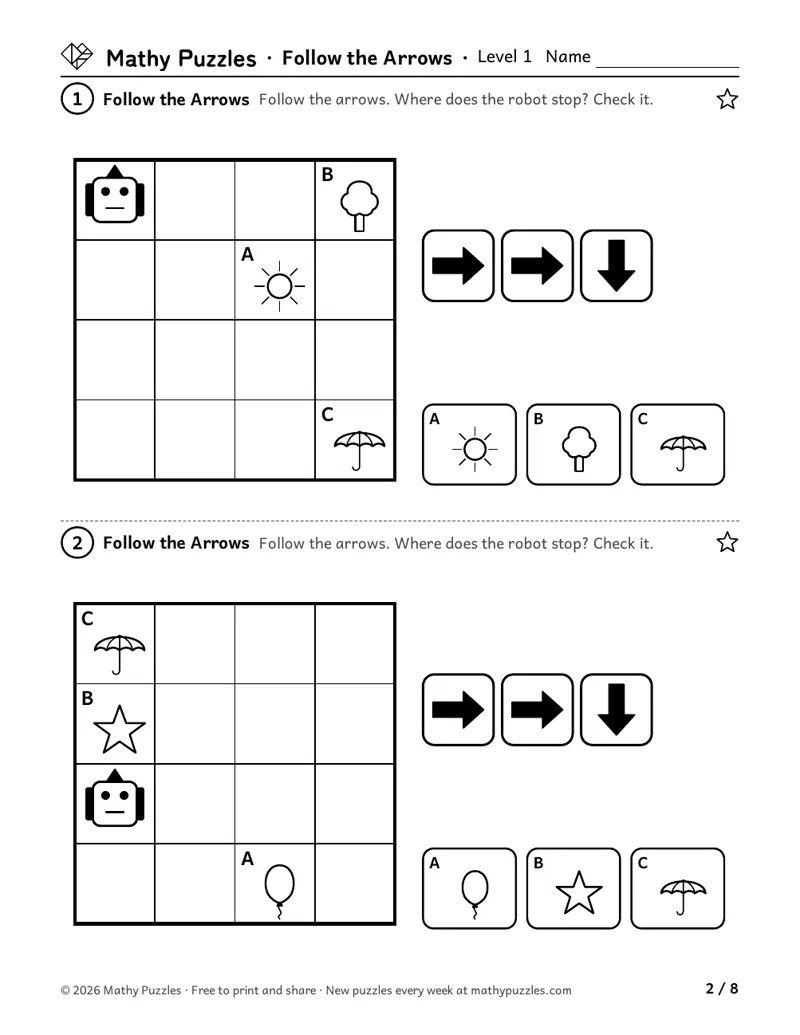 Level 1: a page from the free set
Before starting
- Level 1: point the way an arrow points; up, down, left and right help
- Level 1: count to 5
- Level 2: know left from right on your own body
- Level 2: know that a turn card turns the robot on the spot and does not move it
What you need
A small toy to stand in for the robot, and a pencil.
Free puzzles to print
Each set: a Learn sheet with a worked example, 10 puzzles from easiest to hardest, and the answers.
Level 1
Ages 4–6 · Pre-K–K
A 4 × 4 grid with 3 arrows and one change of direction. Then 5 × 5 with 4 or 5 arrows, where each wrong picture is where one misread arrow would lead. Then three programs to choose from, with rocks beside the path. The hardest puzzles use numbered arrows (→2 means two squares).
On the sheet: “Follow the arrows. Where does the robot stop? Check it.”
Print Level 1 (Letter)Other paper size: A4Level 2
Ages 6–8 · Grades 1–2
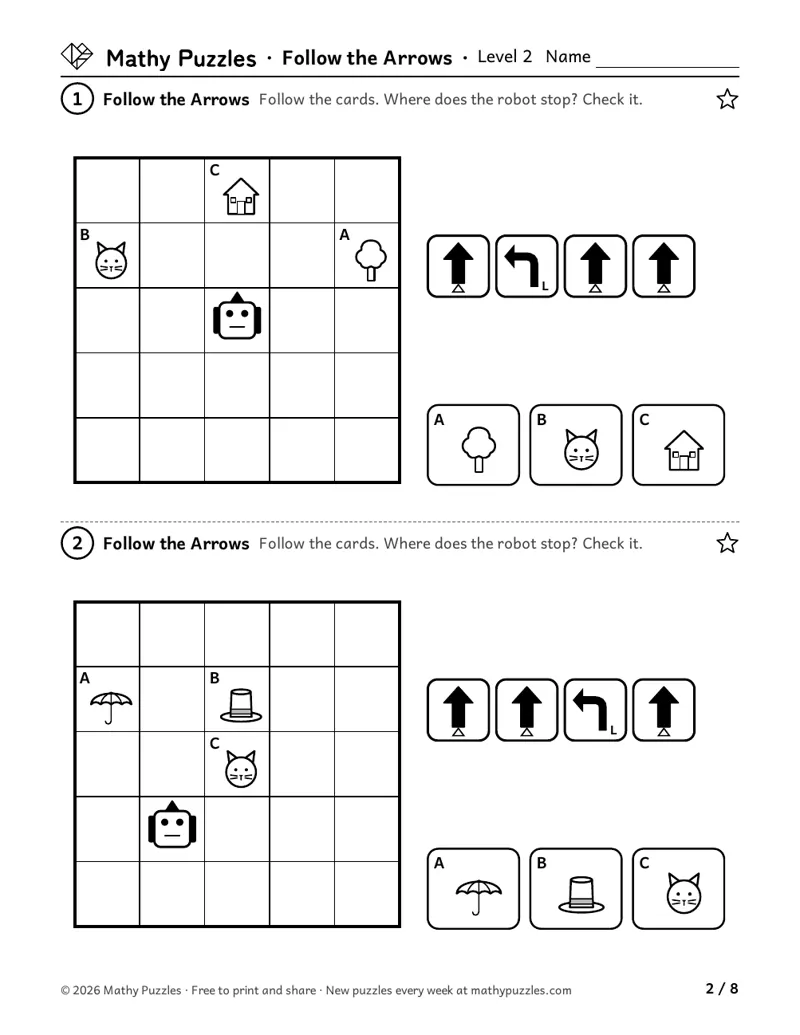
Turn cards with the robot facing up and one turn. Then 6 or 7 cards, two turns, and a robot that starts facing sideways. Then 8 cards with a turn made while the robot faces down the page, and the child draws the path. The hardest puzzles add numbered forward cards (F2, F3).
On the sheet: “Follow the cards. Where does the robot stop? Check it.”
Print Level 2 (Letter)Other paper size: A4
How it works
Each puzzle has a small grid with a robot, three pictures to choose from, and a printed program of cards beside it. The child starts on the robot, follows the cards one at a time, and checks the picture where the robot stops. Some Level 1 puzzles turn this around: one picture and three programs, and the child checks the program that gets there. Level 1 uses arrows that point up, down, left or right. Level 2 uses forward, turn left and turn right cards.
How to play
- Put a finger on the robot.
- Read the first card. Move one square the way it says.
- Keep going, one card and one square at a time, to the last card.
- Check the picture where the robot stops. At Level 2 a turn card spins the robot where it stands; only forward moves it.
When it gets hard
Moving two squares for one arrow, or skipping a card.
Hint: Touch each card with your other hand as you move. One card, one square.
At Level 2, moving the robot on a turn card.
Hint: A turn card only changes which way the robot faces. Only forward moves it.
At Level 2, turning the wrong way when the robot faces down the page.
Hint: Turn the paper so the robot faces up, then decide left or right.
Tip for grown-ups: Chant the cards together (up, up, right) while your child moves. Then swap: your child reads, you move, and you go the wrong way once on purpose for them to catch.
Frequently asked questions
- Should my child use a finger or a pencil?
- A finger first: it keeps the eyes on the path and the page clean. In the harder Level 2 puzzles the child draws the path, and the answers show the path drawn in.
- Can I act this out with my class?
- Yes. Tape a grid on the floor, let one child be the robot, and hold up the cards one at a time. The class calls out where the robot will stop before it moves.
- How is this different from Write the Program?
- Here the program is printed and the child runs it to find the ending. In Write the Program the ending is shown and the child writes the program. Reading a program comes first, and many children like doing one of each.
Questions about printing, levels, answers or membership: see all questions.
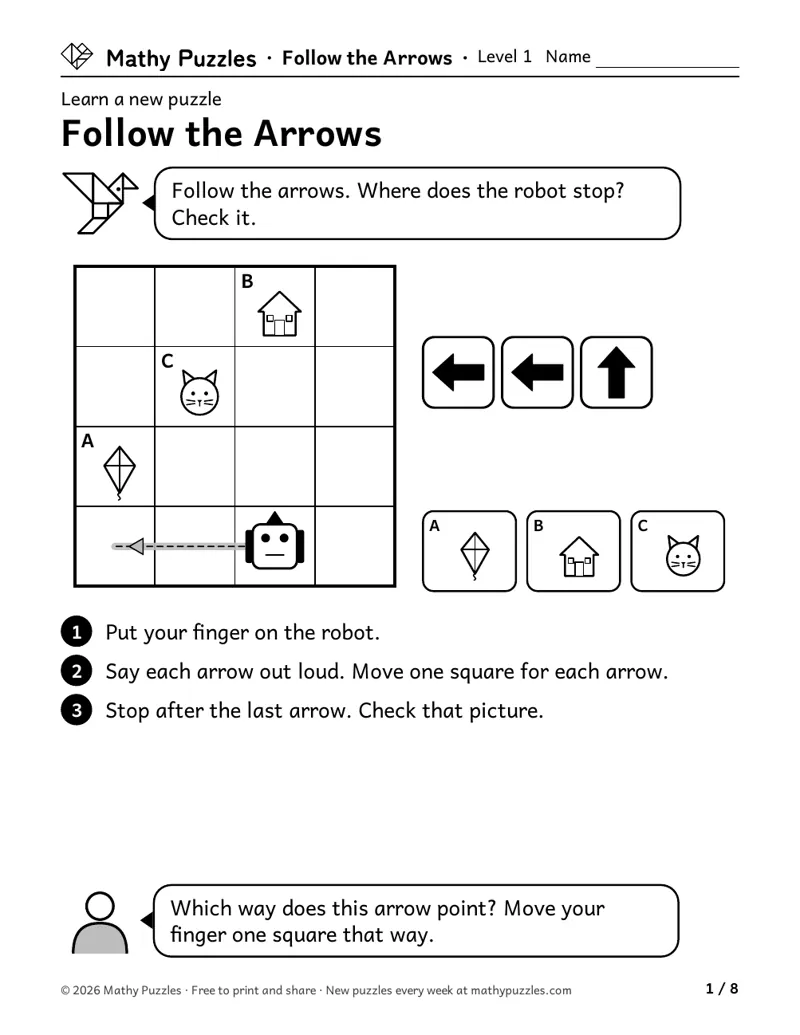
Worked example
From the Level 1 Learn sheet
- Put your finger on the robot.
- Say each arrow out loud. Move one square that way for each arrow.
- Stop after the last arrow. Check that picture.
A question to ask: “Which way does this arrow point? Move your finger one square that way.”
Free every Sunday A mixed bag of 20 new puzzles, all four levels. Get them by email
The thinking it works on
Following a sequence
Acts on each card in turn, in the order printed.
Waterman and colleagues (2017) found that 6- to 10-year-olds carried out a spoken list of instructions more accurately by acting it out than by repeating it in words. Source
Keeping your place
Keeps one hand on the program and one on the grid so no card is lost.
Gathercole and colleagues (2008) gave 5- and 6-year-olds spoken instructions for moving a row of objects. How well a child carried them out was strongly tied to working memory; simply repeating the words was not. Source
Direction words
Turns each card into a move: up, down, left, right, forward, turn.
Rigal (1996) tested 406 children aged 5 to 11. Telling pictures apart was easy even for the youngest. Naming right and left was harder, most of all when the picture had to be turned in the mind. Source
Seeing from the robot's side
Works out the robot's left and right when it faces another way.
In a study of 406 children, Rigal (1994) found that children use the words right and left correctly on their own bodies from about age 7. On a person facing them, they do so only at around 8 to 9. Source
Checking each step, not the general direction
Catches the one card that would send the robot somewhere else.
Davidson and colleagues (2006) tested about 30 children at each age from 4 to 13. The youngest kept the same quick pace on hard trials and paid for it in accuracy, while adults slowed down to stay accurate. Source
Reading a numbered move
Reads →2 or F3 as several squares in a row.
Where is this thinking used?
- Recipes: Doing each step in the order it is written.
- Directions: Following "left at the corner, then the second right" to the right door.
- Dance and games: Step-by-step moves, like a line dance or a game of follow the leader.
- Building kits: Picture instructions for a toy model, one step at a time.
For teachers
Curriculum areas
- Common Core
- Geometry: describing position with words like above, below and next to (Kindergarten)Level 2: No direct curricular match.
- NCERT
- Maths Mela (Class 3): following step-by-step directions with turns on a mapLevel 1: No direct curricular match.
- Computer science (CSTA)
- Following step-by-step instructions (algorithms and programming, ages 5–7)
- National Curriculum (England)
- Geometry – position and direction: describing position, direction, movement and turns (Years 1–2)
- Cambridge Primary Mathematics
- Geometry and measure: position, direction and movement; quarter and half turns (Stages 1–2)
Math practices: see the box below.
Math practices this puzzle uses
- Uses: MP1 Make sense of problems and persevere in solving them
- Not used: MP2 Reason abstractly and quantitatively
- Not used: MP3 Construct viable arguments and critique the reasoning of others
- Not used: MP4 Model with mathematics
- Not used: MP5 Use appropriate tools strategically
- Uses: MP6 Attend to precision
- Not used: MP7 Look for and make use of structure
- Not used: MP8 Look for and express regularity in repeated reasoning
From the Common Core Standards for Mathematical Practice.
More Follow the Arrows puzzles for members
Members get at least 5 more worksheets at each difficulty for every puzzle, 80 new puzzles every Sunday, and the whole archive. $39 a year or $25 for 6 months.
See membershipNot ready yet?
One email, all four levels: 20 puzzles, 5 for each level.
For grown-ups (18+). One email every Sunday with the puzzles and the odd note about membership; unsubscribe any time. We never ask about your child. How we use your email