
Weighing Puzzles
An old market balance settles arguments fast: put two things on, and one goes down. Now take a pile of coins that look the same, with one fake among them. Every level scale clears the coins on it, and every tipped scale points toward the fake.
Free sets by level, ages 8–12:
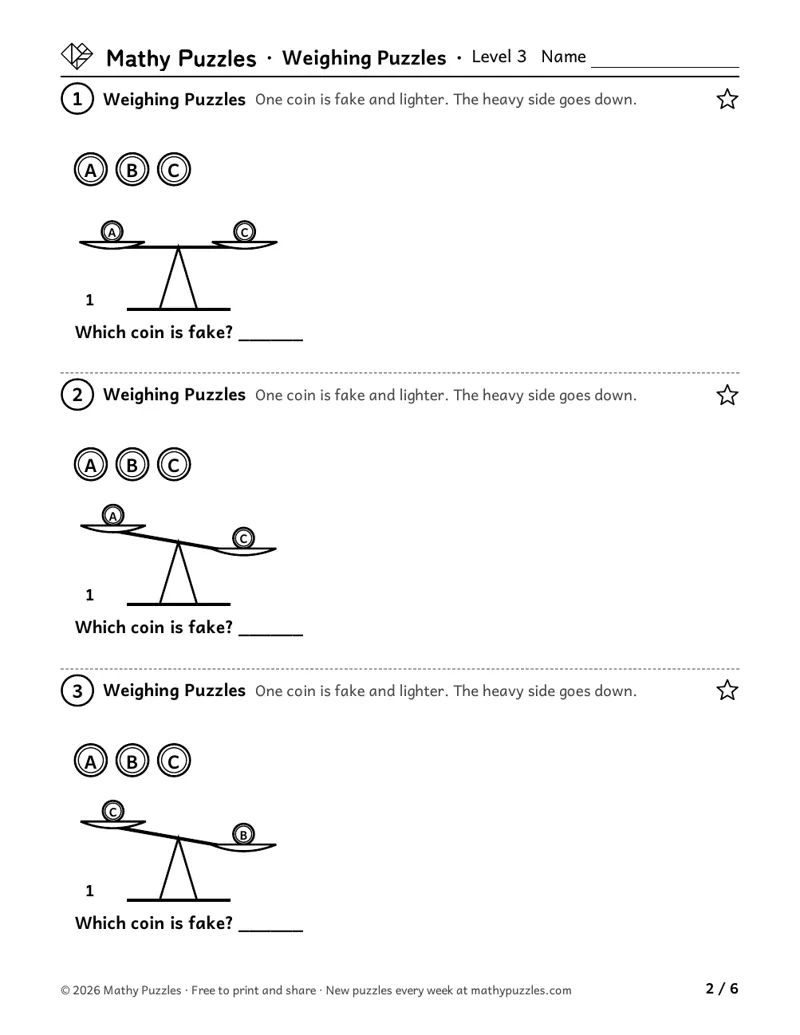 Level 3: a page from the free set
Before starting
- Know that the heavier side of a balance goes down
- Count up to 12 coins
- Level 4: keep two cases in mind (the fake could be heavier or lighter)
What you need
Real coins or buttons to test an idea, and a pencil.
Free puzzles to print
Each set: a Learn sheet with a worked example, 10 puzzles from easiest to hardest, and the answers.
Level 3
Ages 8–10 · Grades 3–4
3 coins and one weighing, where the fake is lighter. Then 9 coins and 2 weighings, then groups of different sizes. The hardest ask which of 3 next weighings is sure to find the fake.
On the sheet: “Read the scales. Find the fake coin.”
Print Level 3 (Letter)Other paper size: A4Level 4
Ages 10–12 · Grades 5–6
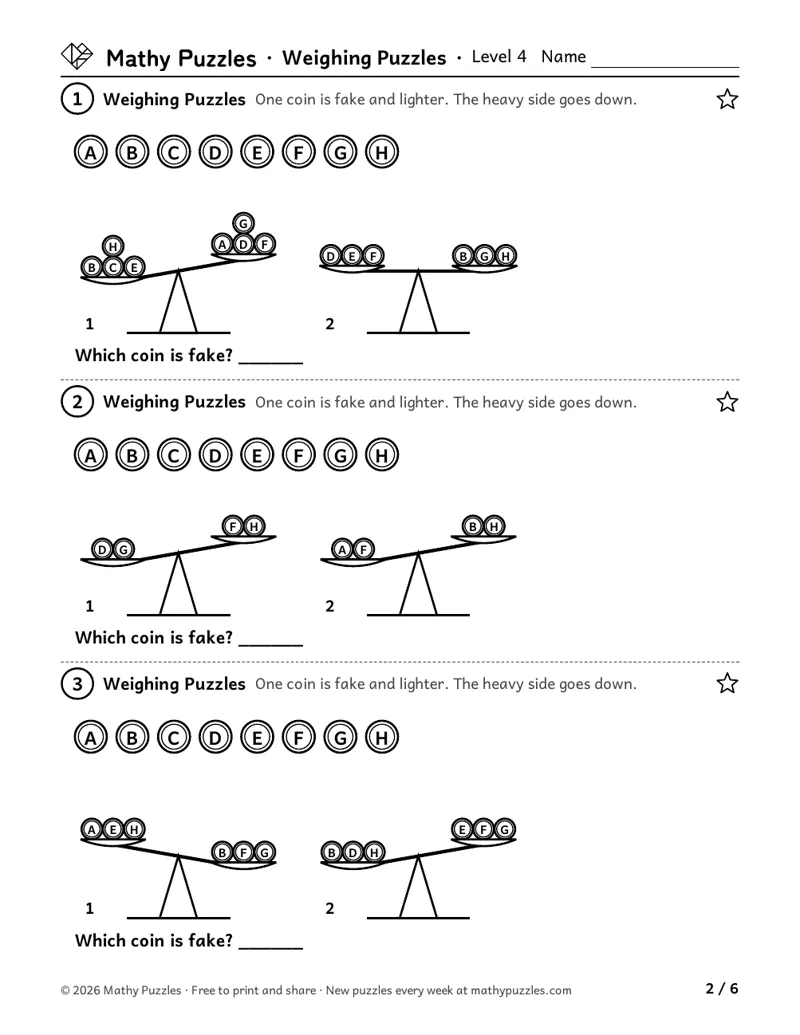
8 coins and 2 weighings. Then the fake could be heavier or lighter, so the child finds which coin and which way. Then 12 coins and 3 weighings; the hardest plan the next weighing for 12 coins.
On the sheet: “Read the scales. Find the fake coin.”
Print Level 4 (Letter)Other paper size: A4
How it works
The coins all look the same, but one is fake. A few weighings on a balance are already drawn. The child reads each scale to find the fake coin, or, in the hardest puzzles, picks the next weighing that is sure to find it.
How to play
- Look at the first scale. Level? Cross out every coin on it.
- Tipped? The lighter fake is on the side that went up, so coins off the scale are real.
- Do the same with the next scale.
- When one coin is left, check it against every scale.
When it gets hard
Thinking the side that goes down holds a lighter fake.
Hint: A lighter fake makes its side go up.
Forgetting the coins left off the scale.
Hint: If the scale is level, the fake is among the coins left off.
At Level 4, deciding heavier or lighter too soon.
Hint: Keep both ideas until a scale rules one out.
Tip for grown-ups: Put out 9 buttons and secretly choose one as the fake; your child says which buttons to weigh and you say what the scale would show. That makes the drawn scales feel real.
Frequently asked questions
- Why coins and not toys?
- Coins all look the same, which is the point: only the scale can tell the fake. It also keeps this puzzle apart from Which Is Heavier? for younger children.
- Is there a hands-on version for class?
- Yes. Tape a paper clip under one of 9 plastic counters and use a pan balance if your room has one. Then hand out the printed puzzles, which use the same rules.
- How do the planning puzzles work?
- Three weighings are offered. Your child looks for the one that is sure to find the fake whatever the scale shows; the others can leave you guessing.
Questions about printing, levels, answers or membership: see all questions.
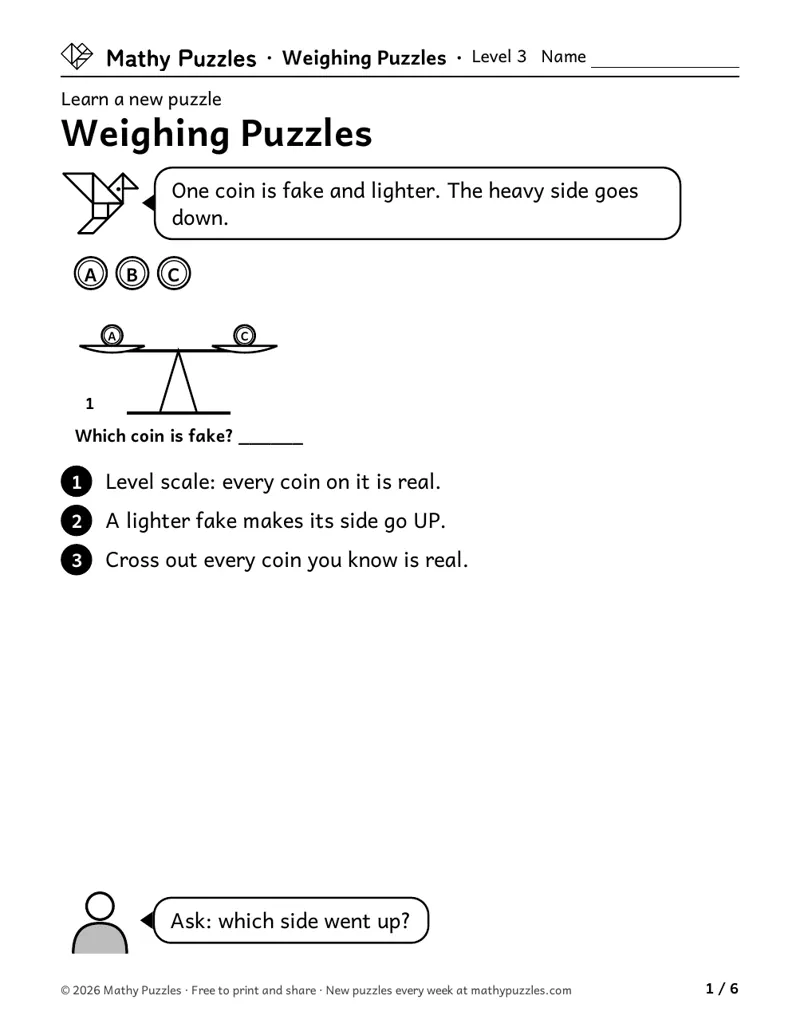
Worked example
From the Level 3 Learn sheet
- A level scale: every coin on it is real.
- A lighter fake makes its side go up.
- Cross out every coin you know is real.
A question to ask: “Which side went up?”
Free every Sunday A mixed bag of 20 new puzzles, all four levels. Get them by email
The thinking it works on
Reading a balance
Reads level as the same and tipped as one side heavier.
Jansen and van der Maas (2002) gave balance scale problems to 805 people aged 5 to 19. Children used rules to read the scale, and children of different ages used different rules. Their use of a rule was not always consistent. Source
Ruling out whole groups
Clears every coin on a level scale at once.
In a twenty-questions game, Ruggeri and colleagues (2016) found that 7- and 10-year-olds searched better than random guessing but short of the best possible search. Source
Keeping two possibilities
Tracks heavy-fake and light-fake cases together.
Planning for every outcome
Tests a weighing against all three results.
Sodian, Zaitchik and Carey (1991) found that most first graders and almost all second graders chose a test that would settle which of two ideas was right. They could also explain why a weaker test would not. Source
Keeping records
Crosses out cleared coins after each scale.
Eskritt and Lee (2002) studied fifth and seventh graders' notes in a card memory game. The notes worked as a real store: taking them away made the children do worse. Source
Where is this thinking used?
- Quality checks: Finding the one faulty item in a batch with as few tests as possible.
- Tournaments: Groups and knockout rounds narrow many teams to one.
- Plumbing: Shutting off half the pipes to find which part drips.
- Kitchen scales: Comparing two bags to see which is short.
For teachers
Curriculum areas
- Common Core
- No direct curricular match.
- NCERT
- Maths Mela: the heavy ball puzzle with a pan balance (Class 3) and which way a balance tilts (Class 4)
- National Curriculum (England)
- Measurement: comparing and ordering mass (Year 2)
- Cambridge Primary Mathematics
- No direct curricular match.
Math practices: see the box below.
Math practices this puzzle uses
- Uses: MP1 Make sense of problems and persevere in solving them
- Not used: MP2 Reason abstractly and quantitatively
- Uses: MP3 Construct viable arguments and critique the reasoning of others
- Not used: MP4 Model with mathematics
- Not used: MP5 Use appropriate tools strategically
- Not used: MP6 Attend to precision
- Uses: MP7 Look for and make use of structure
- Not used: MP8 Look for and express regularity in repeated reasoning
From the Common Core Standards for Mathematical Practice.
More Weighing Puzzles for members
Members get at least 5 more worksheets at each difficulty for every puzzle, 80 new puzzles every Sunday, and the whole archive. $39 a year or $25 for 6 months.
See membershipNot ready yet?
One email, all four levels: 20 puzzles, 5 for each level.
For grown-ups (18+). One email every Sunday with the puzzles and the odd note about membership; unsubscribe any time. We never ask about your child. How we use your email