
Turn the Block
Hold a shoe up to a mirror and the reflection is a shoe for the other foot. Turn the Block plays on that. A block of cubes can face any way and stay the same block, but its mirror twin never matches, however it is turned.
Free sets by level, ages 8–12:
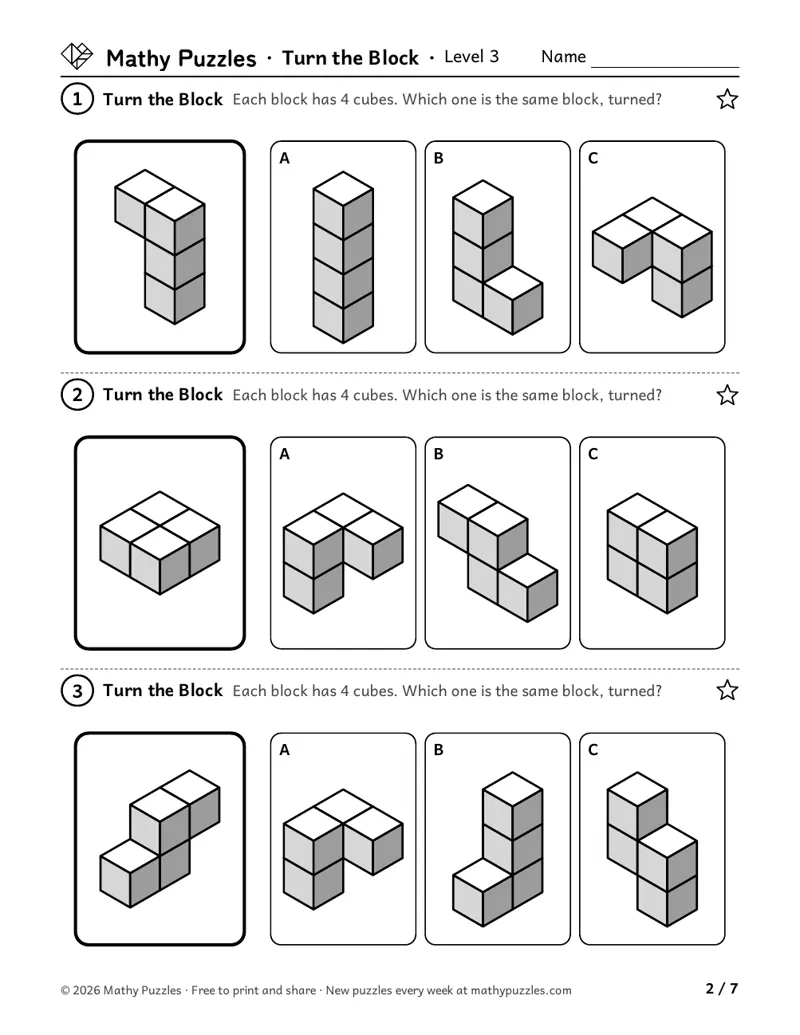 Level 3: a page from the free set
Before starting
- Count cubes in a drawing (see Count the Cubes)
- Know left from right
- Some practice with flat turns, such as Turn or Flip?
What you need
A few snap-together cubes for checking, and a pencil.
Free puzzles to print
Each set: a Learn sheet with a worked example, 10 puzzles from easiest to hardest, and the answers.
Level 3
Ages 8–10 · Grades 3–4
Blocks of 4 cubes, then 5 and 6 cubes with a mirror twin among the options, and in the hardest puzzles 7 cubes.
On the sheet: “Which one is the same block, turned?”
Print Level 3 (Letter)Other paper size: A4Level 4
Ages 10–12 · Grades 5–6
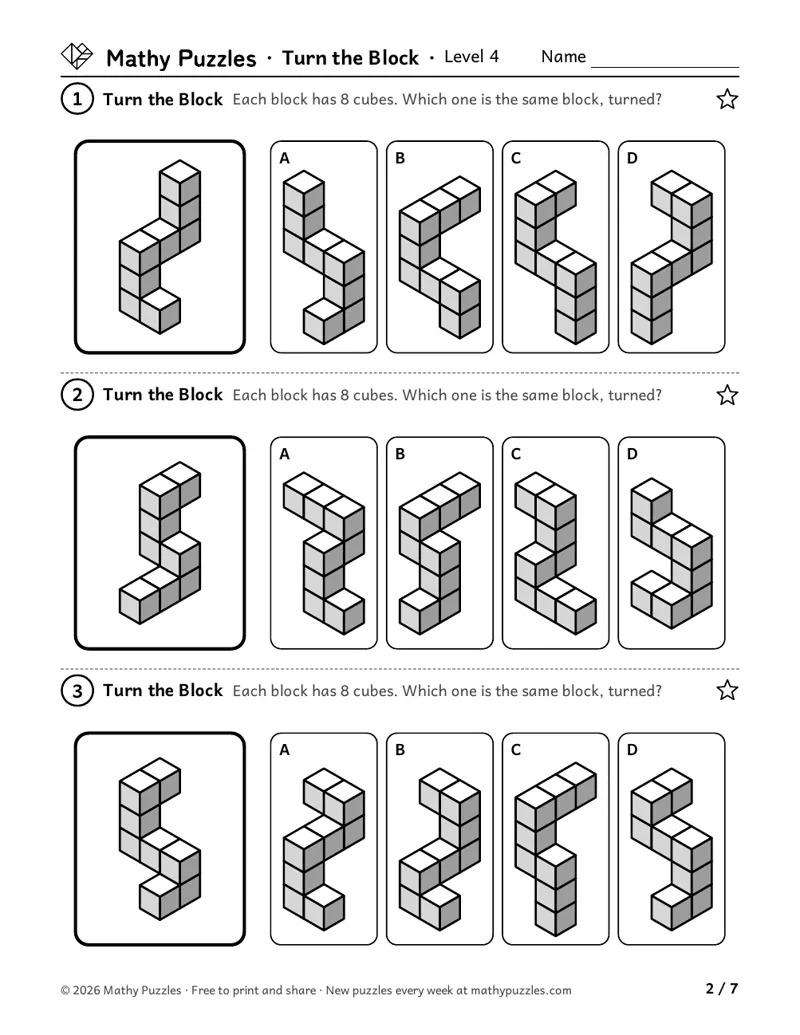
Arms of 7 to 8 cubes. From the middle puzzles, the child finds which two of four are the same block. In the harder puzzles one wrong block is a near miss that differs by one cube; the hardest show five arms with two near misses.
On the sheet: “Which one is the same block, turned?”
Print Level 4 (Letter)Other paper size: A4
How it works
A shape built from cubes is shown, then three or four more drawings. The child finds the one that is the same block, just turned to face another way. In most Level 4 puzzles there is no first block: the child finds the two drawings, out of four or five, that are the same block. Some wrong answers are the block's mirror twin, which can never be turned to match.
How to play
- The question tells you how many cubes. Every option has that many, so counting alone won't find the answer.
- Find something special about the block, such as a cube sticking up or a long arm.
- Look for that feature in each option and see where it went after the turn.
- Watch for the mirror twin: it looks right but bends the other way. Check the one that matches.
When it gets hard
Picking the mirror twin.
Hint: Hold up your two hands. They match but can't be turned to sit on top of each other. Is this option a 'left hand'?
Picking a block that matches except for one cube at the end.
Hint: Follow the arm cube by cube; count each straight part.
Trying to turn the whole block at once.
Hint: Follow one end cube only. Where did it go?
Tip for grown-ups: Snap together a few building cubes to copy the block, then let your child turn the real thing to check.
Frequently asked questions
- My child says two options look the same.
- One is probably the mirror twin. Ask which way the arm bends at each corner. Building both with cubes settles it fast.
- Where should a grade 3 class start?
- With the 4-cube blocks. The 6-cube blocks, where one choice is a mirror twin, stretch strong students.
Questions about printing, levels, answers or membership: see all questions.
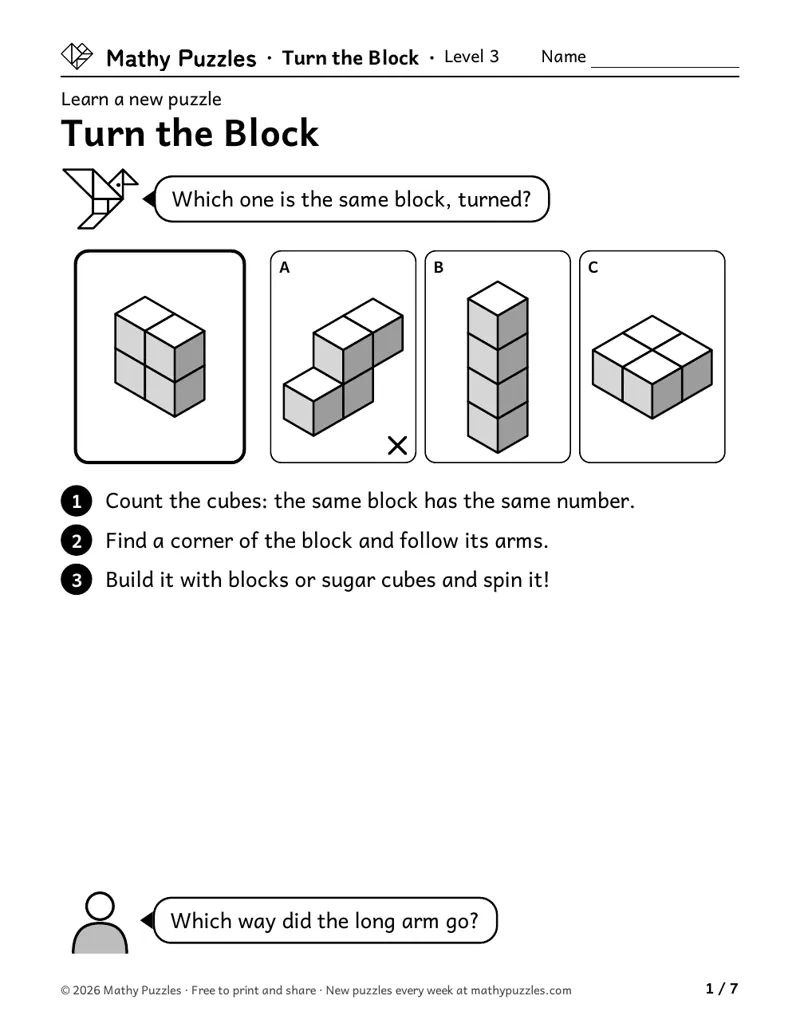
Worked example
From the Level 3 Learn sheet
- Count the cubes: the same block has the same number.
- Find a corner of the block and follow its arms.
- Build it with blocks or sugar cubes and spin it!
A question to ask: “Which way did the long arm go?”
Free every Sunday A mixed bag of 20 new puzzles, all four levels. Get them by email
The thinking it works on
Turning a block in the mind
Turns a block of cubes in the head, following one end cube through the turn.
Lütke and Lange-Küttner (2015) gave 100 children aged 7 to 11 a test of matching turned 3-D cube models. The 10-year-olds did clearly better than the 7- and 8-year-olds. Source
Telling a turn from a mirror image
Spots the mirror twin, which bends the other way and can never match.
Finding a landmark
Picks one special feature and looks for it in each option.
Seeing a drawing as a solid block
Reads each flat drawing as a solid block before turning it.
Battista and Clements (1996) found that children have to learn to pull the separate faces in a drawing together into one solid they can reason about. Source
Comparing cube by cube
Counts the cubes and follows the arm one straight part at a time.
Diamond (2013) reviews evidence that holding back the first look-alike answer and checking carefully is harder for children than for adults and gets easier through the school years. Source
Where is this thinking used?
- 3D modeling and CAD: A part is turned on screen to check it from every side.
- Assembly: Fitting a part into an engine, or building furniture from a kit using the diagram.
- Chemistry: Some molecules come in left-handed and right-handed forms that behave differently.
- Packing: Oddly shaped things fit a box only when turned the right way.
For teachers
Curriculum areas
- Common Core
- No direct curricular match.
- NCERT
- Building with cubes and views of a cube (Classes 4–5)
- National Curriculum (England)
- Geometry – properties of shapes: 3-D shapes in different orientations (Year 3) and from 2-D drawings (Year 5)
- Cambridge Primary Mathematics
- Geometry and measure: drawings of 3D shapes; 3D shapes in different orientations (Stages 3–6)
Math practices: see the box below.
Math practices this puzzle uses
- Not used: MP1 Make sense of problems and persevere in solving them
- Not used: MP2 Reason abstractly and quantitatively
- Not used: MP3 Construct viable arguments and critique the reasoning of others
- Not used: MP4 Model with mathematics
- Not used: MP5 Use appropriate tools strategically
- Uses: MP6 Attend to precision
- Uses: MP7 Look for and make use of structure
- Not used: MP8 Look for and express regularity in repeated reasoning
From the Common Core Standards for Mathematical Practice.
More Turn the Block puzzles for members
Members get at least 5 more worksheets at each difficulty for every puzzle, 80 new puzzles every Sunday, and the whole archive. $39 a year or $25 for 6 months.
See membershipNot ready yet?
One email, all four levels: 20 puzzles, 5 for each level.
For grown-ups (18+). One email every Sunday with the puzzles and the odd note about membership; unsubscribe any time. We never ask about your child. How we use your email