
Treasure Count
A metal detector beeps when there are coins buried nearby. Each number here is like a beep: it says how many chests are buried in the squares around it. A few sure facts, used carefully, uncover all of them.
Free sets by level, ages 6–12:
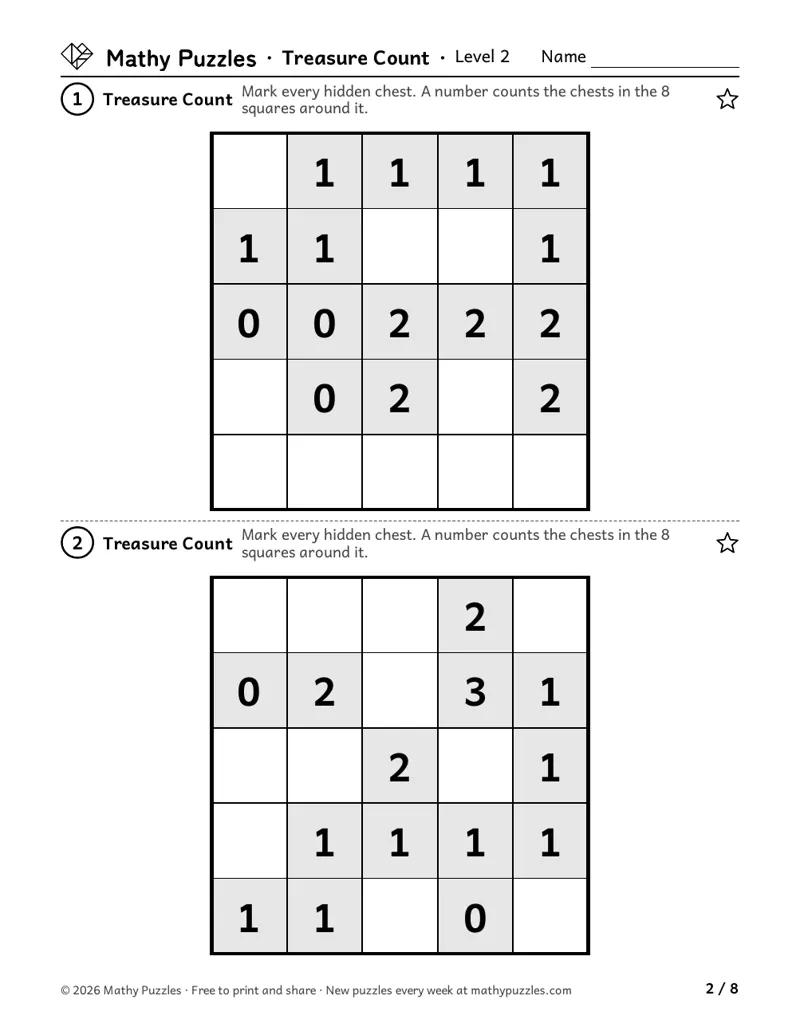 Level 2: a page from the free set
Before starting
- Count to 8
- Know that corner squares count as neighbors
- Make two kinds of marks (a chest and a dot)
What you need
Two colored pencils (one for chests, one for dots), and a pencil.
Free puzzles to print
Each set: a Learn sheet with a worked example, 10 puzzles from easiest to hardest, and the answers.
Level 2
Ages 6–8 · Grades 1–2
A 5 × 5 grid, then 6 × 6 grids with plenty of numbers; the hardest have fewer numbers to start from.
On the sheet: “Mark every hidden chest. A number counts the chests in the 8 squares around it.”
Print Level 2 (Letter)Other paper size: A4Level 3
Ages 8–10 · Grades 3–4
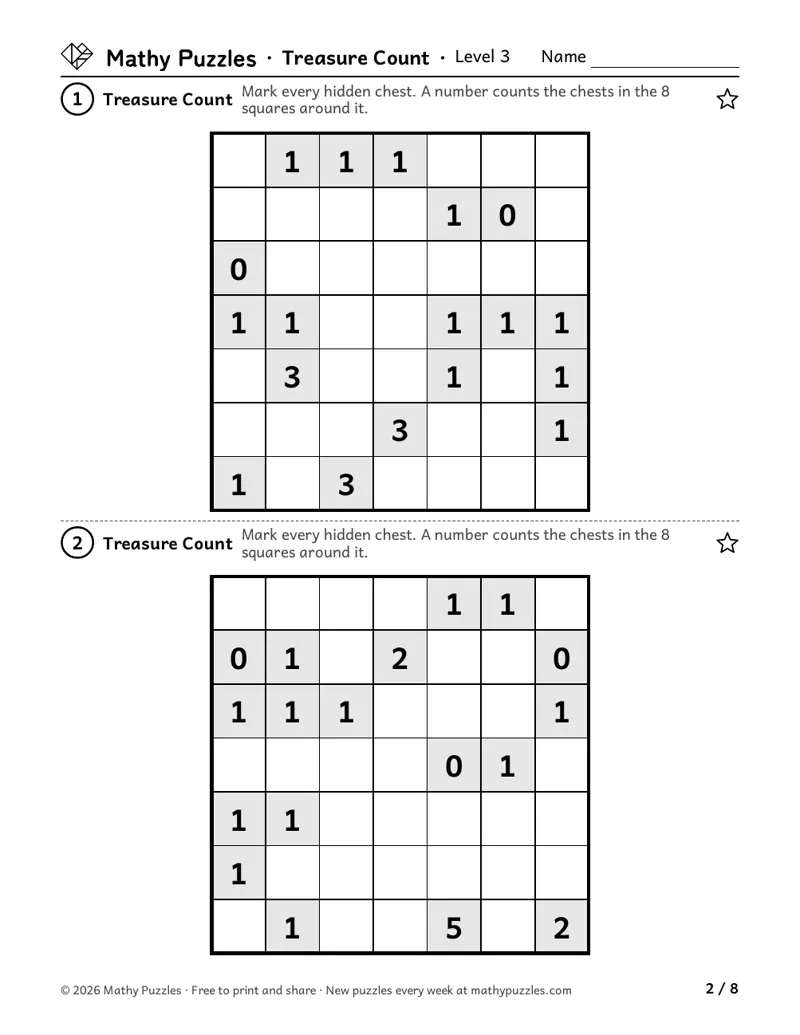
7 × 7 grids where two numbers share neighbors; in the hardest puzzles the total number of chests is given and needed.
On the sheet: “Mark every hidden chest. A number counts the chests in the 8 squares around it.”
Print Level 3 (Letter)Other paper size: A4Level 4
Ages 10–12 · Grades 5–6
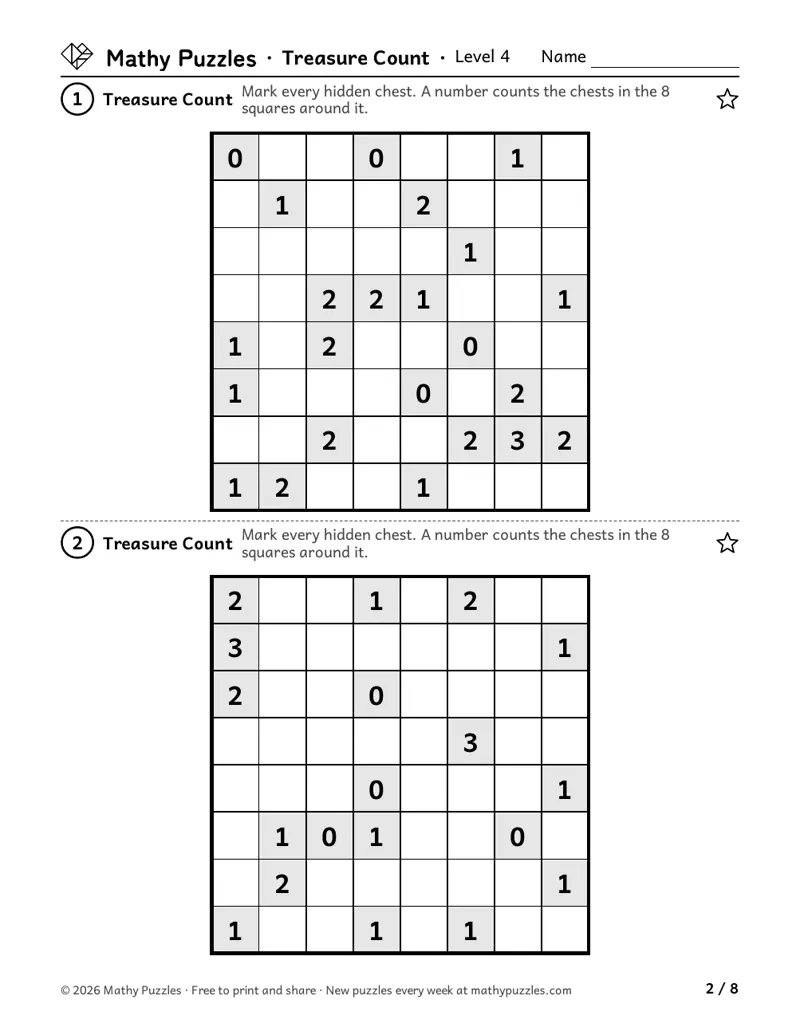
8 × 8, then 9 × 9 grids with 14 to 18 chests; the hardest puzzles need one "what if" test.
On the sheet: “Mark every hidden chest. A number counts the chests in the 8 squares around it.”
Print Level 4 (Letter)Other paper size: A4
How it works
Treasure chests are hidden in a grid. Some squares have numbers. A number tells how many of the 8 squares around it (side by side and corner to corner) hide a chest. The child uses the numbers to find and mark every chest.
How to play
- If there is a 0, start there: none of the squares around it has a chest. Dot them all.
- Find a number with exactly that many empty squares around it. All of them are chests.
- When a number already has all its chests, dot its other empty neighbors.
- Keep going. A square with a number never hides a chest.
When it gets hard
Forgetting the corner (diagonal) squares.
Hint: Touch all 8 squares around the number, going around like a clock.
Putting a chest on a square that has a number.
Hint: Numbered squares are always empty of chests.
Not dotting the squares that can't have chests.
Hint: A dot is progress too. It helps the next number.
Tip for grown-ups: Give your child two colors, one for chests and one for 'no chest' dots, so the grid stays easy to read.
Frequently asked questions
- Can I use this with a whole class?
- Yes. Do the first puzzle on the board, dotting around the zeros together, and keep the bigger grids for early finishers.
- Is guessing ever needed?
- No. Each number gives a sure fact, and the answers show every chest. Only the hardest Level 4 puzzles need one "what if" test, which is reasoning, not guessing.
Questions about printing, levels, answers or membership: see all questions.
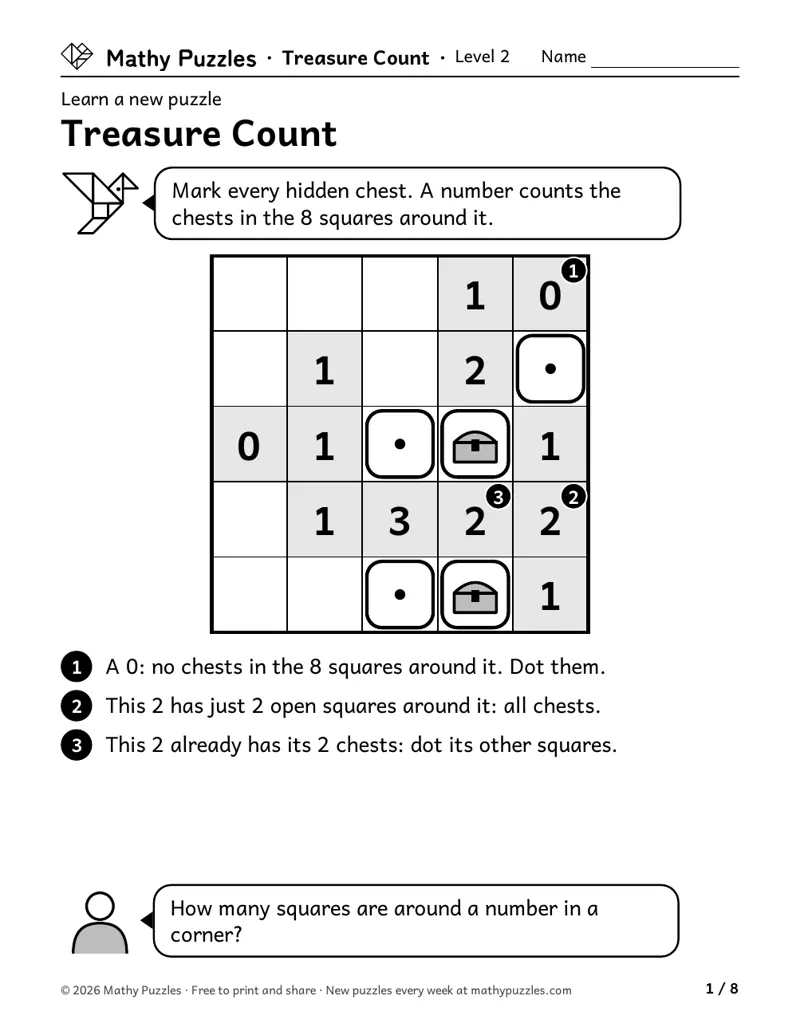
Worked example
From the Level 2 Learn sheet
- A 0: no chests in the 8 squares around it. Dot them.
- This 1 has just 1 open square around it: a chest.
- This 1 already has its chest: dot its other squares.
A question to ask: “How many squares are around a number in a corner?”
Free every Sunday A mixed bag of 20 new puzzles, all four levels. Get them by email
The thinking it works on
Reasoning from sure facts
Draws sure conclusions from each number without guessing.
Pillow and Pearson (2009) found that kindergartners already rated a conclusion forced by the facts as surer than a guess. By third grade, children explained it differently from a hunch. Source
Counting neighbors on a grid
Touches all eight squares around a number, corners included, and counts them.
Keeping track of what is known and what is ruled out
Marks chests and dots so the grid remembers what is known.
Bulley and colleagues (2020) found that few younger children thought up their own way to mark where things were hidden. By ages 10 and 11, nearly all did. Source
Combining clues
Works out what one number forces, then what that leaves for the next.
Testing a 'what if' and backing out
Supposes a chest, follows it until a number breaks, then knows it's empty.
Markovits and Vachon (1989) found that taking a 'suppose' they knew was false as a starting point for reasoning was hard for many 10-year-olds and easier by 15. Source
Where is this thinking used?
- Mysteries: Each clue rules some things out.
- Fault finding: Finding which cable or part is the broken one by elimination.
- Board games: Counting what a square touches, corners included.
- Checking totals: Counts in a list must agree with the totals.
For teachers
Curriculum areas
- Common Core
- No direct curricular match.
- NCERT
- No direct curricular match.
- National Curriculum (England)
- No direct curricular match.
- Cambridge Primary Mathematics
- No direct curricular match.
Math practices: see the box below.
Math practices this puzzle uses
- Uses: MP1 Make sense of problems and persevere in solving them
- Not used: MP2 Reason abstractly and quantitatively
- Uses: MP3 Construct viable arguments and critique the reasoning of others
- Not used: MP4 Model with mathematics
- Not used: MP5 Use appropriate tools strategically
- Not used: MP6 Attend to precision
- Uses: MP7 Look for and make use of structure
- Not used: MP8 Look for and express regularity in repeated reasoning
From the Common Core Standards for Mathematical Practice.
More Treasure Count puzzles for members
Members get at least 5 more worksheets at each difficulty for every puzzle, 80 new puzzles every Sunday, and the whole archive. $39 a year or $25 for 6 months.
See membershipNot ready yet?
One email, all four levels: 20 puzzles, 5 for each level.
For grown-ups (18+). One email every Sunday with the puzzles and the odd note about membership; unsubscribe any time. We never ask about your child. How we use your email