
Top, Front, Side
A tall building looks like a small square from the air and a tall rectangle from the street. Neither view alone tells you its shape. Put two or three views together and the blocks can be pinned down.
Free sets by level, ages 6–12:
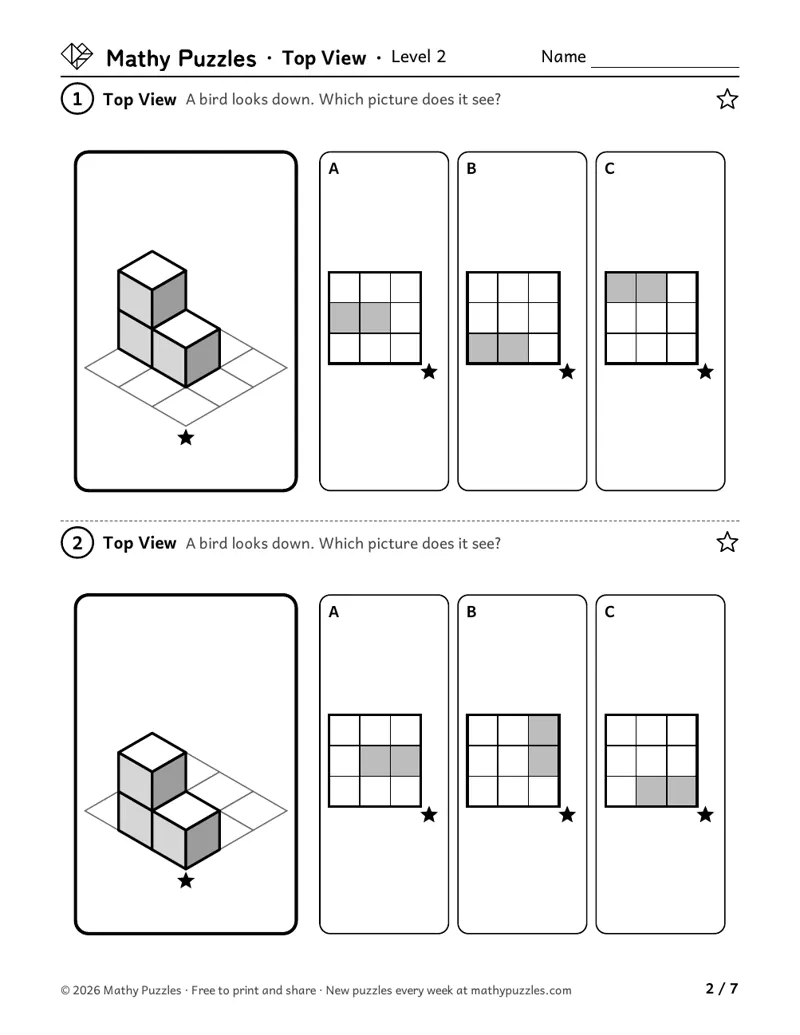 Level 2: a page from the free set
Before starting
- Count to 9
- Know above, front, left and right
- Some play with building blocks
- Level 3: this puzzle's Level 2, or some practice picturing blocks from above
- Level 3: count blocks in a drawn stack
- Level 3: know left and right from someone else's position
- Level 4: read front, side and top views (this puzzle's Level 3)
- Level 4: count and add small numbers
What you need
A few building blocks for checking, and a pencil.
Free puzzles to print
Each set: a Learn sheet with a worked example, 10 puzzles from easiest to hardest, and the answers.
Level 2
Ages 6–8 · Grades 1–2
The easiest puzzles: 3 to 6 blocks, no more than 2 high. Which of 3 views is the one from above?
Next: 4 to 7 blocks, still no more than 2 high. Which of 4 views? One is the mirror image, one is turned, and one has a square moved.
The hardest puzzles: a view from above, and 3 block scenes. Which blocks look like this from above? Up to 8 blocks, stacks up to 3 high.
On the sheet: “Which is the view from above?”
Print Level 2 (Letter)Other paper size: A4The sheet is titled “Top View”.
Level 3
Ages 8–10 · Grades 3–4
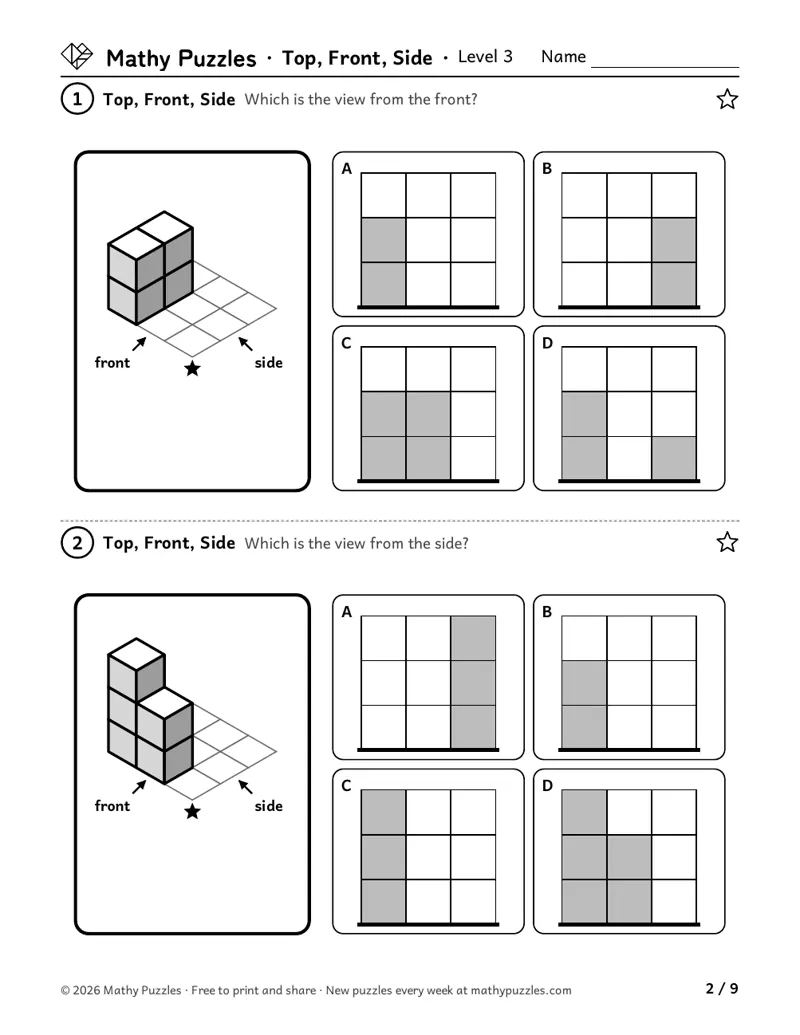
The easiest puzzles: 4 to 7 blocks, stacks up to 3 high. Which is the view from the front (or the side)? Four choices: the right one, its mirror image, the view from the other arrow, and one with a column changed.
Next: a view from above and a view from the front are given. Which of 3 block scenes has both? Each wrong scene matches only one.
Then: the views from above and the front are given. Which is the view from the side? Only puzzles where those two views fix the side view are used.
The hardest puzzles: views from above, the front and the side of 5 to 8 blocks. Which of 4 block scenes has all three? Each wrong scene matches two.
On the sheet: “Which view is it?”
Print Level 3 (Letter)Other paper size: A4Level 4
Ages 10–12 · Grades 5–6
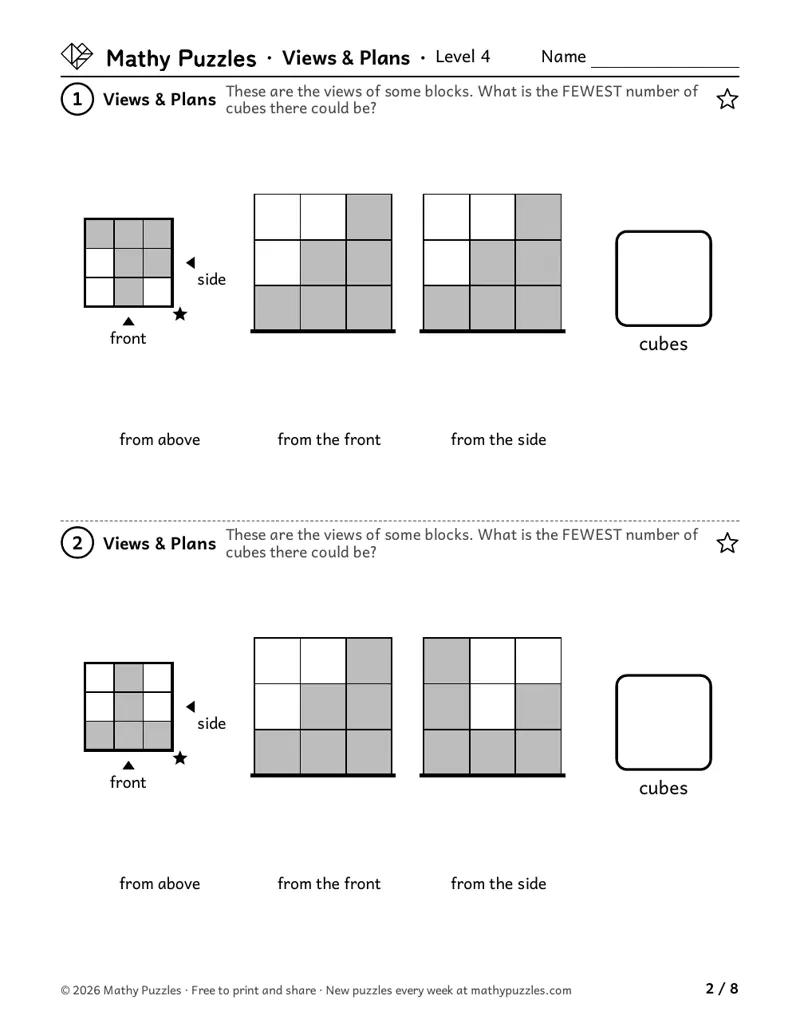
The easiest puzzles: views from above, the front and the side of 5 to 10 cubes on a 3 × 3 mat, stacks up to 3 high. What is the fewest number of cubes there could be?
Next: the same three views. What is the most?
Then: only the top and front views. Shade the view from the side.
The hardest puzzles: the same task on a bigger 4 × 4 mat, stacks up to 4 high, with blocks on 8 or more squares. Each column of the side view now depends on several squares at once.
On the sheet: “Use the views to work out the blocks.”
Print Level 4 (Letter)Other paper size: A4The sheet is titled “Views & Plans”.
How it works
Blocks stand on a small square mat, 3 × 3 (4 × 4 in the hardest Level 4 puzzles). The child matches blocks to the flat pictures you would see from above, from the front or from the side. Level 2 starts with the view from straight above. Level 3 adds the front and side views and asks which blocks fit two or three views at once. Level 4 turns it around: from the views alone, the child works out the fewest and the most cubes there could be, or draws a missing view.
How to play
- Find where you are looking from: straight above (Level 2), or along the "front" or "side" arrow on the mat.
- Look from there, as if you were standing (or flying) in that spot.
- From the front or side, each column of the view is the tallest stack in that line. From above, a square shows if any block stands on it.
- Pick or match the view, or at Level 4 work out the fewest or most cubes. Build it with blocks if you are not sure.
When it gets hard
Adding up all the blocks in a line instead of taking the tallest.
Hint: From the front, a short stack hides behind a tall one. Use the tallest.
Picking the view from the back (the mirror image).
Hint: Stand where the arrow is. Your left is the view's left.
Mixing up the front and side views.
Hint: Say out loud which arrow you are looking along before you choose.
Picking the mirror image.
Hint: Line up the star first. Then check the left and right sides.
Tip for grown-ups: Build the scene, then crouch down together at table height in front of it. Ask what your child sees; then move to the side, or look straight down, and ask again.
Frequently asked questions
- What does "side" mean here?
- The mat has a second arrow marked "side". The side view is what you see looking along that arrow, at the right side of the blocks.
- Why are the stacks drawn so carefully?
- Every scene is checked so the top of every stack shows and no block can hide where the drawing doesn't show it.
- How should I introduce this to my class?
- Build one scene at the front and have children sketch what they see from their seat. Then compare sketches from the front row and the side.
Questions about printing, levels, answers or membership: see all questions.
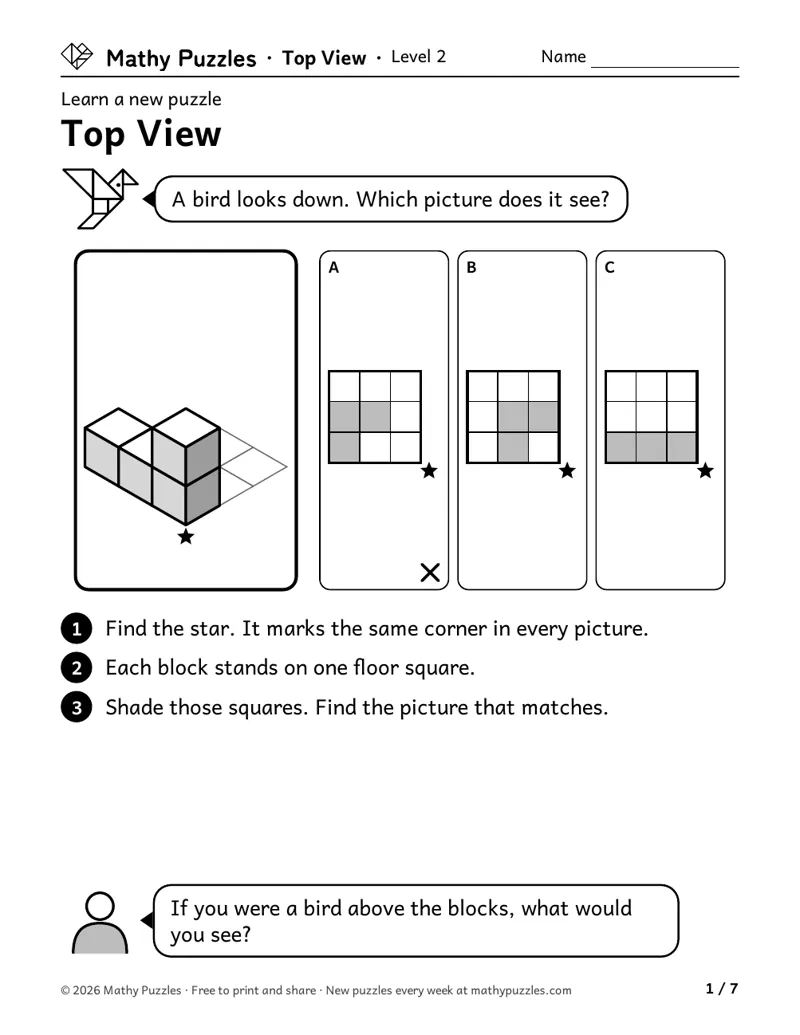
Worked example
From the Level 2 Learn sheet
- A bird looks down. Which picture does it see?
- Find the star. It marks the same corner in every picture.
- Each block stands on one floor square. Find the squares that have blocks.
- Shade those squares in your head, and find the picture that matches.
A question to ask: “If you were a bird above the blocks, what would you see?”
Free every Sunday A mixed bag of 20 new puzzles, all four levels. Get them by email
The thinking it works on
Perspective taking
Pictures the blocks from where the arrow points.
Frick, Möhring and Newcombe (2014) found that picking the photo of a scene taken from another spot was near chance at 4. It jumped between 7 and 8, and still varied widely among 8-year-olds. Source
Knowing what hides behind what
Knows which blocks hide behind others.
Coordinating two views
Puts two flat views together into one scene.
Gutiérrez (1996) studied 11 children in grades 2 to 8. Building a cube model from its side views was the hardest task, and second graders could match only one view at a time. Source
Telling mirror images apart
Keeps left and right from the viewer's side.
In Rigal's (1996) study of 406 children aged 5 to 11, many picked their own view, not the view of a person facing them. Even at 11, only half chose correctly. Source
Working out what must be true
Works out what a view must be from what is given.
Pillow and Pearson (2009) found that by third grade, children rated a conclusion that had to follow from the facts as surer than a guess. They also rated it surer than a good hunch. Source
Linking 3-D and 2-D
Matches solid blocks to a flat picture.
Gutiérrez (1996) ran a small study of children in grades 2 to 8. Second and fourth graders asked to draw one face-on view of a cube model tended to mix in faces seen from other sides. Source
Where is this thinking used?
- Reading building drawings: Architects show a house from the front, the side and above.
- Assembling furniture from a kit: Instruction pictures show the same piece from different sides.
- Engineering and design: A part is drawn as several flat views that together fix its shape.
- Photography: The same object looks different from each side; you choose where to stand.
For teachers
Curriculum areas
- Common Core
- Geometry: position words such as above and in front of (Kindergarten); Measurement: counting unit cubes (Grade 5). No standard covers views.Level 3: No direct curricular match.
- NCERT
- Top, front and side views in Hide and Seek (Maths Mela, Class 4)
- National Curriculum (England)
- Geometry – properties of shapes: 3-D shapes in different orientations (Year 3) and from 2-D drawings (Year 5)Level 2: No direct curricular match.
- Cambridge Primary Mathematics
- Geometry and measure: drawings of 3D shapes, 3D shapes in different orientations, shapes made of several parts (Stages 3–6)
Math practices: see the box below.
Math practices this puzzle uses
- Not used: MP1 Make sense of problems and persevere in solving them
- Not used: MP2 Reason abstractly and quantitatively
- Not used: MP3 Construct viable arguments and critique the reasoning of others
- Not used: MP4 Model with mathematics
- Uses: MP5 Use appropriate tools strategically
- Uses: MP6 Attend to precision
- Not used: MP7 Look for and make use of structure
- Not used: MP8 Look for and express regularity in repeated reasoning
From the Common Core Standards for Mathematical Practice.
More Top, Front, Side puzzles for members
Members get at least 5 more worksheets at each difficulty for every puzzle, 80 new puzzles every Sunday, and the whole archive. $39 a year or $25 for 6 months.
See membershipNot ready yet?
One email, all four levels: 20 puzzles, 5 for each level.
For grown-ups (18+). One email every Sunday with the puzzles and the odd note about membership; unsubscribe any time. We never ask about your child. How we use your email