
Painted Cubes
Dip a block made of little cubes in paint, then pull it apart. Some little cubes got paint on three faces, some on two, some on none, and where each one sat tells you which. The trick is to count the groups, not every cube.
Free sets by level, ages 10–12:
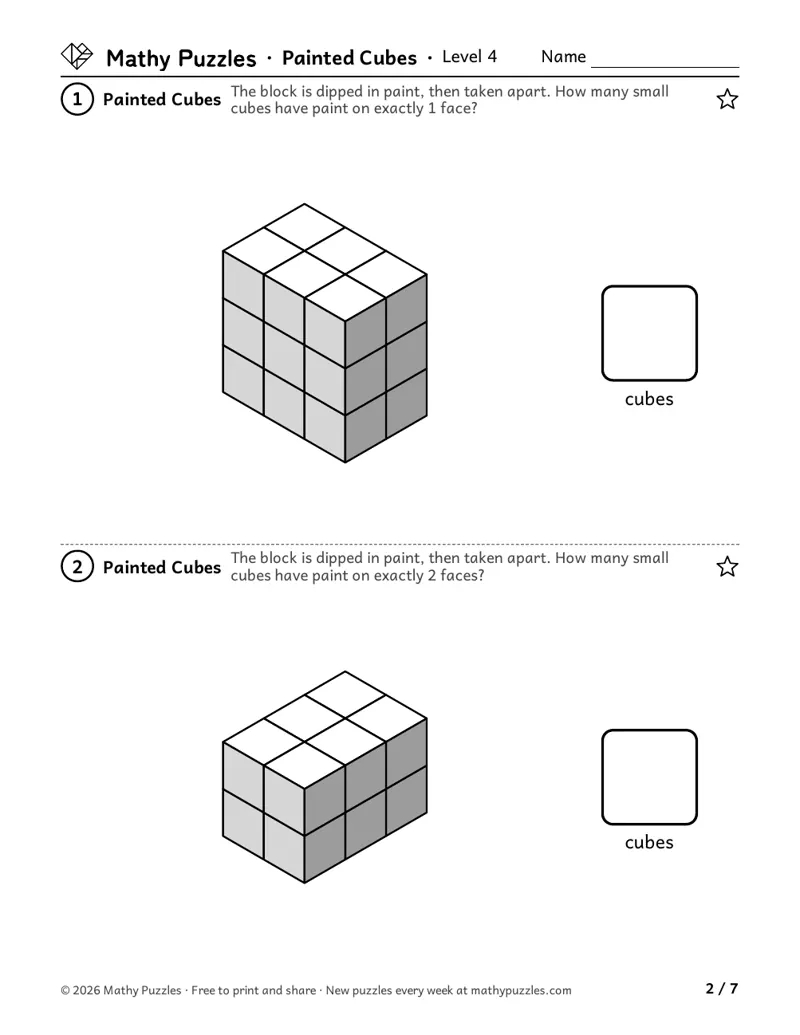 Level 4: a page from the free set
Before starting
- Count cubes in a drawn block, including hidden ones (Count the Cubes)
- Multiply small numbers
- Know the corner, edge and face of a cube
What you need
Building blocks or sugar cubes, and small stickers if you have them, for the first few puzzles; and a pencil.
Free puzzles to print
Each set: a Learn sheet with a worked example, 10 puzzles from easiest to hardest, and the answers.
Level 4
Ages 10–12 · Grades 5–6
The easiest puzzles: a 3 × 3 × 3 cube or a small box shape with sides of 2 or 3. How many small cubes have 3, 2, 1 or no painted faces?
Next: a 4 × 4 × 4 cube or a bigger box shape (sides up to 5).
Then: a 3 × 3 × 3 or 4 × 4 × 4 cube with some corner cubes taken out, or a square tunnel straight through. It is painted after, so the gap's walls get paint too, and a small cube can end up with 4 painted faces.
The hardest puzzles work backward: the child is told how many cubes have each amount of paint and finds the size of the block.
On the sheet: “The block is dipped in paint, then taken apart.”
Print Level 4 (Letter)Other paper size: A4
How it works
A big block is built from small cubes, dipped in paint, then taken apart. The child works out how many small cubes have paint on exactly 3 faces, or 2, or 1, or none (and, when cubes are taken out, sometimes 4). In the hardest puzzles the child works backward from the counts to the size of the block.
How to play
- Read how many painted faces the question asks for.
- Decide where cubes like that sit: corners, edges, the middle of faces, or inside.
- Count them on one edge or one face, then multiply by how many edges or faces there are.
- Write the number. For a block with gaps, look for cubes next to the gap: they get extra paint.
When it gets hard
Counting the corner cubes again as edge cubes.
Hint: An edge cube with 2 faces is between the corners. On a 4-long edge, that is 2 cubes, not 4.
Forgetting the faces underneath and at the back.
Hint: Dipped means every outside face gets paint, even the ones you can't see.
Forgetting the cubes hidden inside have no paint.
Hint: Take off the outer layer in your head. What is left inside has no paint.
Tip for grown-ups: Build a 3 × 3 × 3 block of small cubes and put small stickers on every outside face. Take it apart and sort the cubes into piles by number of stickers.
Frequently asked questions
- Is the bottom painted too?
- Yes. The block is dipped, so every outside face gets paint, including the bottom and the back.
- My child counts every cube one by one. Is that OK?
- It works on small blocks, and it is a fine start. On a 4 × 4 × 4 block, suggest counting along one edge and multiplying.
- How do I explain this to a whole class?
- Build one 3 × 3 × 3 block from linking cubes at the front. Take off one corner, one edge cube and one face cube, and ask how many painted faces each had.
Questions about printing, levels, answers or membership: see all questions.
Worked example
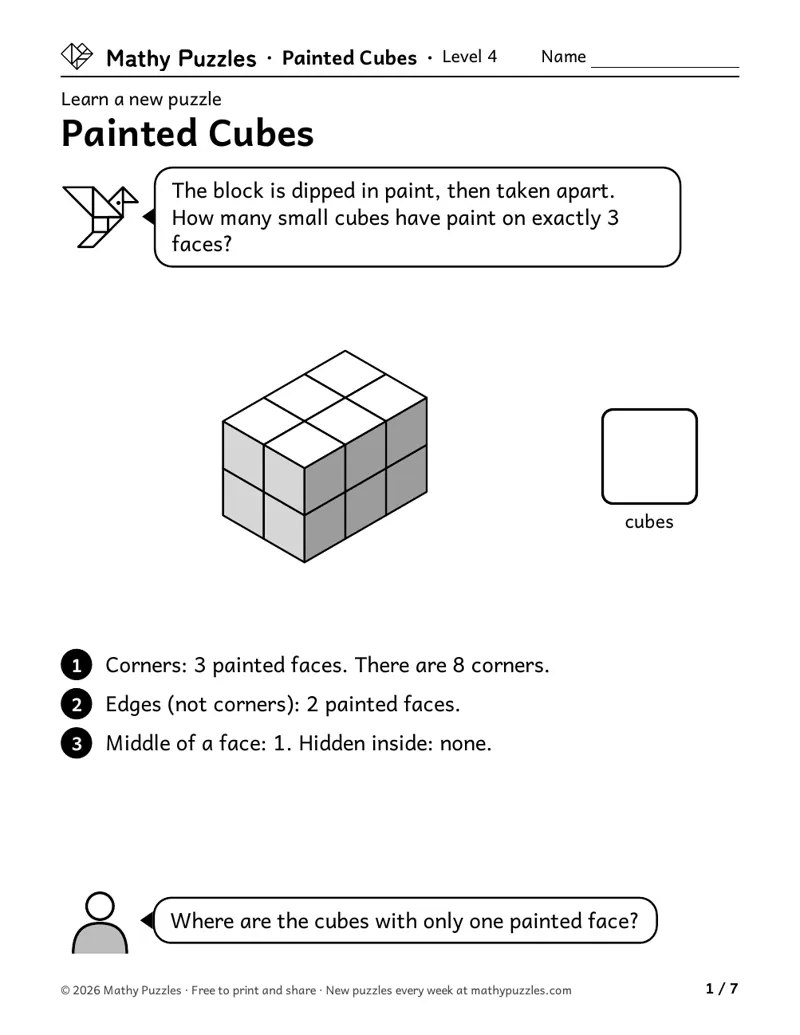
From the Level 4 Learn sheet
- The block is dipped in paint, then taken apart. How many small cubes have paint on the faces asked?
- Corner cubes have 3 painted faces. A plain block has 8 corners.
- Cubes along an edge, not at a corner, have 2. Cubes in the middle of a face have 1.
- Cubes hidden inside have no paint. Count only the group the question asks about.
A question to ask: “Where are the cubes with only one painted face?”
Free every Sunday A mixed bag of 20 new puzzles, all four levels. Get them by email
The thinking it works on
Counting by groups
Counts cubes by where they sit, not one by one.
Battista and Clements (1996) found that children first see a drawn block of cubes as a loose set of faces. Only those who come to see it as filled space count it in layers or groups. Source
Visualizing hidden parts
Pictures cubes that the drawing can't show.
Ben-Chaim, Lappan and Houang (1985) found that students in grades 5 to 8 find it hard to match a drawn solid made of small cubes to the solid. Source
Seeing a pattern as size grows
Notices how each group changes with the block's size.
Lannin, Barker and Townsend (2006) watched 25 sixth graders work on growing patterns. Moving from 'add the same amount each time' to a rule that gives any size directly was hard for them. Source
Reasoning about change
Works out how a gap changes the paint.
Working backward
Goes from the counts to the block.
Where is this thinking used?
- Building and tiling: Corner, edge and middle pieces are counted separately.
- Packing boxes: Items on the outside of a stack are the ones that show or get wet.
- Ordering materials for a project: Counting by type is faster than counting one by one.
- Baking a sheet cake: Corner pieces get the most frosting; middle pieces get the least.
For teachers
Curriculum areas
- Common Core
- Measurement: volume by counting unit cubes and multiplying edge lengths (Grade 5)
- NCERT
- The painted-cube puzzle in Shapes and Patterns (Maths Mela, Class 5)
- National Curriculum (England)
- Number: cube numbers (Year 5); Measurement: volume of cubes and cuboids (Year 6); faces, edges and vertices of cubes in 3-D problems (Key Stage 3)
- Cambridge Primary Mathematics
- Number: cube numbers (Stage 6); Geometry and measure: faces on the surface of 3D shapes (Stage 6)
Math practices: see the box below.
Math practices this puzzle uses
- Not used: MP1 Make sense of problems and persevere in solving them
- Not used: MP2 Reason abstractly and quantitatively
- Not used: MP3 Construct viable arguments and critique the reasoning of others
- Not used: MP4 Model with mathematics
- Not used: MP5 Use appropriate tools strategically
- Not used: MP6 Attend to precision
- Uses: MP7 Look for and make use of structure
- Uses: MP8 Look for and express regularity in repeated reasoning
From the Common Core Standards for Mathematical Practice.
More Painted Cubes puzzles for members
Members get at least 5 more worksheets at each difficulty for every puzzle, 80 new puzzles every Sunday, and the whole archive. $39 a year or $25 for 6 months.
See membershipNot ready yet?
One email, all four levels: 20 puzzles, 5 for each level.
For grown-ups (18+). One email every Sunday with the puzzles and the odd note about membership; unsubscribe any time. We never ask about your child. How we use your email