
Sorting Box
A library shelf puts each book by subject and by author. A Sorting Box does the same with pictures: one question picks the row, another picks the column, and the picture goes where they meet.
Free sets by level, ages 4–10:
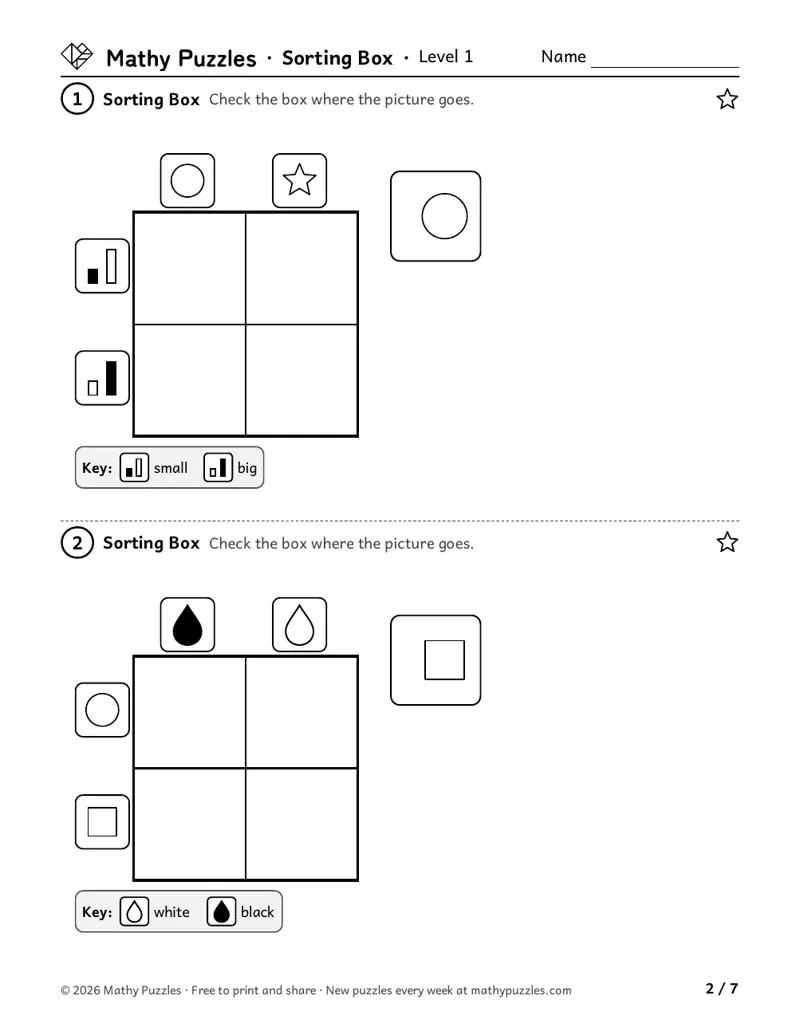 Level 1: a page from the free set
Before starting
- Level 1: name a circle, square, triangle and star; tell big from small; draw a line
- Level 2: write capital letters
- Level 3: test a card against every picture; read even, odd and "more than"; know the multiples of 5 and 10 up to 50
Free puzzles to print
Each set: a Learn sheet with a worked example, 10 puzzles from easiest to hardest, and the answers.
Level 1
Ages 4–6 · Pre-K–K
One picture to check in its square, then three or four pictures to join with lines. The hardest puzzles use "not" cards (a card with a slash).
On the sheet: “Put each picture in its box.”
Print Level 1 (Letter)Other paper size: A4Level 2
Ages 6–8 · Grades 1–2
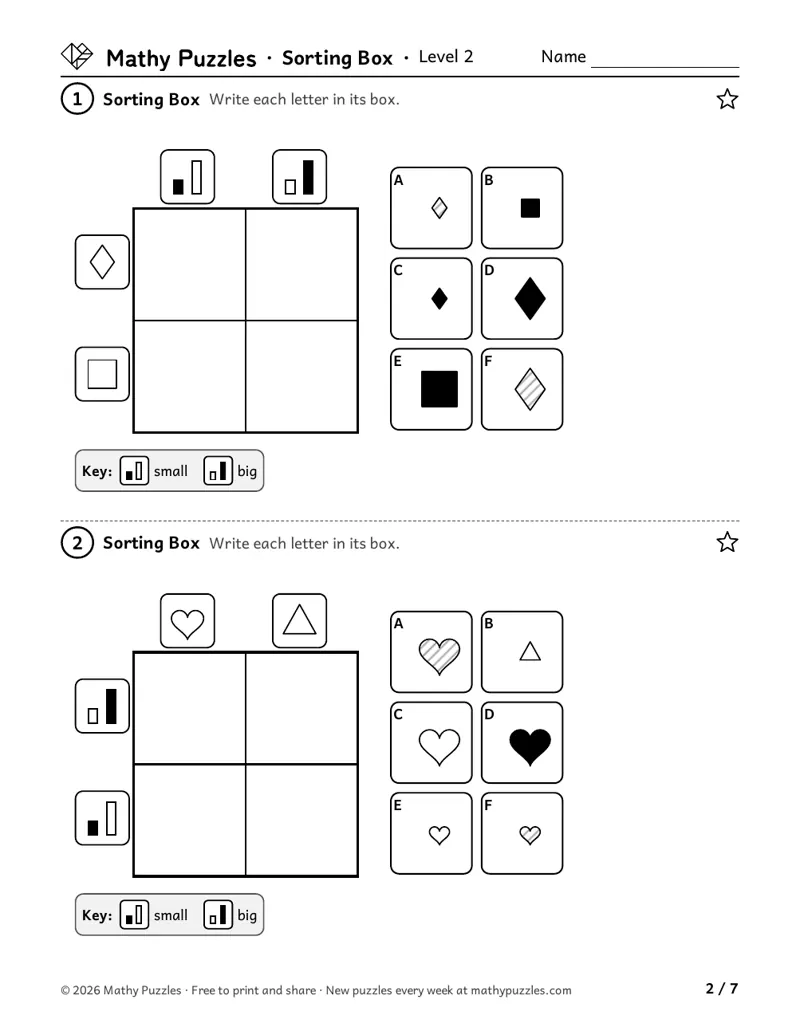
Six pictures to sort by letter; then find the two cards from four. Then find the one picture in the wrong square. The hardest puzzles use a box with three columns, one for each fill.
On the sheet: “Put each picture in its box.”
Print Level 2 (Letter)Other paper size: A4Level 3
Ages 8–10 · Grades 3–4
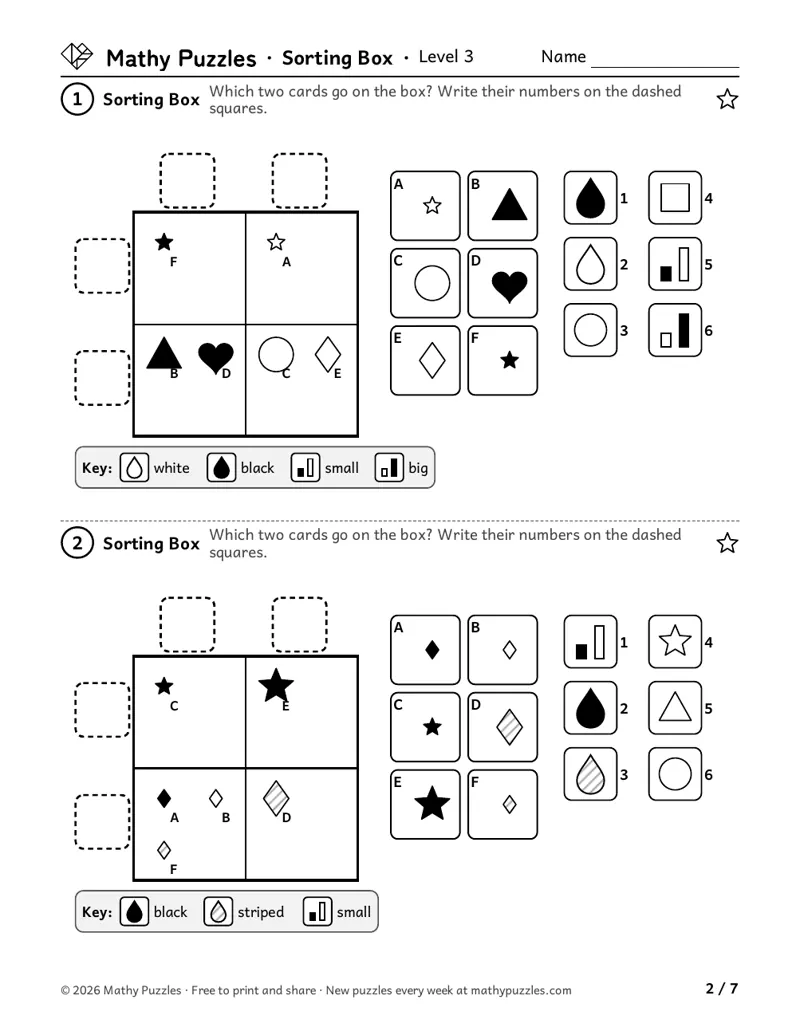
Six sorted pictures and six cards, and the child finds the row card and the column card. Then a box sorted by three features at once (one row card, two layers of column cards, eight squares). The hardest puzzles sort numbers to 50 into a box with word labels, such as even or odd, more than 20, or a multiple of 5.
On the sheet: “Put each picture in its box.”
Print Level 3 (Letter)Other paper size: A4
How it works
Each puzzle is a box split into rows and columns, two of each (three columns in the hardest Level 2 puzzles). A picture card beside each row and on top of each column says what goes there: a shape, a fill, or small and big. Each picture goes in the square where its row and its column meet. Harder puzzles use "not" cards, ask which picture is in the wrong square, or show the pictures already sorted and ask which cards go on the box. Level 3 also sorts by three features at once, and sorts numbers to 50 with word labels such as even and odd.
How to play
- Read the row cards and the column cards.
- Take one picture. Find its row.
- Find its column.
- Draw a line, or write its letter, where the row and column meet.
When it gets hard
Using only the row card.
Hint: Every picture needs two answers: its row and its column.
Reading a slashed card as the shape itself.
Hint: A slash means "not": everything except that.
Taking the bars card for a shape.
Hint: Bars mean size. The filled bar says small or big.
Level 3: putting the edge number in "more than".
Hint: "More than 20" does not include 20 itself. Twenty goes in "20 or less".
Tip for grown-ups: Make a sorting box on the table with masking tape and sort socks or blocks by two things, such as color and size. The paper box then feels familiar.
Frequently asked questions
- What is the slash on some cards?
- A slash means "not". A circle card with a slash means "not a circle", so every other shape goes there. It appears in the hardest Level 1 puzzles and in the Level 3 boxes that sort by three features.
- Is this the same as a Carroll diagram?
- Yes. A table sorted by two rules is often called a Carroll diagram, after Lewis Carroll. We call it a Sorting Box for children.
- Does my 4-year-old need to read?
- No. Every card is a picture, and a panel shows what each card means. A grown-up can read the one-line instruction.
Questions about printing, levels, answers or membership: see all questions.
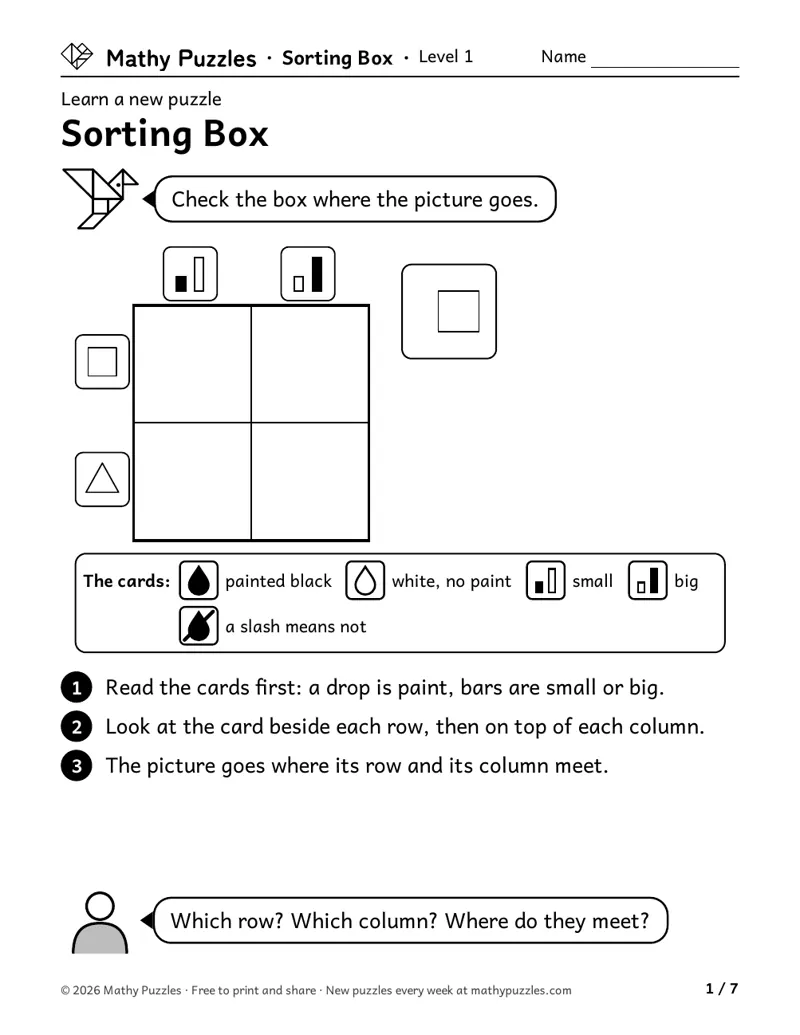
Worked example
From the Level 1 Learn sheet
- Read the cards first: a drop is paint, bars are small or big.
- Look at the card beside each row, then on top of each column.
- The picture goes where its row and its column meet.
A question to ask: “Which row? Which column? Where do they meet?”
Free every Sunday A mixed bag of 20 new puzzles, all four levels. Get them by email
The thinking it works on
Sorting by two features at once
Places a picture by two features together.
Podjarny, Kamawar and Andrews (2022) studied 4- and 5-year-olds. They could fill a gap in a grid by thinking about two features of a picture at the same time. Source
Reading a table by row and column
Finds the square where a row and a column meet.
Understanding "not"
Reads a slashed card as "everything except".
Working back to the rules
Reads the row and column cards off a finished sort.
Huizinga, Dolan and van der Molen (2006) tested 7-, 11-, 15- and 21-year-olds on working out a hidden sorting rule from feedback. At every age, holding information in mind was the strongest predictor of how well they did. Source
Spotting the misfit
Finds the one picture in the wrong square.
Sorting numbers by their properties
Places a number by two facts about it.
Where is this thinking used?
- Laundry: Lights or darks, and hot wash or cold.
- Charts: A two-way chart shows who likes which snack.
- Storage: Shelves split by size one way and by kind the other.
- Shops: Shoes sorted by size along the rows and by style down the columns.
For teachers
Curriculum areas
- Common Core
- Measurement and data: sorting into given categories (Kindergarten) and organizing data (Grade 1); Operations and algebraic thinking: even and odd (Grade 2) and multiples (Grade 4)
- NCERT
- Joyful Mathematics (Class 1): sorting objects into groups; Maths Mela (Class 4): even and odd numbers and multiples
- Computer science (CSTA)
- Sorting information into a table by its features (data and analysis, ages 8–11)Levels 1–2: No direct curricular match.
- National Curriculum (England)
- Geometry: comparing and sorting shapes and objects (Year 2); Number: odd and even numbers (Year 2) and multiples (Year 5)
- Cambridge Primary Mathematics
- Statistics: sorting into Carroll diagrams (Stages 1–3); Number: even and odd numbers, multiples of 2, 5 and 10 (Stage 3)
Math practices: see the box below.
Math practices this puzzle uses
- Not used: MP1 Make sense of problems and persevere in solving them
- Not used: MP2 Reason abstractly and quantitatively
- Not used: MP3 Construct viable arguments and critique the reasoning of others
- Not used: MP4 Model with mathematics
- Not used: MP5 Use appropriate tools strategically
- Uses: MP6 Attend to precision
- Uses: MP7 Look for and make use of structure
- Not used: MP8 Look for and express regularity in repeated reasoning
From the Common Core Standards for Mathematical Practice.
More Sorting Box puzzles for members
Members get at least 5 more worksheets at each difficulty for every puzzle, 80 new puzzles every Sunday, and the whole archive. $39 a year or $25 for 6 months.
See membershipNot ready yet?
One email, all four levels: 20 puzzles, 5 for each level.
For grown-ups (18+). One email every Sunday with the puzzles and the odd note about membership; unsubscribe any time. We never ask about your child. How we use your email