
Slice It
Slice a block of cheese straight down and the cut face is a rectangle. Slice off a corner and it is a triangle. Slice It asks a child to picture the cut face before the knife goes in.
Free sets by level, ages 10–12:
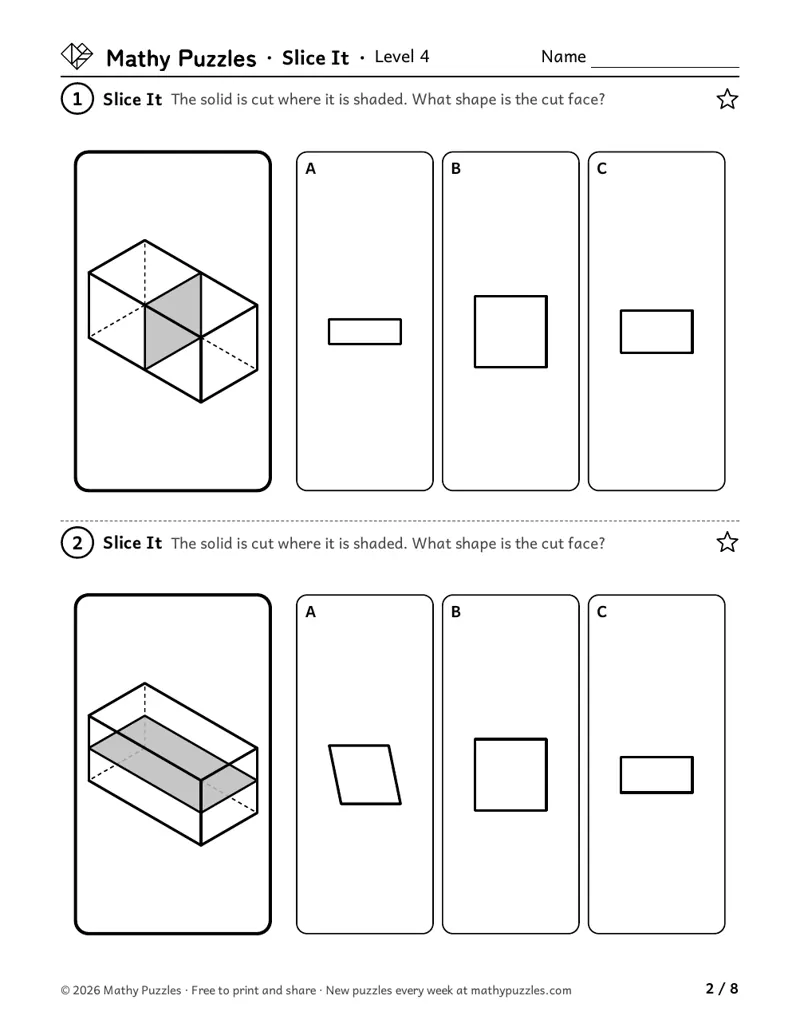 Level 4: a page from the free set
Before starting
- Name squares, rectangles, triangles, pentagons and hexagons
- Know the faces of a box, a prism and a pyramid
- Know what a right angle (square corner) is
What you need
A block of modeling clay, a potato or a block of cheese to slice and look at (optional), and a pencil.
Free puzzles to print
Each set: a Learn sheet with a worked example, 10 puzzles from easiest to hardest, and the answers.
Level 4
Ages 10–12 · Grades 5–6
The easiest puzzles: a box shape with one flat cut, the cut face shaded.
Next: a triangular prism or a square pyramid, the cut face shaded.
Then: a cube cut on a slant, with no shading. Dots mark where the cut crosses the edges; the face can be a triangle, a rectangle, a pentagon or a hexagon.
The hardest puzzles work backward: a shape and three cubes, each marked with the dots of a cut. Which cut makes the shape?
On the sheet: “The solid is cut flat. What shape is the cut face?”
Print Level 4 (Letter)Other paper size: A4
How it works
Each puzzle shows a solid, such as a box, a prism, a pyramid or a cube, cut with one flat cut. The child picks the shape of the new cut face from 3 drawings. The wrong drawings have the same number of corners as the right one, so the child must also think about equal sides and square corners.
How to play
- Find the cut: the shaded part, or the dots on the edges.
- Count how many faces of the solid the cut crosses. That is how many sides the cut face has.
- Look at the sides: which are equal, and which meet at a square corner?
- Pick the drawing that matches.
When it gets hard
Picking a drawing by how the shaded part looks on the page.
Hint: The drawing is slanted to show depth. A square cut can look like a diamond. Think about the real sides.
Counting corners only.
Hint: All three choices have the same number of corners. Check equal sides and square corners too.
Thinking a slanted cut through a cube must be a square or a rectangle.
Hint: A slanted cut can make a triangle, a pentagon or even a hexagon. Count the faces it crosses.
Tip for grown-ups: Slice a block of cheese, a potato or modeling clay at different angles and look at the cut face together. Let your child predict the shape before each cut.
Frequently asked questions
- Isn't this grade 7 math?
- Grade 7 names cross-sections formally. Here the child only pictures a cut and matches a shape, using shape names learned by grade 5.
- Why do all three choices have the same number of corners?
- So counting corners is not enough. The child has to look at which sides are equal and which corners are square.
- Can I use this as a class warm-up?
- Yes. Show one puzzle, let everyone pick, then cut a clay block at the front to check.
Questions about printing, levels, answers or membership: see all questions.
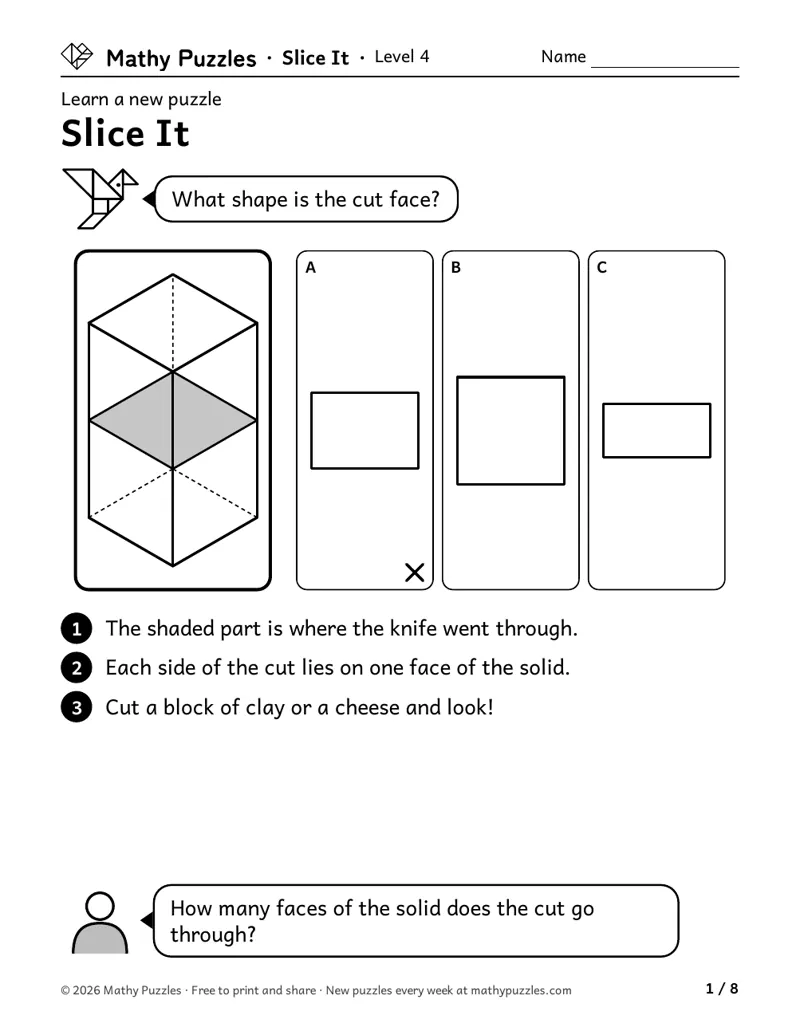
Worked example
From the Level 4 Learn sheet
- What shape is the cut face?
- The shaded part is where the knife went through.
- Count its sides. Each side lies on one face of the solid.
- Two choices may have the same number of sides. Check which sides are equal and which corners are square, then pick.
A question to ask: “How many faces of the solid does the cut go through?”
Free every Sunday A mixed bag of 20 new puzzles, all four levels. Get them by email
The thinking it works on
Picturing the cut face
Pictures the flat face a cut leaves.
Duroisin and Demeuse (2016) tested 276 pupils aged 8 to 14 on the print or cut face a solid leaves. Average scores rose from about 38% at age 8 to 67% at 14. Source
Reading a 3-D drawing
Sees past the slant of a drawing.
Ben-Chaim, Lappan and Houang (1985) found that many students in grades 5 to 8 struggle to link a slanted drawing of a solid with the real solid. Source
Sorting shapes by sides and corners
Uses equal sides and square corners, not just corner count.
Burger and Shaughnessy (1986) interviewed students from grade 1 to grade 12 about triangles and four-sided shapes. Their reasoning moved through levels, from judging a shape by its look to sorting it by properties such as equal sides and right angles. Source
Linking faces and edges
Ties each side of the cut to one face of the solid.
Working backward
Matches a shape to the cut that makes it.
Where is this thinking used?
- Cooking: Slicing a loaf, a cucumber or a block of cheese gives a cut face with its own shape.
- Medical scans: A scan shows a body as a stack of flat slices.
- Woodwork: The angle of a saw cut decides the shape of the new face.
- Reading building plans: A section drawing shows a building as if sliced through.
For teachers
Curriculum areas
- Common Core
- Geometry: classifying flat shapes by their sides and angles (Grades 4–5); a first look at slicing solids, which Grade 7 covers
- NCERT
- No direct curricular match.
- National Curriculum (England)
- Geometry – properties of shapes: regular and irregular polygons (Year 5); classifying shapes by their properties (Year 6); solids in 3-D problems (Key Stage 3)
- Cambridge Primary Mathematics
- Geometry and measure: faces of 3D shapes; classifying triangles and quadrilaterals (Stages 4–6)
Math practices: see the box below.
Math practices this puzzle uses
- Not used: MP1 Make sense of problems and persevere in solving them
- Not used: MP2 Reason abstractly and quantitatively
- Not used: MP3 Construct viable arguments and critique the reasoning of others
- Not used: MP4 Model with mathematics
- Not used: MP5 Use appropriate tools strategically
- Uses: MP6 Attend to precision
- Uses: MP7 Look for and make use of structure
- Not used: MP8 Look for and express regularity in repeated reasoning
From the Common Core Standards for Mathematical Practice.
More Slice It puzzles for members
Members get at least 5 more worksheets at each difficulty for every puzzle, 80 new puzzles every Sunday, and the whole archive. $39 a year or $25 for 6 months.
See membershipNot ready yet?
One email, all four levels: 20 puzzles, 5 for each level.
For grown-ups (18+). One email every Sunday with the puzzles and the odd note about membership; unsubscribe any time. We never ask about your child. How we use your email