
Ship Hunt
In the old pencil game of hidden ships, players guess. Here no guessing is needed. The numbers say how many ship parts are in each line, and marking the open sea first leaves the ships fewer places to be.
Free sets by level, ages 6–12:
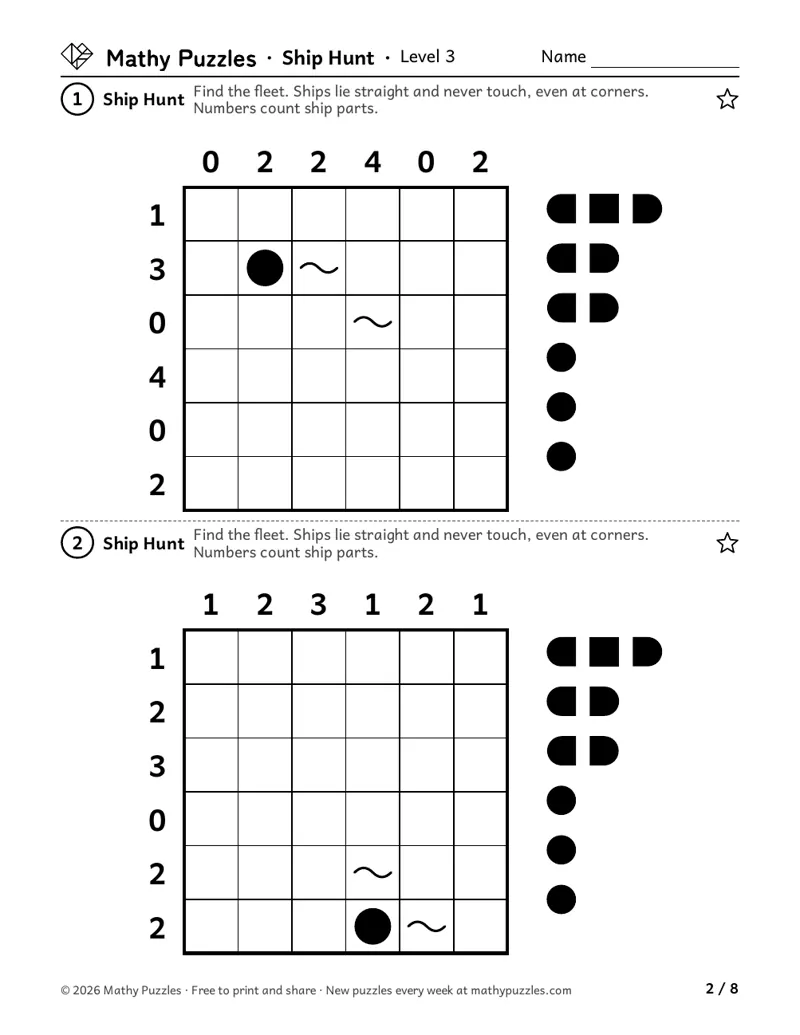 Level 3: a page from the free set
Before starting
- Count to 8
- Know rows (across) and columns (down)
- Match a ship drawing to a row of squares
- Level 2: a grown-up nearby for the first puzzle
Free puzzles to print
Each set: a Learn sheet with a worked example, 10 puzzles from easiest to hardest, and the answers.
Level 2
Ages 6–8 · Grades 1–2
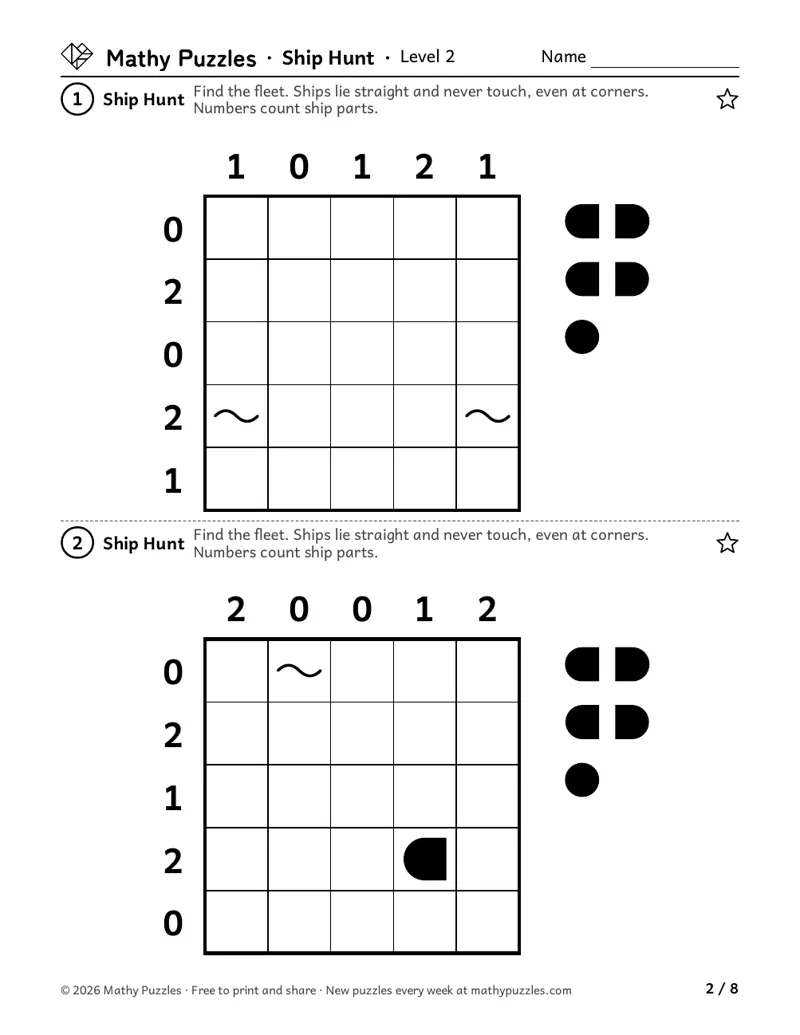
A 5 × 5 sea throughout. First come three small ships (two 2-square ships and a 1-square ship) with 2 to 4 pieces shown. Then a 3-square, a 2-square and a 1-square ship. The hardest have four ships (3, 2, 1 and 1 squares) with only 1 or 2 pieces shown.
On the sheet: “Find the fleet. Ships lie straight and never touch, even at corners. Numbers count ship parts.”
Print Level 2 (Letter)Other paper size: A4Level 3
Ages 8–10 · Grades 3–4
A 6 × 6 sea with six ships (one 3-square, two 2-square and three 1-square). Fewer pieces are shown as puzzles get harder, and the hardest need "biggest ship first".
On the sheet: “Find the fleet. Ships lie straight and never touch, even at corners. Numbers count ship parts.”
Print Level 3 (Letter)Other paper size: A4Level 4
Ages 10–12 · Grades 5–6
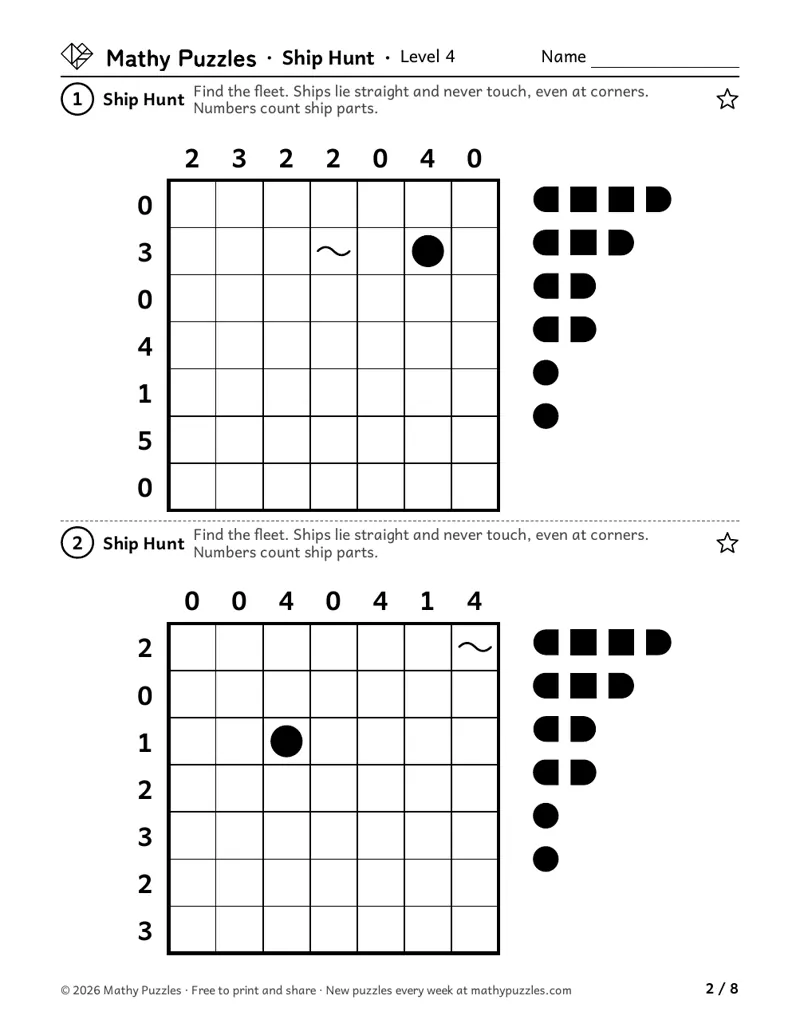
A 7 × 7 sea with six ships led by a 4-square ship, then 8 × 8 with eight ships. Every puzzle needs "biggest ship first", and the hardest need one "what if" test.
On the sheet: “Find the fleet. Ships lie straight and never touch, even at corners. Numbers count ship parts.”
Print Level 4 (Letter)Other paper size: A4
How it works
Each puzzle is a square sea with numbers along the top and side, and a fleet of ships drawn beside it. The child finds where every ship hides. Ships lie straight, across or down, and never touch, not even at the corners. Each number says how many ship parts are in its row or column. A few pieces are shown to start: an end piece points along its ship, a round piece is a one-square ship, and a wave is open sea.
How to play
- Dot every square in a row or column marked 0. That is open sea.
- Read the shown pieces. An end piece points along its ship; a round piece is a one-square ship with sea all around.
- Ships never touch, even at corners. Dot the corner squares around every ship part.
- Find where the biggest ship can still fit. Cross ships off the fleet picture as you place them.
When it gets hard
Letting two ships touch at a corner.
Hint: After placing any ship part, dot the four squares at its corners.
Losing track of which ships are found.
Hint: Cross each ship off the fleet picture as soon as it is placed.
Reading an end piece the wrong way round.
Hint: The ship carries on from the end piece the way it points. Its other three sides are sea.
Tip for grown-ups: If your child knows the guessing game with hidden ships, point out the difference: here nobody guesses. The numbers and the shown pieces do the work.
Frequently asked questions
- Is this like the guessing game with hidden ships?
- It borrows the idea of a hidden fleet, but there is no guessing and no second player. The numbers and the shown pieces are meant to lead to every ship.
- Why is Level 2 so much smaller than Level 3?
- Level 2 is a gentle first look: a 5 × 5 sea, three or four small ships and a few pieces shown. Level 3 adds a bigger sea, a fleet of six and fewer helping pieces.
Questions about printing, levels, answers or membership: see all questions.
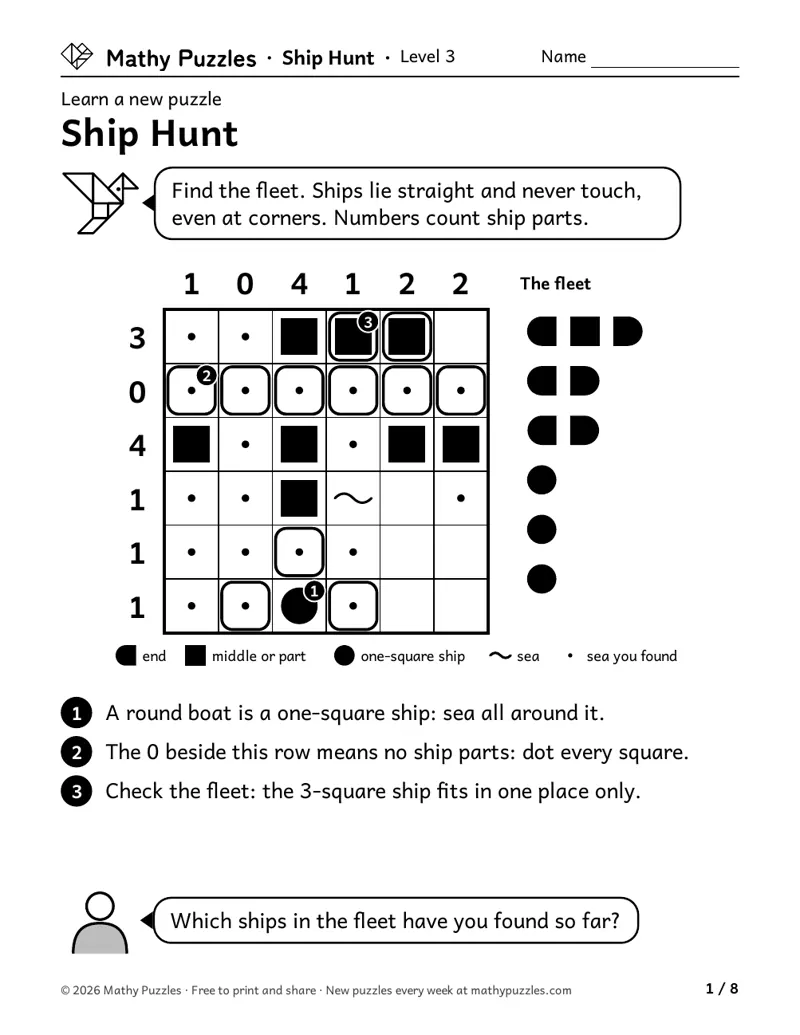
Worked example
From the Level 3 Learn sheet
- Find the fleet. Ships lie straight and never touch, even at corners. Numbers count ship parts.
- The end piece points along its ship. Its other sides are sea.
- A row with all its ship parts found: dot the rest. A row that needs every open square: fill them.
- Check the fleet: the biggest ship fits in one place only.
A question to ask: “Which ships in the fleet have you found so far?”
Free every Sunday A mixed bag of 20 new puzzles, all four levels. Get them by email
The thinking it works on
Reasoning by elimination
Marks open sea to narrow down where ships can be.
Galotti, Komatsu and Voelz (1997) studied children in grades 2 to 5. They answered faster and felt surer when a conclusion had to follow than when it was only likely. Source
Counting in rows and columns
Compares a row's number with the parts found and the squares left.
Fitting lengths into gaps
Works out where a ship of a given length can still fit.
Keeping track of what is left
Uses the fleet picture as a checklist.
In children aged 4 to 11, Alloway, Gathercole and Pickering (2006) found all the parts of working memory already in place by 4. There were separate stores for words and for pictures in space. Source
Planning: biggest first
Places the longest ship first, because it has the fewest places to go.
Albert and Steinberg (2011) found that planning several moves ahead is still developing from age 10 into the early twenties. Source
Testing a "what if"
Tries a ship part in one square and sees whether the fleet still fits.
Where is this thinking used?
- Packing a car trunk: Fitting the longest things first, then filling the gaps.
- Parking: Cars of different lengths fit along a street with space kept between them.
- Planting a garden: Spacing plants so none crowds its neighbor.
- Searching an area: Ruling out empty places one by one to narrow down where something is.
For teachers
Curriculum areas
- Common Core
- No direct curricular match.
- NCERT
- No direct curricular match.
- National Curriculum (England)
- No direct curricular match.
- Cambridge Primary Mathematics
- No direct curricular match.
Math practices: see the box below.
Math practices this puzzle uses
- Uses: MP1 Make sense of problems and persevere in solving them
- Not used: MP2 Reason abstractly and quantitatively
- Not used: MP3 Construct viable arguments and critique the reasoning of others
- Not used: MP4 Model with mathematics
- Not used: MP5 Use appropriate tools strategically
- Uses: MP6 Attend to precision
- Not used: MP7 Look for and make use of structure
- Not used: MP8 Look for and express regularity in repeated reasoning
From the Common Core Standards for Mathematical Practice.
More Ship Hunt puzzles for members
Members get at least 5 more worksheets at each difficulty for every puzzle, 80 new puzzles every Sunday, and the whole archive. $39 a year or $25 for 6 months.
See membershipNot ready yet?
One email, all four levels: 20 puzzles, 5 for each level.
For grown-ups (18+). One email every Sunday with the puzzles and the odd note about membership; unsubscribe any time. We never ask about your child. How we use your email