
Shape Series
A flip-book changes a little on every page: an arm lifts, a ball drops. A shape series is the same, each picture one small step from the last, so saying what changes is how you find the next one.
Free sets by level, ages 4–12:
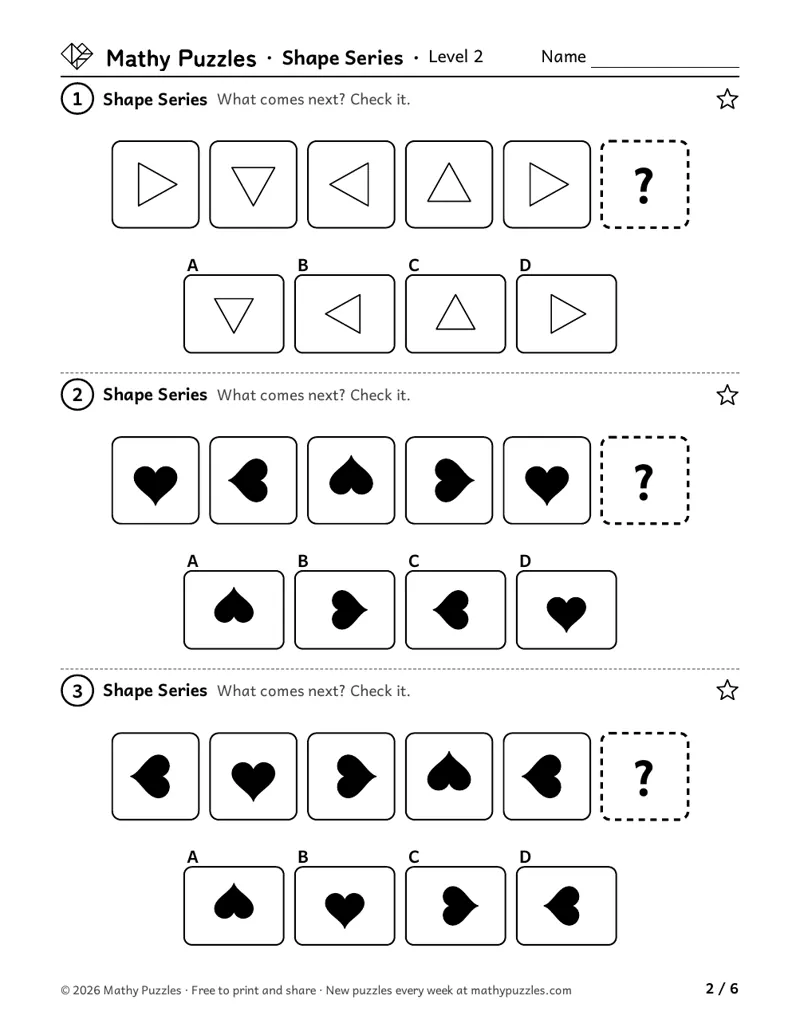 Level 2: a page from the free set
Before starting
- Level 1: count to 5 and know a quarter turn
- Level 2: shading names (white, striped, black)
- Level 3: eighth turns and jumps that grow
- Level 4: follow two rules that take turns
Free puzzles to print
Each set: a Learn sheet with a worked example, 10 puzzles from easiest to hardest, and the answers.
Level 1
Ages 4–6 · Pre-K–K
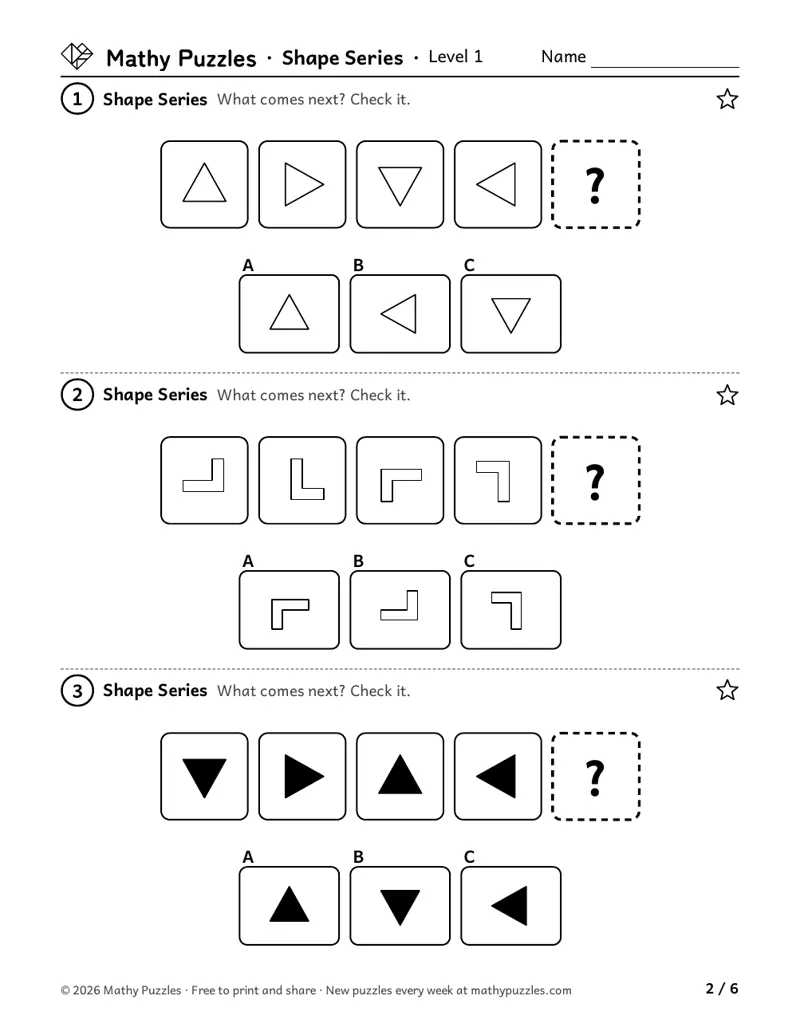
Four pictures and three options; a quarter turn each step, then one more each step, then both together.
On the sheet: “What comes next? Check it.”
Print Level 1 (Letter)Other paper size: A4Level 2
Ages 6–8 · Grades 1–2
Five pictures and four options. First one change (a turn, or one more or one fewer each step), then two at once. Then a shading cycle (white, striped, black, and again). The hardest puzzles make three changes at once.
On the sheet: “What comes next? Check it.”
Print Level 2 (Letter)Other paper size: A4Level 3
Ages 8–10 · Grades 3–4
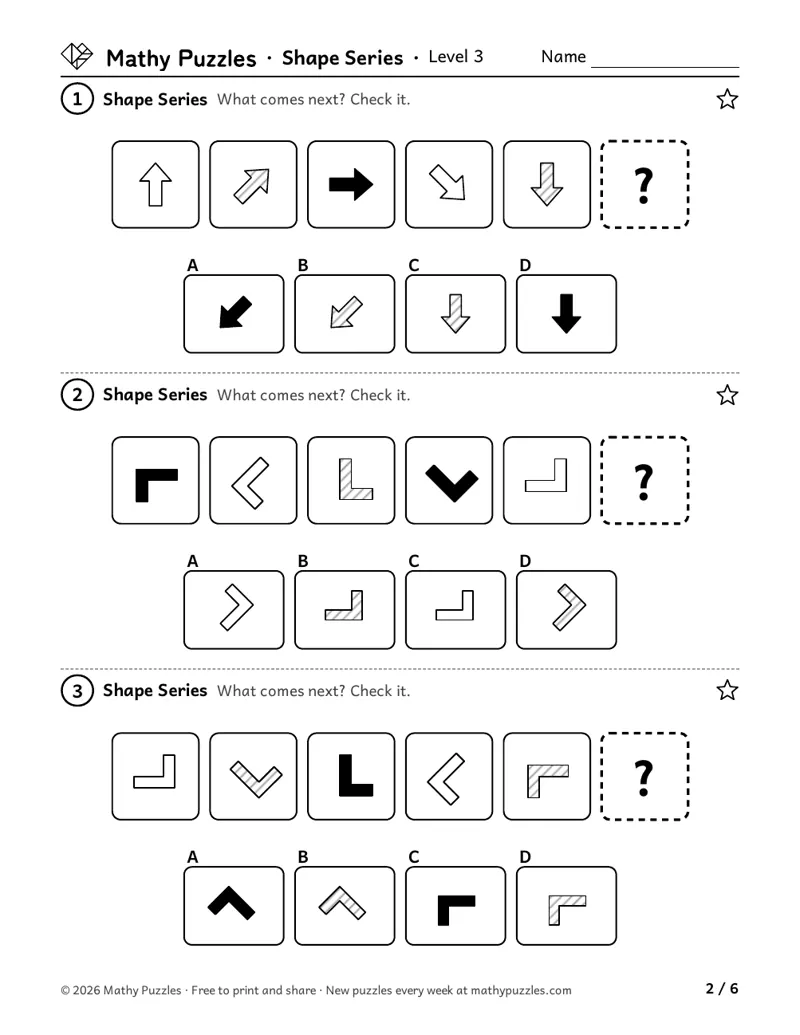
An eighth of a turn with a shading cycle, then three changes including a size cycle. Next, a number that jumps a little more each step (1, 1, 2, 4, 7). The hardest puzzles hide a middle picture.
On the sheet: “What comes next? Check it.”
Print Level 3 (Letter)Other paper size: A4Level 4
Ages 10–12 · Grades 5–6
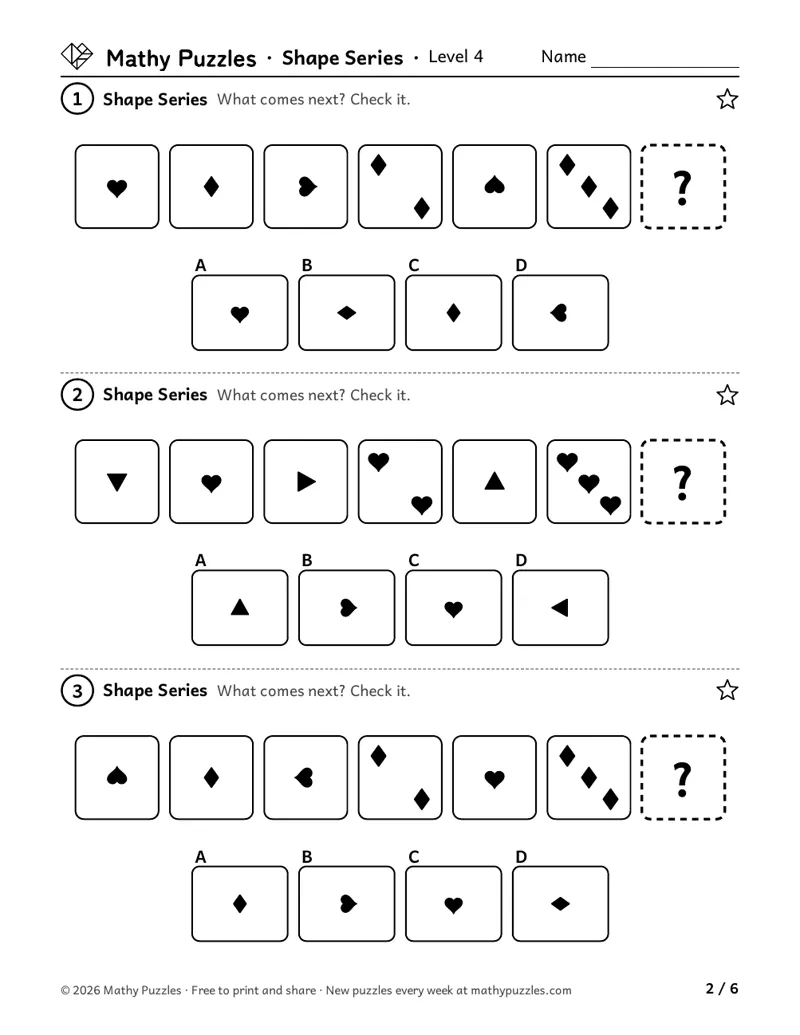
Two rules taking turns, odd pictures one way and even pictures another. Then a change on each, then six options. The hardest puzzles hide a middle picture in a row of eight.
On the sheet: “What comes next? Check it.”
Print Level 4 (Letter)Other paper size: A4
How it works
Each puzzle is a row of pictures that change a little at every step: a shape turns, gains one more, changes its shading or its size. The child works out what changes each time and checks the picture that comes next. At Level 4 two rules take turns, one for the odd pictures and one for the even pictures. The hardest Level 3 and 4 puzzles hide a picture in the middle of the row.
How to play
- Look at the first two pictures. What changed?
- Check that the same change happens at every step.
- Look for a second change: how many, shading, size.
- Make every change once more and check that picture.
When it gets hard
Seeing the turn but missing the count, or the other way round.
Hint: Check each thing in turn: direction, how many, shading, size.
Turning the wrong way.
Hint: Follow one corner of the shape from picture to picture.
Treating a cycle as a straight line.
Hint: Shading that goes white, striped, black starts again at white.
Tip for grown-ups: A small arrow between each pair of pictures, with the change written on it ("turn", "+1"), helps a lot. Written changes make the two- and three-change puzzles manageable.
Frequently asked questions
- How is this different from What Comes Next?
- What Comes Next? repeats a short unit (apple, banana, apple, banana). Shape Series changes a little at every step, such as one more or a quarter turn, so the next picture is one you have not seen yet.
- Can students make their own series for a partner?
- Yes. Give each student a paper flag to turn and a few counters. Making a series is a good check that the idea of a steady change is clear.
- What does it mean when the gap is in the middle?
- In the hardest Level 3 and 4 puzzles the missing picture sits inside the row. It must fit the rule from both sides: one step on from the left and one step back from the right.
Questions about printing, levels, answers or membership: see all questions.
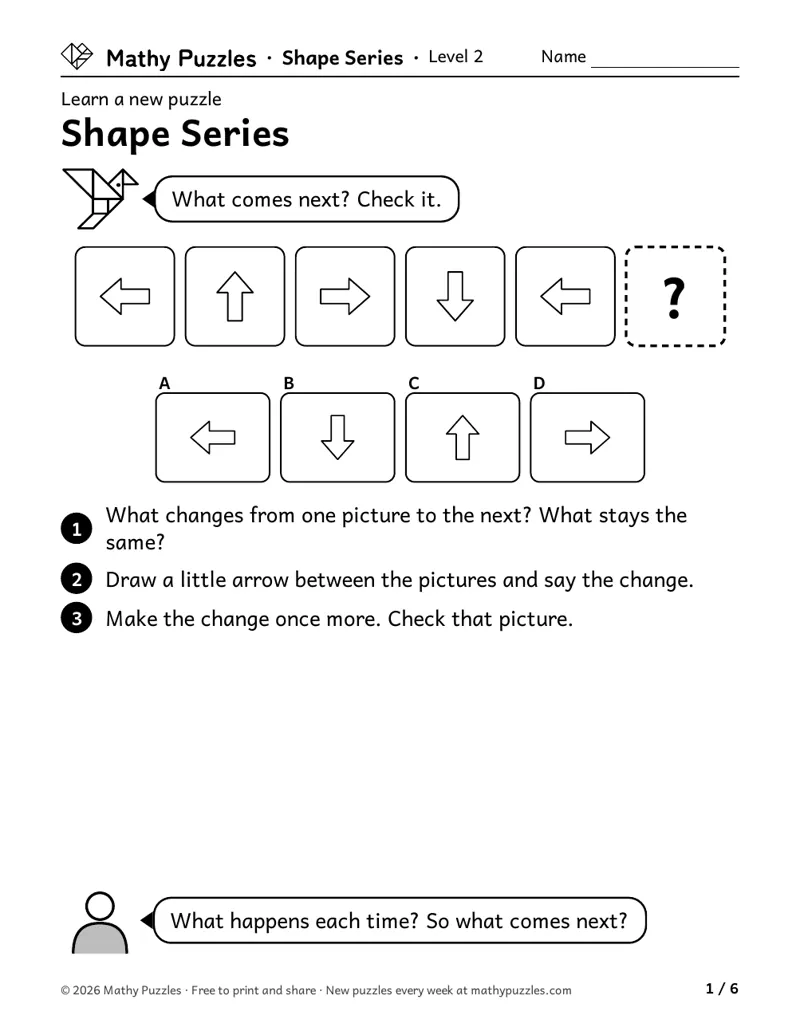
Worked example
From the Level 2 Learn sheet
- What changes from one picture to the next? What stays the same?
- Draw a little arrow between the pictures and say the change.
- Make the change once more. Check that picture.
A question to ask: “What happens each time? So what comes next?”
Free every Sunday A mixed bag of 20 new puzzles, all four levels. Get them by email
The thinking it works on
Finding the rule in a row of changes
Works out the change from each picture to the next.
Following turns in the mind
Pictures where a shape points after one more turn.
In Kosslyn and colleagues' (1990) imagery tasks, 5-year-olds were noticeably weaker than 8- and 14-year-olds at turning a shape in the mind. Yet they could hold a shape in mind about as well. Source
Tracking several changes at once
Keeps turn, count, shading and size apart.
Telling cycles from steady change
Sees that shading or size goes round and starts again.
Reasoning across a gap or between two rules
Uses pictures on both sides of a gap, or every other picture.
Where is this thinking used?
- Animation: Each drawing moves a little further than the one before.
- Clocks: The hands make the same turn every hour.
- Seasons and lights: Some changes go round and start again, like traffic lights.
- Building: Each row of a stack or staircase grows by a set step.
For teachers
Curriculum areas
- Common Core
- Operations and algebraic thinking: shape or number patterns that follow a rule (Grade 4)Levels 1–2: No direct curricular match.
- NCERT
- Joyful Mathematics (Class 1): extending patterns; Maths Mela (Class 5): quarter and eighth turns; Ganita Prakash (Class 6): shape sequences
- National Curriculum (England)
- Geometry – position and direction: turns (Year 1); patterns and sequences of objects (Year 2)Level 4: No direct curricular match.
- Cambridge Primary Mathematics
- Number: sequences of objects (Stage 1) and sequences that are not steady steps (Stage 4); Geometry and measure: quarter turns (Stage 2)
Math practices: see the box below.
Math practices this puzzle uses
- Not used: MP1 Make sense of problems and persevere in solving them
- Not used: MP2 Reason abstractly and quantitatively
- Not used: MP3 Construct viable arguments and critique the reasoning of others
- Not used: MP4 Model with mathematics
- Not used: MP5 Use appropriate tools strategically
- Not used: MP6 Attend to precision
- Uses: MP7 Look for and make use of structure
- Uses: MP8 Look for and express regularity in repeated reasoning
From the Common Core Standards for Mathematical Practice.
More Shape Series puzzles for members
Members get at least 5 more worksheets at each difficulty for every puzzle, 80 new puzzles every Sunday, and the whole archive. $39 a year or $25 for 6 months.
See membershipNot ready yet?
One email, all four levels: 20 puzzles, 5 for each level.
For grown-ups (18+). One email every Sunday with the puzzles and the odd note about membership; unsubscribe any time. We never ask about your child. How we use your email