
Secret Codes
Children love passing secret notes. A code is just a matching list, and with the key in hand, a child reads the message one sign at a time, in order.
Free sets by level, ages 4–10:
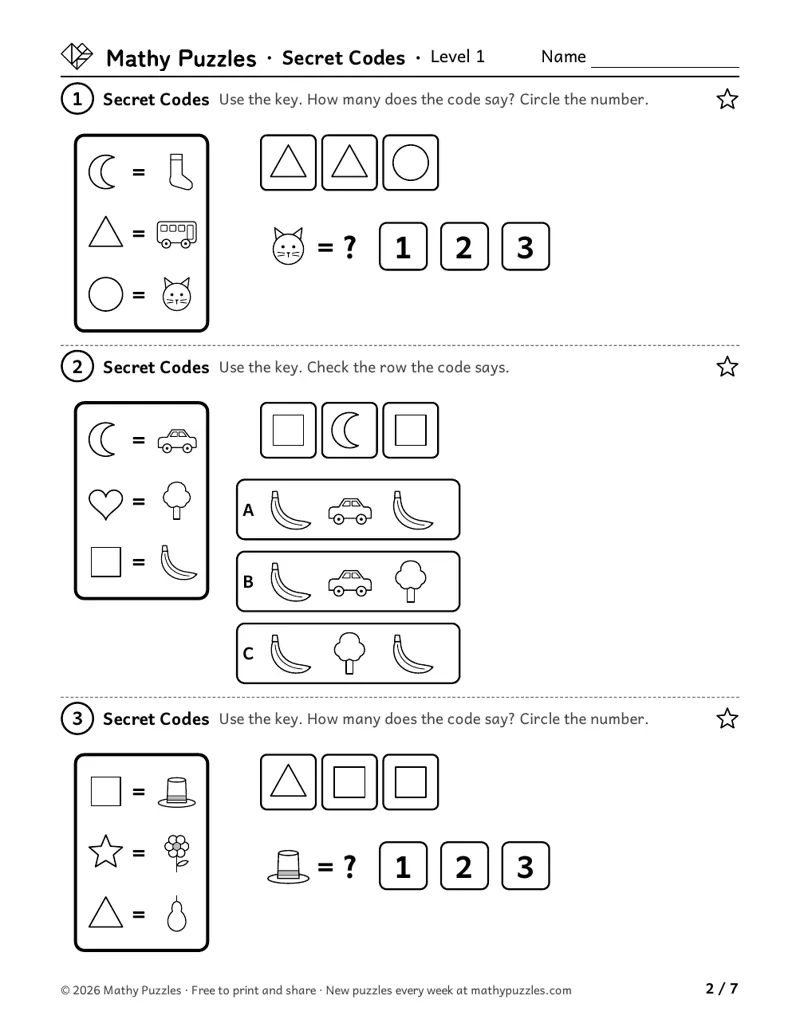 Level 1: a page from the free set
Before starting
- Level 1: match a shape to a picture; no reading or writing needed
- Level 2: know capital letters and write them
- Level 3: read and spell short words
Free puzzles to print
Each set: a Learn sheet with a worked example, 10 puzzles from easiest to hardest, and the answers.
Level 1
Ages 4–6 · Pre-K–K
A picture key of 3 signs and a code of 3, then 4 and 4. Then the other way round: the pictures are given, and the child finds the code that says them. The hardest puzzles put two look-alike signs in the key. Some items ask "how many" of one picture the code says.
On the sheet: “Use the key. Check the row the code says.”
Print Level 1 (Letter)Other paper size: A4Level 2
Ages 6–8 · Grades 1–2
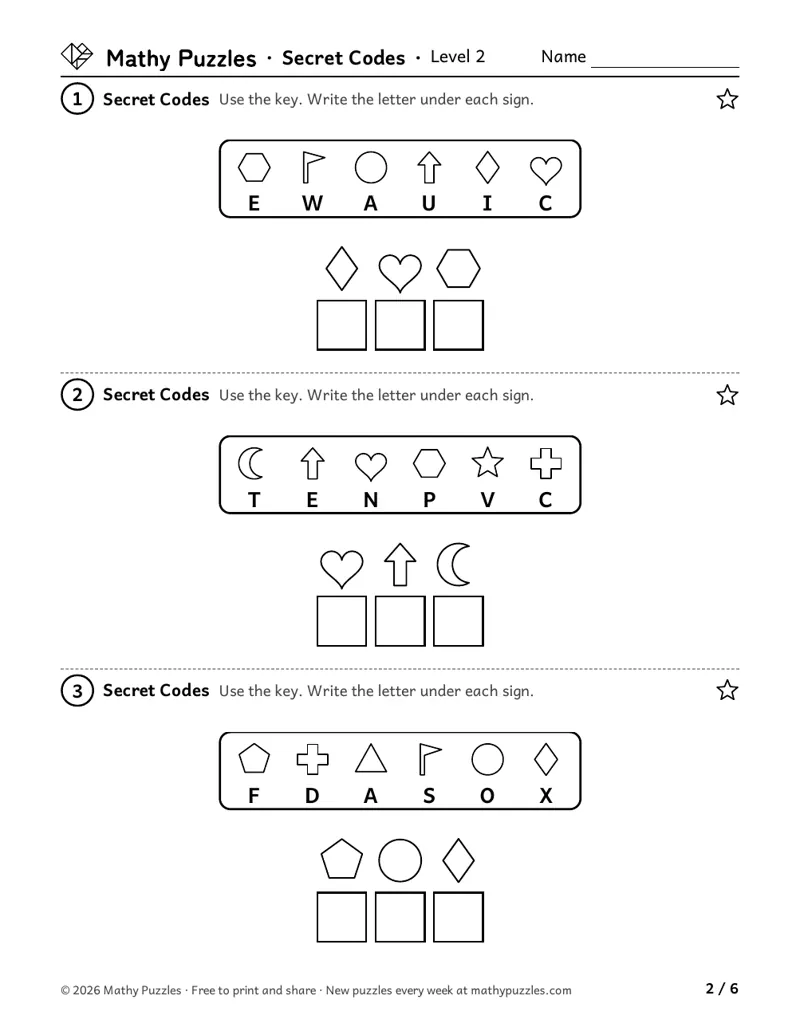
Shape signs for letters, from a 3-letter word to a 4- or 5-letter word, then a short message of two or three words. In the hardest puzzles some signs in the key show "?", and two example words give their letters away.
On the sheet: “Use the key. Write the letters.”
Print Level 2 (Letter)Other paper size: A4Level 3
Ages 8–10 · Grades 3–4
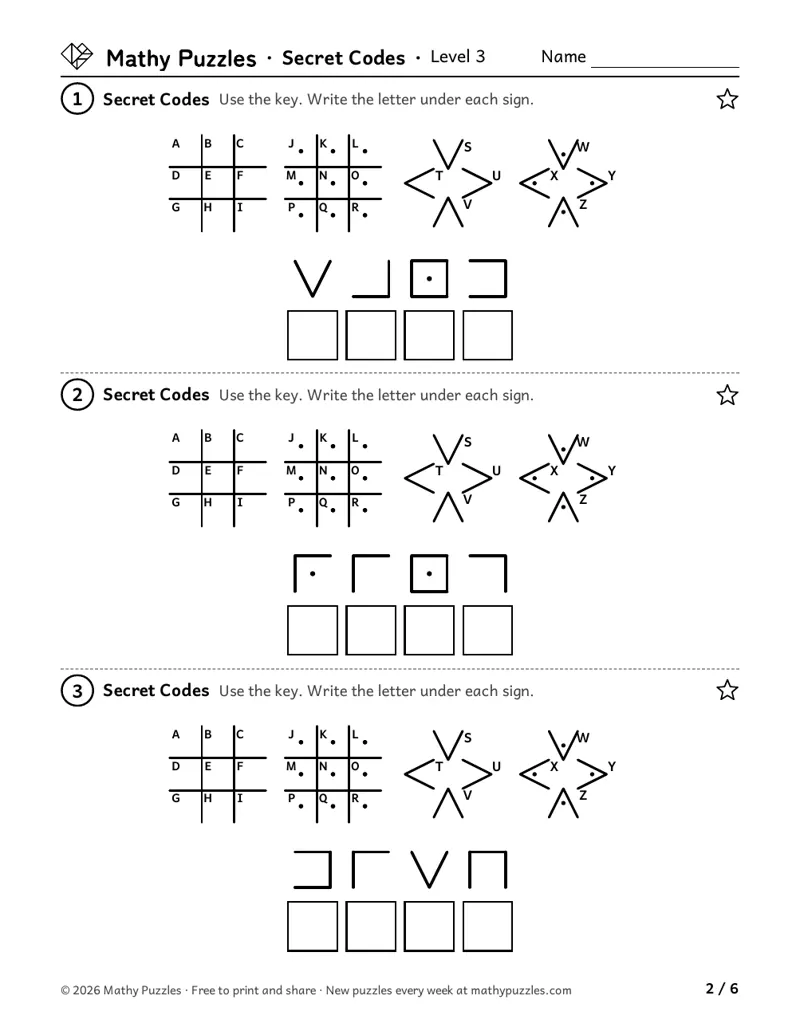
The pigpen key (letters in two grids and two Xs), from a 4- or 5-letter word to a short message. The hardest puzzles ask the child to write a word in pigpen.
On the sheet: “Use the key. Write the letters.”
Print Level 3 (Letter)Other paper size: A4
How it works
A key matches each sign to a picture or a letter. The child reads a short code, one sign at a time, and turns it into a message. At Level 1 the key uses pictures, so no reading is needed. At Levels 2 and 3 the code spells a word or a short message. At Level 3 the signs are pigpen shapes drawn from two grids and two Xs.
How to play
- Look at the first sign in the code.
- Find the same sign in the key. See what it stands for.
- Write the letter (or find the picture) under that sign.
- Do every sign in order, then read the whole message.
When it gets hard
Mixing up two signs that look alike, such as a square and a diamond.
Hint: Look at the corners: does the sign sit flat or stand on a point?
Decoding the signs out of order.
Hint: Keep a finger on the code and move it one sign at a time, left to right.
Guessing the word after two letters.
Hint: Decode every sign first. Then read the word.
Tip for grown-ups: Make up a code at the dinner table with three shapes and three foods. Let your child write the key and a message, and you decode it.
Frequently asked questions
- Can a 4-year-old do this before reading?
- Yes. Level 1 uses pictures only: a shape stands for an apple, a cat or a bus. Your child points, matches and checks a row. No letters are needed.
- What is pigpen?
- An old letter code. The alphabet is written in two tic-tac-toe grids and two Xs. Each letter is drawn as the shape of its spot, with a dot for the second grid and X. The Level 3 key shows the whole alphabet.
Questions about printing, levels, answers or membership: see all questions.
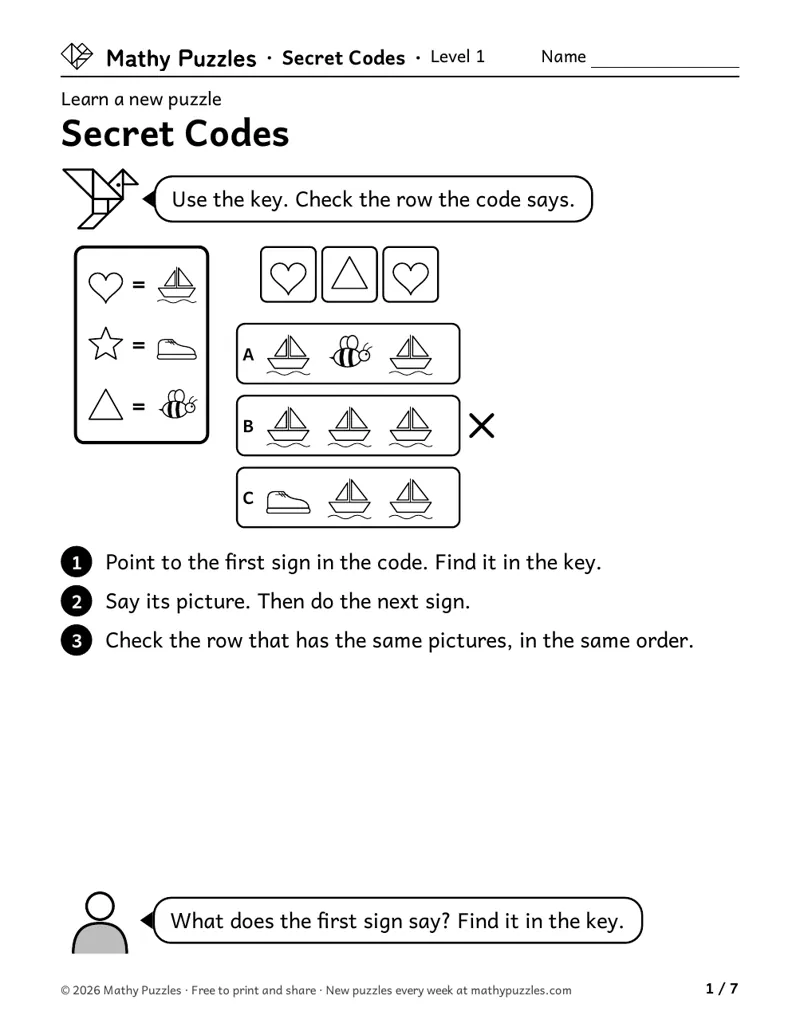
Worked example
From the Level 1 Learn sheet
- Point to the first sign in the code. Find it in the key.
- Say its picture. Then do the next sign.
- Check the row that has the same pictures, in the same order.
A question to ask: “What does the first sign say? Find it in the key.”
Free every Sunday A mixed bag of 20 new puzzles, all four levels. Get them by email
The thinking it works on
Matching each sign to its meaning
Uses a key to link each sign to what it stands for.
Bialystok (2000) showed 3- to 5-year-olds a card with a picture, a numeral or a written word, and then moved the card. The children kept track of what a picture or numeral stood for. But many thought a written word changed its meaning when the card moved. Source
Working in sequence
Decodes one sign at a time, in order, without skipping.
Tversky, Kugelmass and Winter (1991) asked about 1,200 children and adults to lay out events in time on paper. English speakers put earlier events on the left, the way they read. Source
Careful visual comparison
Tells look-alike signs apart before matching.
Gibson, Gibson, Pick and Osser (1962) asked 4- to 8-year-olds to pick exact copies of letter-like forms from versions that were turned, mirrored, bent or broken. Mistakes on the turned and mirrored versions were common at 4 and fell with age. Source
Reversing a rule
Uses the key backward: from message to code.
Reasoning from examples
Works out a missing part of the key from solved words.
Suanda, Mugwanya and Namy (2014) found that 5- to 7-year-olds worked out which made-up word went with which object. They noticed which pairs kept appearing together across several scenes, even though no single scene gave the answer. Source
Where is this thinking used?
- Map legends: A small key tells you what each symbol on the map means.
- Reading music: Each mark on the staff stands for a note, read in order.
- Signs and icons: Road signs and washing-label symbols each stand for a rule.
- Early reading: Each letter stands for a sound, decoded left to right.
For teachers
Curriculum areas
- Common Core
- Counting and cardinality: counting to answer "how many?" (Kindergarten), for the Level 1 "how many" items onlyLevels 2–3: No direct curricular match.
- NCERT
- No direct curricular match.
- Computer science (CSTA)
- Symbols that stand for pictures or letters, and a first look at secret codes (ages 5–14)
- National Curriculum (England)
- No direct curricular match.
- Cambridge Primary Mathematics
- No direct curricular match.
Math practices: see the box below.
Math practices this puzzle uses
- Not used: MP1 Make sense of problems and persevere in solving them
- Not used: MP2 Reason abstractly and quantitatively
- Not used: MP3 Construct viable arguments and critique the reasoning of others
- Not used: MP4 Model with mathematics
- Not used: MP5 Use appropriate tools strategically
- Uses: MP6 Attend to precision
- Uses: MP7 Look for and make use of structure
- Not used: MP8 Look for and express regularity in repeated reasoning
From the Common Core Standards for Mathematical Practice.
More Secret Codes puzzles for members
Members get at least 5 more worksheets at each difficulty for every puzzle, 80 new puzzles every Sunday, and the whole archive. $39 a year or $25 for 6 months.
See membershipNot ready yet?
One email, all four levels: 20 puzzles, 5 for each level.
For grown-ups (18+). One email every Sunday with the puzzles and the odd note about membership; unsubscribe any time. We never ask about your child. How we use your email