
Picture Grids
A picture grid starts as a blank page with numbers around the edge. Shade only the squares the numbers prove, never a guess, and a picture slowly comes through, like a photo developing.
Free sets by level, ages 4–12:
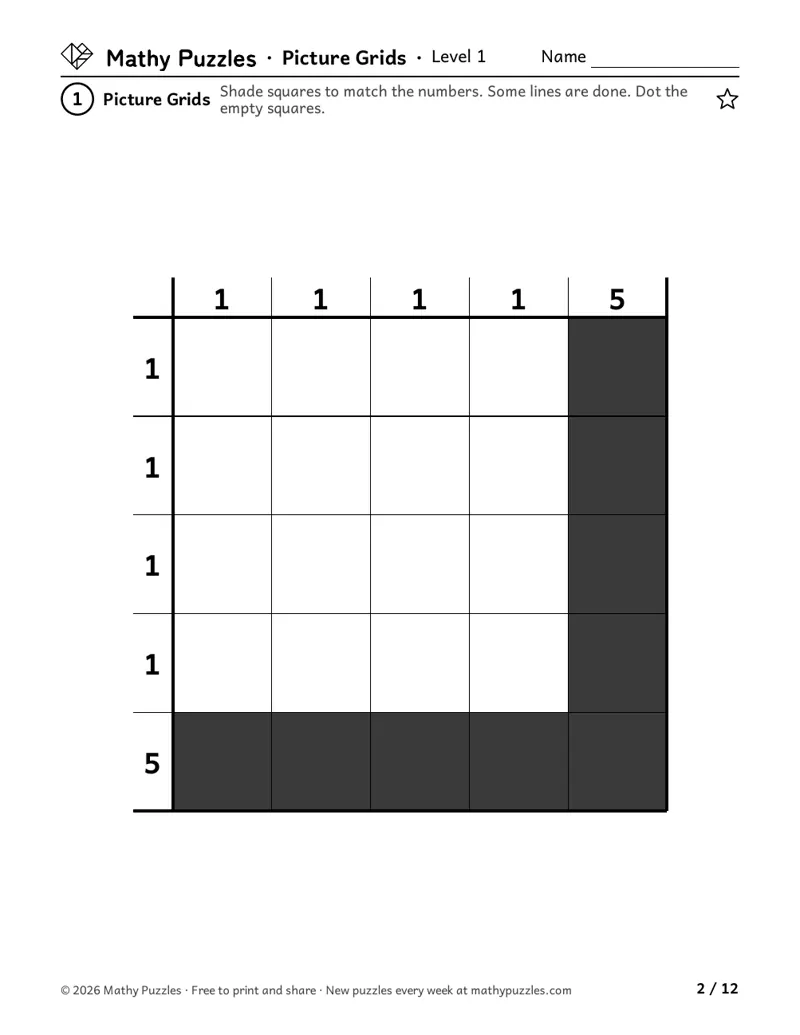 Level 1: a page from the free set
Before starting
- Count to 5 (Level 1), to 10 (Level 2) or to 20 (Levels 3–4)
- Tell rows from columns
Free puzzles to print
Each set: a Learn sheet with a worked example, 10 puzzles from easiest to hardest, and the answers.
Level 1
Ages 4–6 · Pre-K–K
5 × 5 with big squares and one number per line; two lines are shaded for you, then one, then none.
On the sheet: “Shade squares to match the numbers. A picture appears!”
Print Level 1 (Letter)Other paper size: A4Level 2
Ages 6–8 · Grades 1–2
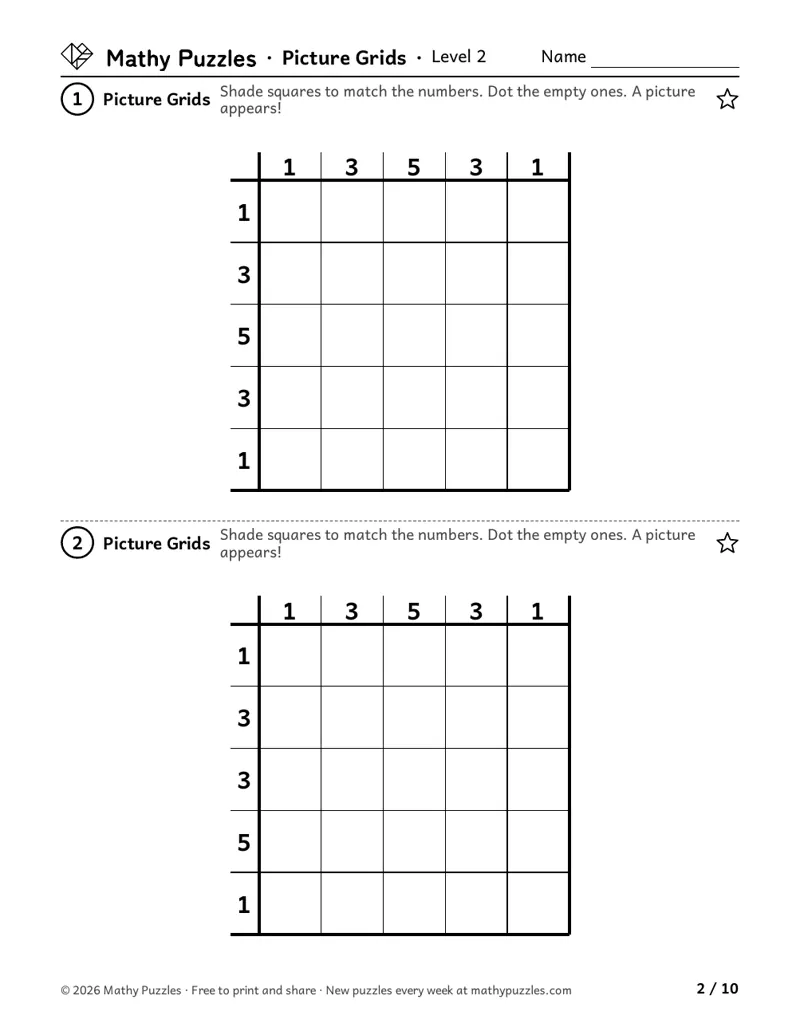
5 × 5 with one number per line, up to 8 × 8 with up to four numbers per line.
On the sheet: “Shade squares to match the numbers. A picture appears!”
Print Level 2 (Letter)Other paper size: A4Level 3
Ages 8–10 · Grades 3–4
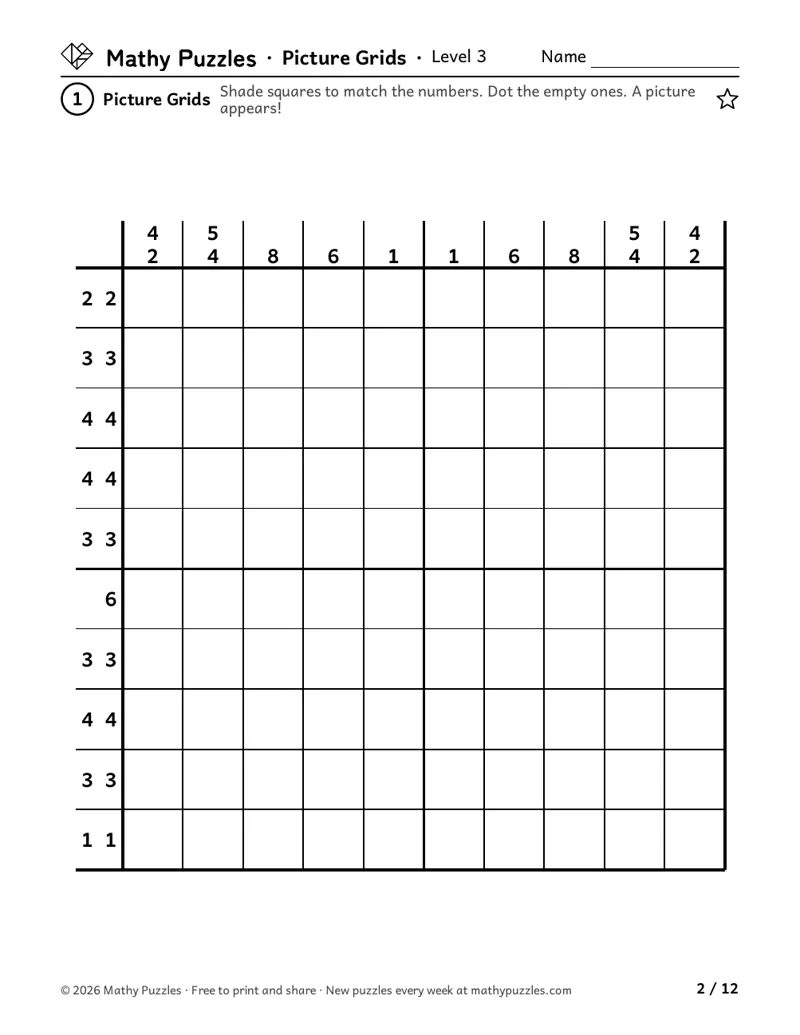
10 × 10, then harder 10 × 10 and 12 × 12, then 15 × 15.
On the sheet: “Shade squares to match the numbers. A picture appears!”
Print Level 3 (Letter)Other paper size: A4Level 4
Ages 10–12 · Grades 5–6
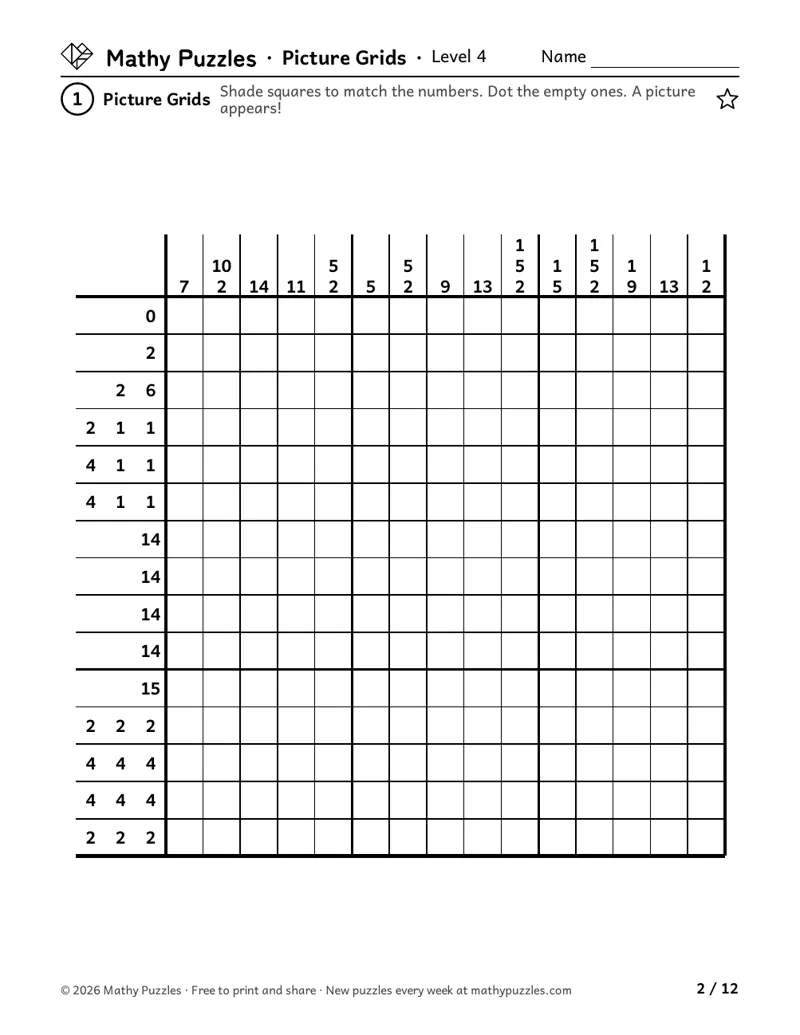
15 squares wide and up to 20 tall, with longer chains of reasoning. No guessing is needed at any level.
On the sheet: “Shade squares to match the numbers. A picture appears!”
Print Level 4 (Letter)Other paper size: A4
How it works
Numbers sit beside each row and above each column of the grid. They say how many squares in that line are shaded, in groups, in order. When every line matches its numbers, a hidden picture appears. These are often called nonograms. At Level 1 the grids are 5 by 5 with big squares and at most one number per line, and some lines come already shaded.
How to play
- Read the numbers: "2 1" means a group of 2 shaded squares, a gap, then a group of 1.
- Start with the biggest number. In a line of 5, a 5 fills the whole line.
- Shade only the squares you are sure of. Put a small dot in squares that must stay empty.
- Go back and forth between rows and columns. Each new shaded square helps the other way.
- Keep going until every line matches its numbers. Then name the picture.
When it gets hard
Shading a group with no gap after it, so two groups run together.
Hint: Between two groups there is always at least one empty square. Dot it.
Guessing where a group goes and shading it.
Hint: Ask: is this square shaded in every way the numbers could fit? If not, leave it.
Forgetting the dots, then losing track.
Hint: Dots for empty squares are as useful as shading.
Tip for grown-ups: Do the first two lines together, saying aloud why each square must be shaded; after that, let your child take over.
Frequently asked questions
- My child keeps guessing and erasing. Is that normal?
- Yes, at first. Every puzzle here can be finished without guessing. Ask "how do you know?" before each square; the dots for empty squares help a lot.
Questions about printing, levels, answers or membership: see all questions.
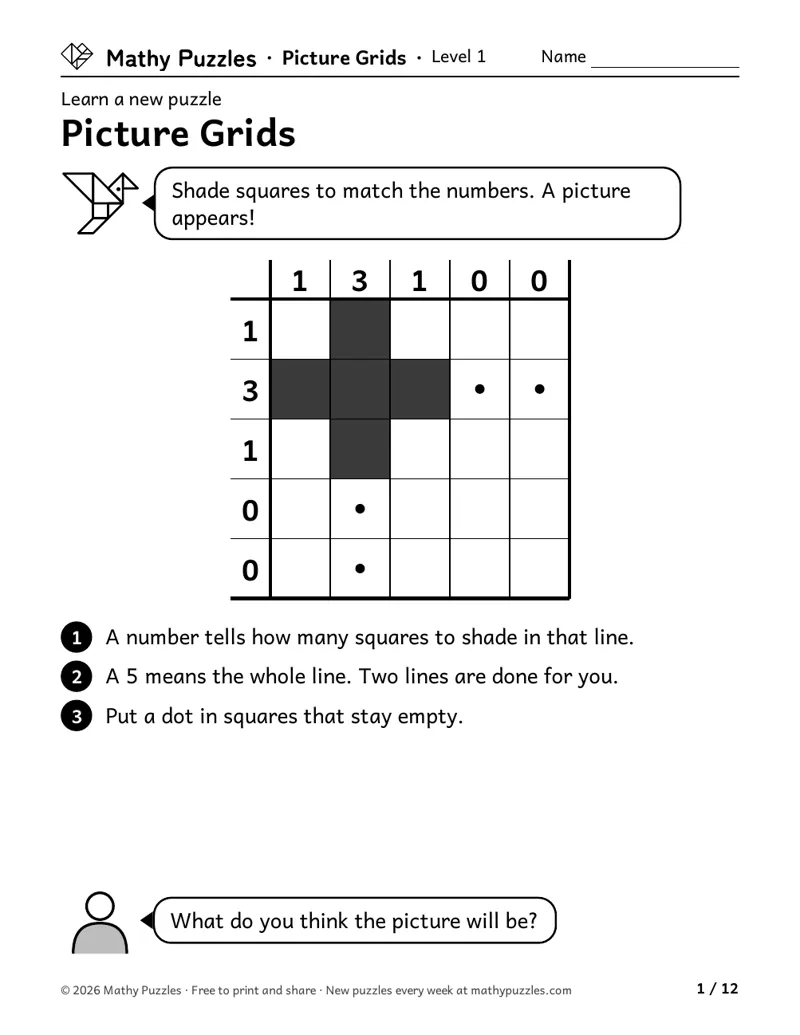
Worked example
From the Level 1 Learn sheet
- A number tells how many squares to shade in that line.
- A 5 means the whole line. Two lines are done for you.
- Put a dot in squares that stay empty.
A question to ask: “What do you think the picture will be?”
Free every Sunday A mixed bag of 20 new puzzles, all four levels. Get them by email
The thinking it works on
Reasoning from clues
Works out which squares every possible placing of a clue must cover, and shades those.
Fay and Klahr (1996) asked 4- and 5-year-olds whether clues settled an answer. They could often say 'I can tell' when the clues did and 'I can't tell' when they did not. Some patterns of clues tripped them up. Source
Holding back until sure
Dots squares that must stay empty and leaves 'probably' squares alone.
Diamond (2013) reviews evidence that holding back a quick response (inhibitory control) is much harder for children than for adults and keeps developing through the school years. Source
Combining rows and columns
Goes back and forth between rows and columns, since every square is in both.
Battista and colleagues (1998) found that many students do not 'see' the row-by-column structure that adults take for granted in a grid of squares. Source
Counting and adding along a line
Adds a line's numbers and gaps to see how much spare room there is.
Working memory
Keeps several half-finished lines and placed groups in mind on the big grids.
Gathercole and colleagues (2004) found that working memory grows steadily from age 4 to 15, so older children hold more in mind at once. Source
Where is this thinking used?
- Schedules and spreadsheets: A cell is set by its row and its column together.
- Knitting, cross-stitch and pixel art: A picture is built square by square from a chart.
- Detective work: Ruling out what can't be true, one clue at a time.
- Quality checks: Work is checked line by line against a rule.
For teachers
Curriculum areas
- Common Core
- Counting and cardinality (K); adding and subtracting within 20 (Grade 2, used at Levels 3–4)Level 2: No direct curricular match.
- NCERT
- No direct curricular match.
- National Curriculum (England)
- Number: numbers to 10 (Reception); addition facts to 20 (Year 2)
- Cambridge Primary Mathematics
- Number: counting objects (Stage 1)Levels 3–4: No direct curricular match.
Math practices: see the box below.
Math practices this puzzle uses
- Uses: MP1 Make sense of problems and persevere in solving them
- Not used: MP2 Reason abstractly and quantitatively
- Uses: MP3 Construct viable arguments and critique the reasoning of others
- Not used: MP4 Model with mathematics
- Not used: MP5 Use appropriate tools strategically
- Not used: MP6 Attend to precision
- Not used: MP7 Look for and make use of structure
- Not used: MP8 Look for and express regularity in repeated reasoning
From the Common Core Standards for Mathematical Practice.
More Picture Grids puzzles for members
Members get at least 5 more worksheets at each difficulty for every puzzle, 80 new puzzles every Sunday, and the whole archive. $39 a year or $25 for 6 months.
See membershipNot ready yet?
One email, all four levels: 20 puzzles, 5 for each level.
For grown-ups (18+). One email every Sunday with the puzzles and the odd note about membership; unsubscribe any time. We never ask about your child. How we use your email