
Number Pyramids
Set two blocks side by side and one on top, and the top block is their sum: that is the whole rule. Know the top and one block below, and the other is already decided, so adding and taking away become one idea seen from two sides.
Free sets by level, ages 6–10:
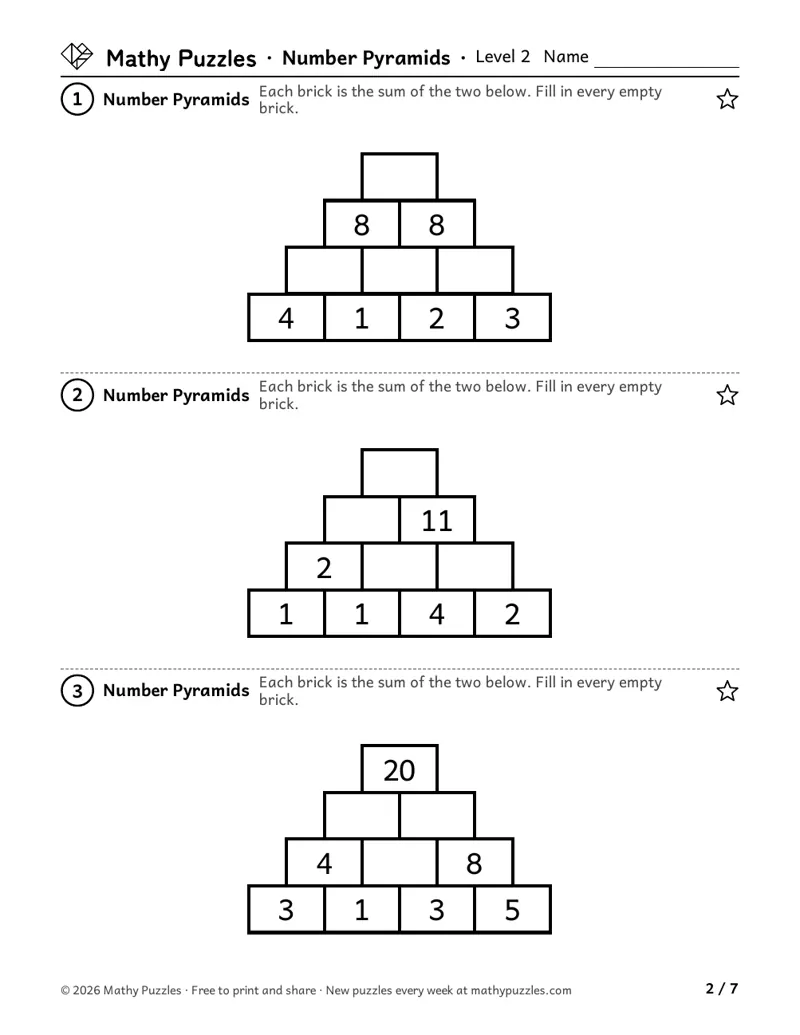 Level 2: a page from the free set
Before starting
- Level 2: add numbers within 20, and know that if 5 + ? = 8, then ? = 3
- Level 2, hardest puzzles: add and subtract within 100
- Level 3: add and subtract 2- and 3-digit numbers with regrouping
Free puzzles to print
Each set: a Learn sheet with a worked example, 10 puzzles from easiest to hardest, and the answers.
Level 2
Ages 6–8 · Grades 1–2
The easiest have 4 rows with the bottom row given, adding going up (top brick up to 20). Then some bricks need subtraction (numbers up to 30). Then 4 or 5 rows up to 50, with a chain that works downward. The hardest have 5 rows with numbers up to 100 and a longer downward chain.
On the sheet: “Each brick is the sum of the two below. Fill in every empty brick.”
Print Level 2 (Letter)Other paper size: A4Level 3
Ages 8–10 · Grades 3–4
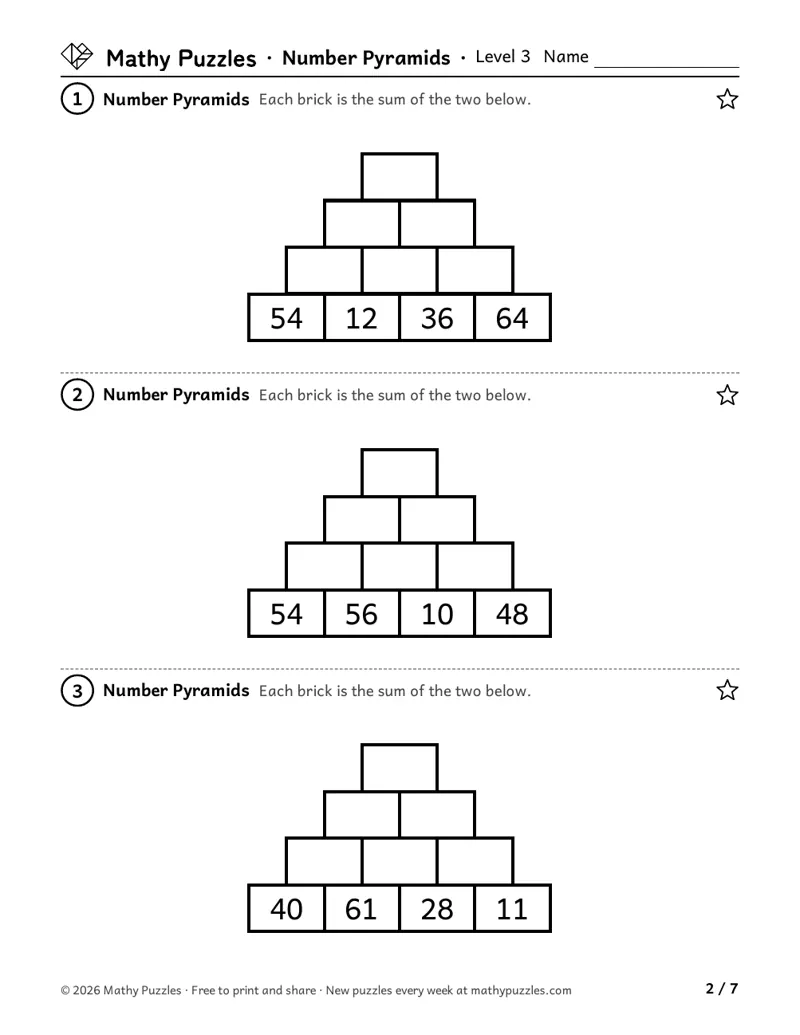
The easiest give the whole bottom row of two-digit numbers, and the additions going up need regrouping (top up to 500). Then bricks up to 1,000 with bottom bricks missing, so three-digit subtractions work down. Then the middle trick: the top take away both bottom corners is twice the middle brick (bricks up to 200). The hardest have 5 rows, tops from 201 to 1,000, and use the middle trick plus a chain of subtractions.
On the sheet: “Each brick is the sum of the two below.”
Print Level 3 (Letter)Other paper size: A4
How it works
Each puzzle is a pyramid of bricks with some numbers filled in. Each brick is the sum of the two bricks it sits on. The child fills every empty brick, adding going up and, in harder ones, subtracting to work down. Level 2 works within 20, then up to 100; Level 3 uses bricks up to 1,000 and a trick for the middle brick.
How to play
- Find two bricks side by side that both have numbers. Add them and write the sum in the brick above.
- If you know a brick and one brick under it, subtract to find the other one.
- Keep filling bricks you can work out.
- Check: every brick should equal the two under it added together.
When it gets hard
Adding when the missing brick is underneath.
Hint: Is the empty brick above or below the two you know? Below means subtract.
Adding the wrong pair of bricks.
Hint: A brick sits on the two bricks that touch its bottom edge.
Getting stuck because no two neighbors are filled.
Hint: Look for a brick with a number above it and one number beside it below.
Level 3: forgetting to halve when using the middle trick.
Hint: The middle brick is counted twice in the top. Take away both corners, then take half of what is left.
Tip for grown-ups: When your child finishes, ask them to check one brick by adding the two below; that habit catches most slips.
Frequently asked questions
- Can I use this as a starter for grade 2?
- It works well: the first puzzles are quick. Early finishers can make a pyramid of their own with some bricks blank for a partner.
Questions about printing, levels, answers or membership: see all questions.
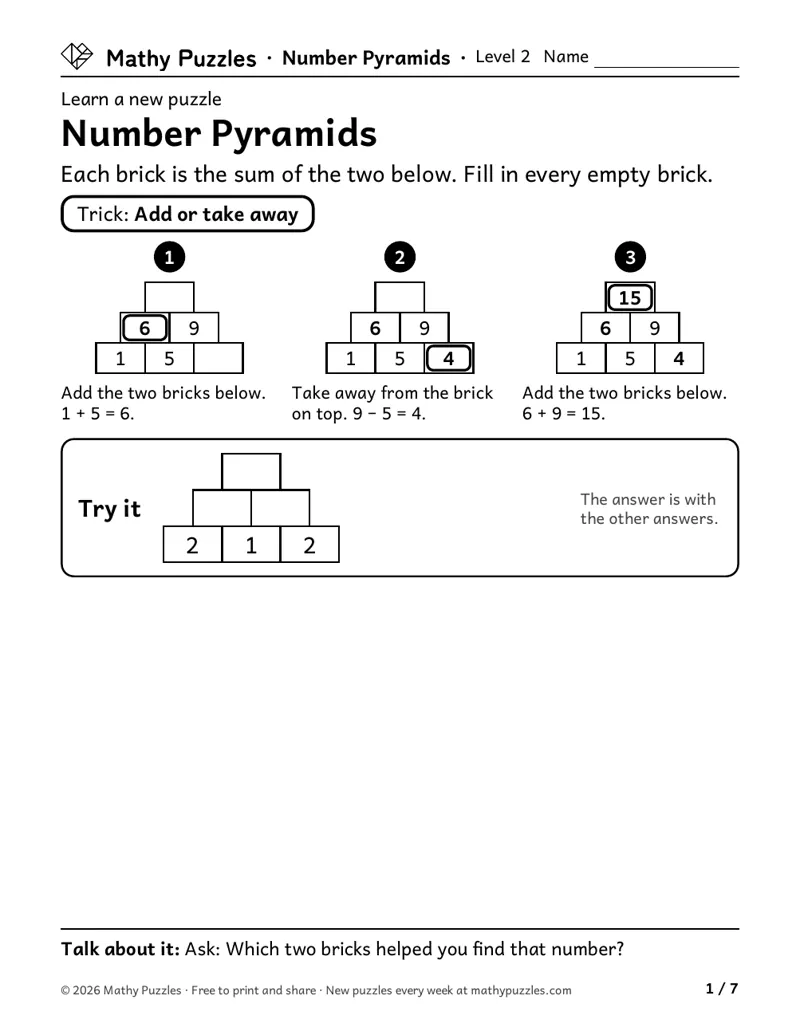
Worked example
From the Level 2 Learn sheet
- Each brick is the sum of the two below.
- Two bricks side by side are known? Add them and write the sum above.
- The brick above and one brick below are known? Take away to find the other one.
- Keep going until every brick is filled.
A question to ask: “Which two bricks helped you find that number?”
Free every Sunday A mixed bag of 20 new puzzles, all four levels. Get them by email
The thinking it works on
Part-whole thinking
Sees each brick as made of the two under it, so any two tell the third.
Canobi (2005) found that 5- to 9-year-olds differed a lot in how they understood adding and taking away. A key step was fitting taking away into how parts make a whole. Source
Seeing subtraction as undoing addition
Subtracts to fill a lower brick instead of adding.
Gilmore and Bryant (2006) tested 127 children aged 6 to 9 on problems where adding a number and then taking it away cancel out. They used that idea more readily with pictures than with words. Source
Adding and subtracting with growing numbers
Adds and subtracts within 20, then up to 100, then to 1,000 at Level 3.
In Geary, Hoard and Nugent's (2012) four-year study, children moved from counting toward remembered facts and breaking numbers apart as they went from grade 1 to grade 4. Source
Choosing where to start
Looks for a brick that can be worked out now, wherever it sits.
Chaining steps and keeping track
Follows a chain of steps downward and keeps each result straight.
Brocki and Bohlin (2004) tested 92 children aged 6 to 13. Thinking skills, working memory among them, changed most at ages 6 to 8 and 9 to 12. Source
Seeing a hidden pattern
Notices the middle brick is counted twice in the top.
Checking your own work
Checks one brick against the two below it when done.
Roebers (2017) reviews evidence that checking one's own work (monitoring) grows steadily through childhood, hand in hand with self-control. Source
Where is this thinking used?
- Shopping: What's left after a purchase, from the total and what was spent.
- Receipts: Checking a running total line by line.
- Budgets: What came in, what went out, what remains.
- Mental math: Quick adding and taking away in shops and games.
For teachers
Curriculum areas
- Common Core
- Operations and algebraic thinking: adding and subtracting within 20; subtraction as finding an unknown part (Grade 1)
- Common Core
- Number and operations in base ten: adding and subtracting within 100 (Grade 2, the hardest Level 2 puzzles) and within 1,000 (Grade 3)
- NCERT
- Joyful Mathematics (Classes 1–2): adding and subtracting, and the addition and subtraction pyramid in Decoration for Festival (Class 2); Maths Mela (Classes 3–4): adding and subtracting with regrouping
- National Curriculum (England)
- Number – addition and subtraction: two-digit numbers and missing number problems (Year 2); columnar methods with three digits (Year 3)
- Cambridge Primary Mathematics
- Number: adding and subtracting, and how they are linked (Stages 2–3)
Math practices: see the box below.
Math practices this puzzle uses
- Not used: MP1 Make sense of problems and persevere in solving them
- Not used: MP2 Reason abstractly and quantitatively
- Not used: MP3 Construct viable arguments and critique the reasoning of others
- Not used: MP4 Model with mathematics
- Not used: MP5 Use appropriate tools strategically
- Not used: MP6 Attend to precision
- Uses: MP7 Look for and make use of structure
- Uses: MP8 Look for and express regularity in repeated reasoning
From the Common Core Standards for Mathematical Practice.
More Number Pyramids puzzles for members
Members get at least 5 more worksheets at each difficulty for every puzzle, 80 new puzzles every Sunday, and the whole archive. $39 a year or $25 for 6 months.
See membershipNot ready yet?
One email, all four levels: 20 puzzles, 5 for each level.
For grown-ups (18+). One email every Sunday with the puzzles and the odd note about membership; unsubscribe any time. We never ask about your child. How we use your email