
Number Mazes
Crossing a frozen pond, you test the ice before each step. Number Mazes asks for the same care: a square that looks right isn't always right, so every step is checked against the rule.
Free sets by level, ages 4–12:
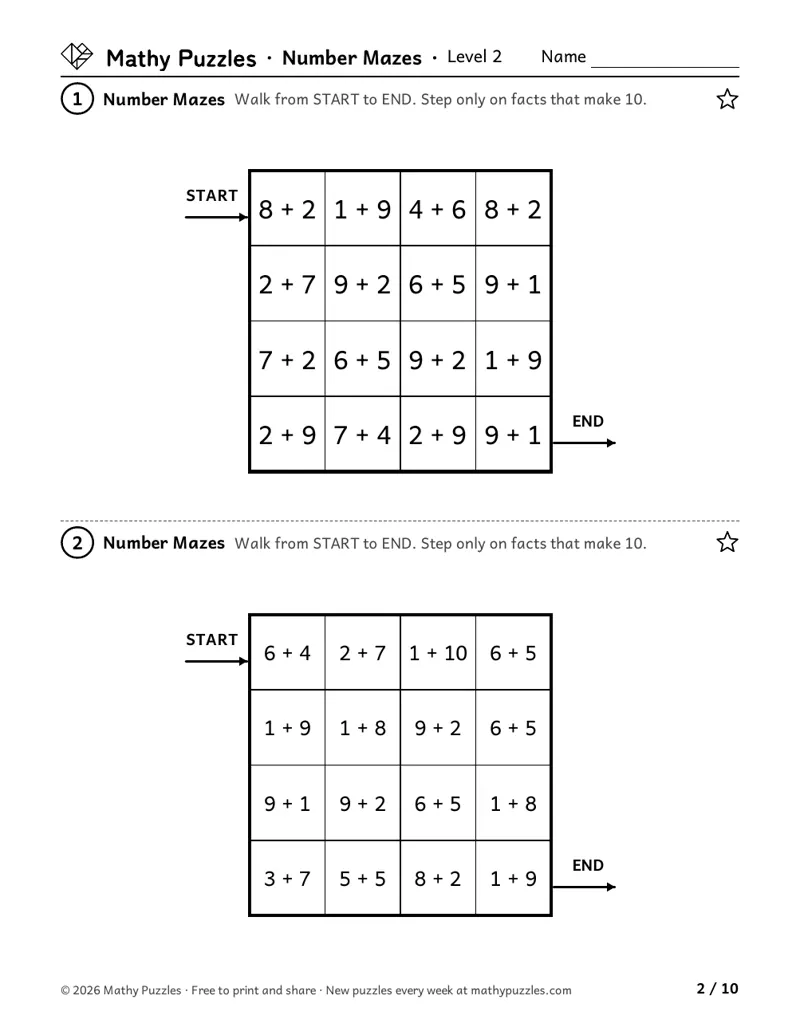 Level 2: a page from the free set
Before starting
- Level 1: say numbers 1 to 10 in order
- Level 2: add within 20, and count by 2s, 5s and 10s
- Level 3: multiplication facts
- Level 4: multiplication facts to 10 × 10, and dividing to find factors
What you need
A colored pencil to mark the path, a multiplication chart at Level 3 if facts are still new, and a pencil.
Free puzzles to print
Each set: a Learn sheet with a worked example, 10 puzzles from easiest to hardest, and the answers.
Level 1
Ages 4–6 · Pre-K–K
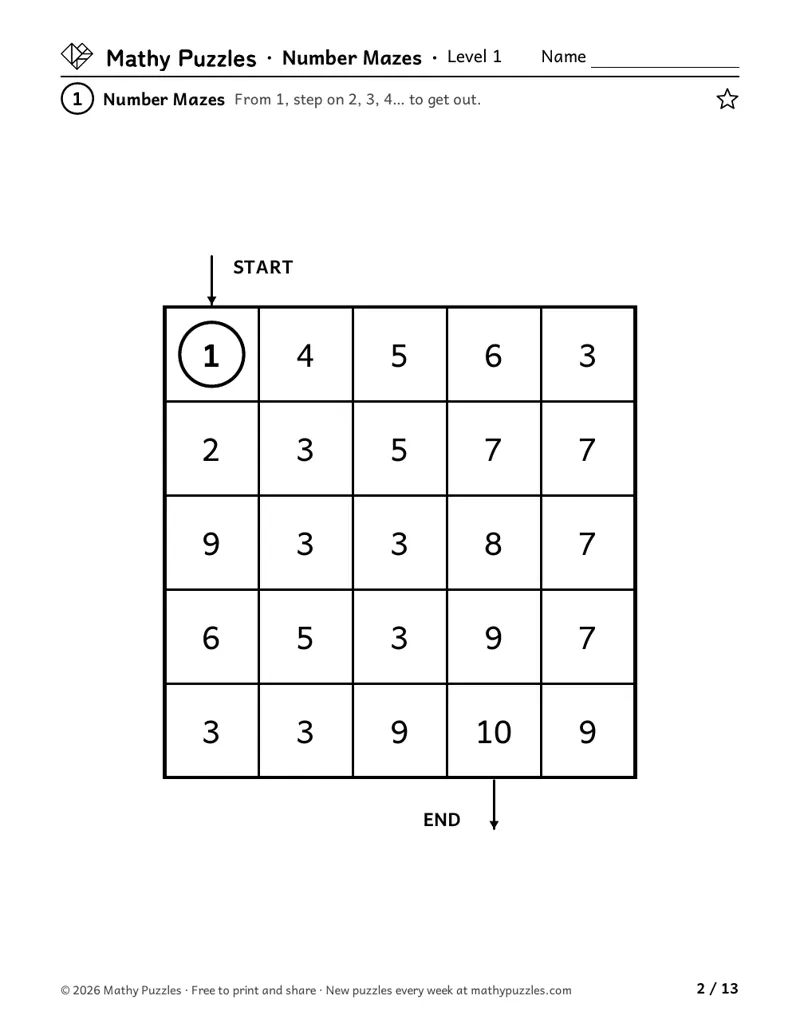
Count 1 to 10 on a square grid, then with tempting wrong turns, then on a honeycomb, and in the hardest puzzles to 15 or 20.
On the sheet: “From 1, step on 2, 3, 4… to get out.”
Print Level 1 (Letter)Other paper size: A4Level 2
Ages 6–8 · Grades 1–2
Mixes three kinds of maze. Make 10: step on facts that make 10 (near misses make 9 or 11). Doubles: step on doubles (near misses like 6 + 7). Skip counting: from a circled number, count by 10s to 100, then by 5s to 100 past near misses. Then count by 2s to 40, or by 10s from an odd start (3, 13, 23…). The hardest maze of each kind is a honeycomb.
On the sheet: “Walk from START to END. Step only on facts that make 10.”
On the sheet: “Walk from START to END. Step only on doubles, like 6 + 6.”
On the sheet: “Skip count from the circled number. Find the way out.”
Print Level 2 (Letter)Other paper size: A4Level 3
Ages 8–10 · Grades 3–4
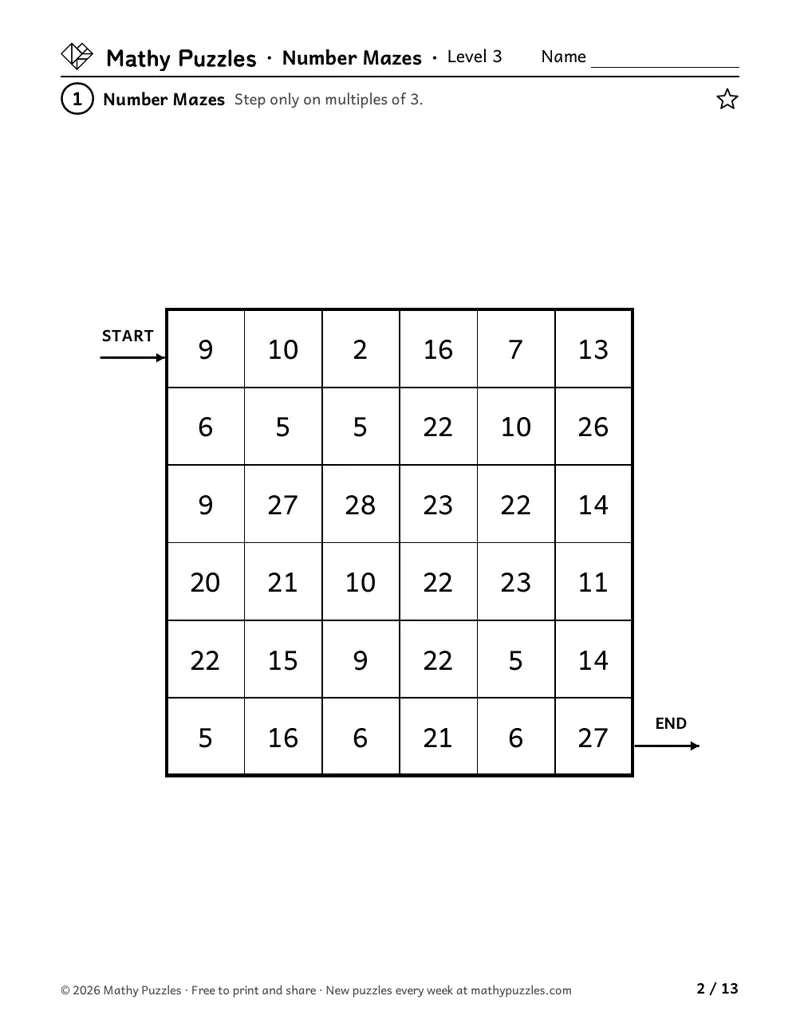
Multiples of 3, 4 or 5, then 6 to 9, then multiplication and division facts that may be off by a little.
On the sheet: “Walk from START to END. Step only on squares that follow the rule: a multiple of a number, or a multiplication fact that is true (7 × 8 = 56).”
Print Level 3 (Letter)Other paper size: A4Level 4
Ages 10–12 · Grades 5–6
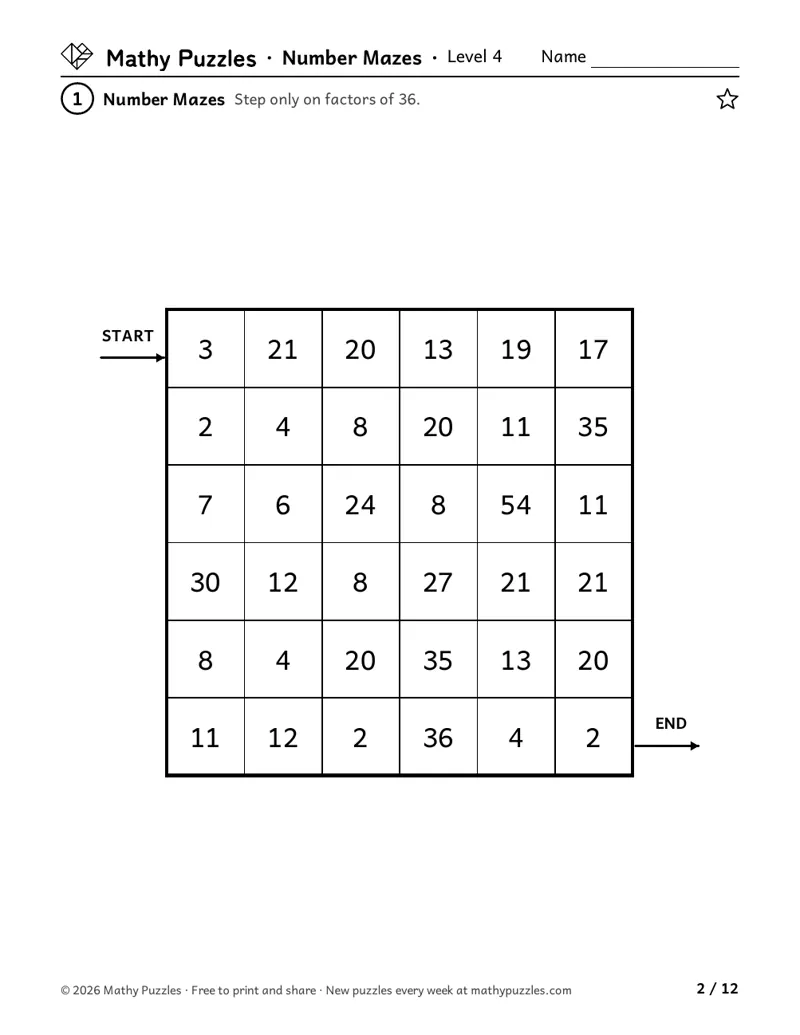
Factors of a number, primes, then expressions where × comes before + and −.
On the sheet: “Walk from START to END. Step only on squares that follow the rule. Do × before + and −: 2 + 3 × 4 = 2 + 12 = 14.”
Print Level 4 (Letter)Other paper size: A4
How it works
A maze with no walls: the numbers make the path. The child walks from START to END, or from a circled first number out of the maze. Each step goes only on a square that follows the rule. The rule might be the next counting number, the next number when counting by 5s, or a fact that makes 10. Squares that break the rule are dead ends.
How to play
- Read the rule at the top. In a skip-count maze, start at the circled number and say the count out loud.
- From START, look at the squares that share a side with yours (not corners). On a honeycomb, that is up to six cells.
- Step onto the one that follows the rule and color it.
- Keep going until you reach END or the way out. If you hit a dead end, go back and check your last few steps.
When it gets hard
Stepping on a near miss, such as 3 + 6 when the rule is make 10.
Hint: Work out every fact you step on. Don't trust how it looks.
In a skip-count maze, stepping on a number that is close but off the count, like 24 when counting by 5s.
Hint: Say the next number before you look for it: 20, then 25. Step only on that number.
Moving corner to corner.
Hint: Squares touch along a side only. Put your finger on the shared edge.
At Level 4, working left to right (2 + 3 × 4 = 20).
Hint: Multiply first: what is 3 × 4? Now add.
Tip for grown-ups: If the facts are still slow, let your child use a multiplication chart and put the effort into the path; the checking habit is the point.
Frequently asked questions
- Is this fact practice?
- Yes. One maze holds 16 to 36 squares, and the wrong squares are near misses like 3 + 6. Level 3 covers multiples and multiplication facts; Level 4 adds factors, primes and order of operations.
- What does a dead end mean?
- A square along the way wasn't checked carefully. Go back a few steps and work each fact out again. Any route that steps only on squares that follow the rule and reaches the end is right; the answers show one.
Questions about printing, levels, answers or membership: see all questions.
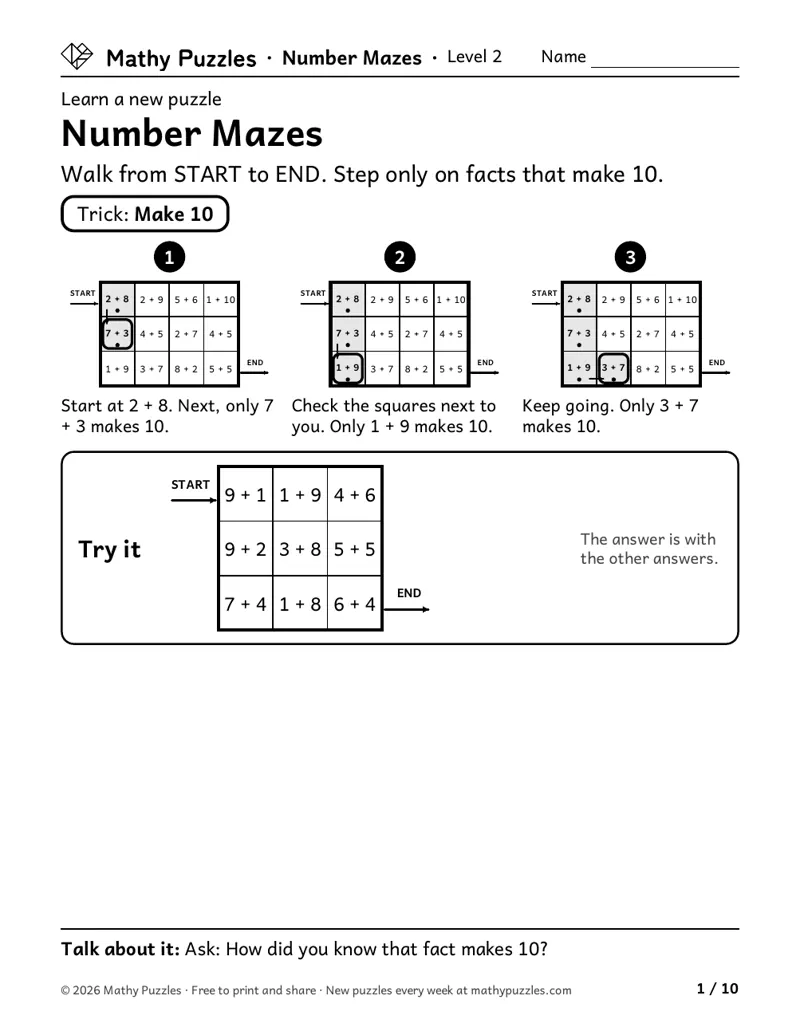
Worked example
From the Level 2 Learn sheet
- Walk from START to END. Step only on facts that make 10.
- Work out each fact next to you. Only one of them makes 10.
- Step onto it and color it. Then check the squares next to that one.
- Keep going until you reach END.
A question to ask: “How did you know that fact makes 10?”
Free every Sunday A mixed bag of 20 new puzzles, all four levels. Get them by email
The thinking it works on
Working out facts, one after another
Works out every fact on the way through the maze.
De Brauwer, Verguts and Fias (2006) found that the extra time children needed for larger multiplication facts shrank between ages 9 and 11, when they matched adults. Source
Counting in order
Steps to the next number of the count, by 1s at Level 1 and by 2s, 5s or 10s at Level 2.
Checking each step against a rule
Asks of every cell whether it follows the rule.
Lemaire and Fayol (1995) found that schoolchildren judging whether a multiplication was true used whether the answer should be odd or even. How they used it depended on their age and the problem. Source
Ignoring the near miss
Stops at the near miss, like 7 × 8 = 54, and works it out.
Houdé and Guichart (2001) studied 9-year-olds who knew that a spread-out row has the same number. They still had to hold back the 'longer means more' idea, which slowed them on the next item. Source
Thinking about multiples and factors
Decides whether a number is a multiple, a factor or a prime.
Sutarto and colleagues (2021) found that some fourth graders mixed up a number's multiples with its factors. Source
Order of operations
Does × before + and − when the rule says so.
Lee and colleagues (2026) studied 578 middle school students. Accuracy fell and answers slowed as the multiply sign moved from the left of an expression to the middle or right. Source
Going back when a path dies
Retraces the last few cells at a dead end to find the wrong step.
Asato, Sweeney and Luna (2006) found that skill on a tower-moving planning puzzle was still maturing through the teens, in 100 people aged 8 to 30. Source
Where is this thinking used?
- Receipts and bills: The sums are checked before paying.
- Checking someone's work: A calculation is tested before it's trusted.
- Checklists: A safety list or a recipe is followed step by step.
- Data entry: Proofreading numbers, where the error looks almost right.
For teachers
Curriculum areas
- Common Core
- Counting and cardinality: the counting sequence to 20 (Kindergarten)
- Common Core
- Operations and algebraic thinking: making 10 (Kindergarten, used again at Level 2); adding within 20 and deciding whether an equation is true or false (Grade 1); multiplying and dividing within 100 (Grade 3); multiples, factors and primes (Grade 4). Number and operations in base ten: skip counting by 5s and 10s (Grade 2)
- Common Core
- Expressions and equations: order of operations (Grades 5–6, hardest puzzles of Level 4)
- NCERT
- Joyful Mathematics: a path through 1 to 9 in order and making 10 (Class 1); skip counting (Class 2); Maths Mela: times tables and multiples (Classes 3–4), factors (Class 5); Ganita Prakash (Class 6): prime numbers. Order of operations is Class 7, above the level
- National Curriculum (England)
- Number: counting on (Year 1); facts to 20 and counting in steps (Year 2); times tables (Year 4); factors, multiples and primes, and the order of operations (Year 6)
- Cambridge Primary Mathematics
- Number: counting on and in steps, pairs that make 10, doubles (Stages 1–2); times tables (Stages 3–4); prime numbers and the order of operations (Stage 5)
Math practices: see the box below.
Math practices this puzzle uses
- Not used: MP1 Make sense of problems and persevere in solving them
- Not used: MP2 Reason abstractly and quantitatively
- Not used: MP3 Construct viable arguments and critique the reasoning of others
- Not used: MP4 Model with mathematics
- Not used: MP5 Use appropriate tools strategically
- Uses: MP6 Attend to precision
- Not used: MP7 Look for and make use of structure
- Uses: MP8 Look for and express regularity in repeated reasoning
From the Common Core Standards for Mathematical Practice.
More Number Mazes puzzles for members
Members get at least 5 more worksheets at each difficulty for every puzzle, 80 new puzzles every Sunday, and the whole archive. $39 a year or $25 for 6 months.
See membershipNot ready yet?
One email, all four levels: 20 puzzles, 5 for each level.
For grown-ups (18+). One email every Sunday with the puzzles and the odd note about membership; unsubscribe any time. We never ask about your child. How we use your email