
Nets & Solids
Wrap a present in patterned paper and you soon notice that every side has to point the right way. These cube nets ask the same question in the head: once the net is folded, which way does each mark point, and which edges and corners meet?
Free sets by level, ages 10–12:
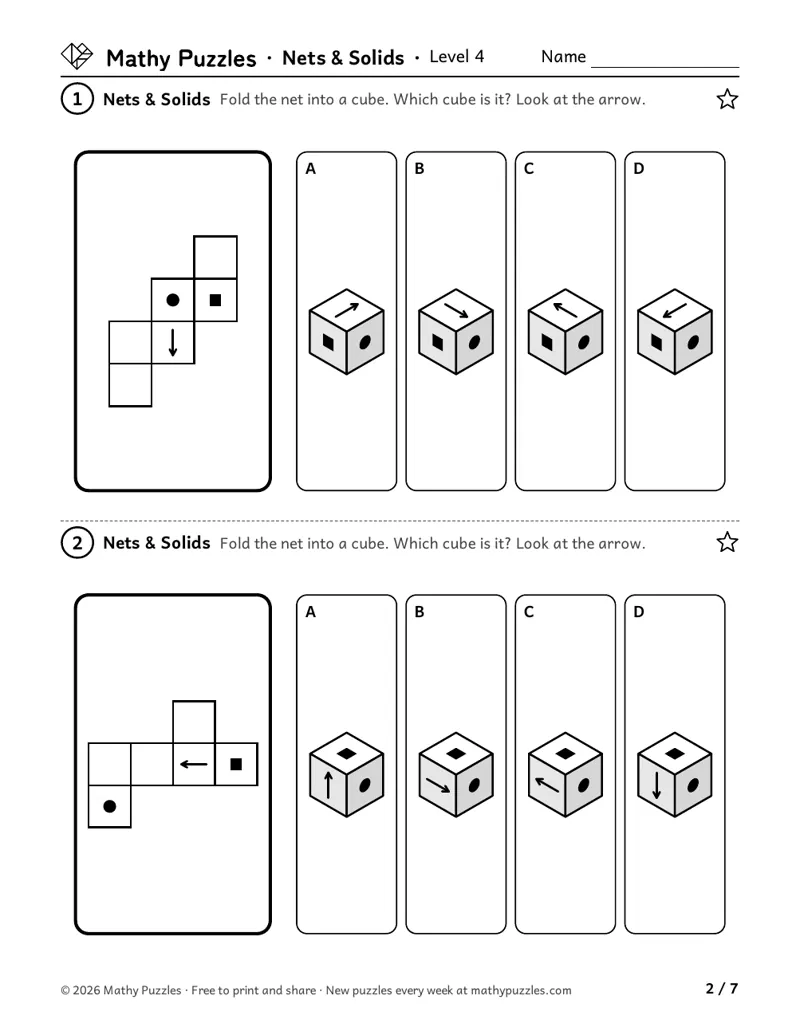 Level 4: a page from the free set
Before starting
- Know that a cube has 6 square faces
- Some experience folding paper
- Cube Nets & Dice (Level 3) is a good warm-up
What you need
A spare sheet of paper and scissors to cut out a net and fold it, and a pencil.
Free puzzles to print
Each set: a Learn sheet with a worked example, 10 puzzles from easiest to hardest, and the answers.
Level 4
Ages 10–12 · Grades 5–6
The easiest puzzles: a cube net with an arrow, a dot and a square. Which of 4 cubes shows the arrow pointing the right way?
Next: one edge of the net is thick. When it folds, which of 3 marked edges meets it?
Then: one corner is marked. Which of 3 marked corners meets it? Three squares meet at every corner of a cube.
The hardest puzzles: a cube with an arrow, a dot and a square. Which of 4 different nets folds into it? Each wrong net has one flaw: the arrow turned, the dot and square swapped, or two marks on opposite faces.
On the sheet: “Fold the net in your head.”
Print Level 4 (Letter)Other paper size: A4
How it works
A net is a flat pattern of six squares that folds into a cube. Each puzzle marks the net and asks what happens when it folds. Which way does an arrow point on the cube? Which edge meets a marked edge, or which corner meets a marked corner? The faces carry arrows, dots and squares, not letters, so no reading is needed.
How to play
- Choose one square of the net to be the bottom of the cube.
- Fold the squares around it up, one at a time, in your head.
- Follow the marked arrow, edge or corner as you fold.
- Pick the choice that matches. Fold a paper copy if you are not sure.
When it gets hard
Thinking edges that touch on the flat net are the only ones that meet.
Hint: Edges far apart on the net can close together. Fold the squares between them.
Tracking which face an arrow is on but not which way it points.
Hint: Look at where the arrow's tip goes as each square folds up.
Mixing up a cube with its mirror image.
Hint: Check the order of the dot, the square and the arrow going around the corner.
Tip for grown-ups: Fold one real net together before starting the sheet. After that, ask your child to say which edges will meet before folding, then check.
Frequently asked questions
- Is it cheating to cut out the net?
- No. Folding real paper shows what folding does. Encourage a guess first, then a fold to check.
- Does this include nets of pyramids and prisms?
- No. These puzzles use cube nets only, with marks that show which way each face points. Nets of other solids are a separate topic.
- How can I use this with a group?
- Give each pair one printed net to cut and fold. One child predicts, the other folds and checks, then they swap.
Questions about printing, levels, answers or membership: see all questions.
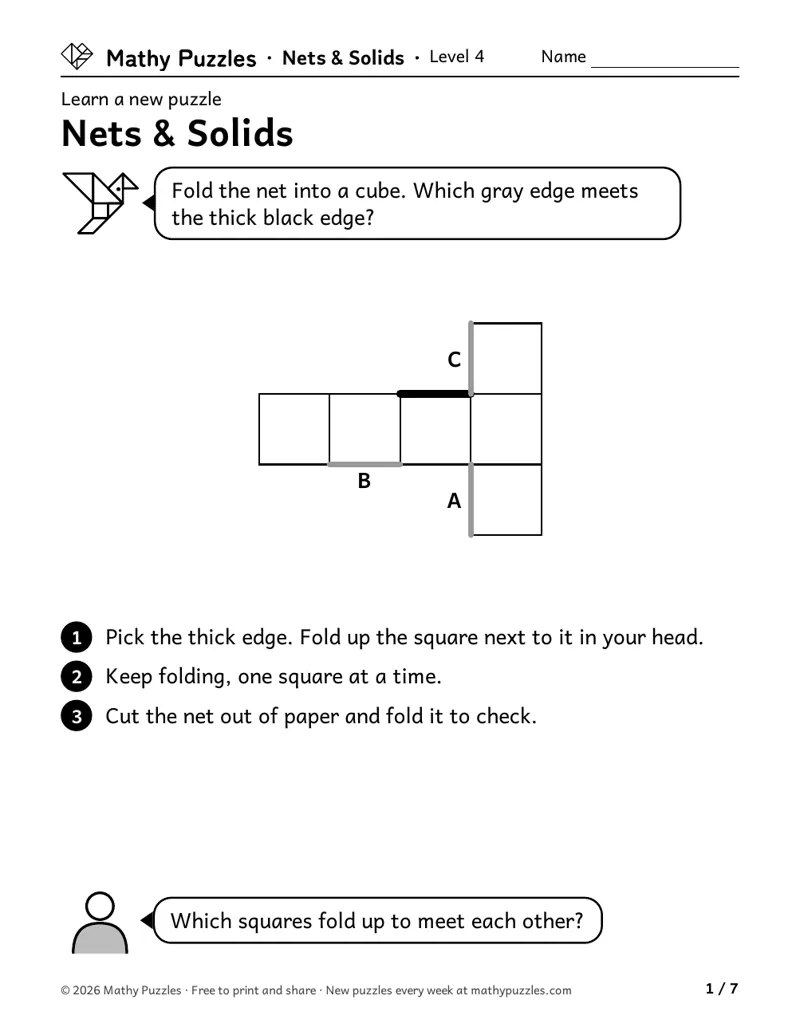
Worked example
From the Level 4 Learn sheet
- Fold the net into a cube. Which gray edge meets the thick black edge?
- Start at the thick edge. Fold up the square next to it in your head.
- Keep folding, one square at a time, and watch where the thick edge goes.
- The gray edge that ends up beside it is the answer. Cut the net out of paper and fold it to check.
A question to ask: “Which squares fold up to meet each other?”
Free every Sunday A mixed bag of 20 new puzzles, all four levels. Get them by email
The thinking it works on
Folding the net square by square
Folds a flat net into a cube in the mind.
Chen and Yang (2023) found that how complex a net was changed how hard cube-folding questions were for 199 sixth graders. Source
Tracking orientation
Follows which way a mark points as a face folds.
Edge and corner matching
Works out which edges and corners come together.
Keeping the folded squares in mind
Holds a half-folded cube in mind.
By about age 10, children hold as many visual items in mind as adults do, roughly three or four, according to change-spotting tests by Riggs and colleagues (2006). Source
Checking with a model
Uses a paper net to test an idea.
Where is this thinking used?
- Packaging design: A flat cardboard shape is cut and folded into a box.
- Gift wrapping: Paper is planned so its edges meet neatly when folded.
- Sewing and tailoring: Flat pieces are cut so their edges join into a 3-D shape.
- Making a model or a paper craft: Tabs and edges are planned flat, then folded up.
For teachers
Curriculum areas
- Common Core
- Geometry: nets of solid figures (Grade 6)
- NCERT
- Nets and solids (Classes 4–5)
- National Curriculum (England)
- Geometry – properties of shapes: nets of 3-D shapes (Year 6); using faces, edges and vertices of cubes to solve 3-D problems (Key Stage 3)
- Cambridge Primary Mathematics
- Geometry and measure: nets of a cube (Stages 4–5)
Math practices: see the box below.
Math practices this puzzle uses
- Not used: MP1 Make sense of problems and persevere in solving them
- Not used: MP2 Reason abstractly and quantitatively
- Not used: MP3 Construct viable arguments and critique the reasoning of others
- Not used: MP4 Model with mathematics
- Uses: MP5 Use appropriate tools strategically
- Not used: MP6 Attend to precision
- Uses: MP7 Look for and make use of structure
- Not used: MP8 Look for and express regularity in repeated reasoning
From the Common Core Standards for Mathematical Practice.
More Nets & Solids puzzles for members
Members get at least 5 more worksheets at each difficulty for every puzzle, 80 new puzzles every Sunday, and the whole archive. $39 a year or $25 for 6 months.
See membershipNot ready yet?
One email, all four levels: 20 puzzles, 5 for each level.
For grown-ups (18+). One email every Sunday with the puzzles and the odd note about membership; unsubscribe any time. We never ask about your child. How we use your email