
Hit the Target
Give a child the numbers 2, 3 and 4, and they can make 9, or 1, or 24, just by changing the signs between them. Hit the Target asks for one total: try a step, see how close it gets, and adjust.
Free sets by level, ages 6–12:
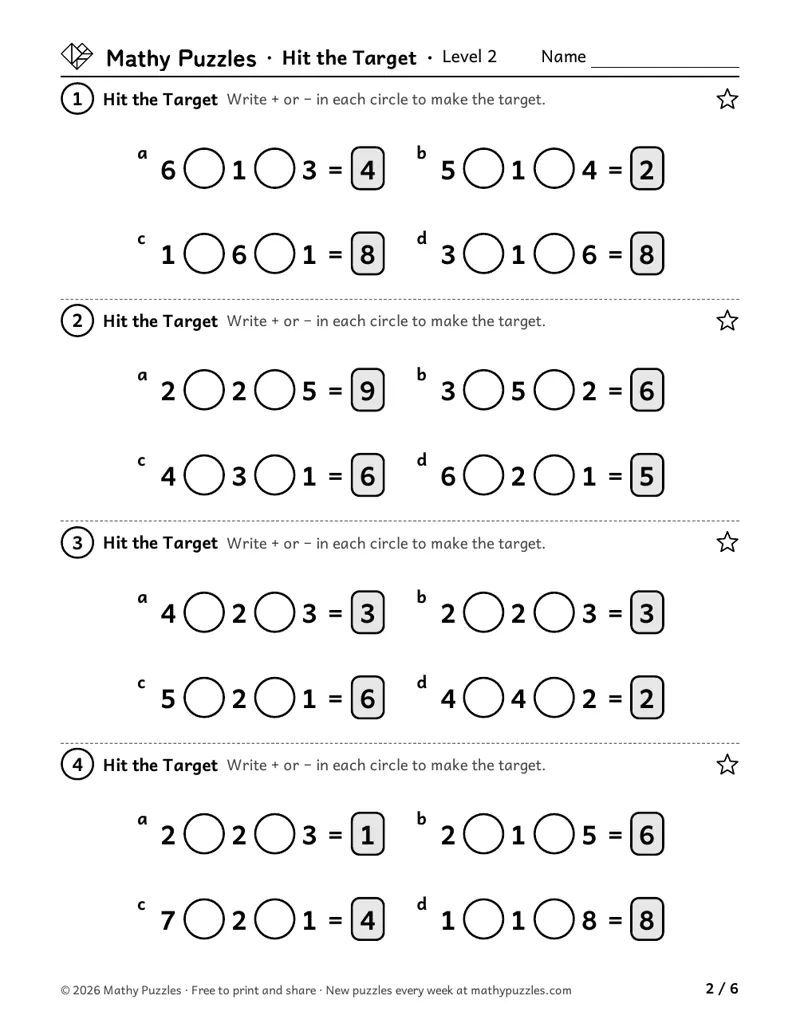 Level 2: a page from the free set
Before starting
- Level 2: adding and taking away within 20; within 100 for the hardest
- Level 3: addition, subtraction and multiplication facts; division facts for the harder puzzles
- Level 4: facts for all four operations to 10 × 10, and that × and ÷ go before + and −
What you need
Scrap paper for trying steps, and a pencil with an eraser.
Free puzzles to print
Each set: a Learn sheet with a worked example, 10 puzzles from easiest to hardest, and the answers.
Level 2
Ages 6–8 · Grades 1–2
The easiest put + or − between three numbers from 1 to 9, with every total within 10. Then the same within 20. Then four numbers within 20. The hardest use three two-digit numbers within 100 (45 ○ 20 ○ 13 = 52). No step ever goes below zero.
On the sheet: “Write + or − in each circle to make the target.”
Print Level 2 (Letter)Other paper size: A4Level 3
Ages 8–10 · Grades 3–4
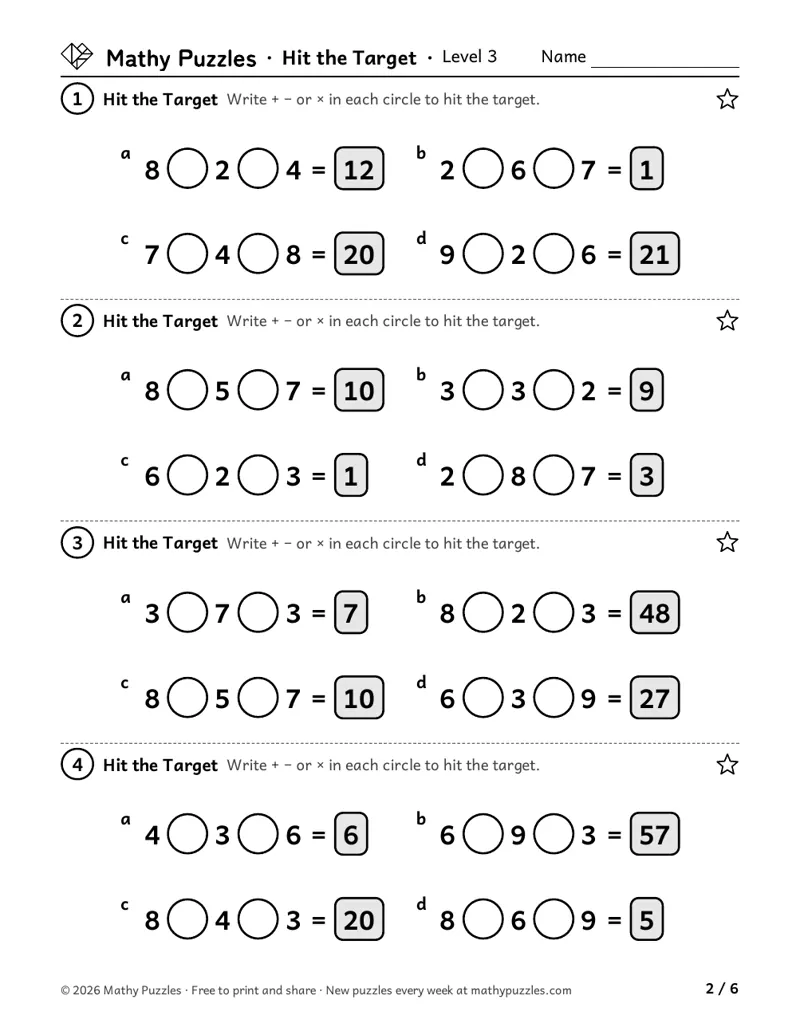
First, write + − or × between three numbers in order (× goes first). Then four numbers and all four signs. Then use four numbers once each to make a target, one step per line. The hardest ask for two different ways.
On the sheet: “Use the numbers and + − × ÷ to hit the target.”
Print Level 3 (Letter)Other paper size: A4Level 4
Ages 10–12 · Grades 5–6
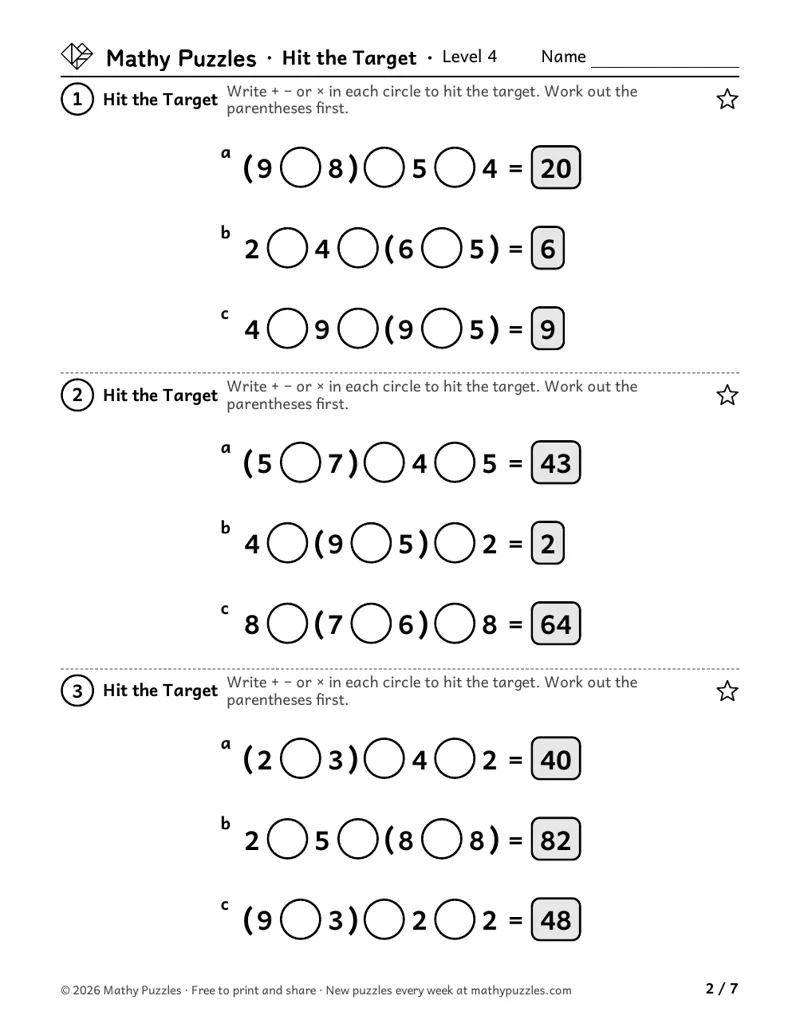
First, fill in signs around printed parentheses. Then add one pair of parentheses to make a number sentence true. Then write a whole answer on one line with parentheses. The hardest ask for two ways.
On the sheet: “Use the numbers and + − × ÷ to hit the target.”
Print Level 4 (Letter)Other paper size: A4
How it works
Each puzzle gives a few numbers and a target. The child chooses signs to make the target. At Level 2 there are only + and −: write one in each circle between three or four numbers in order. At Level 3, × and ÷ join in. At first the numbers are in order and only the signs are missing; later the child picks the order and writes the steps. At Level 4 parentheses come in. The child fills in signs around printed parentheses, adds one pair of parentheses to make a number sentence true, or writes a whole answer on one line.
How to play
- At Level 2, add all the numbers first. If that is too big, find the number to take away instead: half of the amount too big.
- Read the target first. Is it big (try ×) or small (try − or ÷)?
- Try one step with two numbers. Write it on a line.
- Use that answer with the next number. Keep going until every number is used once.
- If you miss, go back one step and try another sign or pair. At Level 4, work inside the parentheses first.
When it gets hard
Level 2: changing a + to a − and expecting the total to drop by that number only.
Hint: Switching a + to a − drops the total by twice the number. 5 + 3 + 2 = 10, but 5 + 3 − 2 = 6.
Working left to right: 2 + 3 × 4 = 20.
Hint: × and ÷ go first: 2 + 12 = 14. At Level 4, parentheses can make the + go first.
Using a number twice, or leaving one out.
Hint: Cross out each number as you use it.
Putting parentheses around a × that already goes first.
Hint: Parentheses only change the answer when they make + or − go first.
Tip for grown-ups: Play it aloud in the car with four digits from a license plate and a target of your choice. Any way that uses each number once and gets the math right counts. Trying steps on scrap paper first means only the working answer goes on the sheet.
Frequently asked questions
- Can a puzzle be solved more than one way?
- A puzzle may have more than one way. The "find two ways" puzzles ask for two. The answers show examples, and any other way is right if each number is used once and the math is right.
- My students haven't met parentheses yet. Which level should I use?
- Use Level 2 or 3. Level 2 uses only + and − in a line; Level 3 writes one step per line, so no parentheses are needed. Level 4 brings in parentheses, which Common Core places in Grade 5.
- Will my child need numbers below zero or fractions?
- No. Every step stays a whole number, never below zero, and every division comes out even.
Questions about printing, levels, answers or membership: see all questions.
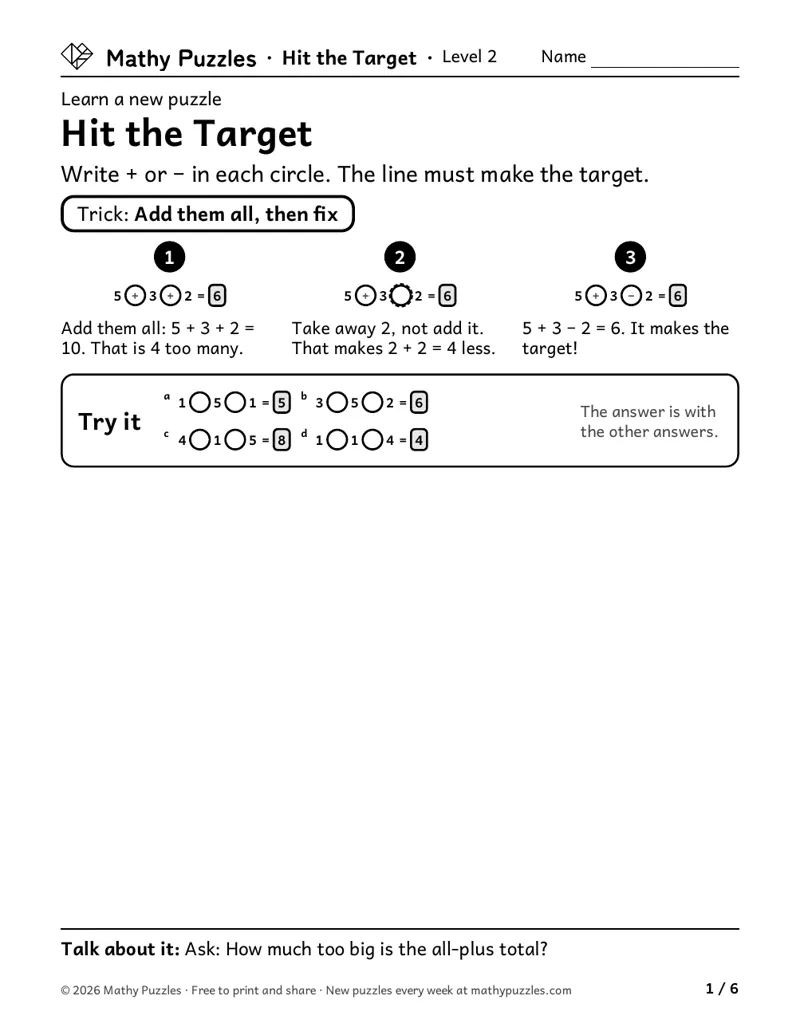
Worked example
From the Level 2 Learn sheet
- Write + or − in each circle. The line must make the target.
- Add them all first. Is that total too big? By how much?
- Changing a + to a − takes that number away twice: once for not adding it, once for taking it away. Pick the number that is half of the amount too big.
- Work the line out from left to right. It makes the target!
A question to ask: “How much too big is the all-plus total?”
Free every Sunday A mixed bag of 20 new puzzles, all four levels. Get them by email
The thinking it works on
Choosing the sign
Picks the sign that moves a number toward the target.
Hickendorff (2017) found that 648 Dutch sixth graders used shortcut methods on only 6 to 21% of multidigit adding, subtracting, multiplying and dividing problems. Source
Order of operations
Does × and ÷ before + and −, and parentheses first.
Linchevski and Livneh (1999) interviewed 53 sixth graders. Many misread how a number expression is grouped, and the same child could be right in one problem and wrong in another. Source
Judging how close a step gets
Judges whether a step gets closer to the target or further away.
Fourth graders, sixth graders and adults asked to estimate sums of three-digit numbers most often rounded both numbers down. Which strategies they chose, and how well they ran them, changed with age and with the numbers in the problem. Source
Working backward
Asks what the last step must be.
Planning and backtracking
Tries a first step, follows it, and backs up when it misses.
On a tower-moving planning task, accuracy kept rising from age 9 until about 15 to 17. Children's working memory (how many digits they could repeat backward) explained part of their planning accuracy, over and above age. Source
Finding more than one way
Looks for a second, different route to the same target.
Torbeyns and colleagues (2009) asked second to fourth graders to find two different ways to solve each problem. Older children had worked out shortcut ways by themselves. Source
Where is this thinking used?
- Shopping: Combining prices to land exactly on a budget.
- Games: Card and dice games where you combine numbers to reach a total.
- Cooking: Scaling a recipe up or down in a few steps.
- Spreadsheet formulas: Putting parentheses in the right place so a formula works out the right total.
For teachers
Curriculum areas
- Common Core
- Operations and algebraic thinking: adding and taking away within 20 (Grades 1–2), multiplying and dividing within 100 and doing × and ÷ first (Grade 3), writing and working out expressions with parentheses (Grade 5); Expressions and equations: the order of operations (Grade 6). Number and operations in base ten: adding and taking away within 100 (Grade 2)
- NCERT
- Joyful Mathematics: adding and taking away within 20 (Class 1) and within 100 (Class 2); Maths Mela (Class 5): "Make your own numbers" with + − × ÷ in The Dairy Farm
- National Curriculum (England)
- Number: adding and subtracting mentally (Year 2); mixed operations and the equals sign (Year 5); order of operations (Year 6 and Key Stage 3)
- Cambridge Primary Mathematics
- Number: adding and subtracting (Stage 2); times tables (Stage 4); order of operations and brackets (Stages 5–6)
Math practices: see the box below.
Math practices this puzzle uses
- Uses: MP1 Make sense of problems and persevere in solving them
- Not used: MP2 Reason abstractly and quantitatively
- Not used: MP3 Construct viable arguments and critique the reasoning of others
- Not used: MP4 Model with mathematics
- Not used: MP5 Use appropriate tools strategically
- Not used: MP6 Attend to precision
- Uses: MP7 Look for and make use of structure
- Not used: MP8 Look for and express regularity in repeated reasoning
From the Common Core Standards for Mathematical Practice.
More Hit the Target puzzles for members
Members get at least 5 more worksheets at each difficulty for every puzzle, 80 new puzzles every Sunday, and the whole archive. $39 a year or $25 for 6 months.
See membershipNot ready yet?
One email, all four levels: 20 puzzles, 5 for each level.
For grown-ups (18+). One email every Sunday with the puzzles and the odd note about membership; unsubscribe any time. We never ask about your child. How we use your email