
Growing Patterns
Nobody wants to draw step 100 of a pattern square by square. Look closely at how it grows from one step to the next, though, and you can reach a far-off step without drawing the ones in between.
Free sets by level, ages 6–12:
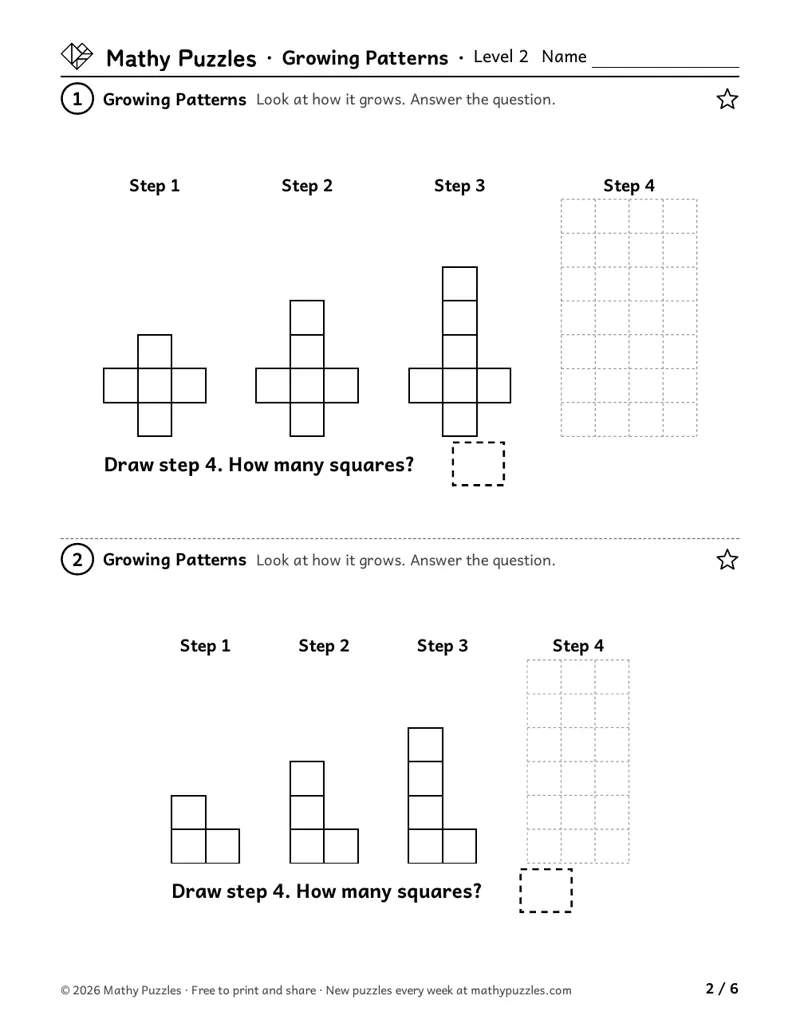 Level 2: a page from the free set
Before starting
- Level 2: count to 20 and count on by 1, 2 or 3
- Level 3: count and add to 50; multiplication facts help for the far steps
- Level 4: multiplication facts to 10 × 10; knowing square numbers helps
Free puzzles to print
Each set: a Learn sheet with a worked example, 10 puzzles from easiest to hardest, and the answers.
Level 2
Ages 6–8 · Grades 1–2
The easiest patterns grow by 1 (a line, a tower on a base, an L with one arm growing): draw step 4 and count. Then patterns that grow by 2, such as an L, a U or two towers. Then patterns that grow by 2 or 3, asking how many squares in step 5 or 6. The hardest work backward: which step has a given number of squares, up to 20.
On the sheet: “Look at how it grows. Answer the question.”
Print Level 2 (Letter)Other paper size: A4Level 3
Ages 8–10 · Grades 3–4
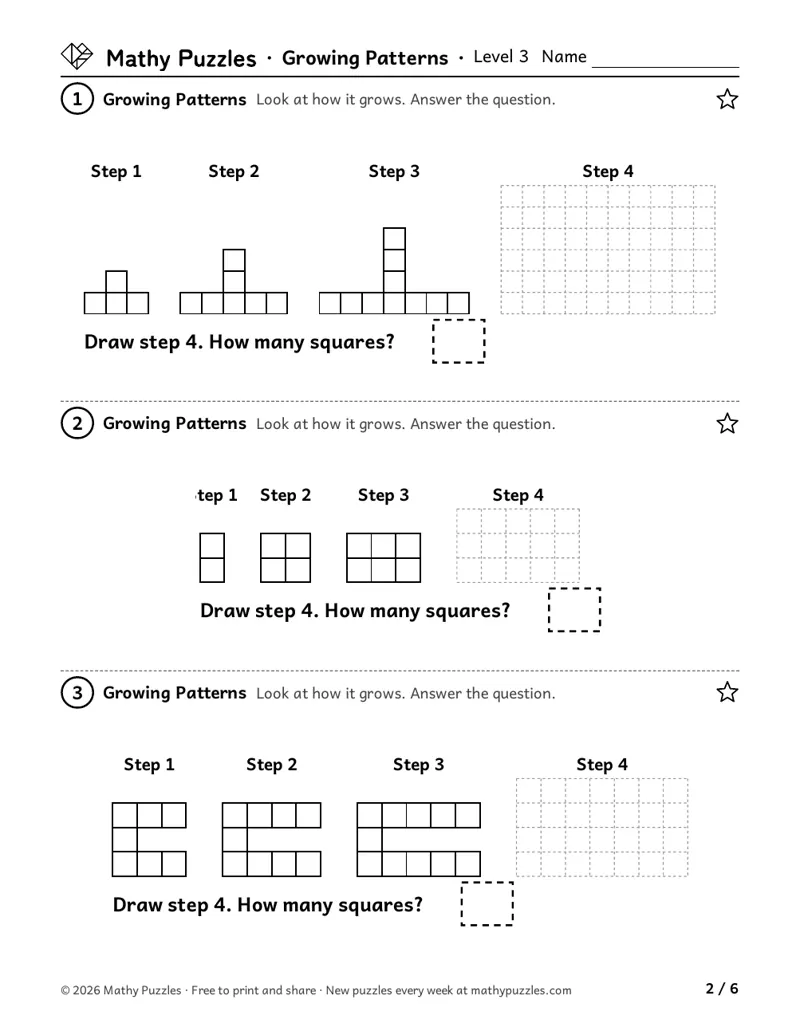
First, patterns that grow by 2 or 3 (an L, a T, a U): draw step 4. Then questions about steps 7 to 10. Then working backward ("Which step has 31 squares?"), arms that grow by different amounts, and a square frame where the corners count once. The hardest use square numbers (1, 4, 9, 16).
On the sheet: “Look at how it grows. Answer the question.”
Print Level 3 (Letter)Other paper size: A4Level 4
Ages 10–12 · Grades 5–6
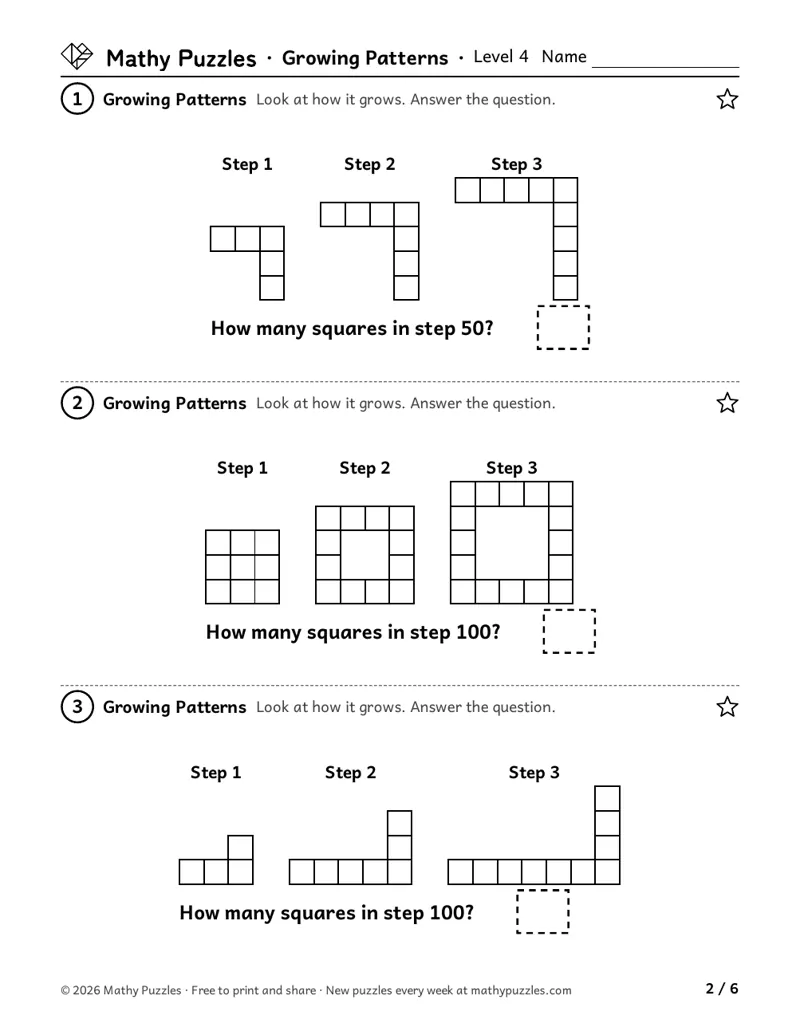
First, steady growth to a far step (20, 25, 50 or 100), with no table to the end. Then square and rectangle numbers. Then staircases (1, 3, 6, 10…). The hardest ask for the rule with a letter: squares in step n = __ × n + __.
On the sheet: “Look at how it grows. Answer the question.”
Print Level 4 (Letter)Other paper size: A4
How it works
Each puzzle shows three steps of a pattern made of square tiles, such as a tower that gets taller or an L whose arms get longer each step. The child works out how many squares each step adds, then draws the next step or answers a question about a later step. At Level 2 that is step 4, 5 or 6, or which step has a given number of squares. At Levels 3 and 4 it reaches step 10 or step 100. The hardest Level 4 puzzles ask for the rule written with a letter.
How to play
- Count the squares in steps 1, 2 and 3. Write the counts.
- Shade the squares that are new in each step. How many does each step add?
- For a later step, start from step 3 and count on. For a far step, start from step 1 and add the new squares once for each step after it.
- Check with a picture: draw the next step and count.
When it gets hard
Level 2: drawing step 4 with the new squares in the wrong place.
Hint: Look where the new squares went in steps 2 and 3. Put the next ones in the same place.
Adding the new squares once for every step, including step 1: step 10 = 3 + 2 × 10.
Hint: Step 1 is already drawn. Step 10 adds the new squares 9 times.
Counting a corner square twice in a frame.
Hint: Shade each square once as you count it.
Assuming every pattern adds the same amount.
Hint: Write the jumps between the counts. If the jumps grow, look at how they grow.
Tip for grown-ups: Before your child counts, ask "Where are the new squares?" Seeing the growth in the picture comes before the numbers.
Frequently asked questions
- Is this algebra?
- It's the start of it. Finding how a pattern grows and jumping to step 100 is the thinking that later becomes writing rules with letters. Only the hardest Level 4 puzzles use a letter.
- Can I use these with a whole class?
- Yes. The tile pictures make good discussion starters: ask students to show where the new squares are in different ways.
- Why ask about step 100 and not just the next step?
- The next step can be drawn by copying. A later step makes the child find the rule: at Level 2 by counting on, and from Level 3 by jumping straight to step 10 or 100.
Questions about printing, levels, answers or membership: see all questions.
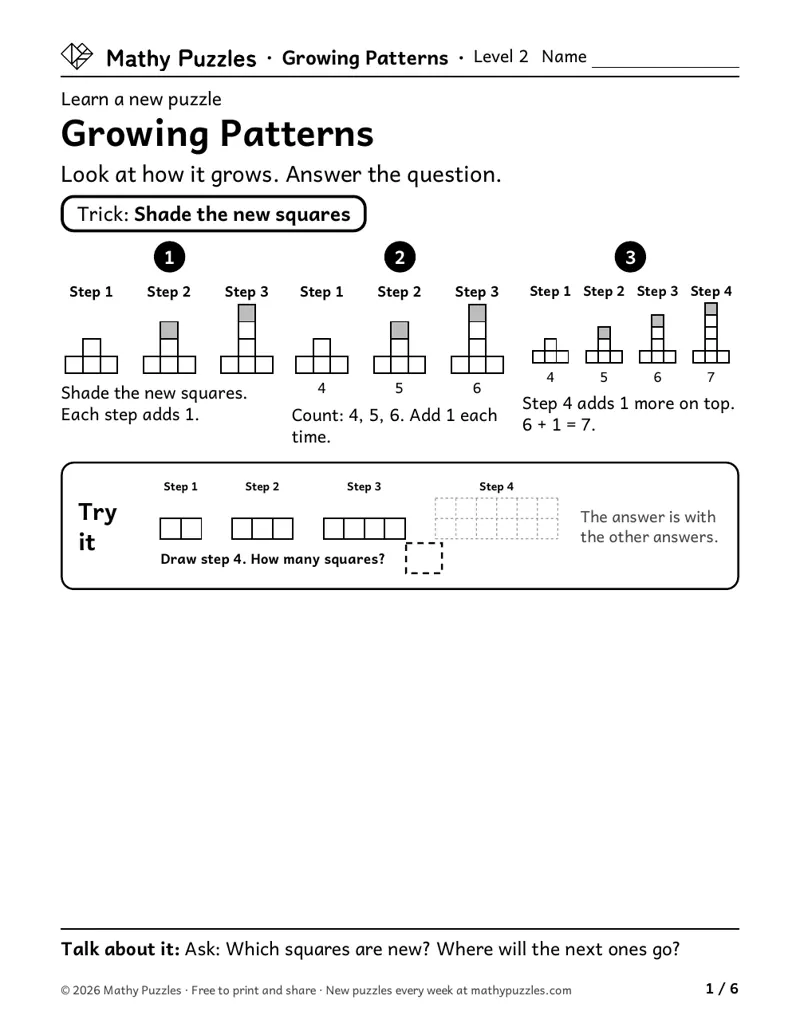
Worked example
From the Level 2 Learn sheet
- Shade the new squares in each step. A tower on a base of 3 adds 1 each step.
- Count: 4, 5, 6. Add 1 each time.
- Step 4 adds 1 more on top: 6 + 1 = 7. Draw it on the dashed grid.
A question to ask: “Which squares are new? Where will the next ones go?”
Free every Sunday A mixed bag of 20 new puzzles, all four levels. Get them by email
The thinking it works on
Seeing structure in a picture
Spots which squares are new in each step.
A study of 25 sixth graders on pattern tasks compared two ways of working. Those who reasoned from the shape of the picture were more successful at giving general rules and valid reasons than those who worked from the numbers alone. Source
Finding a rule for any step
Turns "adds 2 each step" into a way to reach any step.
Stacey (1989) found that students aged 9 to 13 who began a linear pattern question correctly often switched to a simpler but wrong rule for the harder parts. Source
Multiplying instead of adding again and again
Replaces adding again and again with one multiplication.
Clark and Kamii (1996) found that children build multiplying out of adding, and that many fifth graders still did not think in multiplication all the time. Source
Reversing a process
Works back from a total to find which step has it.
Using a letter for any step
Writes the rule so it works for every step.
MacGregor and Stacey (1997) found that many students up to age 15 ignore letters in algebra or treat them as labels. They traced this to several causes, including misleading materials. Source
Where is this thinking used?
- Building: Working out how many bricks a wall needs when each row adds the same number.
- Saving: Putting the same amount aside each week and working out the total by week 20.
- Party planning: Pushing tables together and working out how many chairs fit around 10 of them.
- Spreadsheets: Filling a column with a rule instead of typing every number.
For teachers
Curriculum areas
- Common Core
- Operations and algebraic thinking: counting on to add (Grade 1), generating and analyzing patterns (Grade 4, used again at Level 4); Expressions and equations: expressions with a letter (Grade 6)
- NCERT
- Joyful Mathematics (Class 2): Fun with Numbers (block patterns that grow); Ganita Prakash (Class 6): Patterns in MathematicsLevel 3: No direct curricular match.
- National Curriculum (England)
- Number: counting in steps (Year 2); square numbers (Year 5); linear number sequences and simple formulae (Year 6); nth term (Key Stage 3)
- Cambridge Primary Mathematics
- Number: counting on; spatial patterns that grow by a constant, square and triangular numbers, finding any step of a sequence (Stages 2–6)
Math practices: see the box below.
Math practices this puzzle uses
- Not used: MP1 Make sense of problems and persevere in solving them
- Not used: MP2 Reason abstractly and quantitatively
- Not used: MP3 Construct viable arguments and critique the reasoning of others
- Not used: MP4 Model with mathematics
- Not used: MP5 Use appropriate tools strategically
- Not used: MP6 Attend to precision
- Uses: MP7 Look for and make use of structure
- Uses: MP8 Look for and express regularity in repeated reasoning
From the Common Core Standards for Mathematical Practice.
More Growing Patterns puzzles for members
Members get at least 5 more worksheets at each difficulty for every puzzle, 80 new puzzles every Sunday, and the whole archive. $39 a year or $25 for 6 months.
See membershipNot ready yet?
One email, all four levels: 20 puzzles, 5 for each level.
For grown-ups (18+). One email every Sunday with the puzzles and the odd note about membership; unsubscribe any time. We never ask about your child. How we use your email