
Galaxies
Turn a playing card upside down and the picture looks just the same. Each galaxy in these puzzles is a shape like that, balanced around its dot, and the whole grid has to be split into them.
Free sets by level, ages 8–12:
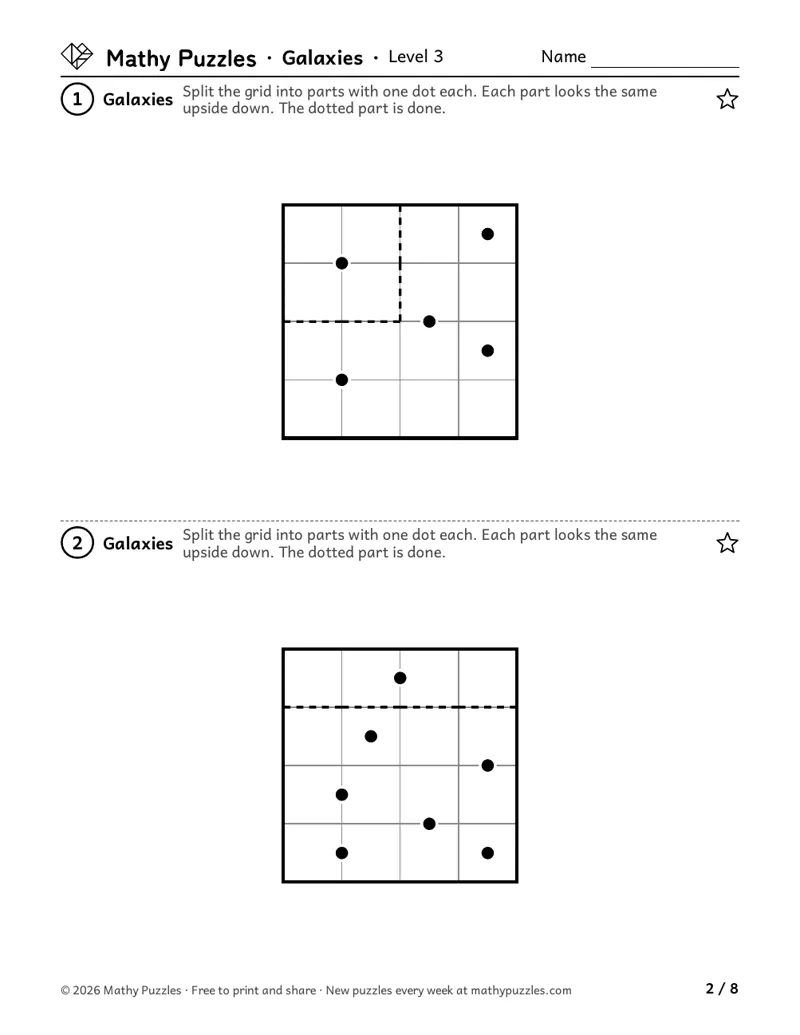 Level 3: a page from the free set
Before starting
- Comfortable with Mirror Match at Level 2 or 3
- Know what a half turn is (upside down)
- Count squares across and down
What you need
Colored pencils to shade each finished galaxy (optional), and a pencil with an eraser.
Free puzzles to print
Each set: a Learn sheet with a worked example, 10 puzzles from easiest to hardest, and the answers.
Level 3
Ages 8–10 · Grades 3–4
A 4 × 4 grid where every galaxy is a rectangle and one is drawn for you. Then 5 × 5 with odd shapes, again with one drawn for you. Then 6 × 6 or 7 × 7 with no help; the hardest are 8 × 8, with longer chains of reasoning.
On the sheet: “Split the grid. Each part has one dot and looks the same turned upside down.”
Print Level 3 (Letter)Other paper size: A4Level 4
Ages 10–12 · Grades 5–6
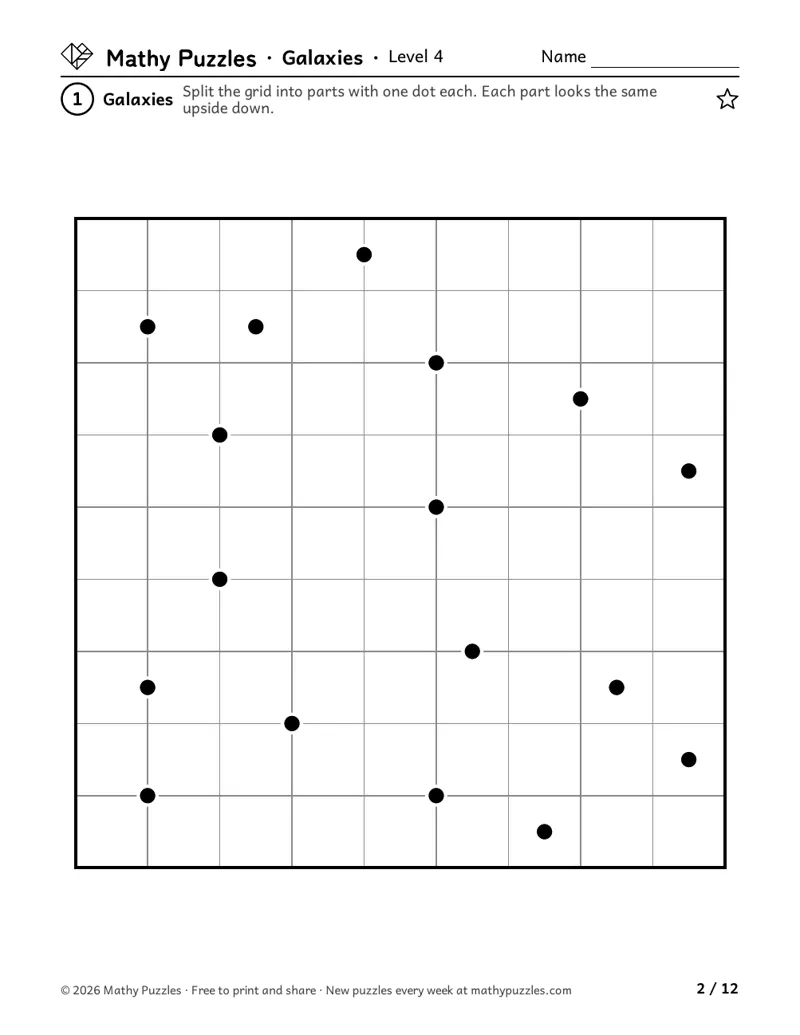
9 × 9 and 10 × 10 grids, where many squares can only be placed by noticing that a dot can't reach them. The hardest need that check again and again across the grid.
On the sheet: “Split the grid. Each part has one dot and looks the same turned upside down.”
Print Level 4 (Letter)Other paper size: A4
How it works
Each puzzle is a square grid with dots on it. The child splits the grid into parts, called galaxies, so that each part holds one dot. Each part must look the same when you turn it halfway around its dot.
How to play
- Start with the squares right around each dot. They belong to that dot.
- For every square you give to a dot, its twin on the other side of the dot belongs to it too.
- If a square's twin is off the grid or already taken, that square can't join that dot.
- Keep going until every square belongs to one galaxy. Draw the walls between them.
When it gets hard
Making a galaxy that looks the same flipped but not turned.
Hint: Turn the page upside down. Does the part still look the same around its dot?
Forgetting the twin of a square.
Hint: Every time you color a square, color its twin across the dot right away.
Leaving a square that no dot can reach.
Hint: Look for lonely squares early. Which dot is the only one that can get to it?
Tip for grown-ups: Point out that a dot can sit in the middle of a square, on a line between two squares, or on a corner. Where it sits changes the shape of its galaxy. Shading each finished galaxy in its own color makes the shapes easy to check.
Frequently asked questions
- This looks hard. Where do we start?
- With the squares right around each dot; they belong to it. The first Level 3 puzzles make every galaxy a rectangle and draw one for you.
- How do we check a finished grid?
- Turn the page upside down: every part must still look the same around its dot, and every part must hold exactly one dot. If your child's split follows those rules, it is right.
Questions about printing, levels, answers or membership: see all questions.
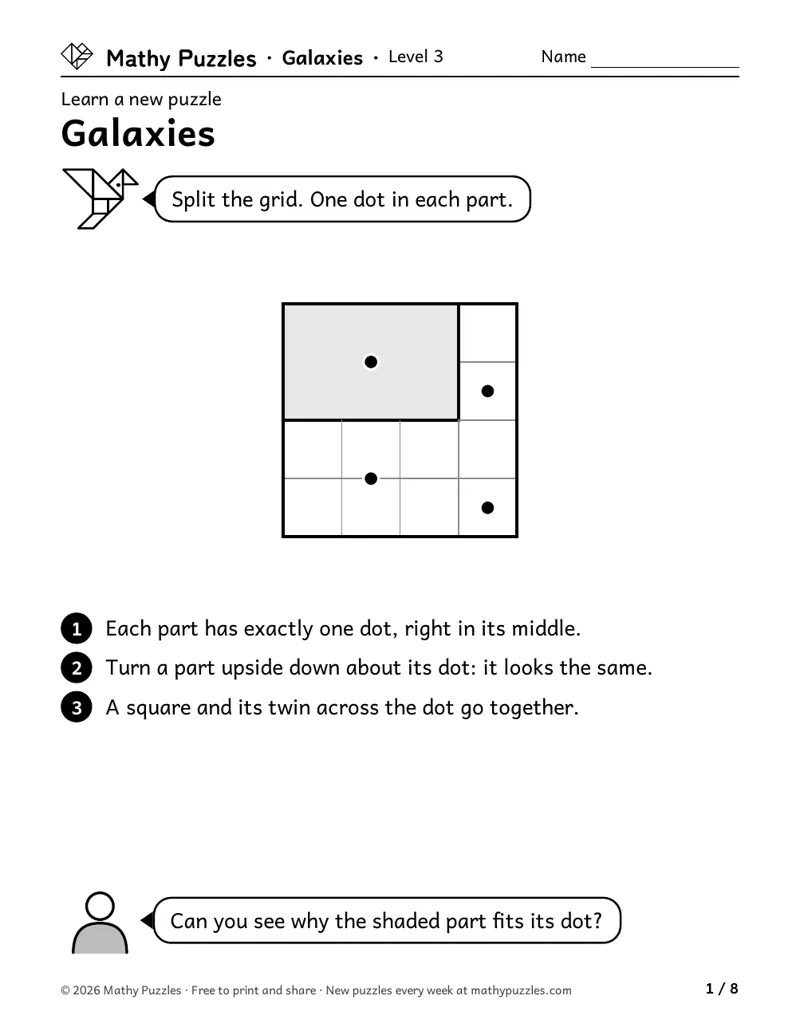
Worked example
From the Level 3 Learn sheet
- Each part has exactly one dot, right in its middle.
- Turn a part upside down about its dot: it looks the same.
- A square and its twin across the dot go together.
A question to ask: “Can you see why the shaded part fits its dot?”
Free every Sunday A mixed bag of 20 new puzzles, all four levels. Get them by email
The thinking it works on
Pairing squares across a center
Finds each square's twin the same distance the other side of the dot.
Van Tetering and colleagues (2019) studied 729 children aged 7 to 12. The 10- to 12-year-olds were better than the 7- to 9-year-olds at judging whether a turned block figure matched another. Source
Telling a turn from a flip
Checks each part by turning the page upside down, not by flipping it.
Perrucci and colleagues (2008) found that 6- and 8-year-olds could tell some turned pictures apart by a telltale feature. To tell a picture from its mirror image, though, they had to turn it in the mind. Source
Reasoning by ruling out
Rules out a dot for a square whose twin is off the grid or taken.
Galotti, Komatsu and Voelz (1997) found that by fourth grade children were more confident in conclusions that follow for certain than in likely guesses, and reached them faster. Source
Planning across the whole grid
Looks for lonely squares early and keeps every part joined up.
Diamond (2013) reviews evidence that holding off a quick first move, so as to look at the whole grid first, is harder for children than for adults. It grows easier through the school years. Source
Working memory
Holds several 'can't reach' facts at once on the big grids.
Gathercole and colleagues (2004) found that working memory keeps growing steadily from age 4 to 15. Source
Where is this thinking used?
- Playing cards, tiles and logos: Designs that look the same upside down.
- Fabric and wallpaper repeats: A motif is turned halfway and repeated across the cloth or paper.
- Engineering: Parts that must balance when they spin.
- Lettering: Words that read the same turned around (ambigrams).
For teachers
Curriculum areas
- Common Core
- No direct curricular match.
- NCERT
- Turn symmetry (Classes 5–6)
- National Curriculum (England)
- Geometry and measures: polygons with reflective and rotational symmetry (Key Stage 3)Level 3: No direct curricular match.
- Cambridge Primary Mathematics
- Geometry and measure: shapes that look the same as they turn; rotational symmetry (Stages 2 and 6)
Math practices: see the box below.
Math practices this puzzle uses
- Uses: MP1 Make sense of problems and persevere in solving them
- Not used: MP2 Reason abstractly and quantitatively
- Not used: MP3 Construct viable arguments and critique the reasoning of others
- Not used: MP4 Model with mathematics
- Not used: MP5 Use appropriate tools strategically
- Not used: MP6 Attend to precision
- Uses: MP7 Look for and make use of structure
- Not used: MP8 Look for and express regularity in repeated reasoning
From the Common Core Standards for Mathematical Practice.
More Galaxies puzzles for members
Members get at least 5 more worksheets at each difficulty for every puzzle, 80 new puzzles every Sunday, and the whole archive. $39 a year or $25 for 6 months.
See membershipNot ready yet?
One email, all four levels: 20 puzzles, 5 for each level.
For grown-ups (18+). One email every Sunday with the puzzles and the odd note about membership; unsubscribe any time. We never ask about your child. How we use your email