
Flowchart Sort
Sorting laundry goes faster with a plan: is it white? Is it a towel? Each yes or no sends it one way. A flowchart is that plan drawn as a map, and every picture follows the arrows to its own box.
Free sets by level, ages 4–10:
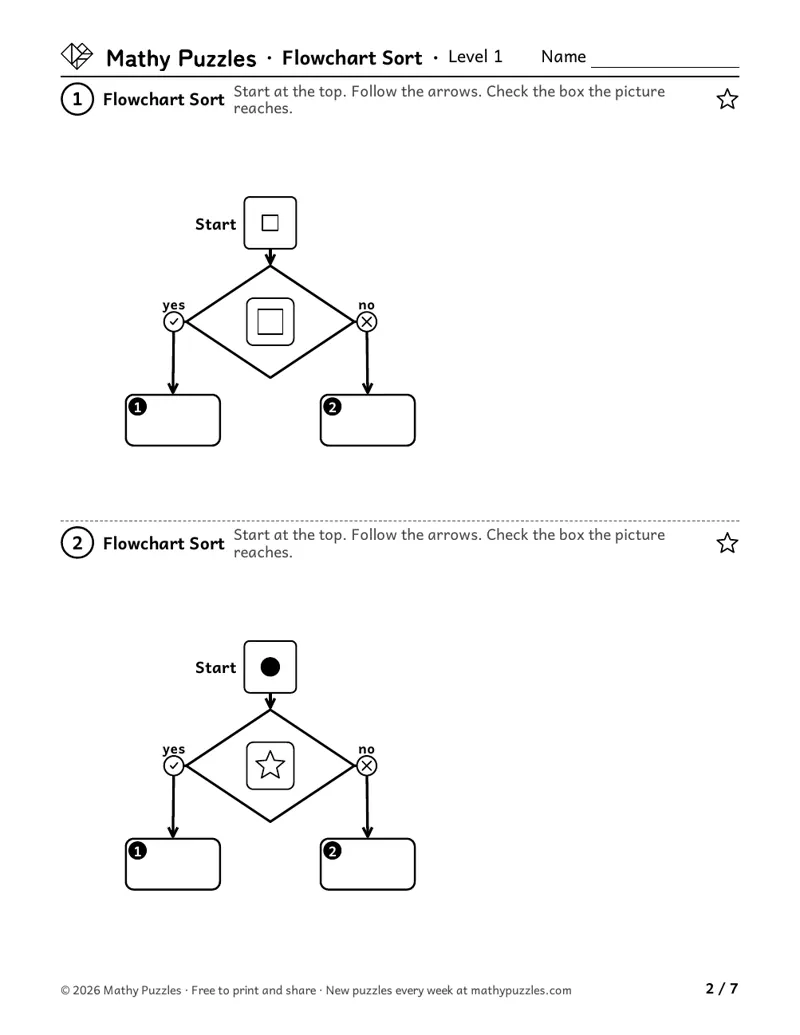 Level 1: a page from the free set
Before starting
- Level 1: match simple shapes (circle, square, triangle, star) and tell big from small, black from white
- Know that a check means yes and a cross means no
- Levels 2–3: a few more shapes, and striped as well as black and white
What you need
A crayon for drawing lines at Level 1, and a pencil for writing letters at Levels 2 and 3.
Free puzzles to print
Each set: a Learn sheet with a worked example, 10 puzzles from easiest to hardest, and the answers.
Level 1
Ages 4–6 · Pre-K–K
One question, two boxes and one picture to check. Then three pictures to sort with lines, then two questions and three boxes. The hardest puzzles ask a 'not' question (a card with a line through it: is it not black?).
On the sheet: “Start at the top. Yes or no? Follow the arrows.”
Print Level 1 (Letter)Other paper size: A4Level 2
Ages 6–8 · Grades 1–2
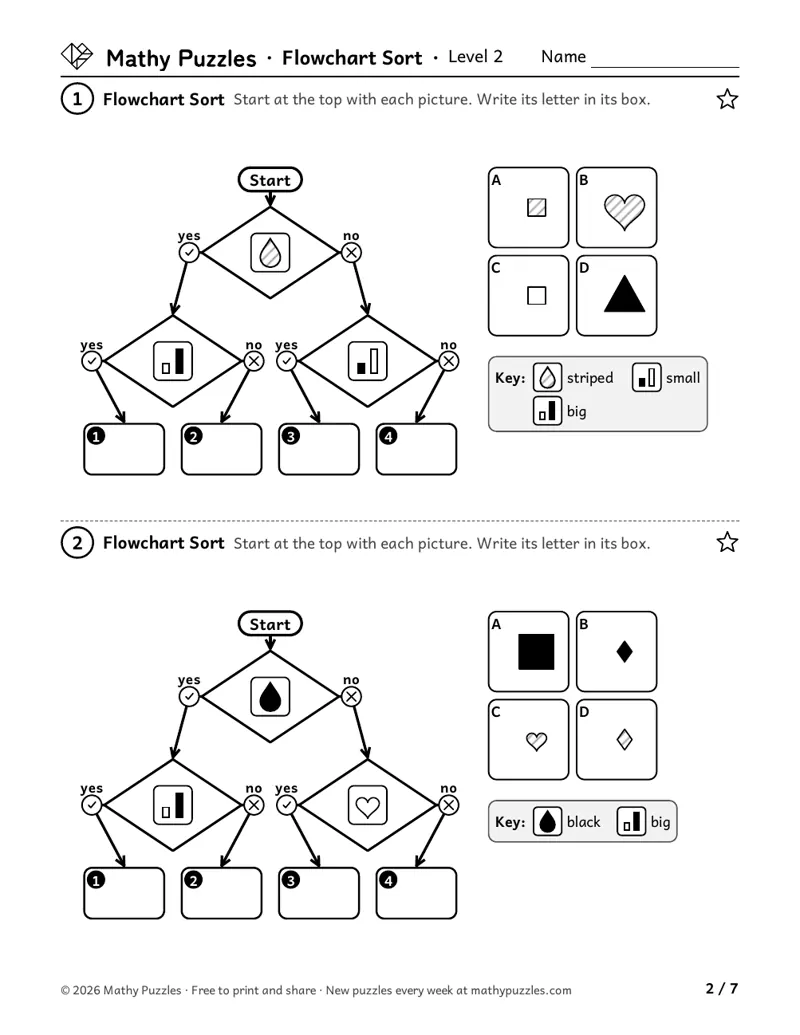
Three questions in two rows and four boxes, with four pictures. Then a chain of three questions, one after another. The hardest puzzles leave one diamond blank, and the child picks the missing question from three cards.
On the sheet: “Start at the top. Yes or no? Follow the arrows.”
Print Level 2 (Letter)Other paper size: A4Level 3
Ages 8–10 · Grades 3–4
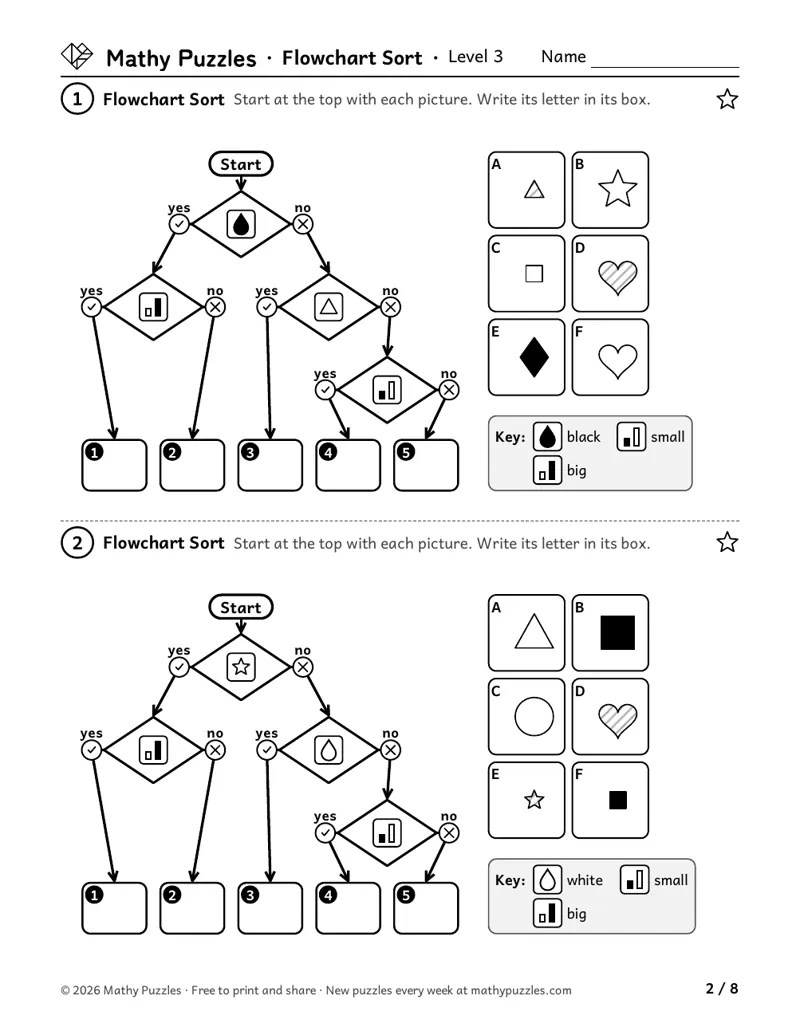
Four questions and five boxes for six pictures. Then a diamond is left blank, and the child picks the missing question from five cards. The hardest puzzles leave every diamond blank, with eight pictures already in their boxes; the child builds the chart by writing a card number in each diamond. More than one way can be right; the answers show one example.
On the sheet: “Start at the top. Yes or no? Follow the arrows.”
Print Level 3 (Letter)Other paper size: A4
How it works
Each puzzle is a chart of yes-or-no questions drawn as diamonds. Each question is a small picture card, with no words: is it a circle? is it black? is it big? A picture starts at the top, follows the check arrow for yes or the cross arrow for no at each diamond, and ends in a numbered box. The child sorts every picture into its box. In the harder Level 2 and 3 puzzles a diamond is blank, and the child works out which question card belongs there.
How to play
- Pick one picture. Start at the top of the chart.
- Look at the card in the diamond. Is your picture like it?
- Yes: follow the check arrow. No: follow the cross arrow.
- Stop at a box. Draw a line to it, or write the picture's letter in it. Then start again with the next picture.
When it gets hard
Answering about the wrong feature: the card asks "black?" and the child says yes because the shape matches.
Hint: Point to the card and say what it asks: "Is it black?" Only that counts.
Following the wrong arrow out of a diamond.
Hint: Check arrow for yes, cross arrow for no. Trace it with a finger to the next shape.
At Level 1, reading a card with a line through it as a plain card.
Hint: A line through the card means "not". Ask: is it not black?
Tip for grown-ups: Sort the laundry or the toy box the same way: one yes-or-no question at a time ("Is it a sock?"), and let your child choose the next question. A crayon is easier than a pencil for small hands at Level 1.
Frequently asked questions
- Are there any words on the chart?
- Only three: Start, yes and no. Each question is a small picture card in a diamond, and each arrow out of it carries a check or a cross as well as the word. Read the one-line instruction aloud and your child can do the rest.
- Can I use this to teach sorting in kindergarten?
- Yes. The first puzzles have one question and two boxes, which fits a lesson on sorting by shape, color or size.
- How is this different from Sorting Box?
- In Sorting Box the labels sit on the rows and columns and the child matches each picture to a place. Here the questions come in an order, and each picture passes through them one at a time to find its box.
Questions about printing, levels, answers or membership: see all questions.
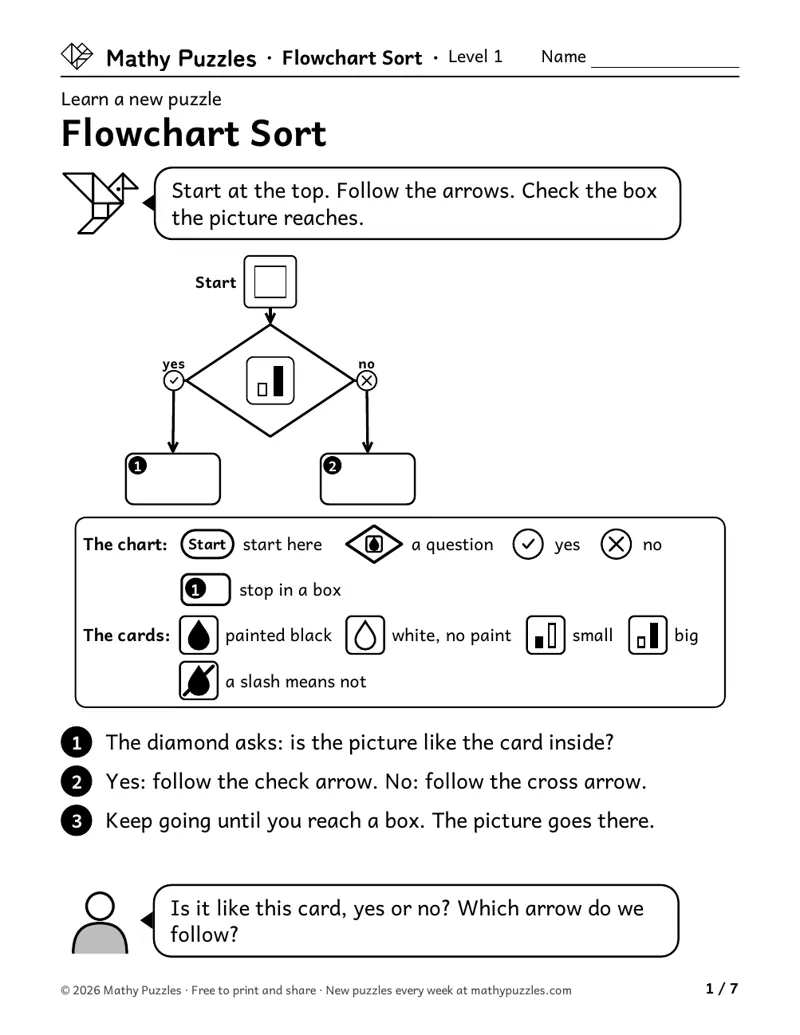
Worked example
From the Level 1 Learn sheet
- The diamond asks: is the picture like the card inside?
- Yes: follow the check arrow. No: follow the cross arrow.
- Keep going until you reach a box. The picture goes there.
A question to ask: “Is it like this card, yes or no? Which arrow do we follow?”
Free every Sunday A mixed bag of 20 new puzzles, all four levels. Get them by email
The thinking it works on
Sorting by one feature
Answers each question about one feature only.
Smith and Kemler (1977) asked kindergartners, second graders and fifth graders to sort cards that differed in size and brightness. The youngest grouped by overall likeness; the fifth graders sorted by one feature at a time. Source
Switching what to look at
Changes focus when the next question asks about something else.
Davidson and colleagues (2006) found that switching between two rules kept developing far longer than holding a rule or holding back a habit. Even 13-year-olds were not yet at adult level. Source
Following a branching path
Takes a different route for each answer.
In Vourletsis's (2026) paper test of coding ideas, 517 children in grades 1 to 3 found 'if' questions the hardest of the three kinds. Step-by-step sequences and loops came easier. Source
Understanding 'not'
Reads a crossed-out card as the opposite.
Working backward to a rule
Works out what a blank diamond must ask.
Where is this thinking used?
- Nature guides: Naming a leaf or a bird by answering yes-or-no questions in order.
- Recycling: "Is it paper? Is it plastic?" decides which bin it goes in.
- Troubleshooting: "Is it plugged in? Is the switch on?" to find why something won't work.
- Programming: Decision trees and "if… else" choices in code.
For teachers
Curriculum areas
- Common Core
- Measurement and data: classifying objects into categories (Kindergarten)
- NCERT
- Joyful Mathematics: sorting objects into groups (Class 1) and picking out flat shapes (Class 2)Level 3: No direct curricular match.
- Computer science (CSTA)
- Following step-by-step instructions, and flowcharts as one way to write them (algorithms and programming, ages 5–14)
- National Curriculum (England)
- Geometry – properties of shapes: comparing and sorting shapes and objects (Year 2)
- Cambridge Primary Mathematics
- Geometry and measure: sorting 2D shapes by their features (Stages 1–2)
Math practices: see the box below.
Math practices this puzzle uses
- Not used: MP1 Make sense of problems and persevere in solving them
- Not used: MP2 Reason abstractly and quantitatively
- Not used: MP3 Construct viable arguments and critique the reasoning of others
- Not used: MP4 Model with mathematics
- Not used: MP5 Use appropriate tools strategically
- Uses: MP6 Attend to precision
- Uses: MP7 Look for and make use of structure
- Not used: MP8 Look for and express regularity in repeated reasoning
From the Common Core Standards for Mathematical Practice.
More Flowchart Sort puzzles for members
Members get at least 5 more worksheets at each difficulty for every puzzle, 80 new puzzles every Sunday, and the whole archive. $39 a year or $25 for 6 months.
See membershipNot ready yet?
One email, all four levels: 20 puzzles, 5 for each level.
For grown-ups (18+). One email every Sunday with the puzzles and the odd note about membership; unsubscribe any time. We never ask about your child. How we use your email