
Dot-to-Dot
The best part of a dot-to-dot is the moment a scribble turns into a rocket. That only happens if the numbers are followed in order, even when they count on from 11, or skip by 2s, 5s or 10s.
Free sets by level, ages 4–8:
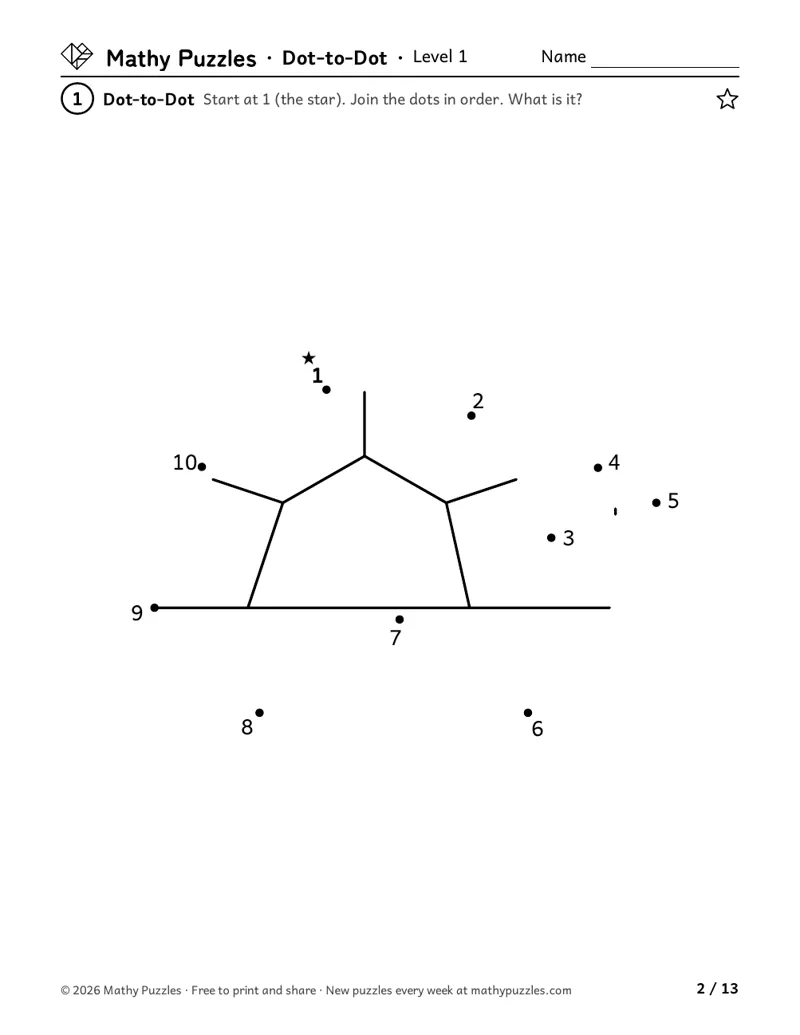 Level 1: a page from the free set
Before starting
- Level 1: say the numbers 1 to 10 in order (to 50, or by tens to 100, for the hardest)
- Recognize written numbers
- Level 2: count by 2s, 5s and 10s, and read numbers past 100 (to 1,000 for the hardest)
What you need
Crayons or colored pencils to color the picture once it appears, and a pencil for the lines.
Free puzzles to print
Each set: a Learn sheet with a worked example, 10 puzzles from easiest to hardest, and the answers.
Level 1
Ages 4–6 · Pre-K–K
The easiest pictures use the numbers 1 to 10, then 1 to 20. Then 1 to 30, or counting on from 11 to 30. The hardest count by tens from 10 to 100, or run from 1 to 50.
On the sheet: “Join the dots in order. What is it?”
Print Level 1 (Letter)Other paper size: A4Level 2
Ages 6–8 · Grades 1–2
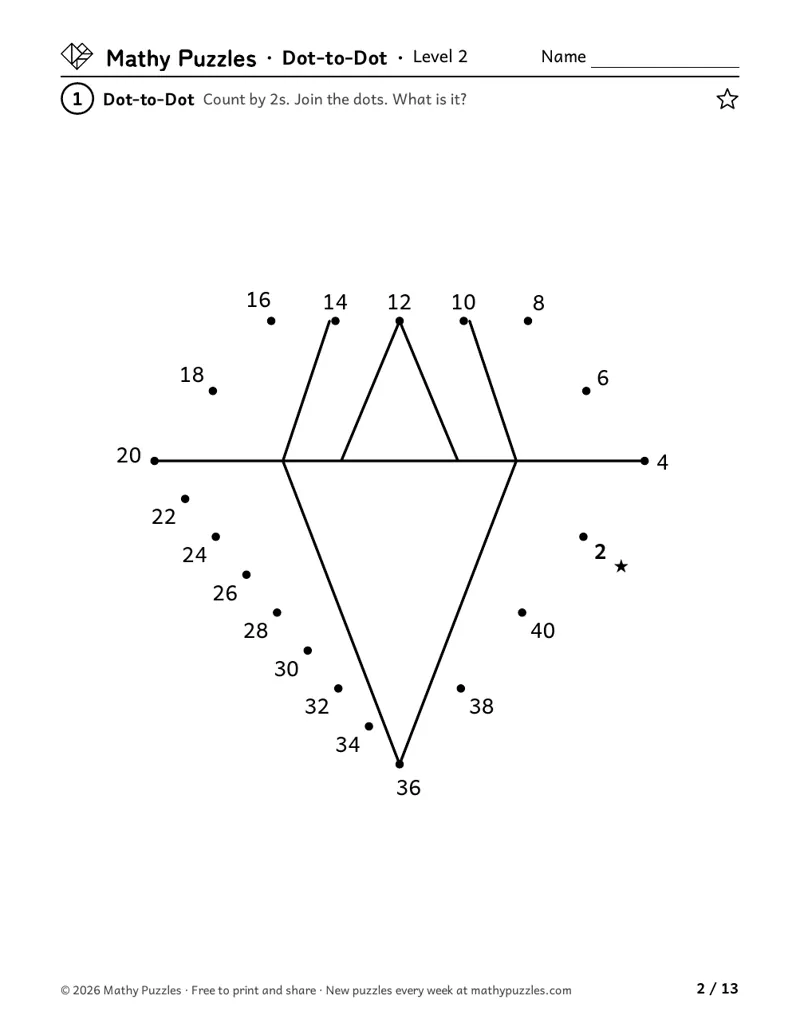
Count by 2s from 2 to 40, then by 5s to 100. Then by 10s from a number that is not a ten (such as 3, 13, 23 and on), or count on from 95 to 120. The hardest count by 100s to 1,000, or by 5s from 100 to 200.
On the sheet: “Count on. Join the dots in order. What is it?”
Print Level 2 (Letter)Other paper size: A4
How it works
Each picture is hidden as numbered dots. The child joins the dots in number order, and a fish, a house or a rocket appears. Small inside details, like an eye or a door, are already printed. Later Level 1 puzzles count on from 11 or count by tens. At Level 2 the dots skip count by 2s, 5s or 10s, past 100, and by 100s up to 1,000.
How to play
- Find the first number. It is marked.
- Say the next number, find it, and draw a straight line to it.
- Keep going in order. If you can't find a number, look near the last dot.
- Join the last dot back to the first. Name the picture, then color it.
When it gets hard
Skipping a number, such as going from 13 to 15.
Hint: Say each number out loud before drawing to it.
Joining a number to the wrong dot when two are close.
Hint: Each number sits right next to its own dot. Put a finger on the number, then slide to its dot.
Counting by ones on a count-by-tens picture and finding no 11.
Hint: Look at the first two numbers. 10, 20 means jump by tens.
Level 2: looking for 15 after 100 in a count by 5s.
Hint: Past 100, every number keeps the 1 in front: 100, 105, 110.
Tip for grown-ups: Ask for a guess halfway through. Predicting the picture keeps a child looking, and it makes the last lines fun. Coloring the picture at the end is the reward.
Frequently asked questions
- When should my child try more than 20 dots?
- When counting to 20 is steady and the child can find numbers like 14 and 17 without help. Counting to 100 by ones and tens is kindergarten work in the US, so the count-by-tens pictures are a fair goal by age 6.
- What if a number gets skipped?
- The picture will look odd, which is a useful clue. Erase back to the last right number and say each number out loud from there.
- Which pictures suit a kindergarten class?
- The 1 to 10 and 1 to 20 pictures suit the start of the year. Counting on from 11 and counting by tens match later kindergarten goals. The finished picture makes a good coloring break.
Questions about printing, levels, answers or membership: see all questions.
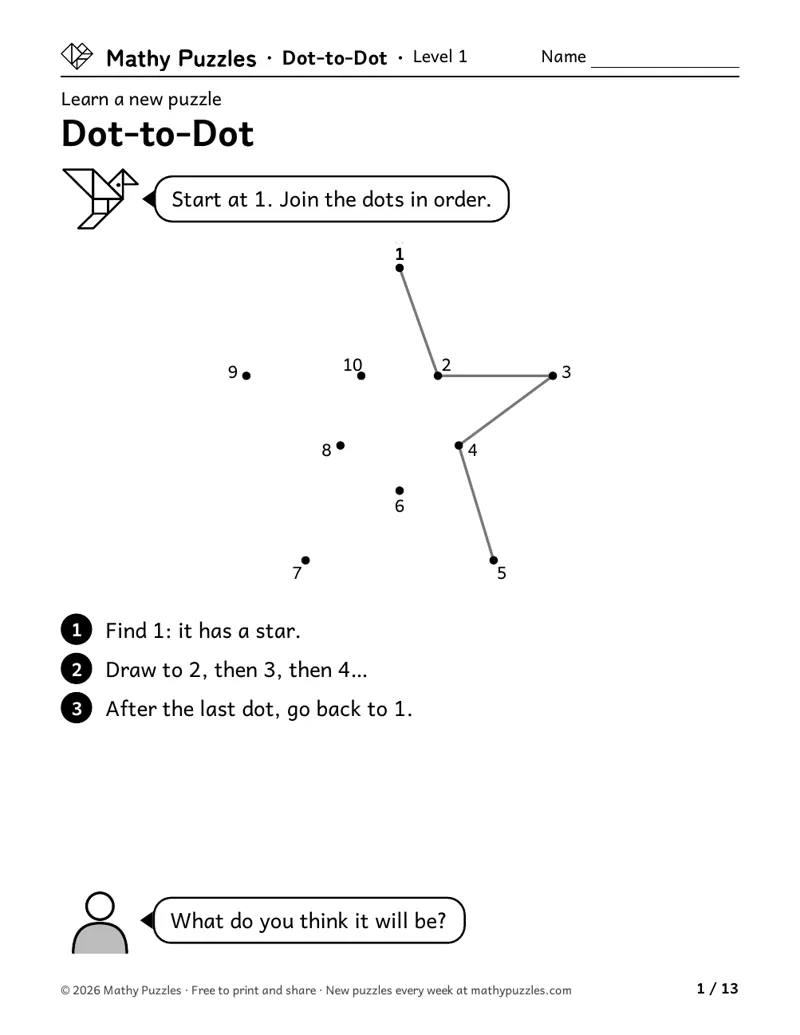
Worked example
From the Level 1 Learn sheet
- Start at 1. Join the dots in order.
- Find the 1. It is marked so it is easy to spot.
- Draw to 2, then 3, then 4, saying each number as you go.
- After the last dot, go back to 1 to close the picture.
A question to ask: “What do you think it will be?”
Free every Sunday A mixed bag of 20 new puzzles, all four levels. Get them by email
The thinking it works on
Knowing the counting order
Knows which number comes next.
LeFevre and colleagues (2006) tested 255 children from kindergarten to grade 2. Counting speed and accuracy rose with each grade. Children's ideas about what makes a count correct changed in a less straightforward way. Source
Reading written numbers
Recognizes numbers like 17 and 71 as different.
Counting on and skip counting
Starts from a number other than 1, or counts in equal jumps.
Secada, Fuson and Hall (1983) found that first graders who counted on could all count up from any starting number. Most who counted from one lacked a step. Source
Searching a page
Looks around the page in a steady way to find the next number.
Studying 134 children aged 2 to 17, Woods and colleagues (2013) found that younger children scanned a page in a less planned order than older ones. Source
Pencil control
Draws straight lines from dot to dot.
Predicting from part of a picture
Guesses the whole from a few lines.
Gollin (1960) showed children aged about 2½ to 5½, and adults, drawings of familiar objects at five levels of completeness and found that older children recognized them sooner. Source
Where is this thinking used?
- Street numbers: Houses go up in order, so you can find number 40 without checking every door.
- Page numbers: A book's index sends you to page 37, and the order of pages gets you there.
- Numbered instructions: Assembly steps only work when you follow them 1, 2, 3, in order.
- Seats and lockers: Numbered rows and doors are found by counting on from the nearest one.
For teachers
Curriculum areas
- Common Core
- Counting and cardinality: counting to 100 by ones and by tens, and counting on from a number other than 1 (Kindergarten)
- Common Core
- Number and operations in base ten: counting to 120 from any number, and skip counting by 5s, 10s and 100s within 1,000 (Grades 1–2)
- NCERT
- Joyful Mathematics: a join-the-numbers picture to 20 (Class 1, Making 10); skip counting by 2s, 5s and 10s (Class 2, Fun with Numbers)
- National Curriculum (England)
- Number: counting beyond 20 (Reception); counting on from any number and in 2s, 5s and 10s (Years 1–2); counting in 100s (Year 3)
- Cambridge Primary Mathematics
- Number: counting on in ones, twos, fives, tens and hundreds (Stages 1–3)
Math practices: see the box below.
Math practices this puzzle uses
- Not used: MP1 Make sense of problems and persevere in solving them
- Not used: MP2 Reason abstractly and quantitatively
- Not used: MP3 Construct viable arguments and critique the reasoning of others
- Not used: MP4 Model with mathematics
- Not used: MP5 Use appropriate tools strategically
- Uses: MP6 Attend to precision
- Not used: MP7 Look for and make use of structure
- Not used: MP8 Look for and express regularity in repeated reasoning
From the Common Core Standards for Mathematical Practice.
More Dot-to-Dot puzzles for members
Members get at least 5 more worksheets at each difficulty for every puzzle, 80 new puzzles every Sunday, and the whole archive. $39 a year or $25 for 6 months.
See membershipNot ready yet?
One email, all four levels: 20 puzzles, 5 for each level.
For grown-ups (18+). One email every Sunday with the puzzles and the odd note about membership; unsubscribe any time. We never ask about your child. How we use your email