
Count the Cubes
Count the blocks in a toy tower and sooner or later you run into a problem: some of them are out of sight. A cube can't float, so if one sits up high, something must be holding it up.
Free sets by level, ages 4–10:
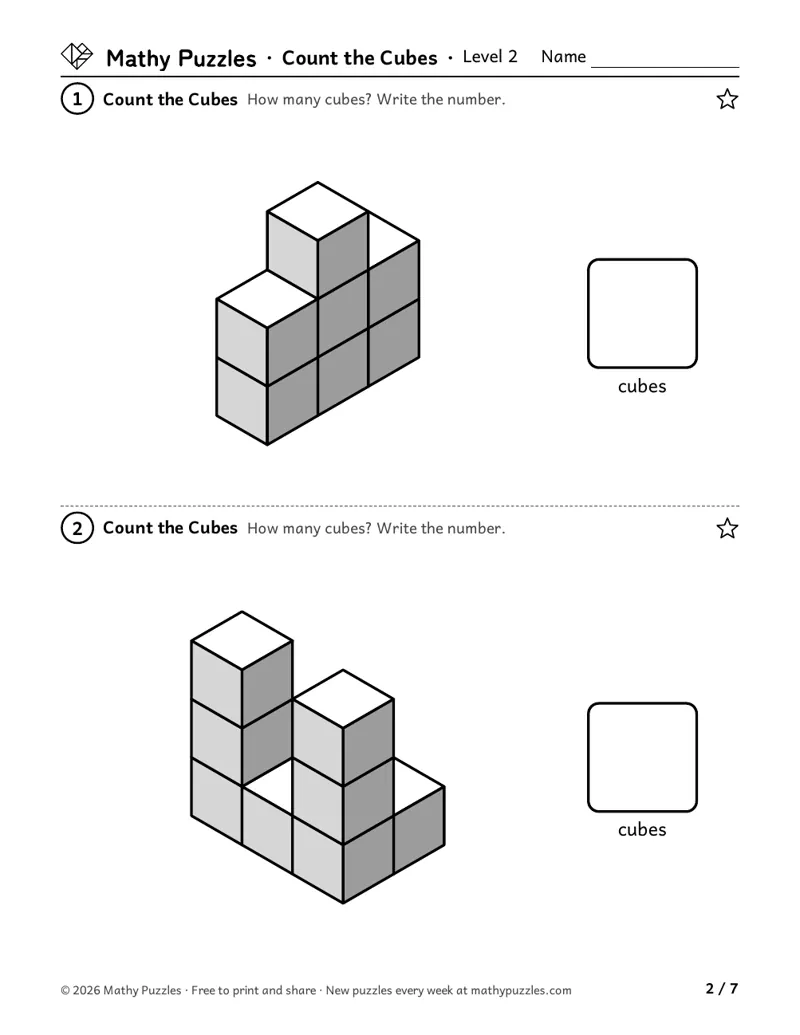 Level 2: a page from the free set
Before starting
- Count objects to 10 (Level 1) or to 20 (Level 2)
- Know what a cube or block looks like
- Level 3: add small numbers in their head, and know that 3 × 3 × 3 is 27 or count it out
What you need
Toy blocks or sugar cubes for a stuck moment, and a pencil.
Free puzzles to print
Each set: a Learn sheet with a worked example, 10 puzzles from easiest to hardest, and the answers.
Level 1
Ages 4–6 · Pre-K–K
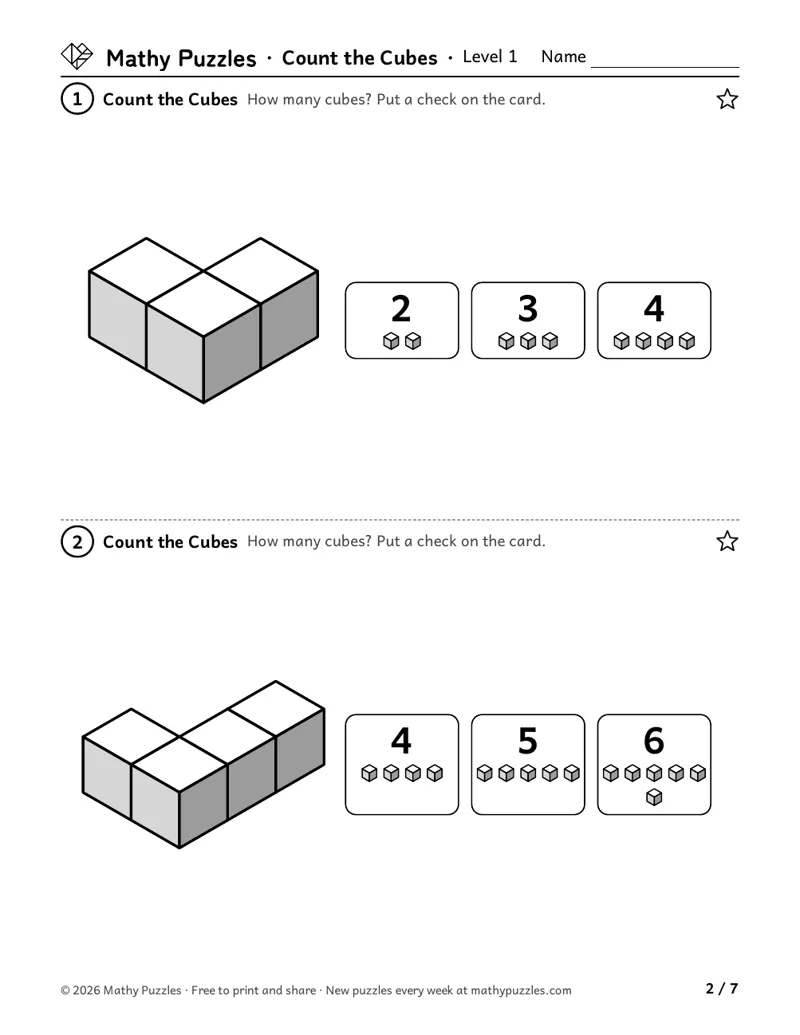
2 to 8 cubes, every cube shows; the child picks from three number cards that show small cubes under each number.
On the sheet: “How many cubes? Put a check on the card.”
Print Level 1 (Letter)Other paper size: A4Level 2
Ages 6–8 · Grades 1–2
7 to 14 cubes, and from the middle puzzles some cubes are hidden under ones you can see.
On the sheet: “How many cubes? Write the number.”
Print Level 2 (Letter)Other paper size: A4Level 3
Ages 8–10 · Grades 3–4
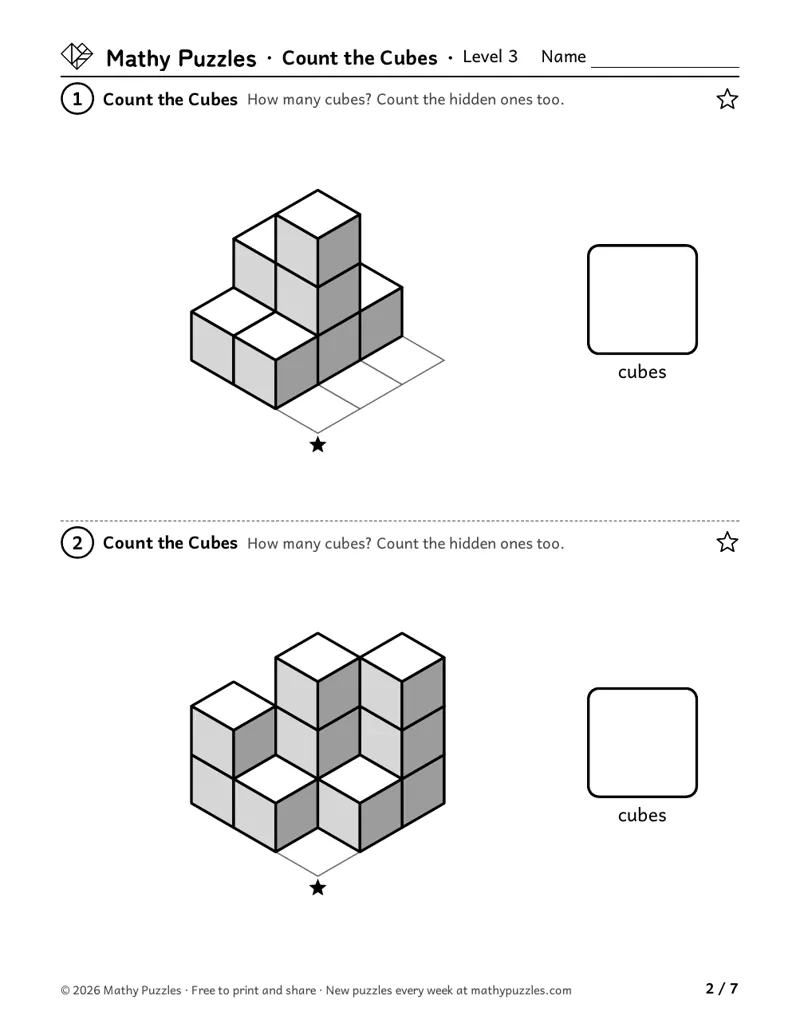
Count a stack on a 3 × 3 mat (8 to 14 cubes, some hidden). Then work out how many more make a 3 × 3 × 3 big cube. Then write a building plan: how many cubes stand on each square.
On the sheet: “How many cubes?”
Print Level 3 (Letter)Other paper size: A4
How it works
Each puzzle is a drawing of cubes stacked like toy blocks, seen from above and a little to one side. The child works out how many cubes are in the stack. At Level 1 every cube is in view. In the later levels some hide underneath others, and the child has to picture what must be there.
How to play
- Look at the stack. Find the cubes on the bottom layer first.
- Count one layer at a time, from the floor up.
- From Level 2: remember that cubes can't float. A cube on top means there are cubes under it, even if you can't see them.
- Level 1: cross out the wrong number cards and check the right one. Later levels: write the number.
When it gets hard
Counting only the cubes whose tops show.
Hint: Point to one top cube and ask: what is it standing on?
Counting the same cube twice, once for its top and once for its side.
Hint: Each cube shows up to three faces. Touch one cube at a time, not one face.
Leaving out the hidden support cubes (from Level 2).
Hint: Say the rule out loud: cubes can't float. Then look under every tall column.
Tip for grown-ups: Real blocks or sugar cubes help a stuck moment: build the stack, count it together, then go back to the drawing.
Frequently asked questions
- What if it's too hard?
- Go back to the easiest puzzles and talk through one stack together: which cubes can you see, and which must be holding them up?
Questions about printing, levels, answers or membership: see all questions.
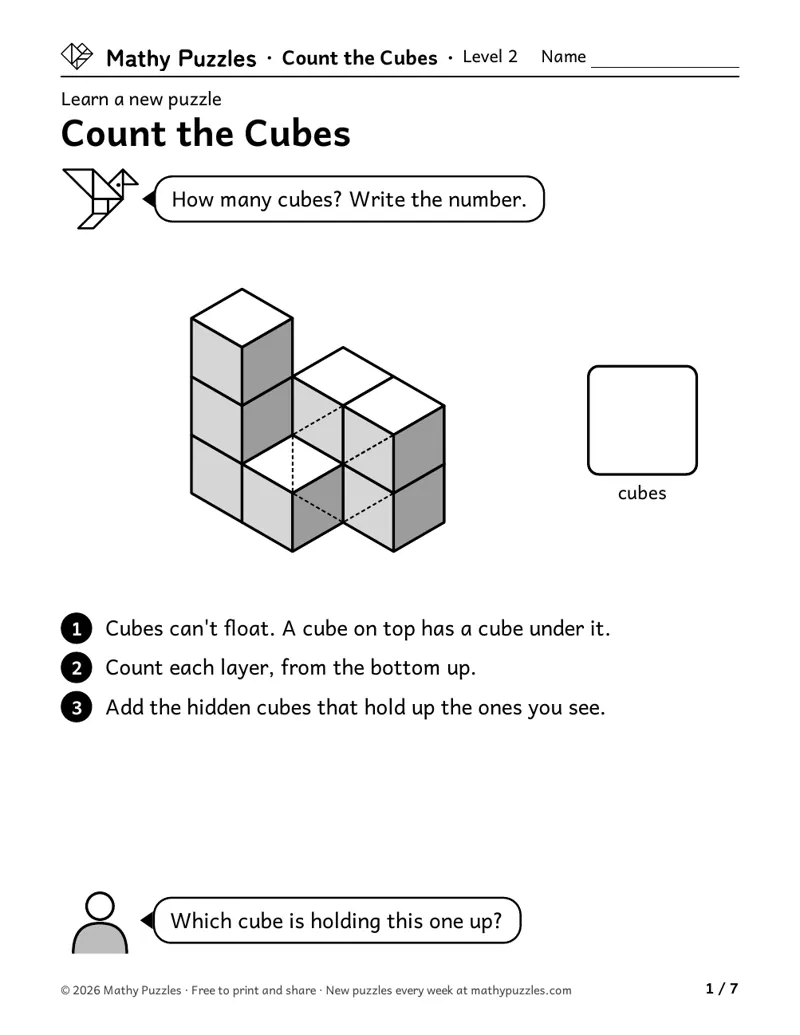
Worked example
From the Level 2 Learn sheet
- Cubes can't float. A cube on top has a cube under it.
- Count each layer, from the bottom up.
- Add the hidden cubes that hold up the ones you see.
A question to ask: “Which cube is holding this one up?”
Free every Sunday A mixed bag of 20 new puzzles, all four levels. Get them by email
The thinking it works on
Reading a flat drawing as a solid
Reads a flat drawing of cubes as a solid stack with layers and columns.
Battista and Clements (1996) found that children at first see a drawing of a box made of cubes as a loose set of faces. Only later do they put the views together into one solid they can count. Source
Reasoning about what is hidden
Works out that a cube must be there even though no part of it shows.
Ben-Chaim, Lappan and Houang (1985) found that even students in grades 5 to 8 often struggle to work out how many cubes build a box in a drawing. Source
Perspective taking
Imagines looking down on the stack or walking around it to count the back.
Frick, Möhring and Newcombe (2014) found that 4-year-olds mostly cannot pick what a scene looks like from another spot. The skill starts to grow around age 6, and children still differ a lot at 8. Source
Systematic counting
Counts layer by layer and keeps track so nothing is counted twice.
Battista and colleagues (1998) found that many students do not 'see' the rows and columns in a grid of squares. They traced several levels in how children organize and count such a grid. Source
Working memory
Holds the running total, the rule and the current layer in mind at once.
Gathercole and colleagues (2004) found that working memory (holding and using a few things in mind at once) grows steadily from age 4 to 15. Source
Reading and writing a plan
Writes a building plan: a number on each square saying how many cubes stand there.
Alon (2026) tested 1,064 children in grades 1 to 6 on picking how a 3-D object looks from another viewpoint, and found steady gains across the grades. Source
Where is this thinking used?
- Architecture: A building is drawn flat as plans and elevations, then built in three dimensions.
- 3D modeling and game design: A flat screen stands for a solid world.
- Packing and inventory: Counting boxes in a van or items on a shelf when some sit behind others.
- Building from a plan: A number on a square stands for a column of bricks that isn't drawn.
For teachers
Curriculum areas
- Common Core
- Counting and cardinality (K); Measurement: volume as counting unit cubes (Grade 5, ahead of Level 3)
- NCERT
- Building with cubes and counting cube towers (Class 4); cube frames (Class 5)
- National Curriculum (England)
- Number: counting objects and pictures (Reception–Year 1); Measurement and geometry: volume with cubes and 3-D shapes from 2-D drawings (Year 5)
- Cambridge Primary Mathematics
- Number: counting objects (Stage 1); Geometry and measure: pictures of 3D shapes (Stage 3)
Math practices: see the box below.
Math practices this puzzle uses
- Not used: MP1 Make sense of problems and persevere in solving them
- Uses: MP2 Reason abstractly and quantitatively
- Not used: MP3 Construct viable arguments and critique the reasoning of others
- Not used: MP4 Model with mathematics
- Not used: MP5 Use appropriate tools strategically
- Not used: MP6 Attend to precision
- Uses: MP7 Look for and make use of structure
- Not used: MP8 Look for and express regularity in repeated reasoning
From the Common Core Standards for Mathematical Practice.
More Count the Cubes puzzles for members
Members get at least 5 more worksheets at each difficulty for every puzzle, 80 new puzzles every Sunday, and the whole archive. $39 a year or $25 for 6 months.
See membershipNot ready yet?
One email, all four levels: 20 puzzles, 5 for each level.
For grown-ups (18+). One email every Sunday with the puzzles and the odd note about membership; unsubscribe any time. We never ask about your child. How we use your email