
Balance Puzzles
Two shopping bags feel even in your hands when they weigh the same. A level scale shows that balance like an equals sign you can see. Swap things that weigh the same, or take the same away from both sides, and it stays level.
Free sets by level, ages 4–12:
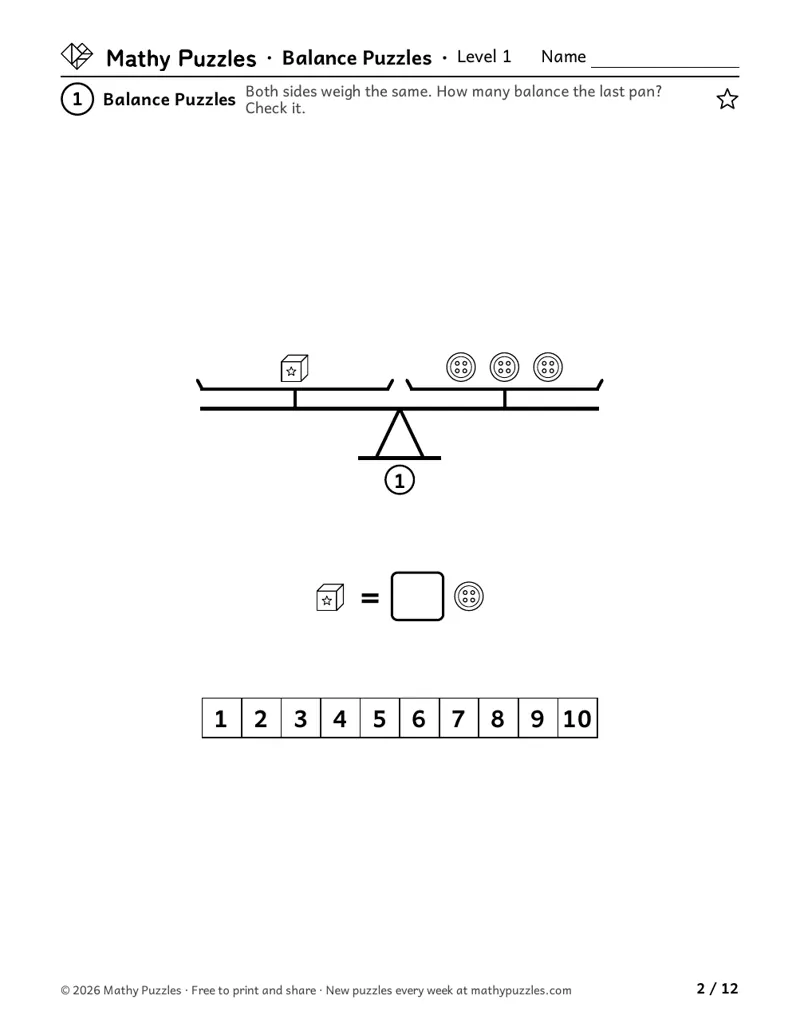 Level 1: a page from the free set
Before starting
- Level 1: count to 10 and add small groups by counting on
- Level 2: add numbers to 12
- Level 2: know that 2 squares worth 3 circles each make 3 + 3
- Level 3: multiplication and division facts (3 squares weigh 18, so 1 weighs 6), and adding and subtracting to 50
- Level 4: the same facts, with three shapes to keep track of
What you need
Scrap paper to write what each shape weighs, a kitchen or toy scale if you have one, and a pencil.
Free puzzles to print
Each set: a Learn sheet with a worked example, 10 puzzles from easiest to hardest, and the answers.
Level 1
Ages 4–6 · Pre-K–K
One scale (1 toy car = 3 buttons; how many buttons balance 2 toy cars?). Then two scales that each say what one object is worth, then an extra scale the question doesn't need. Answers stay within 10.
On the sheet: “Both sides weigh the same. How many balance the last pan? Check it.”
Print Level 1 (Letter)Other paper size: A4Level 2
Ages 6–8 · Grades 1–2
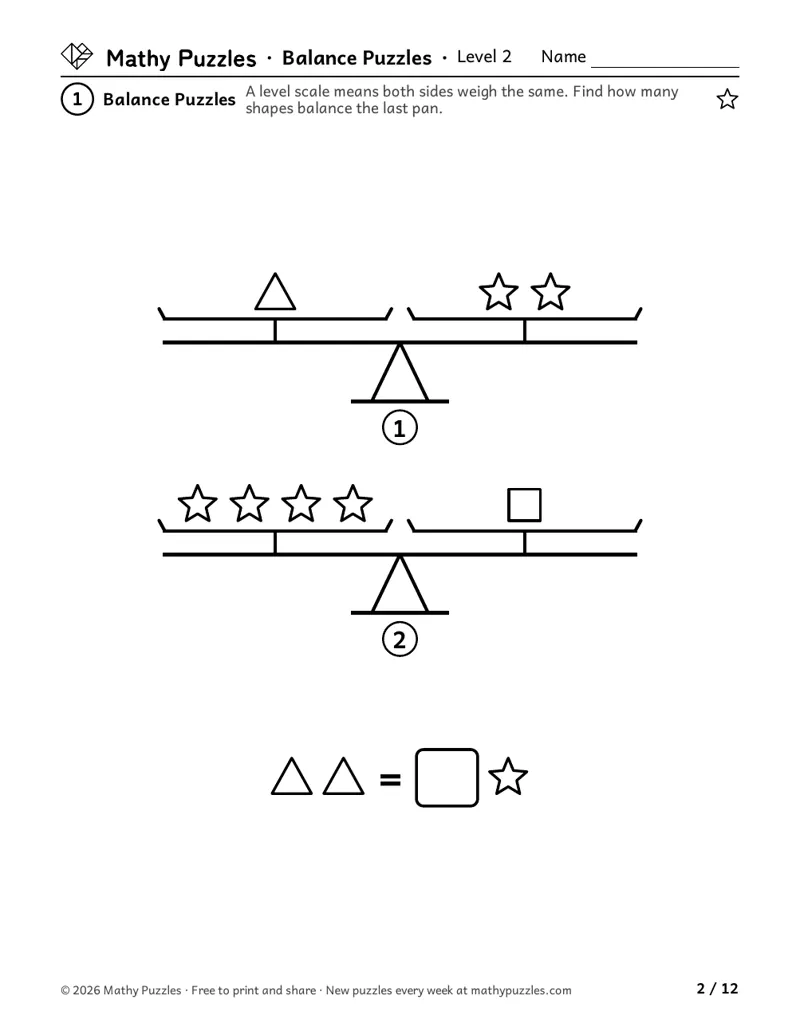
The easiest puzzles have two scales that each say what one shape is worth; the answer comes from reading them and adding (up to 10). One scale may not be needed.
Then one swap. A shape may be worth shapes you already know, so swap each one for its worth and add. Or the same shape sits on both pans, so take it off. Answers go up to 12.
The hardest puzzles have three scales and two or more such steps, sometimes with the same shape on both pans of one scale.
On the sheet: “A level scale means both sides weigh the same. Find how many shapes balance the last pan.”
Print Level 2 (Letter)Other paper size: A4Level 3
Ages 8–10 · Grades 3–4
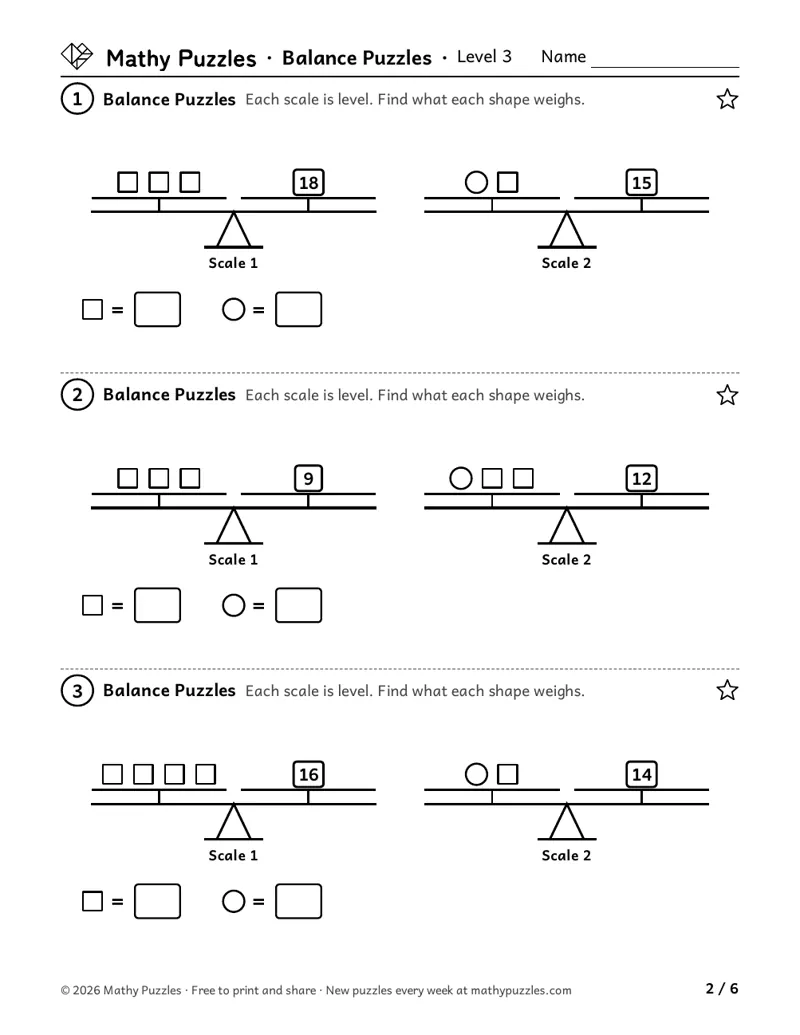
Two shapes and number weights. First comes sharing (3 squares weigh 18, so 1 square weighs 6), with a second scale that uses it. Then the second scale holds more shapes. Then no shape is alone on any scale, so the child compares two scales and takes the difference. The hardest use three scales and totals up to 50.
On the sheet: “Each scale is level. Find what each shape weighs.”
Print Level 3 (Letter)Other paper size: A4Level 4
Ages 10–12 · Grades 5–6
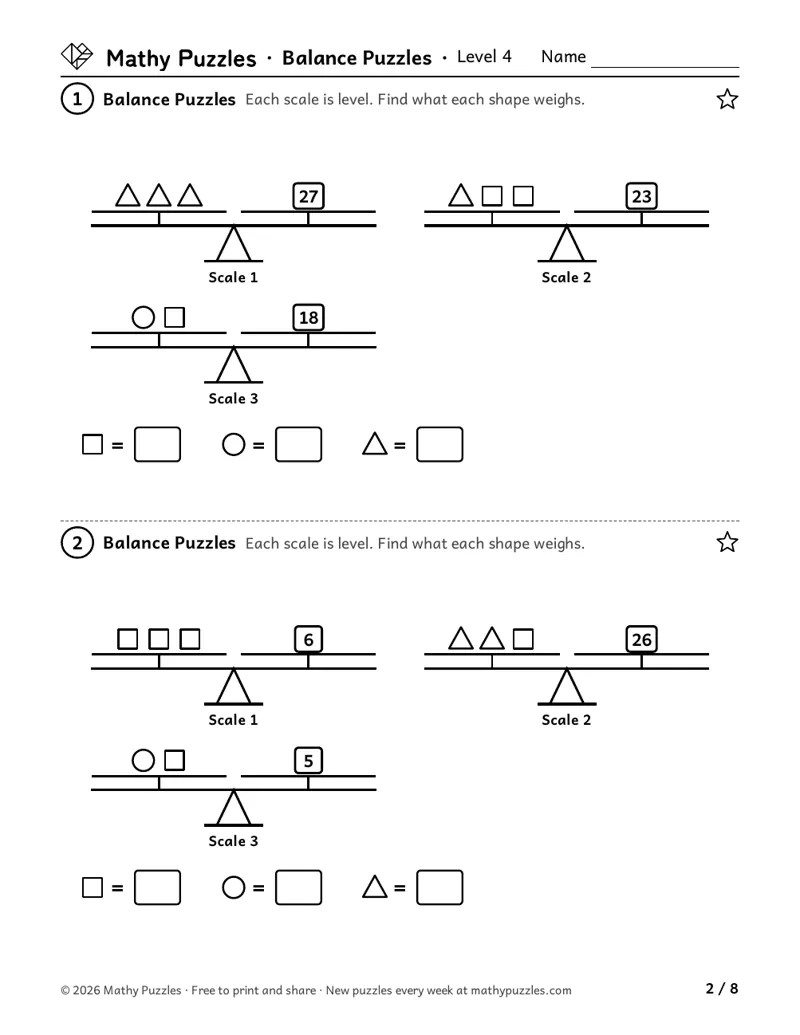
Three shapes (square, circle, triangle) on three scales, up to 5 things on a pan. First a chain where each scale adds one new shape; then one take-away between scales. Next, two take-aways with no shape alone. The hardest also write each scale with letters (s + 2c + t = 21).
On the sheet: “Each scale is level. Find what each shape weighs.”
Print Level 4 (Letter)Other paper size: A4
How it works
Each puzzle shows scales that are level, so both sides weigh the same. At Levels 1 and 2, objects or shapes balance each other, and the child finds how many of one kind balance the last pan. At Levels 3 and 4, shapes sit on one pan and a number weight on the other, and the child finds what each shape weighs.
How to play
- Every scale is level, so both pans weigh the same.
- Look for a scale with only one kind of thing against a number or a group you can count. Start there.
- Write down what you find, then use it on the next scale.
- At Levels 3 and 4, if one scale has everything another has and more, the extra things weigh the difference.
When it gets hard
Thinking a bigger picture must weigh more.
Hint: Only the scales tell the weight. Read what each scale says.
Using every scale at Level 1, even the one the question doesn't need.
Hint: Look at the last pan first. Which objects are on it? Use only the scales about those.
At Level 3, dividing before taking away.
Hint: If no shape is alone, compare two scales first. What does one have that the other doesn't?
Forgetting a number weight that sits next to the shapes.
Hint: Take the same number off both sides, then solve.
Tip for grown-ups: Talk in swaps: "this weighs the same as that." Saying each step that way is the whole idea. A kitchen or toy scale, if you have one, makes the idea of a level scale real.
Frequently asked questions
- Why are the Level 1 scales toys and not fruit?
- With real food, a child's sense of size fights the puzzle: 1 strawberry can't weigh as much as 3 melons. Toy cars, balls and blocks against buttons keep the numbers believable.
- Is this algebra?
- It is the idea underneath it. Level 3 and 4 children find unknown weights by sharing and taking away, as in equations. The hardest Level 4 puzzles write each scale with letters, but each shape still gets a number.
Questions about printing, levels, answers or membership: see all questions.
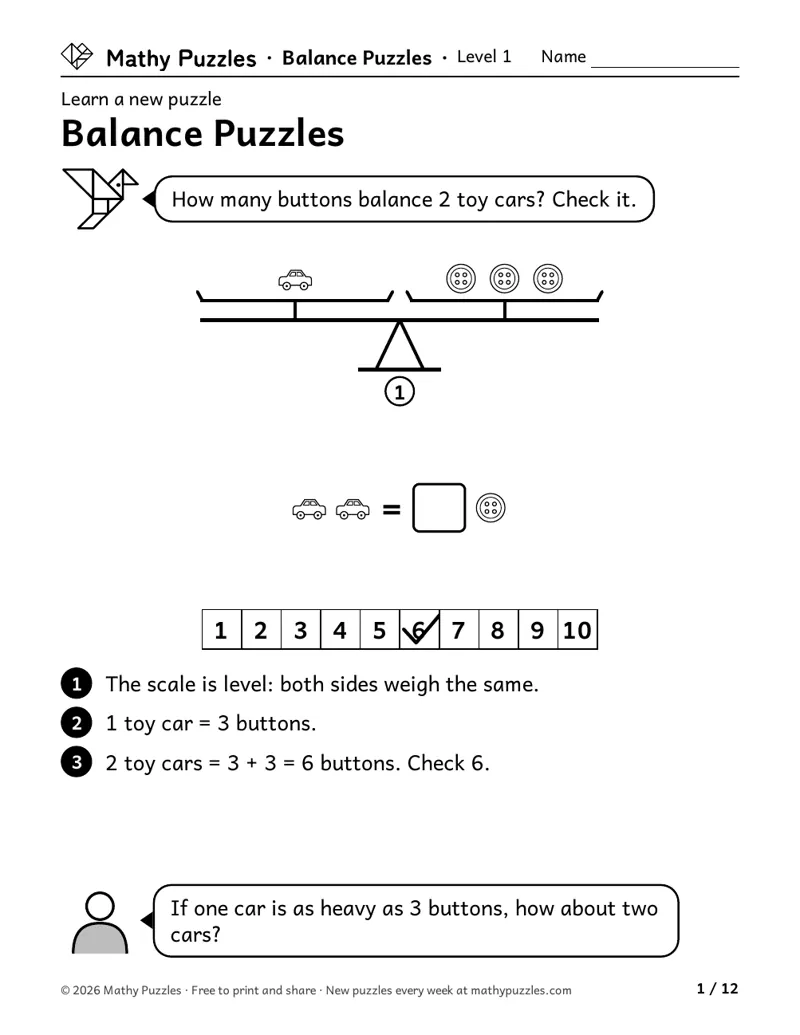
Worked example
From the Level 1 Learn sheet
- How many buttons balance 2 toy cars?
- The scale is level: both sides weigh the same.
- 1 toy car = 3 buttons.
- 2 toy cars = 3 + 3 = 6 buttons. Check 6.
A question to ask: “If one car is as heavy as 3 buttons, how about two cars?”
Free every Sunday A mixed bag of 20 new puzzles, all four levels. Get them by email
The thinking it works on
Equals means the same on both sides
Reads a level scale as "both sides are worth the same".
Rittle-Johnson and colleagues (2011) tested 175 children in grades 2 to 6: by grade 5, most saw the equal sign as 'both sides are worth the same'. Source
Swapping equal things
Replaces something with what it is worth.
Sharing a total
Divides a total weight equally among the same shapes.
Squire and Bryant (2002) studied sharing problems with 5- to 8-year-olds. The children found them much easier when the items were already grouped, with one group for each person sharing. Source
Comparing two scales
Finds what one scale has that another doesn't.
Robinson and Dubé (2009) studied children in grades 2 to 4. They varied widely in whether they noticed that adding and then taking away the same amount cancels out, with little change across the grades. Some used the shortcut and others calculated everything. Source
Picking the useful facts
Decides which scale to use first and which to leave out.
Using letters for unknowns
Reads a scale written with letters.
Where is this thinking used?
- Kitchen scales: A recipe weight can be made from different things that weigh the same.
- Seesaws: Two small children can balance one bigger one.
- Unit prices: If 3 packs cost $18, one pack costs $6, and that settles the rest of the bill.
- Fair trades: A swap is fair when both sides are worth the same.
For teachers
Curriculum areas
- Common Core
- Operations and algebraic thinking: adding with objects (Kindergarten); the meaning of the equal sign, finding an unknown number and adding within 20 (Grades 1–2); finding unknowns in multiplication and division and two-step problems (Grade 3). Expressions and equations: letters for unknowns and simple equations (Grade 6)
- NCERT
- Joyful Mathematics: adding and repeated adding (Classes 1–2), and balancing a see-saw in Rani's Gift (Class 2); Maths Mela: multiplication, sharing and the pan balance (Classes 3–4), shapes that stand for numbers in The Dairy Farm (Class 5)
- National Curriculum (England)
- Number: one-step problems with objects and pictures (Year 1); missing number problems (Years 2–3); writing missing number problems with letters (Year 6) and solving simple equations (Key Stage 3)
- Cambridge Primary Mathematics
- Number: addition as combining sets (Stage 1); shapes standing for unknown numbers (Stages 3–5); letters for amounts (Stage 6)
Math practices: see the box below.
Math practices this puzzle uses
- Not used: MP1 Make sense of problems and persevere in solving them
- Uses: MP2 Reason abstractly and quantitatively
- Not used: MP3 Construct viable arguments and critique the reasoning of others
- Not used: MP4 Model with mathematics
- Not used: MP5 Use appropriate tools strategically
- Not used: MP6 Attend to precision
- Uses: MP7 Look for and make use of structure
- Not used: MP8 Look for and express regularity in repeated reasoning
From the Common Core Standards for Mathematical Practice.
More Balance Puzzles for members
Members get at least 5 more worksheets at each difficulty for every puzzle, 80 new puzzles every Sunday, and the whole archive. $39 a year or $25 for 6 months.
See membershipNot ready yet?
One email, all four levels: 20 puzzles, 5 for each level.
For grown-ups (18+). One email every Sunday with the puzzles and the odd note about membership; unsubscribe any time. We never ask about your child. How we use your email