
What Comes Next?
Children know a repeating pattern long before they can name one: clap, stamp, clap, stamp. Find the short part that repeats, and you know every picture in the row.
Free sets by level, ages 4–8:
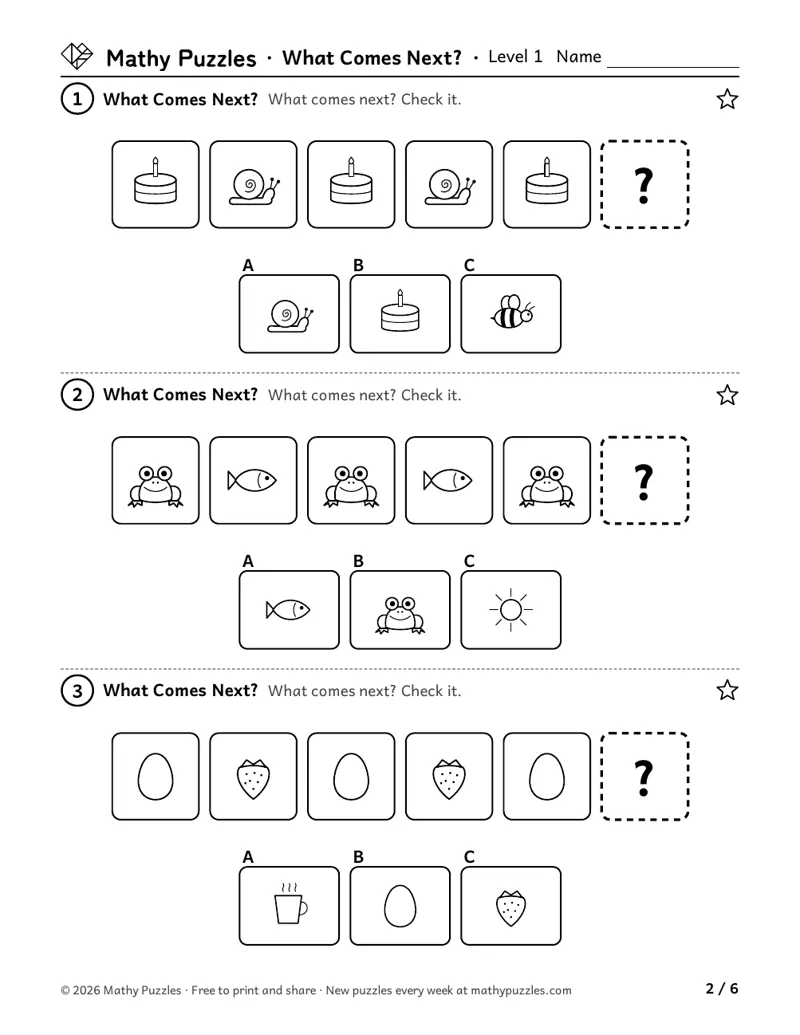 Level 1: a page from the free set
Before starting
- Level 1: name everyday objects; no reading needed
- Level 2: name shapes and fills
- Level 2, hardest puzzles: the letters A, B, C
Free puzzles to print
Each set: a Learn sheet with a worked example, 10 puzzles from easiest to hardest, and the answers.
Level 1
Ages 4–6 · Pre-K–K
Everyday objects. First an AB pattern with one outside option, then AAB, ABB or ABC. Then the gap moves to the middle, or the pattern is made only by which way an object faces (a fish, a car, a key). The hardest puzzles ask which row has the same pattern, or which picture is wrong.
On the sheet: “What comes next? Check it.”
Print Level 1 (Letter)Other paper size: A4Level 2
Ages 6–8 · Grades 1–2
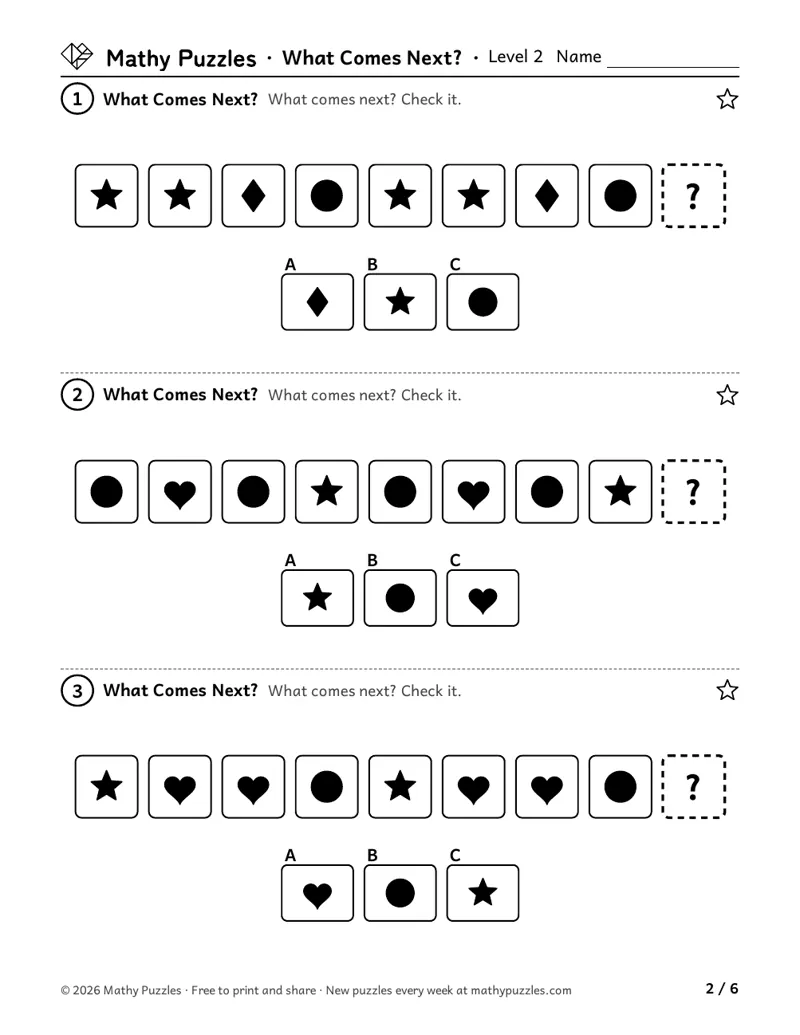
Shapes and fills. First parts of four (ABCD, AABC), then shapes and fills repeating on their own cycles. Then find the one wrong picture. The hardest puzzles name a pattern in letters (A A B) and ask which row matches.
On the sheet: “What comes next? Check it.”
Print Level 2 (Letter)Other paper size: A4
How it works
Each puzzle is a row of pictures that repeats a short part, such as apple, banana, apple, banana, then an empty box. The child finds the part that repeats and checks what comes next. Harder puzzles put the gap in the middle, ask which row has the same pattern, or hide one wrong picture to cross out.
How to play
- Say each picture aloud, in order.
- Find where it starts again. Draw a line after each repeat.
- Say the next one in the rhythm.
- Check that picture in the answer boxes.
When it gets hard
Looking only at the last picture.
Hint: Say the whole row from the start; the repeat tells you what comes next.
Reading AAB as AB.
Hint: Count how many times each picture comes before the switch.
At Level 2, following the shapes and forgetting the fills.
Hint: Check the shape pattern first, then the fill pattern on its own.
Tip for grown-ups: Clap, stomp or sing the pattern together ("apple, banana, banana"). A rhythm in the body helps young children hear where the part repeats.
Frequently asked questions
- My 4-year-old just copies the last picture. What helps?
- Say the row aloud together and clap it. Copying a pattern comes before continuing one, so this is a normal step. Start with the easiest AB puzzles.
- What do the letters A A B mean at Level 2?
- Letters name a pattern's shape: A A B means two the same, then a different one. The child finds the row of pictures that follows that shape.
Questions about printing, levels, answers or membership: see all questions.
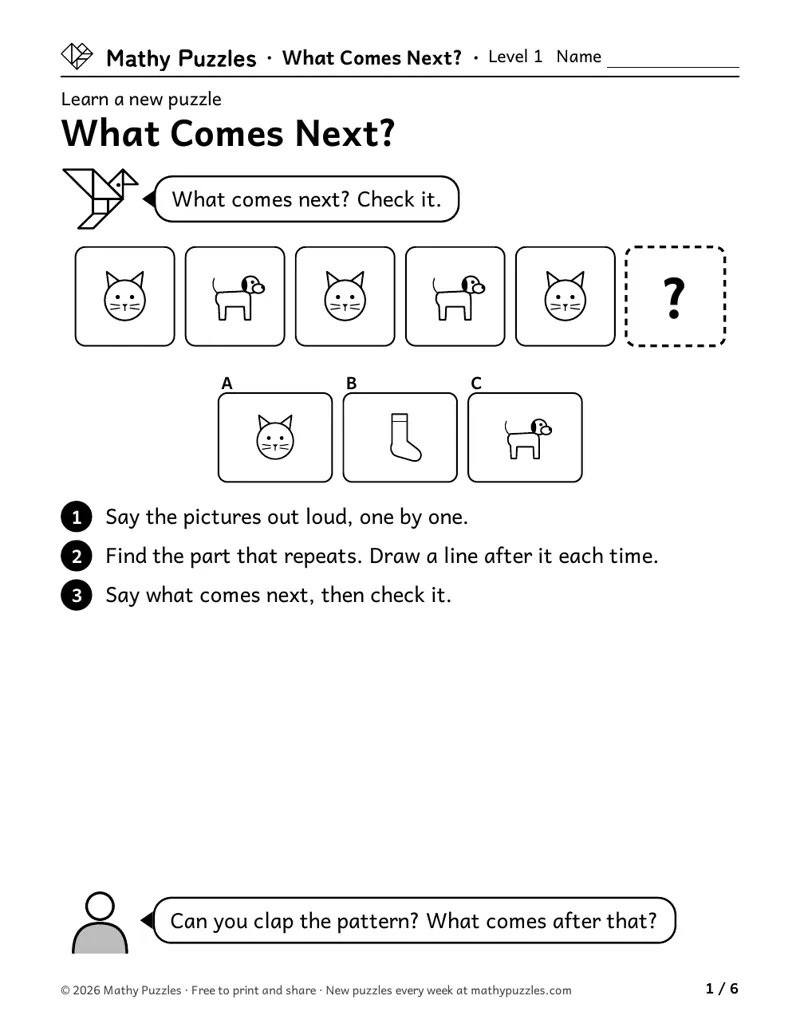
Worked example
From the Level 1 Learn sheet
- Say the pictures out loud, one by one.
- Find the part that repeats. Draw a line after it each time.
- Say what comes next, then check it.
A question to ask: “Can you clap the pattern? What comes after that?”
Free every Sunday A mixed bag of 20 new puzzles, all four levels. Get them by email
The thinking it works on
Finding the part that repeats
Finds the short part that repeats.
Rittle-Johnson and colleagues (2013) found that most 4-year-olds could copy and extend a repeating pattern, but only a small proportion could say what the repeating part was. Source
Continuing a pattern
Uses the repeating part to say what comes next.
Seeing a pattern's shape in new things
Matches the same pattern made with different pictures.
Wijns and colleagues (2019) tested 400 four-year-olds on continuing a pattern, making the same pattern with other things, and naming its structure. Success depended on the task. Source
Checking every picture against the pattern
Finds the one picture that breaks the repeat.
Two patterns on one row
Follows shapes and fills repeating on different cycles.
Fyfe and colleagues (2017) found that children aged 5 to 13 mostly continued patterns that changed in both shape and size. Older children, who often explained both, did better. Source
Where is this thinking used?
- Music: Verses and choruses come around again in the same order.
- Beading and weaving: A short run of colors repeats along the strand.
- Daily routines: Wake, wash, eat: the same steps every morning.
- Tiles and borders: One design repeats along a wall or a page edge.
For teachers
Curriculum areas
- Common Core
- No direct curricular match.
- NCERT
- Joyful Mathematics (Class 1), Chapter 9: Utsav, extending and completing patterns
- National Curriculum (England)
- Geometry – position and direction: patterns and sequences of objects (Year 2)
- Cambridge Primary Mathematics
- Patterns: repeating patterns and sequences of objects (Early Years, before Stage 1 and Stage 1)
Math practices: see the box below.
Math practices this puzzle uses
- Not used: MP1 Make sense of problems and persevere in solving them
- Not used: MP2 Reason abstractly and quantitatively
- Not used: MP3 Construct viable arguments and critique the reasoning of others
- Not used: MP4 Model with mathematics
- Not used: MP5 Use appropriate tools strategically
- Not used: MP6 Attend to precision
- Uses: MP7 Look for and make use of structure
- Uses: MP8 Look for and express regularity in repeated reasoning
From the Common Core Standards for Mathematical Practice.
More What Comes Next? puzzles for members
Members get at least 5 more worksheets at each difficulty for every puzzle, 80 new puzzles every Sunday, and the whole archive. $39 a year or $25 for 6 months.
See membershipNot ready yet?
One email, all four levels: 20 puzzles, 5 for each level.
For grown-ups (18+). One email every Sunday with the puzzles and the odd note about membership; unsubscribe any time. We never ask about your child. How we use your email