
Tetromino Rooms
Four squares joined edge to edge can make only a handful of shapes, and four of them are used here: L, I, T and S. Each room on the grid holds one piece. Start in a room where only one piece fits, and the rooms around it begin to follow.
Free sets by level, ages 10–12:
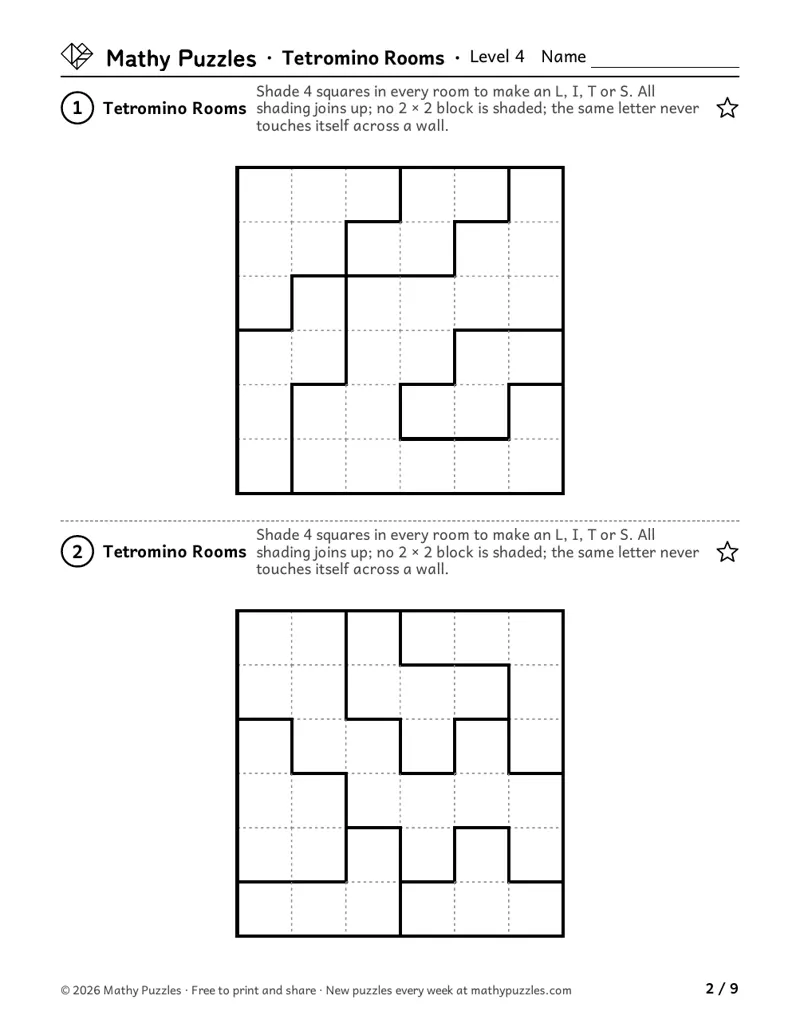 Level 4: a page from the free set
Before starting
- Know the four 4-square pieces: L, I, T and S
- See that a piece turned or flipped is still the same letter
- Some experience with grid logic puzzles helps
What you need
Paper and scissors to cut out L, I, T and S pieces for the first puzzle, and a sharp pencil with a good eraser.
Free puzzles to print
Each set: a Learn sheet with a worked example, 10 puzzles from easiest to hardest, and the answers.
Level 4
Ages 10–12 · Grades 5–6
The easiest puzzles: a 6 × 6 grid with 5 or 6 rooms. Some rooms fit only one piece; the 2 × 2 and same-letter rules rule out the rest.
Next: 7 × 7 with 7 or 8 rooms. May also need "this piece would cut the shading in two".
The hardest puzzles: 8 × 8 with 9 or 10 rooms, needing more ruling out.
On the sheet: “Shade an L, I, T or S in every room.”
Print Level 4 (Letter)Other paper size: A4
How it works
A square grid is split into rooms with thick walls. In each room the child shades 4 squares that make an L, I, T or S piece (turned or flipped is fine). Three rules hold for the whole grid. All the shading joins up, no 2 × 2 block is fully shaded, and two pieces of the same letter never touch across a wall.
How to play
- Start with small rooms: a room of exactly 4 squares is already its piece.
- Mark squares that can't be shaded because they would make a 2 × 2 block.
- Name each piece's letter. The same letter can't sit next to itself across a wall.
- Check at the end that all the shading joins into one.
When it gets hard
Shading a square shape (2 × 2) in a room.
Hint: The square piece is not allowed. Only L, I, T and S.
Forgetting a flipped L is still an L.
Hint: Turned or flipped, a piece keeps its letter. Two Ls still can't touch.
Leaving one piece cut off from the rest.
Hint: Before shading a piece, check it can still join the others.
Tip for grown-ups: Cut out paper L, I, T and S pieces for the first puzzle. Once your child has the rules, put the pieces away and use small pencil marks instead.
Frequently asked questions
- Does my child have to guess at some point?
- No. Each puzzle is checked so that a step-by-step solver finishes it without guessing. If your child is stuck, look for a room with only one piece that fits.
- Why can't the 2 × 2 square piece be used?
- The rules use four of the five 4-square pieces: L, I, T and S. A shaded 2 × 2 block is never allowed anywhere in the grid, so the square piece could never fit the rules.
Questions about printing, levels, answers or membership: see all questions.
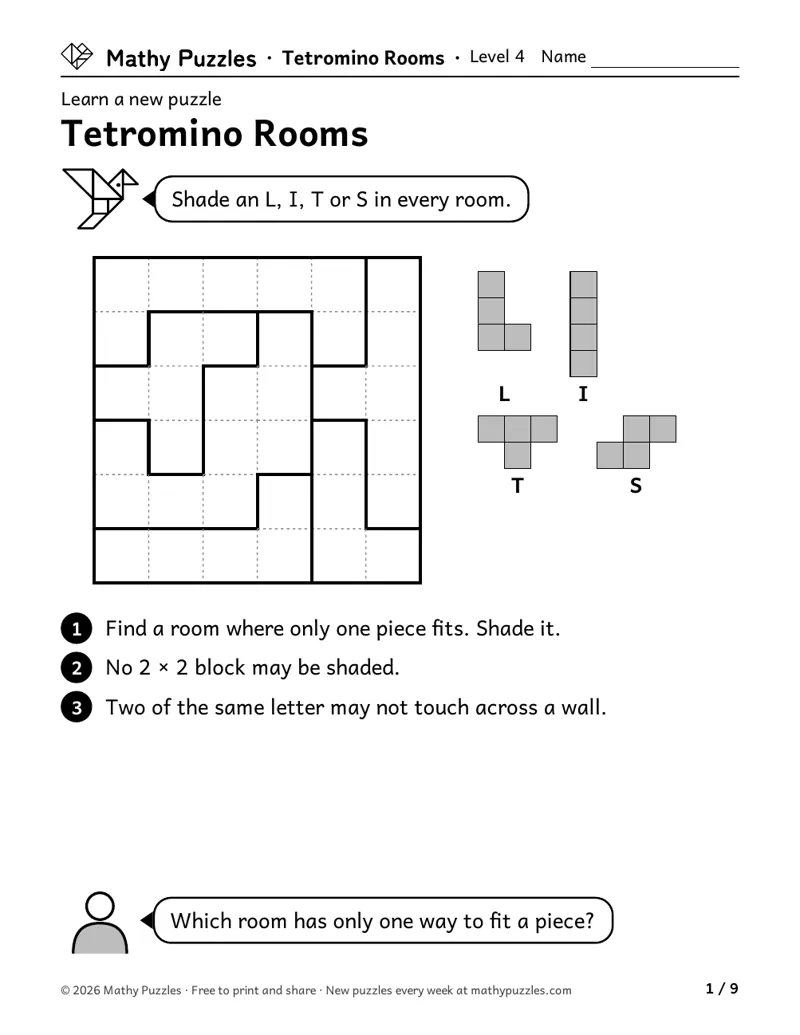
Worked example
From the Level 4 Learn sheet
- Shade an L, I, T or S in every room.
- Find a room where only one piece fits. Shade it.
- No 2 × 2 block may be shaded, so look next to that piece for squares that must stay blank.
- Two of the same letter may not touch across a wall. Use that to rule out pieces in the next room.
A question to ask: “Which room has only one way to fit a piece?”
Free every Sunday A mixed bag of 20 new puzzles, all four levels. Get them by email
The thinking it works on
Trying each way a piece can face
Turns and flips pieces to fit a room.
Van Tetering and colleagues (2019) found a clear age step in turning shapes in the mind among 729 schoolchildren. The older group (ages 10 to 12) was ahead of the younger group. Source
Ruling pieces out
Rules pieces out until one is left.
Barrouillet and Lecas tested children in grades 3, 6 and 9. Older children took more of the possible cases into account when reasoning from a rule, and this went with working memory. Source
Holding several rules at once
Checks three rules before shading.
Gathercole and colleagues (2004) found that the number of things a child can keep in mind and work with at once grows steadily from age 4 to 15. Source
Planning for the whole grid
Thinks about the whole grid, not one room.
Albert and Steinberg (2011) found that on a planning task, thinking several moves ahead goes on maturing from age 10 into the early twenties. Source
Persistence with hard puzzles
Keeps going after a dead end.
Diamond (2013) describes giving up one approach and trying another (cognitive flexibility) as a core thinking skill that develops through childhood. Source
Where is this thinking used?
- Packing a suitcase or a car trunk: Fixed shapes are turned and fitted into a space.
- Planning a garden or a floor plan: Each area gets one piece, and the pieces must link up.
- Scheduling with rules: Choices in one place limit the choices next door.
- Laying paths: Separate parts must join into one route without blocking any area.
For teachers
Curriculum areas
- Common Core
- No direct curricular match.
- NCERT
- No direct curricular match.
- National Curriculum (England)
- No direct curricular match.
- Cambridge Primary Mathematics
- No direct curricular match.
Math practices: see the box below.
Math practices this puzzle uses
- Uses: MP1 Make sense of problems and persevere in solving them
- Not used: MP2 Reason abstractly and quantitatively
- Not used: MP3 Construct viable arguments and critique the reasoning of others
- Not used: MP4 Model with mathematics
- Not used: MP5 Use appropriate tools strategically
- Not used: MP6 Attend to precision
- Uses: MP7 Look for and make use of structure
- Not used: MP8 Look for and express regularity in repeated reasoning
From the Common Core Standards for Mathematical Practice.
More Tetromino Rooms puzzles for members
Members get at least 5 more worksheets at each difficulty for every puzzle, 80 new puzzles every Sunday, and the whole archive. $39 a year or $25 for 6 months.
See membershipNot ready yet?
One email, all four levels: 20 puzzles, 5 for each level.
For grown-ups (18+). One email every Sunday with the puzzles and the odd note about membership; unsubscribe any time. We never ask about your child. How we use your email