
Suns & Moons
Day and night take turns, and this grid has a rule like that. Never three suns or three moons in a line, and as many of each in every row and column. With rules that strict, every "can't be" points to the answer.
Free sets by level, ages 4–12:
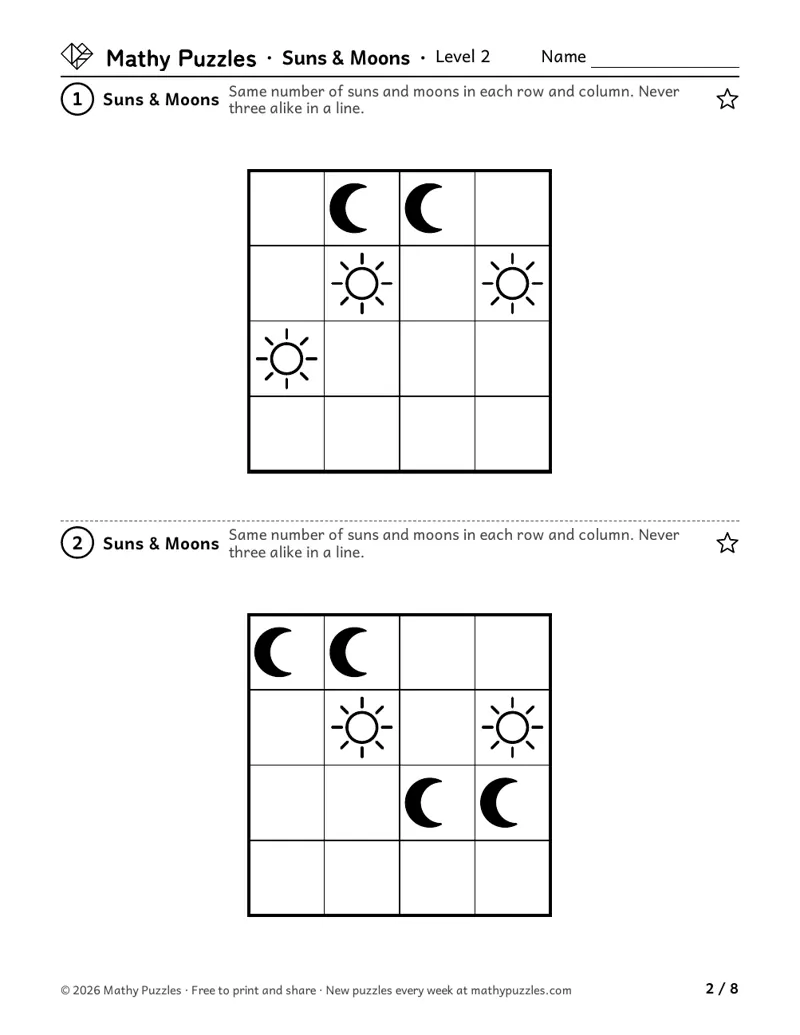 Level 2: a page from the free set
Before starting
- Count to 6 (Level 2), 8 (Level 3) or 10 (Level 4); Level 1 needs no counting
- Know that "as many as" means the same number
- Draw a simple sun and moon, or use S and M
Free puzzles to print
Each set: a Learn sheet with a worked example, 10 puzzles from easiest to hardest, and the answers.
Level 1
Ages 4–6 · Pre-K–K
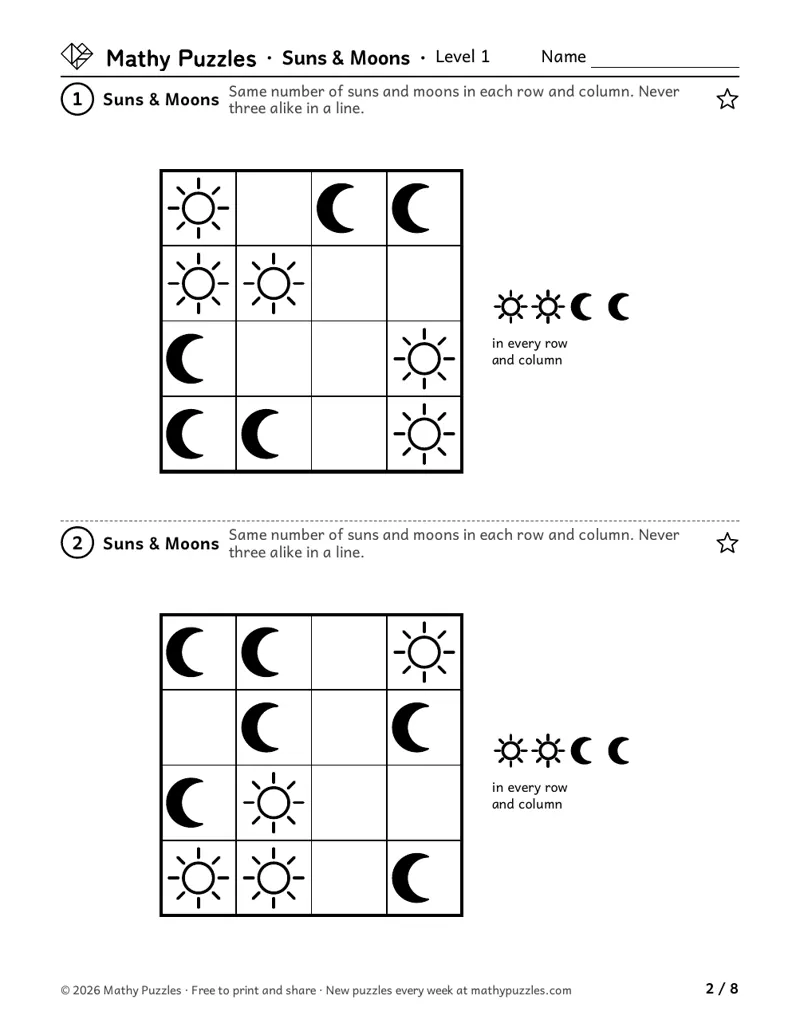
4 × 4 grids with most squares already filled, then fewer filled, then 6 × 6 with many filled. Spotting pairs and gaps finishes each one, with no counting needed.
On the sheet: “Same number of suns and moons in each row and column. Never three alike in a line.”
Print Level 1 (Letter)Other paper size: A4Level 2
Ages 6–8 · Grades 1–2
4 × 4, then 6 × 6, then 6 × 6 with fewer given. Counting what a line still needs starts here.
On the sheet: “Same number of suns and moons in each row and column. Never three alike in a line.”
Print Level 2 (Letter)Other paper size: A4Level 3
Ages 8–10 · Grades 3–4
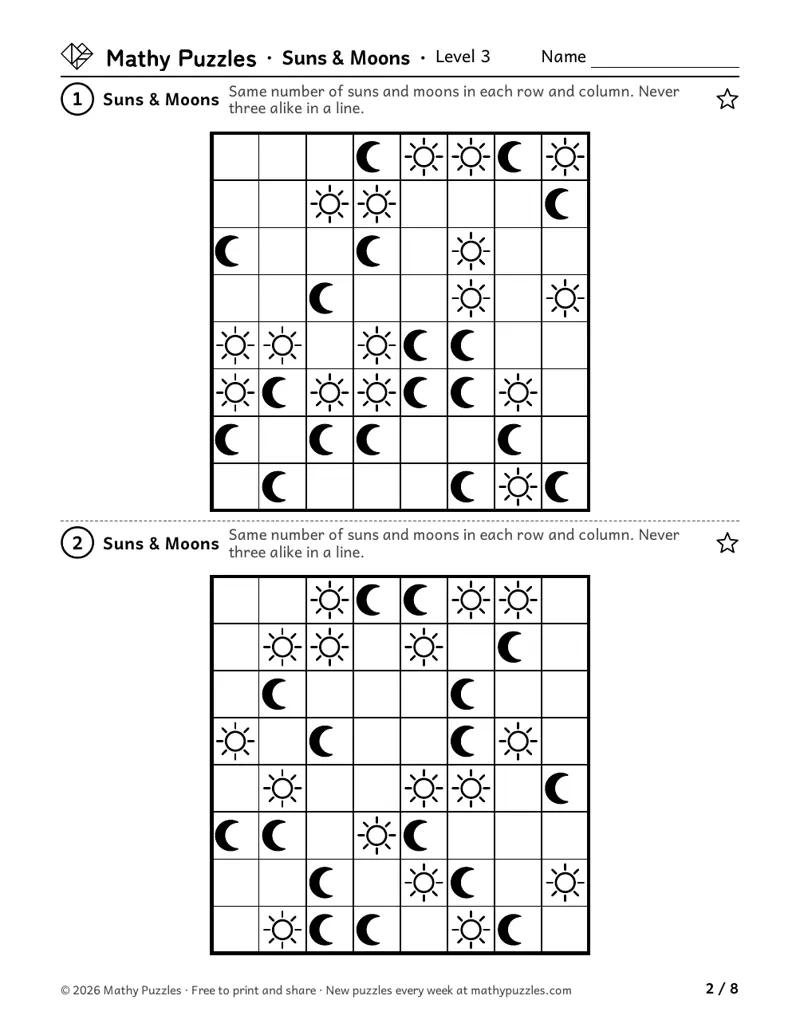
8 × 8; the hardest puzzles need a check across the whole line.
On the sheet: “Same number of suns and moons in each row and column. Never three alike in a line.”
Print Level 3 (Letter)Other paper size: A4Level 4
Ages 10–12 · Grades 5–6
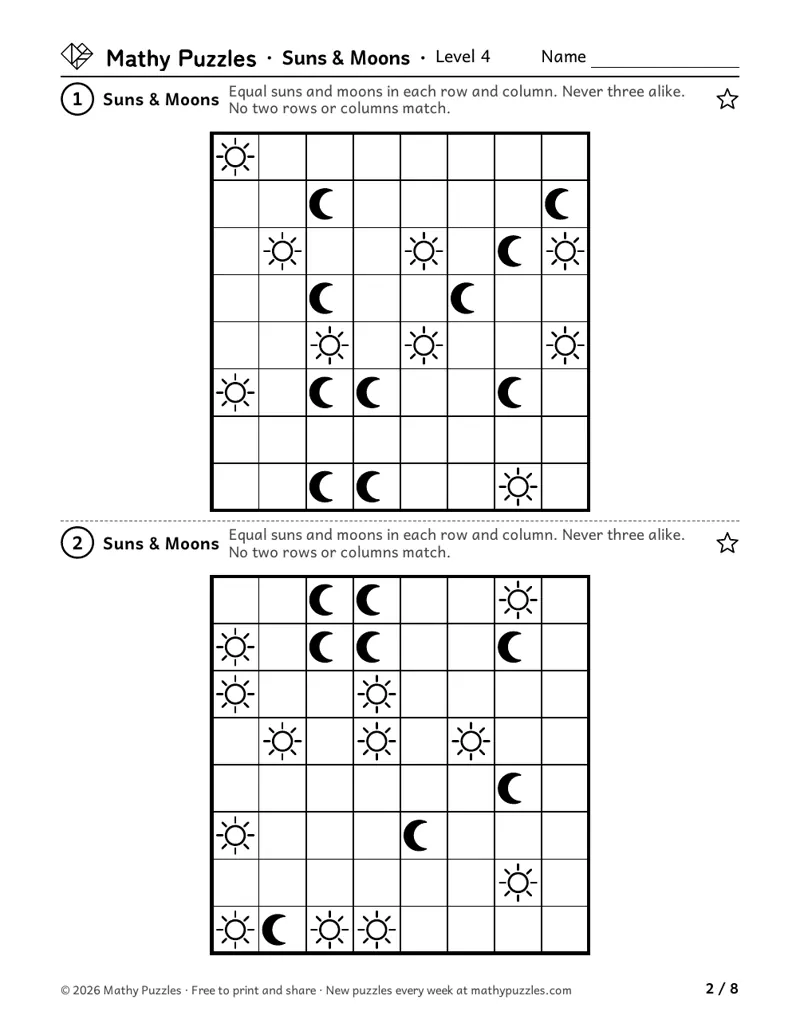
A new rule (no two rows or columns the same), then 10 × 10, with one "what if" in the hardest puzzles.
On the sheet: “Equal suns and moons in each row and column. Never three alike. No two rows or columns match.”
Print Level 4 (Letter)Other paper size: A4
How it works
Each grid starts with some suns and moons already drawn. The child fills every empty square with a sun or a moon. Each row and column needs as many suns as moons, and three of the same can never sit in a line, across or down.
How to play
- Look for two suns side by side. The squares at both ends must be moons.
- Look for a gap between two suns (sun, empty, sun). The gap must be a moon.
- Count a row (from Level 2). If it already has all its suns, the rest are moons.
- Do the same for moons. Keep going until every square is filled.
When it gets hard
Filling a row with the right counts but making three in a line.
Hint: After each mark, look both ways along the row and the column.
Guessing when stuck.
Hint: Count each line. Which line is closest to full?
Checking rows but forgetting columns.
Hint: Every mark is in one row and one column. Check both.
Tip for grown-ups: At home, your child can write S and M instead of drawing. The answers show suns and moons; on the 8 × 8 and 10 × 10 grids they use open and filled dots, with a key.
Frequently asked questions
- Could a grid have two correct fills?
- Any fill that follows every rule is right, and the answers show an example. If your child's grid breaks no rule but looks different, check each row and column together.
Questions about printing, levels, answers or membership: see all questions.
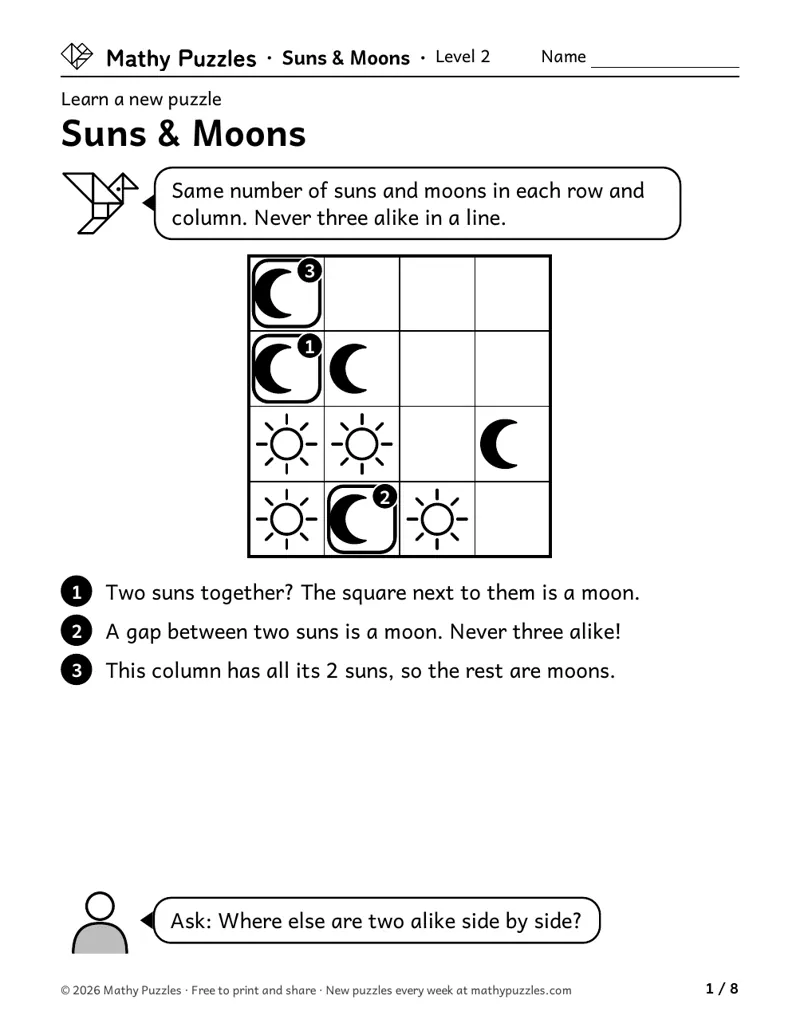
Worked example
From the Level 2 Learn sheet
- Two suns together? The square next to them is a moon.
- A gap between two suns is a moon. Never three alike!
- A line that already has all its suns: the rest are moons.
A question to ask: “Where else are two alike side by side?”
Free every Sunday A mixed bag of 20 new puzzles, all four levels. Get them by email
The thinking it works on
Applying a rule the same way every time
Scans for two alike side by side, or a gap between two alike, and applies the rule.
Reasoning by elimination
Uses 'not a sun, so a moon' many times per grid.
Mody and Carey (2016) found that 2½-year-olds did not yet reason by elimination between two hiding places, while 3- to 5-year-olds did. Source
Counting what is left in a line
Counts a line and fills the rest once half is placed.
Across children aged 4 to 15, Gathercole and colleagues (2004) found broadly similar straight-line rises with age on every working memory measure they used. Source
Checking rows and columns together
Looks along the row and the column after every mark.
Battista and colleagues (1998) found that the row-by-column layout of a square grid, which adults take as obvious, is something many students have not yet built. Source
Checking the whole line before guessing
Checks whether the rest of a line could still work before marking a square.
Roebers (2017) reviews research showing that self-control and the habit of watching over one's own thinking both develop steadily through childhood. Source
Testing a 'what if'
Supposes a sun, follows it, and switches to a moon if a rule breaks.
Moshman and Franks (1986) found that fourth graders judged arguments by whether the facts were true, while many seventh graders judged whether the conclusion followed. Source
Where is this thinking used?
- Schedules: Every slot has limits, and one choice changes the others.
- Fair halves: Balancing teams or turns half and half.
- Checking changes: A change in one place must not break something elsewhere.
For teachers
Curriculum areas
- Common Core
- No direct curricular match.
- NCERT
- No direct curricular match.
- National Curriculum (England)
- No direct curricular match.
- Cambridge Primary Mathematics
- No direct curricular match.
Math practices: see the box below.
Math practices this puzzle uses
- Uses: MP1 Make sense of problems and persevere in solving them
- Not used: MP2 Reason abstractly and quantitatively
- Not used: MP3 Construct viable arguments and critique the reasoning of others
- Not used: MP4 Model with mathematics
- Not used: MP5 Use appropriate tools strategically
- Not used: MP6 Attend to precision
- Uses: MP7 Look for and make use of structure
- Not used: MP8 Look for and express regularity in repeated reasoning
From the Common Core Standards for Mathematical Practice.
More Suns & Moons puzzles for members
Members get at least 5 more worksheets at each difficulty for every puzzle, 80 new puzzles every Sunday, and the whole archive. $39 a year or $25 for 6 months.
See membershipNot ready yet?
One email, all four levels: 20 puzzles, 5 for each level.
For grown-ups (18+). One email every Sunday with the puzzles and the odd note about membership; unsubscribe any time. We never ask about your child. How we use your email