
Sudoku
Sudoku looks like a number puzzle, but no adding happens anywhere. The numbers are only names: swap them for shapes and nothing changes (at Level 1 they are simple marks, and Level 2 starts with shapes). Each empty square asks one plain question: what is still missing here?
Free sets by level, ages 4–12:
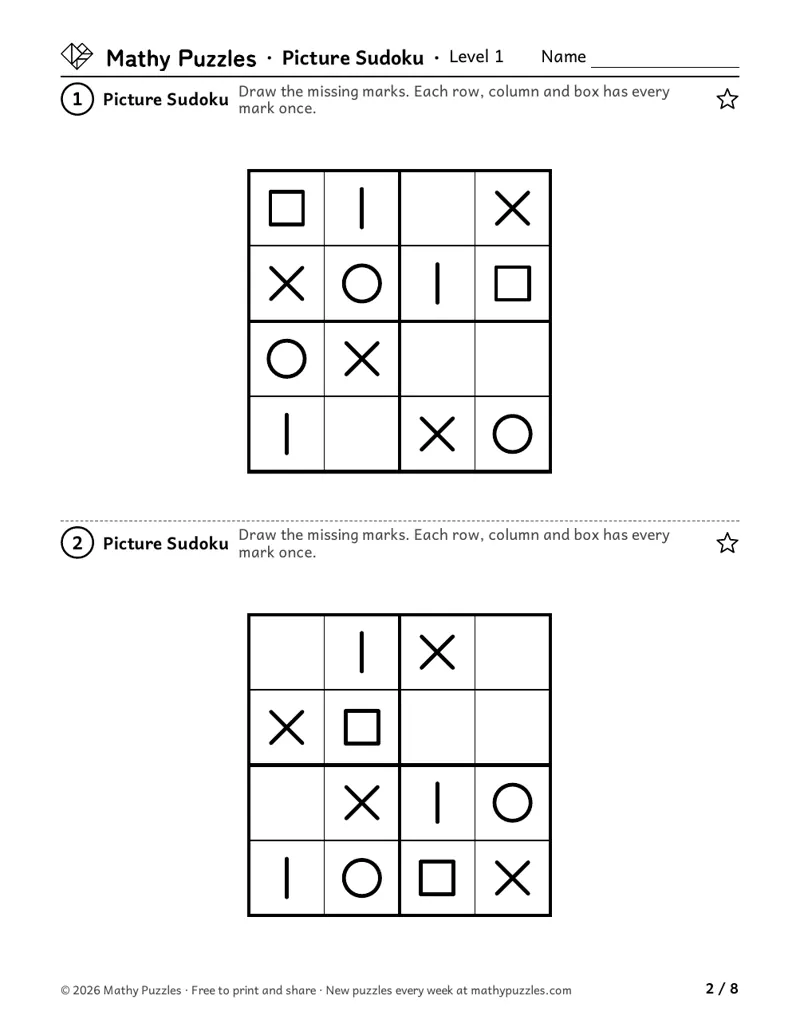 Level 1: a page from the free set
Before starting
- Level 1: hold a crayon and draw a circle, a cross, a line and a square; no numbers or reading needed
- Tell four shapes or marks apart
- Level 2: read and write the numbers 1 to 4 (1 to 6 for the 6 × 6 grids)
- Know what a row and a column are (or learn it on the first sheet)
- Level 2's 6 × 6 grids: comfortable with 4 × 4 first, and can stick with a longer task
- Level 3: has solved 4 × 4 and 6 × 6 sudoku, or starts at the 6 × 6 end
- Level 4: finishes a 9 × 9 by finding the only place for a number
- Levels 3 and 4: patience with small pencil notes
What you need
Small number cards or counters for younger children to try each spot, and a pencil.
Free puzzles to print
Each set: a Learn sheet with a worked example, 10 puzzles from easiest to hardest, and the answers.
Level 1
Ages 4–6 · Pre-K–K
At first 10 to 12 marks are already drawn, so most rows have one gap; then 8. Next comes a tally set (a dot, then two, three and four lines). The hardest have only 4 or 5 marks, so the child checks a row and a box together.
On the sheet: “Draw the missing marks. Each row, column and box has every mark once.”
Print Level 1 (Letter)Other paper size: A4Level 2
Ages 6–8 · Grades 1–2
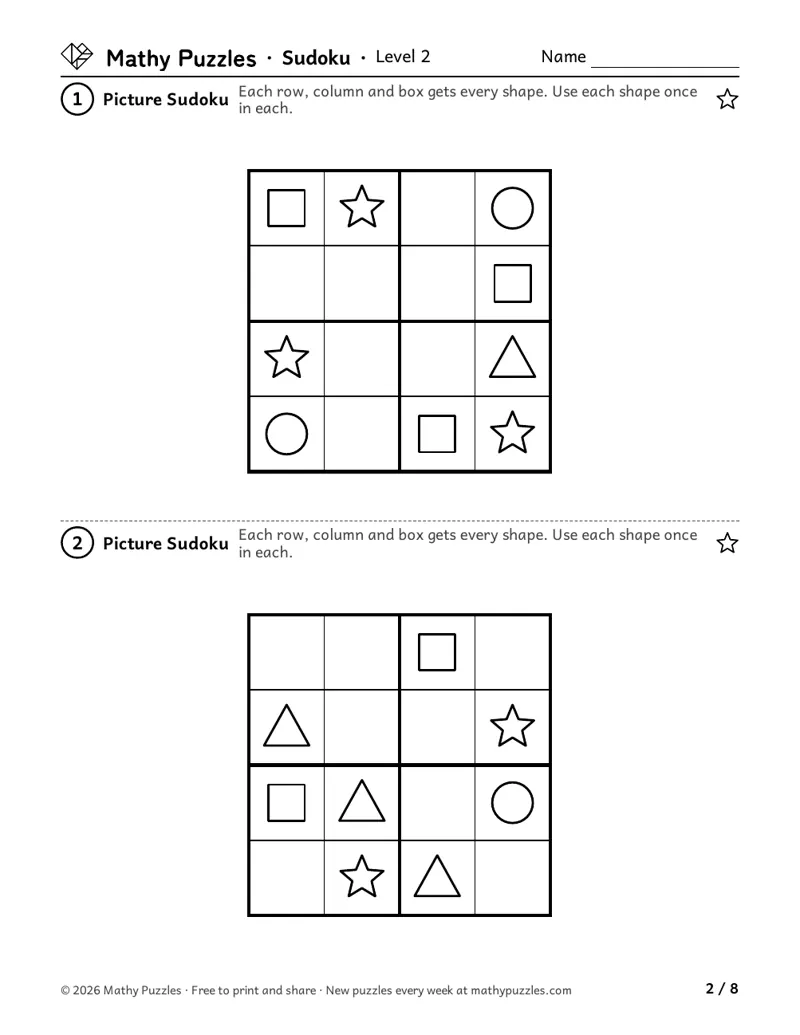
Shape grids: a short warm-up before number sudoku, with a circle, triangle, square and star; first 8 to 10 shapes printed, then 6 or 7.
4 × 4 grids: from 8 to 10 printed numbers, where a row often has just one gap. Then down to 4 or 5 printed numbers, which need a careful look along rows, columns and boxes together.
6 × 6 grids: from 16 to 18 printed numbers down to 8 or 9. Every puzzle can be finished by finding the only place for a number or the only number for a square. With fewer numbers printed, your child scans longer before each move.
On the sheet: “Each row, column and box gets 1, 2, 3, 4. Picture Sudoku uses shapes the same way.”
On the sheet: “Each row, column and box gets every shape. Use each shape once in each.”
On the sheet: “Each row, column and box gets 1 to 6. Use each number once in each.”
Print Level 2 (Letter)Other paper size: A4Level 3
Ages 8–10 · Grades 3–4
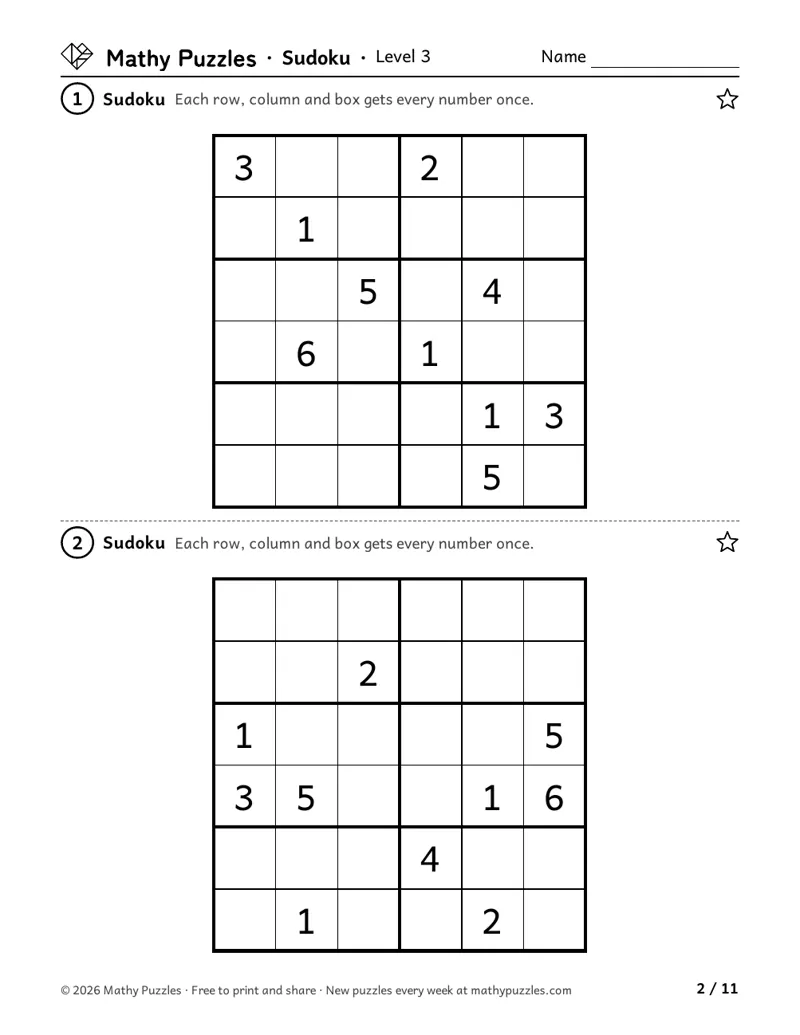
The easiest puzzles are 6 × 6, then 8 × 8 with boxes 2 squares tall and 4 wide. Then come 9 × 9 grids, solved by finding the only place or the only number. The hardest need "pointing" or a pair. Pointing: when a box's only spots for a number lie in one line, that number is crossed off the rest of that line. A pair: two squares in a box or line that can only hold the same two numbers.
On the sheet: “Each row, column and box gets every number once.”
Print Level 3 (Letter)Other paper size: A4Level 4
Ages 10–12 · Grades 5–6
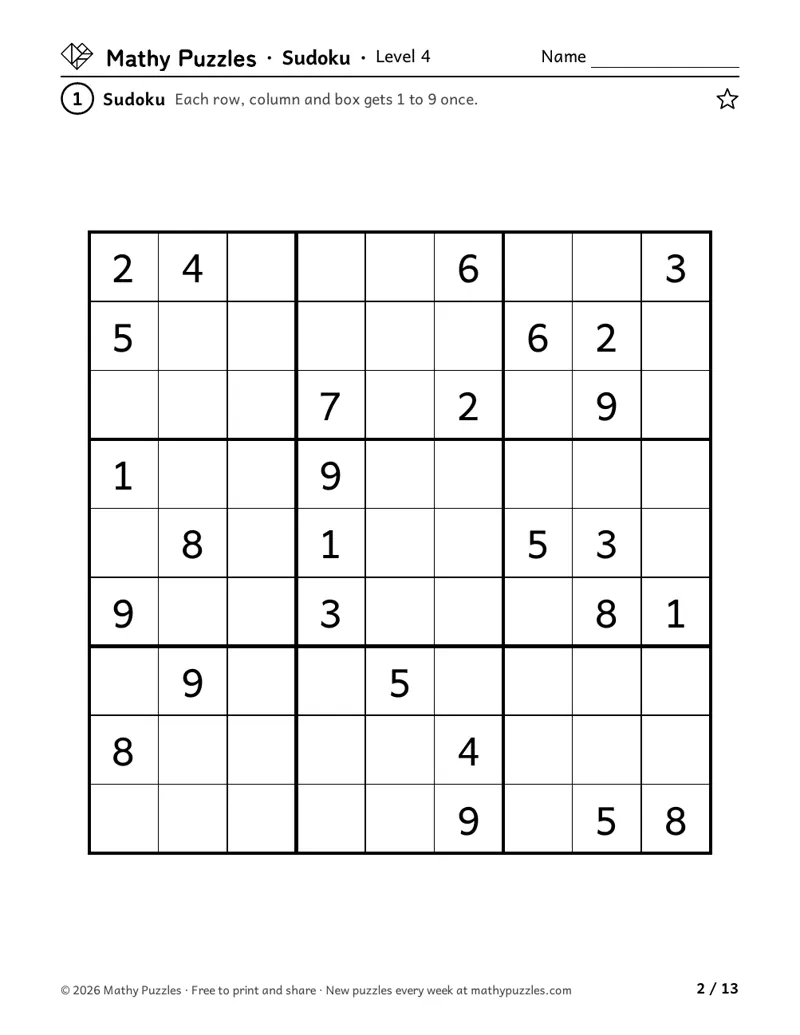
All 9 × 9, with 22 to 30 printed numbers. The moves grow from pointing, to two numbers that must share two squares, to a pattern of four corners across two rows. The hardest puzzles need one careful "what if" on a square with two choices.
On the sheet: “Each row, column and box gets 1 to 9 once.”
Print Level 4 (Letter)Other paper size: A4
How it works
The grid is split into boxes, and some squares are already filled. The child fills the rest so every row, every column and every box has each mark or number once. Level 1 uses simple marks that are easy to draw. Level 2 starts with shapes, then moves to 4 × 4 and 6 × 6 number grids. Level 3 climbs from 6 × 6 to 8 × 8 to the classic 9 × 9, and Level 4 is all 9 × 9.
How to play
- Find a row, column or box with only one empty square. Which number is missing? Write it.
- Pick a number. Check which rows and columns already have it.
- In a box still missing that number, find the one square where it can go.
- Keep going until every square is full, then check each row, column and box.
When it gets hard
Checking rows but forgetting the boxes.
Hint: Each box also needs every number once. Trace the thick lines first.
Writing a number twice in a column.
Hint: Before writing, run a finger down the column and across the row.
Guessing when stuck.
Hint: Look for a row, column or box with just one empty square left.
Drawing a mark that is already in the box.
Hint: Trace the thick lines with a finger. Each box needs every mark too.
Tip for grown-ups: Ask "How did you know?" after each number. A child who can say "this row already has 1, 2 and 4" is reasoning, not guessing. Younger children can place number cards or counters first and write once the row, column and box all check.
Frequently asked questions
- Should my child start with pictures or numbers?
- Either works. Picture Sudoku uses the same rule with shapes, so a child who isn't sure of numbers can start there. The Level 2 Learn sheet for 4 × 4 ends with a picture grid, so one page teaches both.
- Is a 4 × 4 grid enough of a challenge for grade 2?
- The easiest grids are quick; the hardest have only 4 or 5 printed numbers and need careful checking. Children who finish easily can move on to the 6 × 6 grids at the same level.
Questions about printing, levels, answers or membership: see all questions.
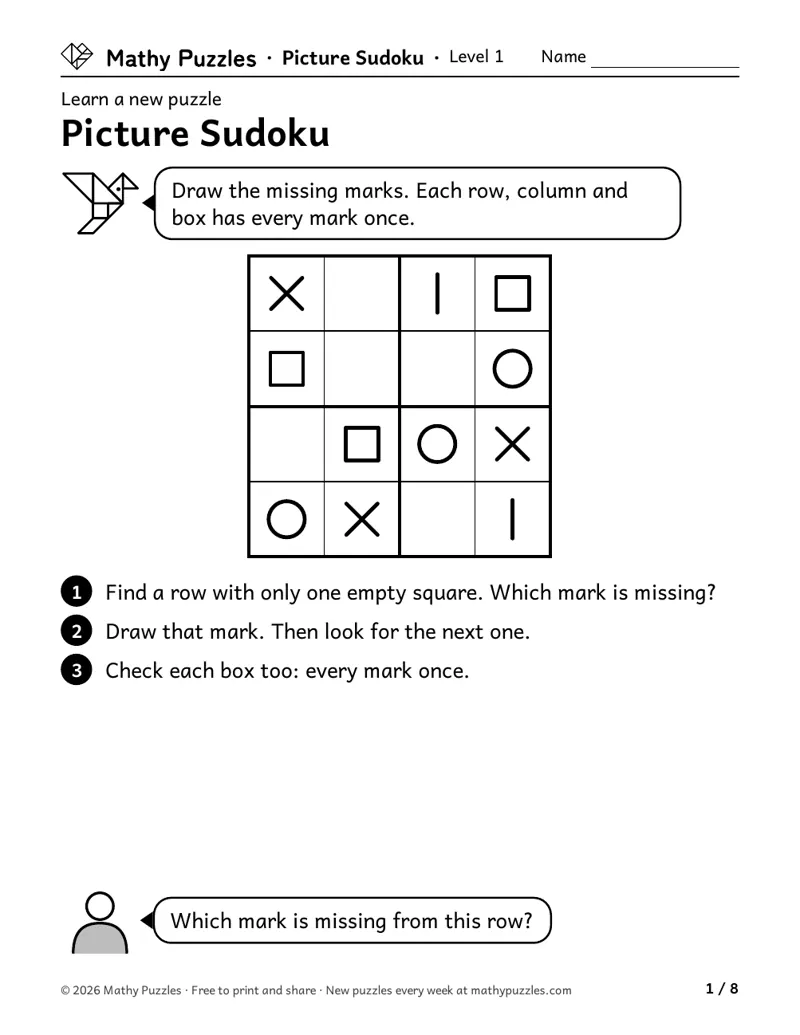
Worked example
From the Level 1 Learn sheet
- Find a row with only one empty square. Which mark is missing?
- Draw that mark. Then look for the next one.
- Check each box too: every mark once.
A question to ask: “Which mark is missing from this row?”
Free every Sunday A mixed bag of 20 new puzzles, all four levels. Get them by email
The thinking it works on
Finding what's missing
Sees which number a row, column or box still needs.
Reasoning by elimination
Rules out squares until one place is left.
Pillow (2002) studied kindergartners to fourth graders. From first grade up, children already treated a conclusion reached by ruling out the other options as surer than a guess. Source
Scanning along lines
Looks along rows, columns and boxes in order.
Donnelly and colleagues (2007) found that 6- to 7-year-olds were slower than 9- to 10-year-olds at searching for an item defined by two features. They took longest to decide that the item was not there. Source
Explaining a step
Says why a number goes in a square.
Domberg, Köymen and Tomasello (2018) found that 5- and 7-year-olds gave more reasons for their choices with a partner toward a shared goal than when competing. The 7-year-olds were also better at countering a partner's reasons. Source
Telling look-alike marks apart
Tells similar marks apart.
Gibson and colleagues (1962) asked 4- to 8-year-olds to pick exact matches of letter-like shapes from changed copies (turned, flipped, a line made curved). Mistaken matches fell with age across this span. Source
Rows and columns
Understands that a grid runs two ways.
Battista and colleagues (1998) found that many students do not yet see a grid of squares as rows crossed by columns. They described the levels by which that view is built. Source
Keeping track of possibilities
Notes where a number can and can't go.
Where is this thinking used?
- Setting the table: Each place gets one fork, one knife and one spoon, with none doubled.
- Sharing turns: Each child gets each toy once before anyone repeats.
- Packing lunch boxes: Every box gets one of each snack.
- Sorting: Spotting what's missing from a set.
For teachers
Curriculum areas
- Common Core
- No direct curricular match.
- NCERT
- Joyful Mathematics (Class 1) puzzle pages: each shape once in every row and column; Maths Mela (Class 5): a grid of signs with no repeatsLevel 3: No direct curricular match.
- National Curriculum (England)
- No direct curricular match.
- Cambridge Primary Mathematics
- No direct curricular match.
Math practices: see the box below.
Math practices this puzzle uses
- Uses: MP1 Make sense of problems and persevere in solving them
- Not used: MP2 Reason abstractly and quantitatively
- Not used: MP3 Construct viable arguments and critique the reasoning of others
- Not used: MP4 Model with mathematics
- Not used: MP5 Use appropriate tools strategically
- Uses: MP6 Attend to precision
- Uses: MP7 Look for and make use of structure
- Not used: MP8 Look for and express regularity in repeated reasoning
From the Common Core Standards for Mathematical Practice.
More Sudoku puzzles for members
Members get at least 5 more worksheets at each difficulty for every puzzle, 80 new puzzles every Sunday, and the whole archive. $39 a year or $25 for 6 months.
See membershipNot ready yet?
One email, all four levels: 20 puzzles, 5 for each level.
For grown-ups (18+). One email every Sunday with the puzzles and the odd note about membership; unsubscribe any time. We never ask about your child. How we use your email