
River Crossing
A farmer, a wolf, a goat and a cabbage, and a boat too small to take them all: the puzzle is more than 1,200 years old. These versions keep the idea with gentle animals that chase each other, and the clever move is often to bring someone back.
Free sets by level, ages 8–12:
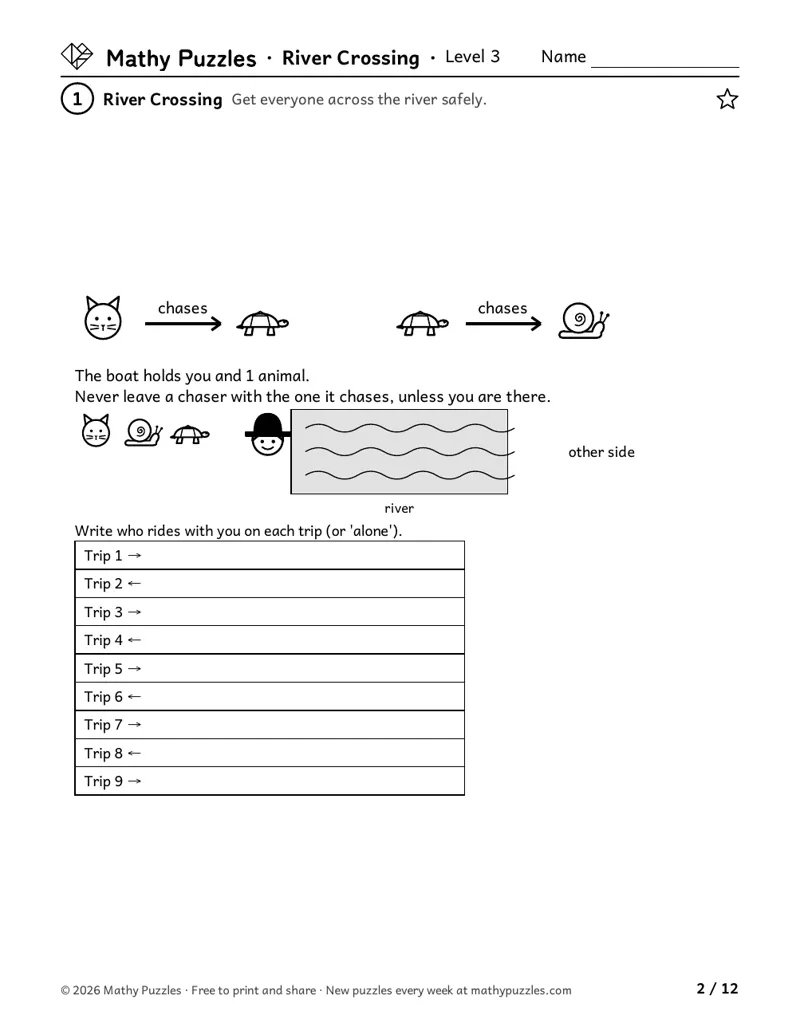 Level 3: a page from the free set
Before starting
- Read a short rule card with chase arrows
- Fill in a table, one row per trip
- Patience to undo a plan and try again
What you need
Small toys or paper cutouts for the travelers, and a pencil with an eraser.
Free puzzles to print
Each set: a Learn sheet with a worked example, 10 puzzles from easiest to hardest, and the answers.
Level 3
Ages 8–10 · Grades 3–4
3 animals and a boat for one, the classic chain. Then 4 animals and a boat for two, then plans that must carry an animal back. The hardest show a filled-in plan and ask for the first unsafe trip.
On the sheet: “Get everyone across the river safely.”
Print Level 3 (Letter)Other paper size: A4Level 4
Ages 10–12 · Grades 5–6
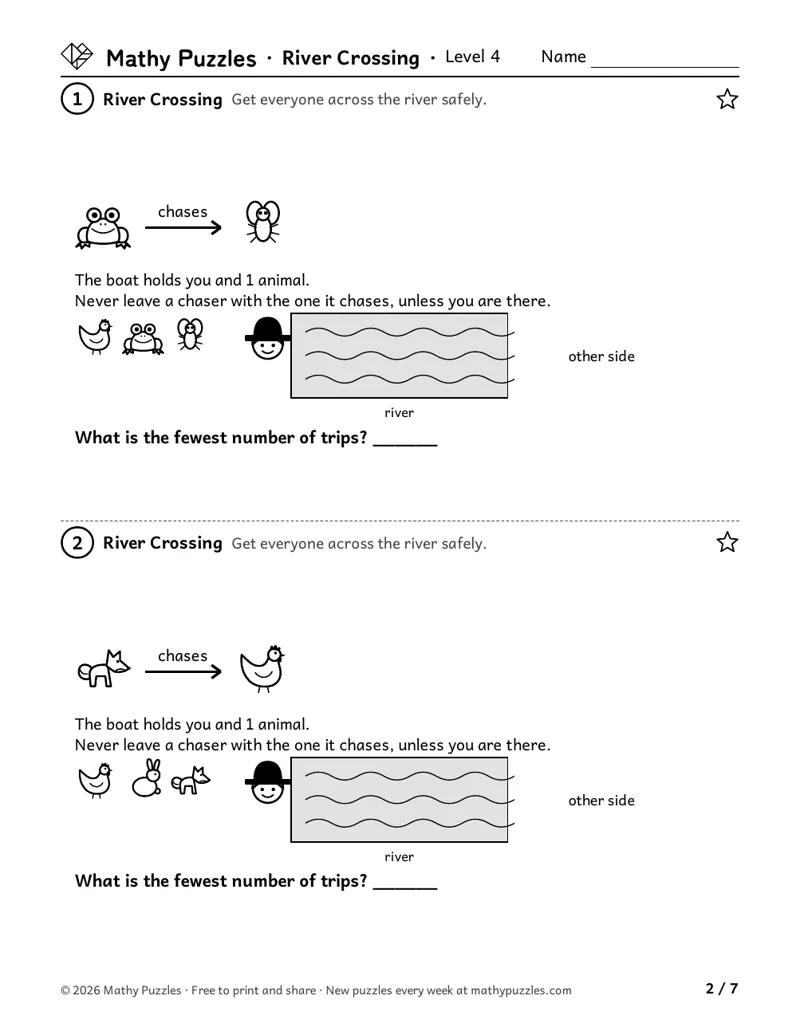
The fewest trips for 3 or 4 animals, then for 4 or 5 with a bigger boat. The hardest find a mistake hidden later in a longer plan.
On the sheet: “Get everyone across the river safely.”
Print Level 4 (Letter)Other paper size: A4
How it works
A kid rows animals across a river in a small boat that holds the kid and one or two animals. Some animals chase others, so they can't be left together without the kid. The child writes each trip in a table until everyone is across. Some puzzles ask only for the fewest trips, or show a filled-in plan and ask for the first unsafe trip.
How to play
- Read the chase arrows. Who can't be left together?
- Pick who rides first. Is everyone left behind safe?
- On the other side, check that bank too before you row back.
- Write each trip in the table. If you get stuck, bring an animal back.
When it gets hard
Checking the boat but not the bank left behind.
Hint: Before you row, look at who stays. Is any chaser left with the one it chases?
Forgetting the far bank on the way back.
Hint: Animals already across can't be left unsafe either.
Never bringing an animal back.
Hint: A return trip with an animal is allowed, and often needed.
Tip for grown-ups: Use toys or paper cutouts and a blue towel as the river. Moving them makes undoing a bad trip painless.
Frequently asked questions
- How old is this puzzle?
- More than 1,200 years. A version with a wolf, a goat and a cabbage is in a Latin puzzle collection credited to Alcuin of York, who died in 804. Ours uses gentle chases, never "eats".
- What should I accept as a correct plan?
- Any plan that keeps both banks safe and gets everyone across. The answers show a shortest plan; a longer safe plan is still right. Level 4's fewest-trips questions ask for one number: the fewest trips.
- My child gets stuck halfway. Should I give a hint?
- First ask, "Could anyone ride back with you?" That return trip is the idea most children miss. If they are still stuck, move toys together.
Questions about printing, levels, answers or membership: see all questions.
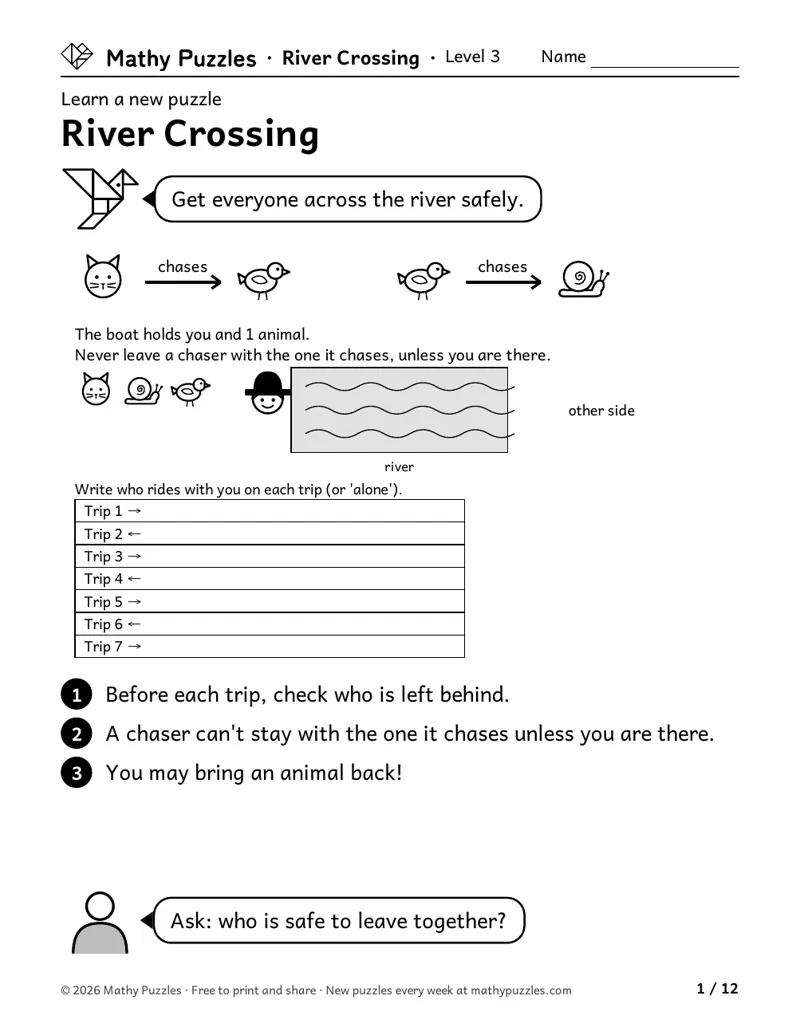
Worked example
From the Level 3 Learn sheet
- Before each trip, check who is left behind.
- A chaser can't stay with the one it chases unless you are there.
- You may bring an animal back!
A question to ask: “Who is safe to leave together?”
Free every Sunday A mixed bag of 20 new puzzles, all four levels. Get them by email
The thinking it works on
Planning ahead
Thinks a trip or two ahead.
Culbertson and Zillmer (1998) gave children aged 7 to 12 a tower puzzle that has to be planned before any move, and found that scores changed with age. Source
Checking every rule
Checks both banks after every trip.
Seeing a step back as progress
Accepts that bringing an animal back can be the way forward.
Finding the mistake
Walks a printed plan trip by trip to find the first unsafe one.
Finding the fewest steps
Compares plans to find the shortest.
Where is this thinking used?
- Travel planning: Getting family and bags somewhere with one car and a few rules.
- Scheduling: Who can't share a room at once, and in what order to move them.
- Moving house: Deciding what goes in each load so nothing is left in the wrong place.
- Video games: Puzzle levels where a step back opens the way.
For teachers
Curriculum areas
- Common Core
- No direct curricular match.
- NCERT
- Maths Mela (Class 5), We the Travellers — I: the river crossing puzzle
- National Curriculum (England)
- No direct curricular match.
- Cambridge Primary Mathematics
- No direct curricular match.
Math practices: see the box below.
Math practices this puzzle uses
- Uses: MP1 Make sense of problems and persevere in solving them
- Not used: MP2 Reason abstractly and quantitatively
- Not used: MP3 Construct viable arguments and critique the reasoning of others
- Not used: MP4 Model with mathematics
- Not used: MP5 Use appropriate tools strategically
- Uses: MP6 Attend to precision
- Not used: MP7 Look for and make use of structure
- Not used: MP8 Look for and express regularity in repeated reasoning
From the Common Core Standards for Mathematical Practice.
More River Crossing puzzles for members
Members get at least 5 more worksheets at each difficulty for every puzzle, 80 new puzzles every Sunday, and the whole archive. $39 a year or $25 for 6 months.
See membershipNot ready yet?
One email, all four levels: 20 puzzles, 5 for each level.
For grown-ups (18+). One email every Sunday with the puzzles and the odd note about membership; unsubscribe any time. We never ask about your child. How we use your email