
Rectangle Split
Twelve chairs can be set out in one long row, or in three rows of four. Rectangle Split asks the same question about squares: each number is a count, and the space around it decides which shape it takes.
Free sets by level, ages 6–10:
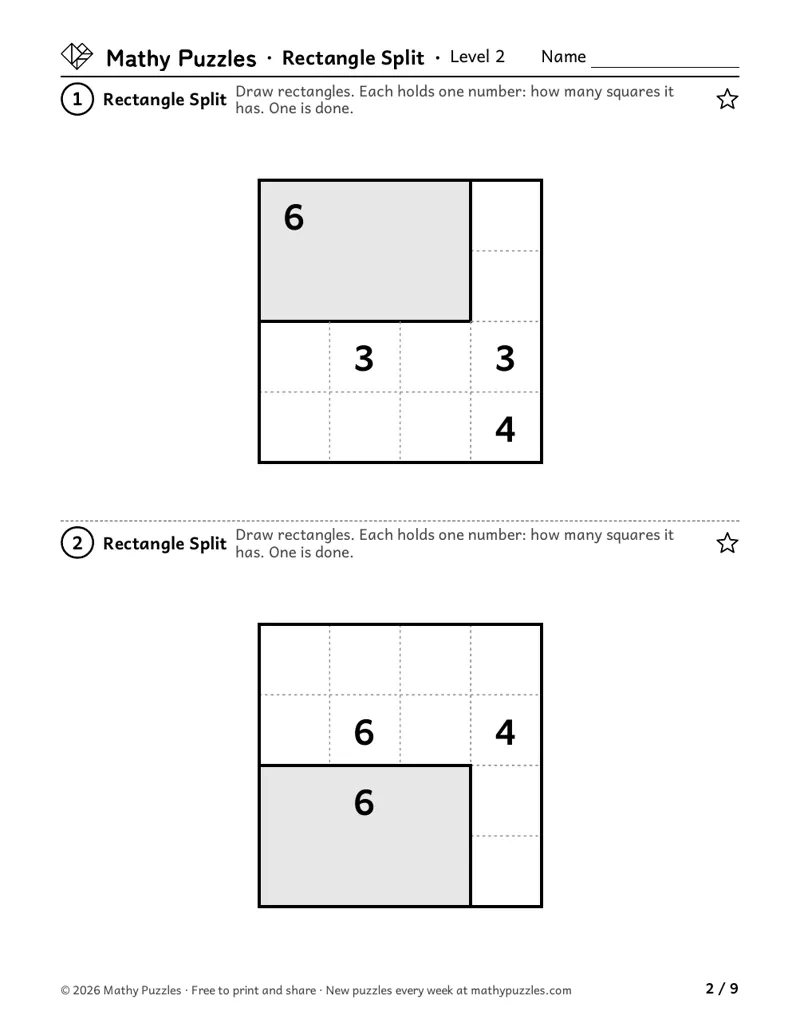 Level 2: a page from the free set
Before starting
- Count squares in a row and column
- Level 2: count up to 12 squares
- Level 3: multiplication facts up to 20, such as 3 × 6 and 4 × 5, or be ready to count the squares
What you need
A ruler for straight lines, and a pencil.
Free puzzles to print
Each set: a Learn sheet with a worked example, 10 puzzles from easiest to hardest, and the answers.
Level 2
Ages 6–8 · Grades 1–2
A 4 × 4 grid with one rectangle drawn for you, up to 6 × 6 with numbers that could take two shapes. The hardest need a two-step look: "if the 8 went here, the 3 would have no room."
On the sheet: “Draw rectangles. Each has one number: its count of squares.”
Print Level 2 (Letter)Other paper size: A4Level 3
Ages 8–10 · Grades 3–4
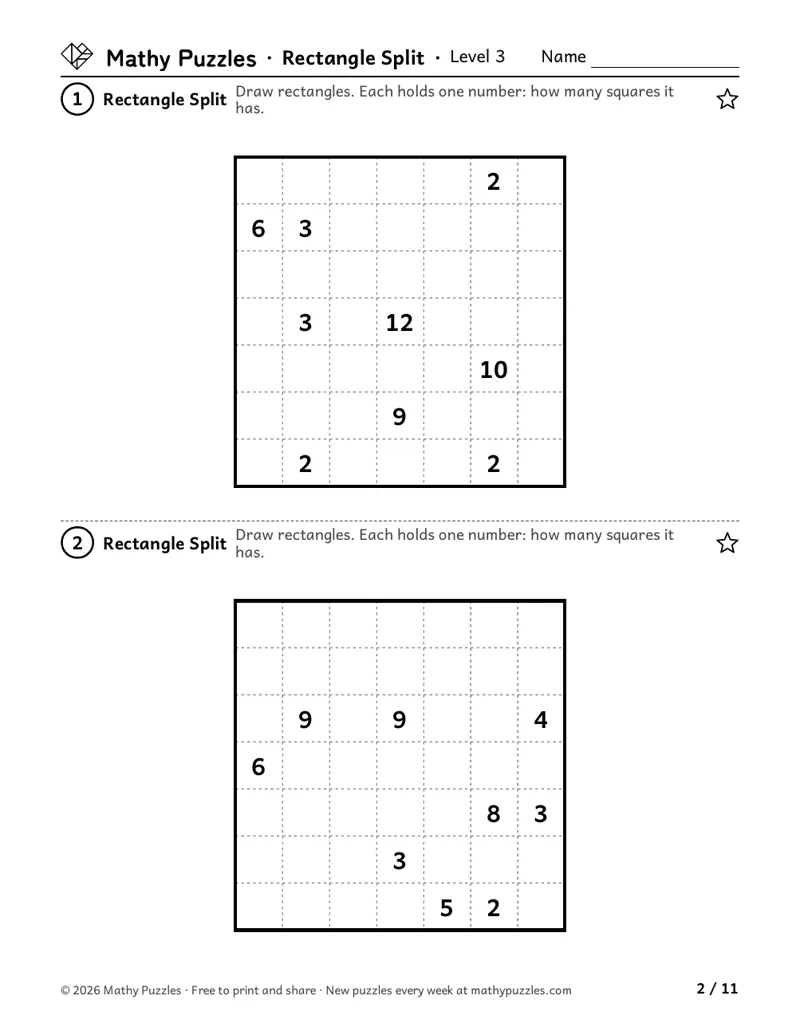
7 × 7 and 8 × 8 grids with bigger numbers (up to 20), so more factor pairs to try; the hardest need the two-step look.
On the sheet: “Draw rectangles. Each has one number: its count of squares.”
Print Level 3 (Letter)Other paper size: A4
How it works
Each puzzle is a grid of squares with some numbers in it. The child splits the whole grid into rectangles. Each rectangle holds one number, and that number is how many squares the rectangle covers. A 6 could be 1 by 6 or 2 by 3, so the child has to think about which fits.
How to play
- Find a number that can only fit one way, often a big number near a corner.
- Draw that rectangle. It must cover exactly that many squares.
- Look for squares that only one number can reach, and give them to it.
- Keep going until every square is in a rectangle with one number.
When it gets hard
Drawing a shape that isn't a rectangle, such as an L.
Hint: Every part has four straight sides and square corners.
A rectangle with two numbers in it, or none.
Hint: Count the numbers inside each rectangle. There must be just one.
Picking the first shape that fits without checking its neighbors.
Hint: Before you draw, ask: does every other number still have room?
Tip for grown-ups: When your child finishes, ask them to add all the numbers; the total is always the number of squares in the grid, which is a quick self-check. A ruler keeps the lines straight, so the rectangles are easy to count.
Frequently asked questions
- Does my child need to know multiplication?
- Not for Level 2: counting squares is enough. Level 3 goes faster with multiplication facts up to 20, such as 3 × 6 and 4 × 5, but counting still works.
- How can I check a finished grid quickly?
- Every number must sit in its own rectangle, and the numbers add up to the number of squares in the grid. A glance and a quick sum does it; the answers show a finished split.
Questions about printing, levels, answers or membership: see all questions.
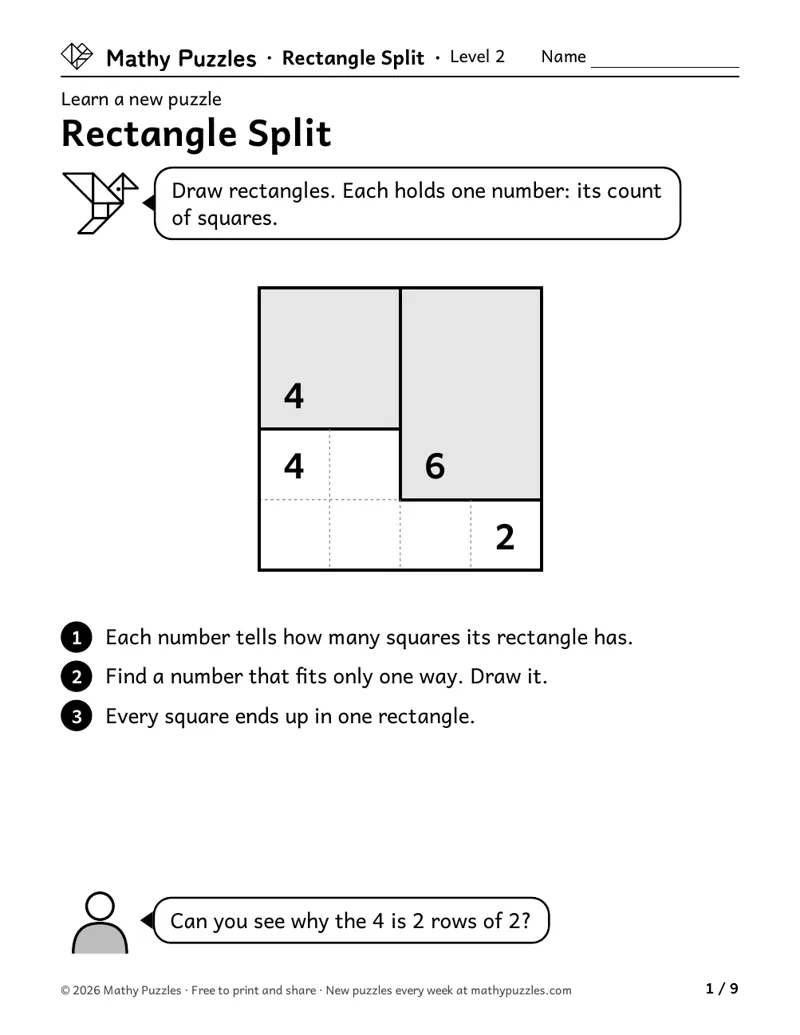
Worked example
From the Level 2 Learn sheet
- Each number tells how many squares its rectangle has.
- Find a number that fits only one way. Draw it.
- Every square ends up in one rectangle.
A question to ask: “Can you see why this number fits only one way?”
Free every Sunday A mixed bag of 20 new puzzles, all four levels. Get them by email
The thinking it works on
Area as rows and columns
Draws a rectangle covering exactly the number of squares its clue says.
Outhred and Mitchelmore (2000) watched 115 children in grades 1 to 4 cover rectangles and found five levels, from scattered guesses to rows and columns linked to multiplication. Source
Factor pairs
Lists the shapes a number can take and tests each against the space.
Battista and colleagues (1998) report that children's mental picture of a grid of squares moves through levels. Many do not yet treat it as rows times columns. Source
Reasoning from what is forced
Finds the number that fits only one way and the squares only one number can reach.
Pillow and colleagues (2010) found that from kindergarten on, children rated a conclusion that had to be true as more certain than a guess. By grade 3 they explained the two differently. Source
Planning ahead
Asks whether every other number still has room before drawing.
Diamond (2013) reviews evidence that holding back a first guess until you have checked is harder for children than for adults. It comes more easily as children move through school. Source
Checking parts against the whole
Adds all the numbers at the end to match the grid's square count.
Where is this thinking used?
- Floor plans: A floor is divided into rooms of set sizes.
- Tiling and carpets: Flooring or garden beds are laid out to fit the space.
- Page and screen layout: Blocks of set sizes are placed on a grid.
- Parking lots and storage units: A lot is split into spaces of set sizes.
For teachers
Curriculum areas
- Common Core
- Geometry: partition rectangles into rows and columns (Grade 2); Measurement: area by counting unit squares and relating area to multiplication (Grade 3); Operations: multiplication and factor pairs (Grades 3–4)
- NCERT
- Arrays and equal groups (Classes 2 and 4); area by covering, as in Grandmother's Quilt (Class 5)
- National Curriculum (England)
- Multiplication: arrays (Year 2); factor pairs and area by counting squares (Year 4)
- Cambridge Primary Mathematics
- Number: multiplication as an array; factors and multiples (Stages 2 and 4); Geometry and measure: area on a square grid (Stage 3)
Math practices: see the box below.
Math practices this puzzle uses
- Uses: MP1 Make sense of problems and persevere in solving them
- Not used: MP2 Reason abstractly and quantitatively
- Not used: MP3 Construct viable arguments and critique the reasoning of others
- Not used: MP4 Model with mathematics
- Not used: MP5 Use appropriate tools strategically
- Not used: MP6 Attend to precision
- Uses: MP7 Look for and make use of structure
- Not used: MP8 Look for and express regularity in repeated reasoning
From the Common Core Standards for Mathematical Practice.
More Rectangle Split puzzles for members
Members get at least 5 more worksheets at each difficulty for every puzzle, 80 new puzzles every Sunday, and the whole archive. $39 a year or $25 for 6 months.
See membershipNot ready yet?
One email, all four levels: 20 puzzles, 5 for each level.
For grown-ups (18+). One email every Sunday with the puzzles and the odd note about membership; unsubscribe any time. We never ask about your child. How we use your email