
Picture Matrices
In a box of crayons the colors may change going across while the crayons get shorter going down. These picture grids hide rules like that, one across each row and one down each column. Ask what stays the same and what changes, and the missing picture shows itself.
Free sets by level, ages 4–10:
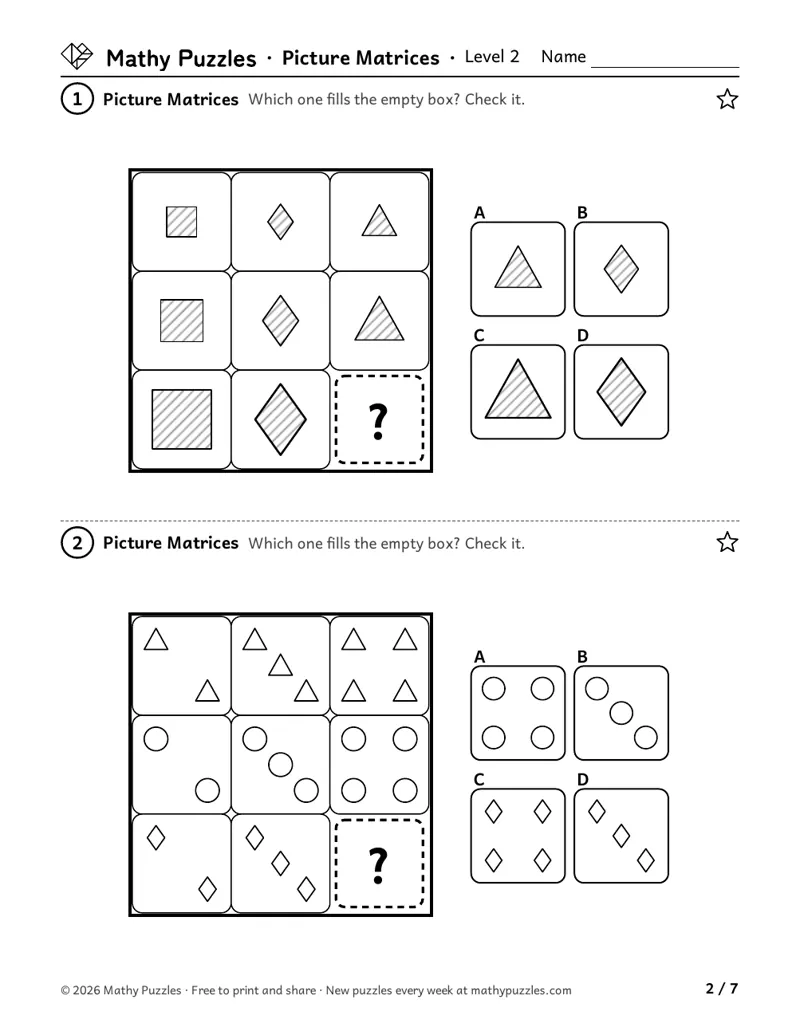 Level 2: a page from the free set
Before starting
- Name shapes and colors
- Count to 4 (Levels 1–2) or to 7 (Level 3)
- Level 3: add two small numbers
Free puzzles to print
Each set: a Learn sheet with a worked example, 10 puzzles from easiest to hardest, and the answers.
Level 1
Ages 4–6 · Pre-K–K
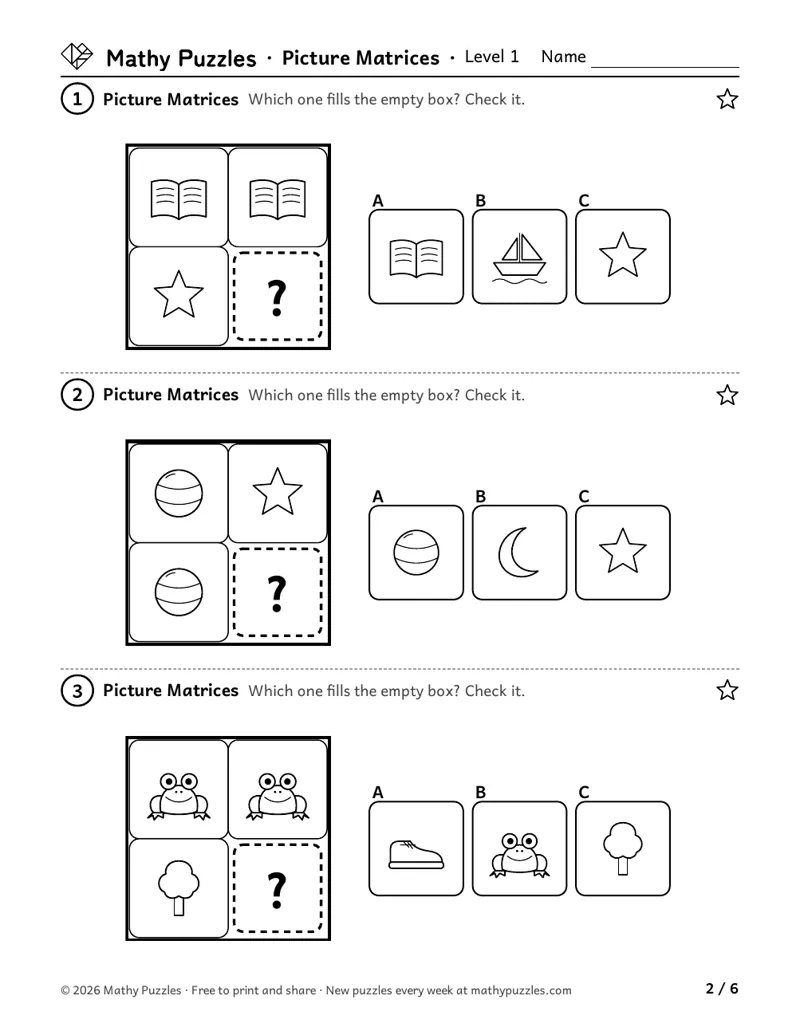
2 × 2 grids of objects with one change, then two features (one across, one down). Then 3 × 3 grids where something stays the same along a row, or steps up along it in number or size.
On the sheet: “Which one fills the empty box? Check it.”
Print Level 1 (Letter)Other paper size: A4Level 2
Ages 6–8 · Grades 1–2
3 × 3 grids of shapes. First one thing stays the same while another steps up. Then each row holds the same three shapes, fills or counts, on one feature and then two, then three rules at once.
On the sheet: “Which one fills the empty box? Check it.”
Print Level 2 (Letter)Other paper size: A4Level 3
Ages 8–10 · Grades 3–4
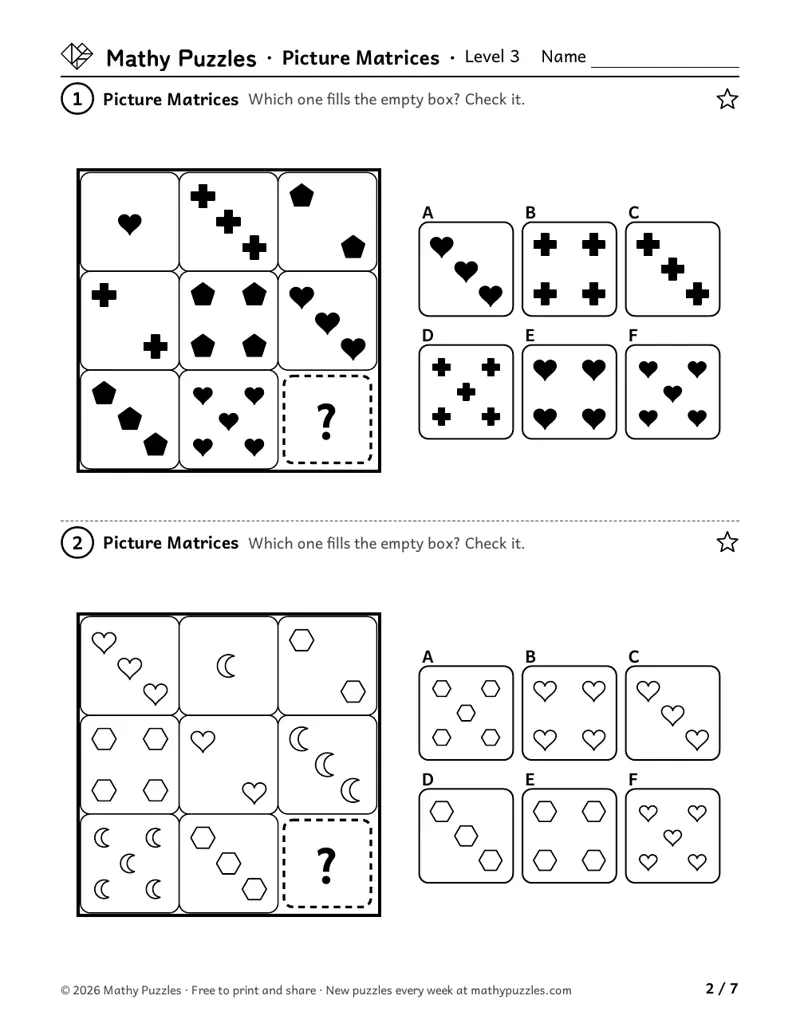
Six options, count rules that start higher each row, sums (third = first + second), and rows and columns with different rules.
On the sheet: “Which one fills the empty box? Check it.”
Print Level 3 (Letter)Other paper size: A4
How it works
Each puzzle is a grid of pictures, 2 by 2 or 3 by 3, with one box empty. The pictures change across each row and down each column by a rule. The child finds the rule and checks the picture that fills the gap.
How to play
- Look across the top row. What stays the same? What changes?
- Look down a column too. Is there a second rule?
- Say the rule in words, such as "each row has one black, one white and one striped".
- Use the rule to work out the missing picture, then find it below and check it.
When it gets hard
Picking an option because it looks like the box next to the gap.
Hint: Check your choice against the whole row and the whole column.
Finding one rule and stopping.
Hint: Look at every feature: shape, color, size and how many.
Picking an answer that is almost right.
Hint: Name each feature of your choice and check it against the rule, one at a time.
Tip for grown-ups: Have the rule said out loud before any box is checked; explaining is where the reasoning happens.
Frequently asked questions
- Why does my class pick the look-alike option?
- Wrong options share some features with the right one, so a glance at the box next to the gap is not enough. Ask students to say the row rule and the column rule aloud before choosing.
- What if my child picks a different option?
- The answers show the option that keeps every rule. If your child chose another, ask which rule it breaks; that is the real work.
Questions about printing, levels, answers or membership: see all questions.
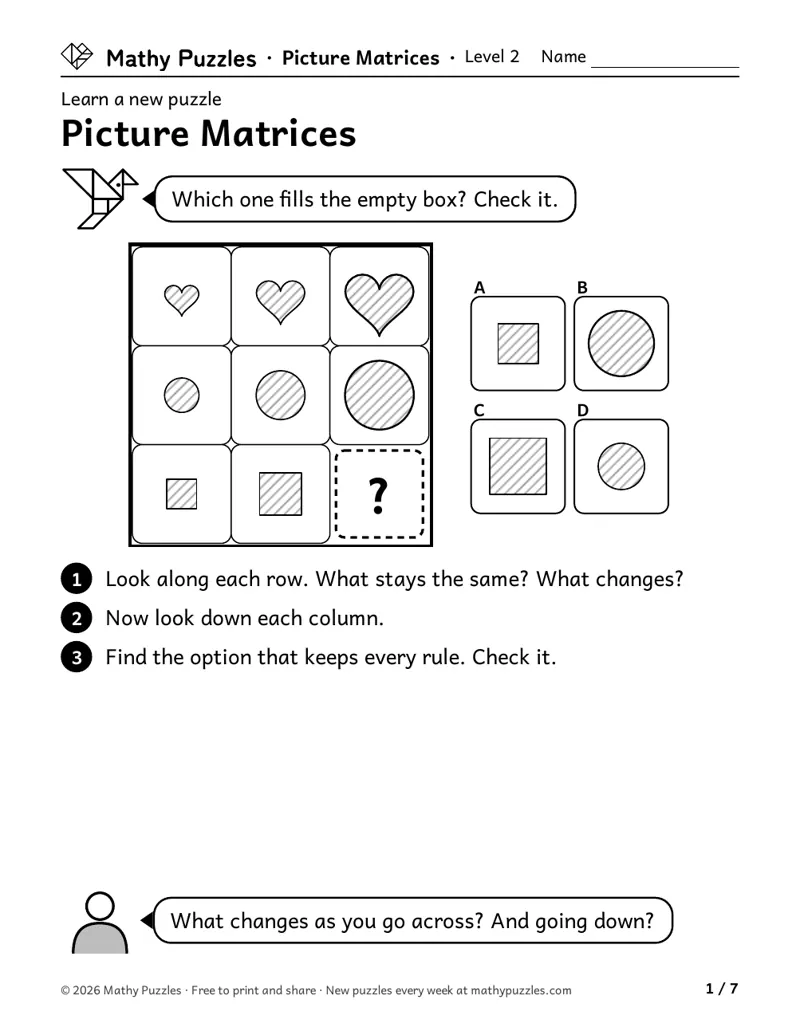
Worked example
From the Level 2 Learn sheet
- Look along each row. What stays the same? What changes?
- Now look down each column.
- Find the option that keeps every rule. Check it.
A question to ask: “What changes as you go across? And going down?”
Free every Sunday A mixed bag of 20 new puzzles, all four levels. Get them by email
The thinking it works on
Pattern and rule finding
Looks across a row and down a column for what stays the same and what changes.
Rittle-Johnson and colleagues (2013) found that 4-year-olds could copy and continue repeating patterns, and some could make the same kind of pattern with new materials. Source
Thinking about several features at once
Holds shape, fill and count in mind when several rules run together.
Stevenson and colleagues (2014) gave grid puzzles to 1,422 children aged 4½ to 12½. Rules about kind, color, number and size were easier than rules about direction and position. Source
Switching attention between features
Lets go of the first feature found and looks at the next.
Zelazo (2006) found that most 3-year-olds keep sorting by the old feature when asked to switch (say, from color to shape), while most 5-year-olds can switch. Source
Looking at the whole grid before the answers
Says the rule before choosing, instead of picking by a glance.
Starr, Vendetti and Bunge (2018) used eye tracking with 6-year-olds. Those who looked at the first pair of a picture analogy before the answer choices were the more successful reasoners. Source
Resisting the look-alike option
Checks the chosen picture against the whole row and the whole column.
Thibaut, French and Vezneva (2010) found that how well 6- and 8-year-olds did on picture analogies depended heavily on what the wrong choices looked like. Source
Saying the rule in words
Puts the rule into words so it can be tested.
Counting and adding inside a pattern
Counts and adds inside the pattern when the rule is a sum.
Gathercole and colleagues (2004) tested children aged 4 to 15 and found that every part of working memory kept growing through the school years. Source
Where is this thinking used?
- Schedules and charts: Rows and columns each mean something, and every row follows a rule.
- Sorting and labeling: Things are grouped by shape, color and size at the same time.
- Science: Several things vary at once and one rule must explain all of them.
For teachers
Curriculum areas
- Common Core
- Operations and algebraic thinking: patterns that follow a rule (Grade 4)Levels 1–2: No direct curricular match.
- NCERT
- Patterns in Joyful Mathematics (Class 1) and Shapes and Patterns in Maths Mela (Class 5)
- National Curriculum (England)
- Geometry – position and direction: patterns and sequences of objects (Year 2)
- Cambridge Primary Mathematics
- Number: describing sequences of objects (Stage 1); spatial patterns that grow by a constant (Stage 3)
Math practices: see the box below.
Math practices this puzzle uses
- Not used: MP1 Make sense of problems and persevere in solving them
- Not used: MP2 Reason abstractly and quantitatively
- Not used: MP3 Construct viable arguments and critique the reasoning of others
- Not used: MP4 Model with mathematics
- Not used: MP5 Use appropriate tools strategically
- Not used: MP6 Attend to precision
- Uses: MP7 Look for and make use of structure
- Uses: MP8 Look for and express regularity in repeated reasoning
From the Common Core Standards for Mathematical Practice.
More Picture Matrices puzzles for members
Members get at least 5 more worksheets at each difficulty for every puzzle, 80 new puzzles every Sunday, and the whole archive. $39 a year or $25 for 6 months.
See membershipNot ready yet?
One email, all four levels: 20 puzzles, 5 for each level.
For grown-ups (18+). One email every Sunday with the puzzles and the odd note about membership; unsubscribe any time. We never ask about your child. How we use your email