
Picture Analogies
A puppy grows into a dog; a kitten grows into a cat. Picture Analogies works like that: say exactly how the first picture changed, then make the same change to a new one.
Free sets by level, ages 4–12:
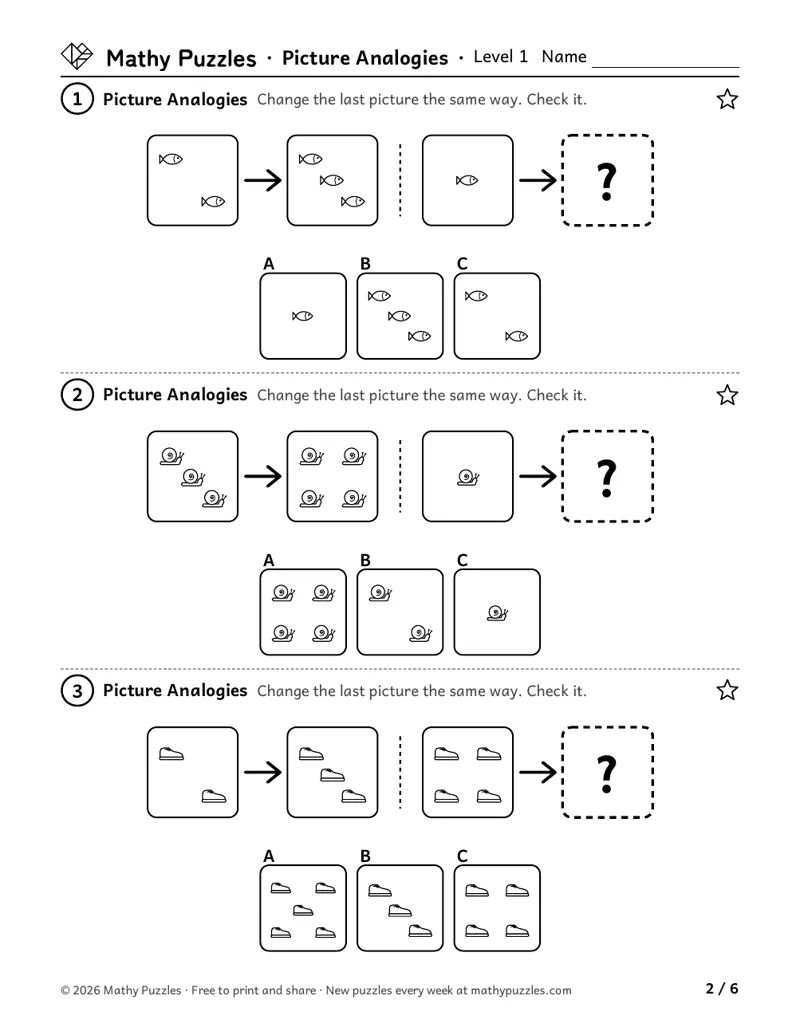 Level 1: a page from the free set
Before starting
- Level 1: words like bigger, smaller and one more
- Level 2: a quarter turn, and fill names (white, black, striped)
- Levels 3–4: tell a turn from a flip
Free puzzles to print
Each set: a Learn sheet with a worked example, 10 puzzles from easiest to hardest, and the answers.
Level 1
Ages 4–6 · Pre-K–K
One change to an object (grows or shrinks, faces the other way, gets one more). First on the same object, then on a new one; the hardest puzzles add a look-alike option that copies the first object.
On the sheet: “Change the last picture the same way. Check it.”
Print Level 1 (Letter)Other paper size: A4Level 2
Ages 6–8 · Grades 1–2
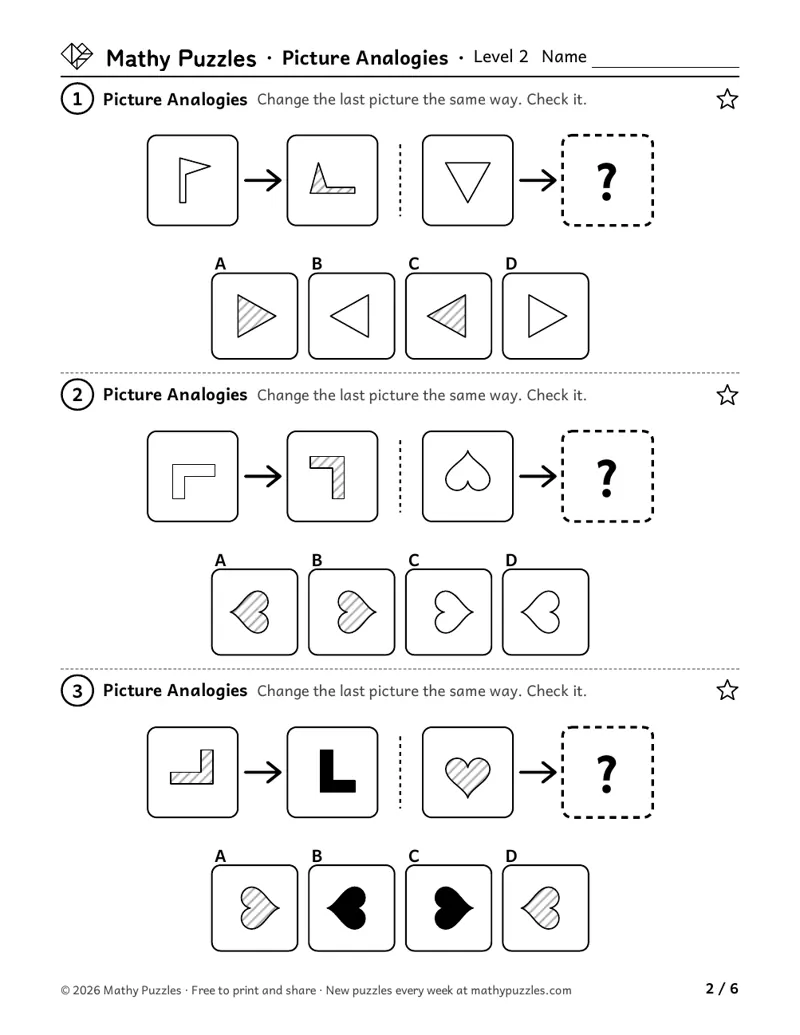
Two changes at once (a quarter turn and a new fill), then "two more", then look-alike options; the hardest puzzles make three changes at once.
On the sheet: “Change the last picture the same way. Check it.”
Print Level 2 (Letter)Other paper size: A4Level 3
Ages 8–10 · Grades 3–4
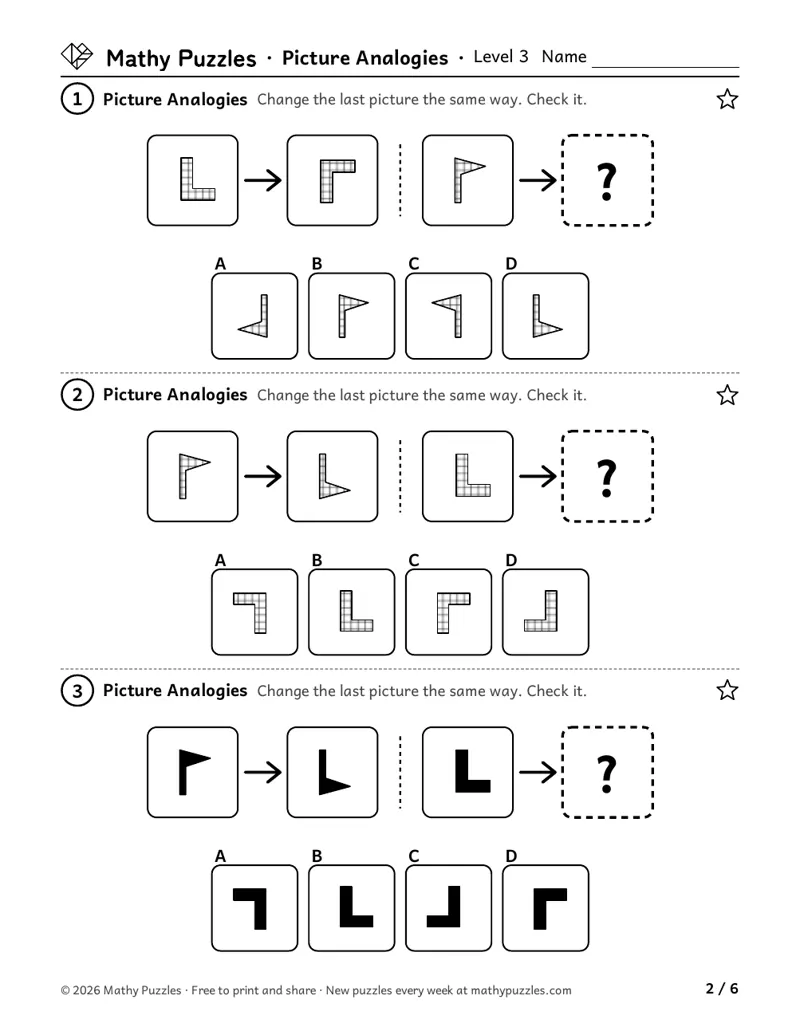
A flip top to bottom, then an eighth of a turn with a new fill, then three changes. The hardest puzzles join a flip and a turn into one change, plus fill and size.
On the sheet: “Change the last picture the same way. Check it.”
Print Level 3 (Letter)Other paper size: A4Level 4
Ages 10–12 · Grades 5–6
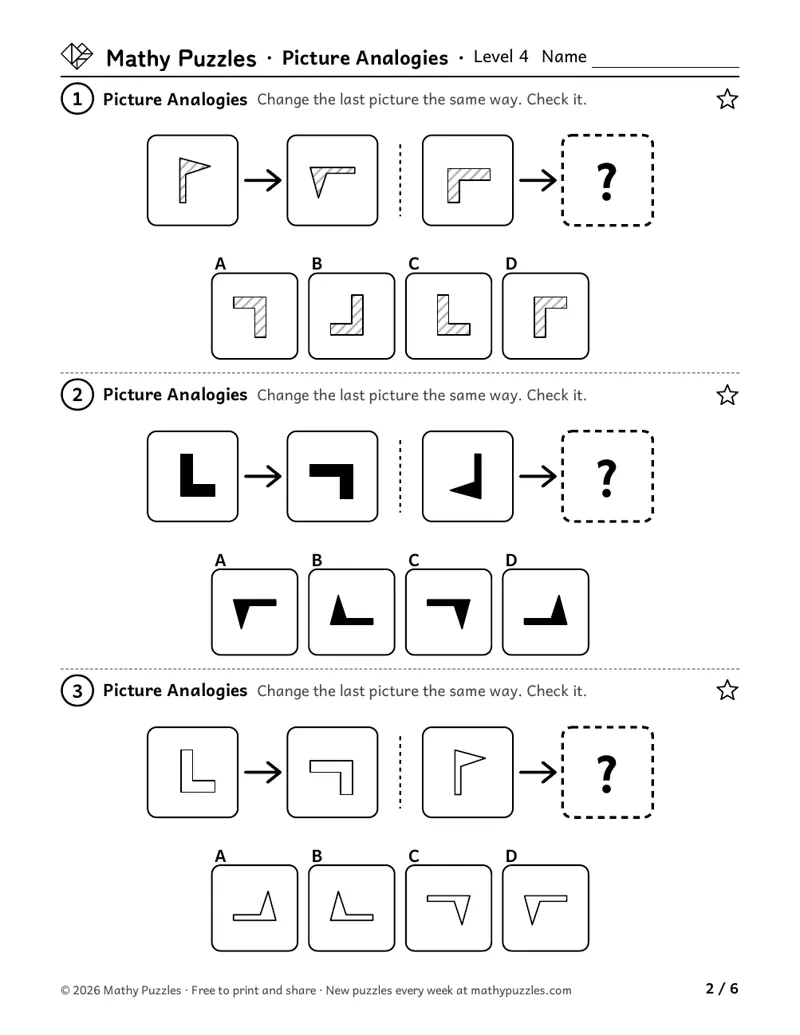
A flip over the slanted line, then with a fill change, then with a size change too. The hardest puzzles give six options that mix in the first picture's shape.
On the sheet: “Change the last picture the same way. Check it.”
Print Level 4 (Letter)Other paper size: A4
How it works
Two pictures show a change: the first turns into the second. A third picture waits for the same change. The child checks the option that changes the third picture in exactly that way. Level 1 uses everyday objects that grow, shrink, face the other way or get one more. Later levels use shapes that turn, flip, and change fill, size or number.
How to play
- Look at the first pair. Name every change: size, turn, flip, fill, how many.
- Picture the third one with those same changes.
- Cross out options that miss a change or add one.
- Check the one that is left.
When it gets hard
Picking the option that looks like the second picture.
Hint: The right picture is the third one changed, not a copy of the second.
Spotting one change and missing another.
Hint: List every change in the first pair before you look at the options.
Turning the wrong way.
Hint: Follow the tip of the shape with a finger: which way did it move?
Tip for grown-ups: Ask "What changed?" and wait. Let your child name each change in their own words before choosing; the words matter more than speed.
Frequently asked questions
- Is this the same as Picture Matrices?
- They are cousins. A matrix has rows and columns that each follow a rule; an analogy has one change to copy onto one new picture. Both ask the child to name what changed.
- How can I introduce turns and flips to a class?
- Turn a paper flag in front of the class, then flip it over, and name each move. Children can copy the move with their own paper flag.
- Why are some options nearly the same?
- Each wrong option gets at least one change wrong, so a child who notices only part of the change finds a near match. Comparing options one change at a time is the skill.
Questions about printing, levels, answers or membership: see all questions.
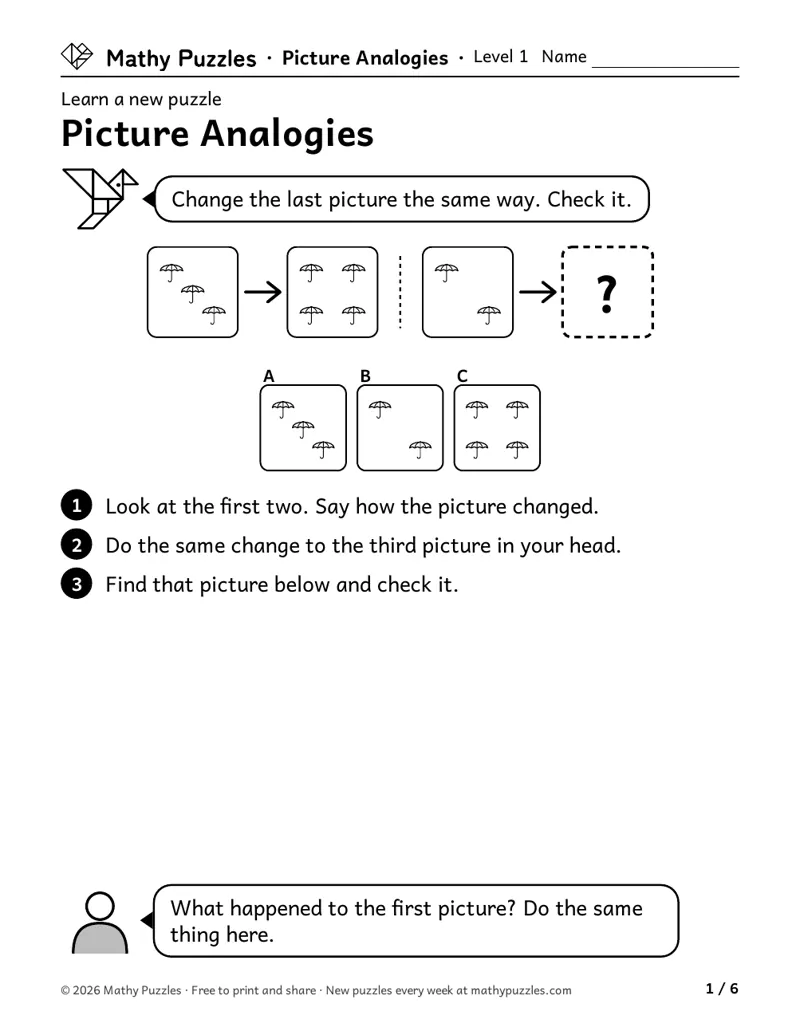
Worked example
From the Level 1 Learn sheet
- Look at the first two. Say how the picture changed.
- Do the same change to the third picture in your head.
- Find that picture below and check it.
A question to ask: “What happened to the first picture? Do the same thing here.”
Free every Sunday A mixed bag of 20 new puzzles, all four levels. Get them by email
The thinking it works on
Copying a change to a new picture
Carries a change from one pair over to a new picture.
Goswami and Brown (1990) gave 4-, 5- and 9-year-olds picture analogies of the form "a is to b as c is to ?". Children of all three ages chose the picture that completed the change over one that merely went with the third picture. Source
Putting the change into words
Names the change before looking at the options.
Turning and flipping in the mind
Pictures a shape after a turn or a flip.
Kosslyn and colleagues (1990) found that 5-year-olds were slower than 8- and 14-year-olds at turning a picture in the mind. They were comparatively good at holding a picture in mind once they had it. Source
Holding several changes at once
Keeps two or three changes in mind together.
Richland, Morrison and Holyoak (2006) found that scene analogies with more relations to track were harder for children from 3 to 14. Older children made fewer errors. Source
Resisting the look-alike
Passes over an option that only looks familiar.
Thibaut, French and Vezneva (2010) found that 6- and 8-year-olds often picked an option that shared a feature with the third picture. Six-year-olds tended to take the first match they noticed, while 14-year-olds were barely drawn to such look-alikes. Source
Where is this thinking used?
- Science: "This happened to that, so it should happen to this" is how a result is carried to a new case.
- Cooking: A change that worked in one recipe, such as halving it, is tried on another.
- Design: Flipping a pattern so the other side matches.
- Language: "Puppy is to dog as kitten is to cat" uses the same move with words.
For teachers
Curriculum areas
- Common Core
- Counting: one more (Kindergarten) and counting on 2 (Grade 1); turns and flips are not a content standard before Grade 8Levels 3–4: No direct curricular match.
- NCERT
- Maths Mela: mirror images (Class 4) and turns (Class 5); Ganita Prakash (Class 6) Symmetry for flipsLevels 1–2: No direct curricular match.
- National Curriculum (England)
- Number: one more (Year 1); Geometry – position and direction: turns (Year 2) and reflections (Year 5)
- Cambridge Primary Mathematics
- Geometry and measure: turns, and reflections in across and diagonal mirror lines (Stages 2–6)Level 1: No direct curricular match.
Math practices: see the box below.
Math practices this puzzle uses
- Not used: MP1 Make sense of problems and persevere in solving them
- Not used: MP2 Reason abstractly and quantitatively
- Not used: MP3 Construct viable arguments and critique the reasoning of others
- Not used: MP4 Model with mathematics
- Not used: MP5 Use appropriate tools strategically
- Uses: MP6 Attend to precision
- Uses: MP7 Look for and make use of structure
- Not used: MP8 Look for and express regularity in repeated reasoning
From the Common Core Standards for Mathematical Practice.
More Picture Analogies puzzles for members
Members get at least 5 more worksheets at each difficulty for every puzzle, 80 new puzzles every Sunday, and the whole archive. $39 a year or $25 for 6 months.
See membershipNot ready yet?
One email, all four levels: 20 puzzles, 5 for each level.
For grown-ups (18+). One email every Sunday with the puzzles and the odd note about membership; unsubscribe any time. We never ask about your child. How we use your email