
Equal Pieces
Sharing a chocolate bar fairly is easy when it snaps along the lines. Equal Pieces asks for something harder: pieces that are the same size and the same shape, cut along the grid. From Level 3, a piece still counts if it is turned or flipped.
Free sets by level, ages 6–12:
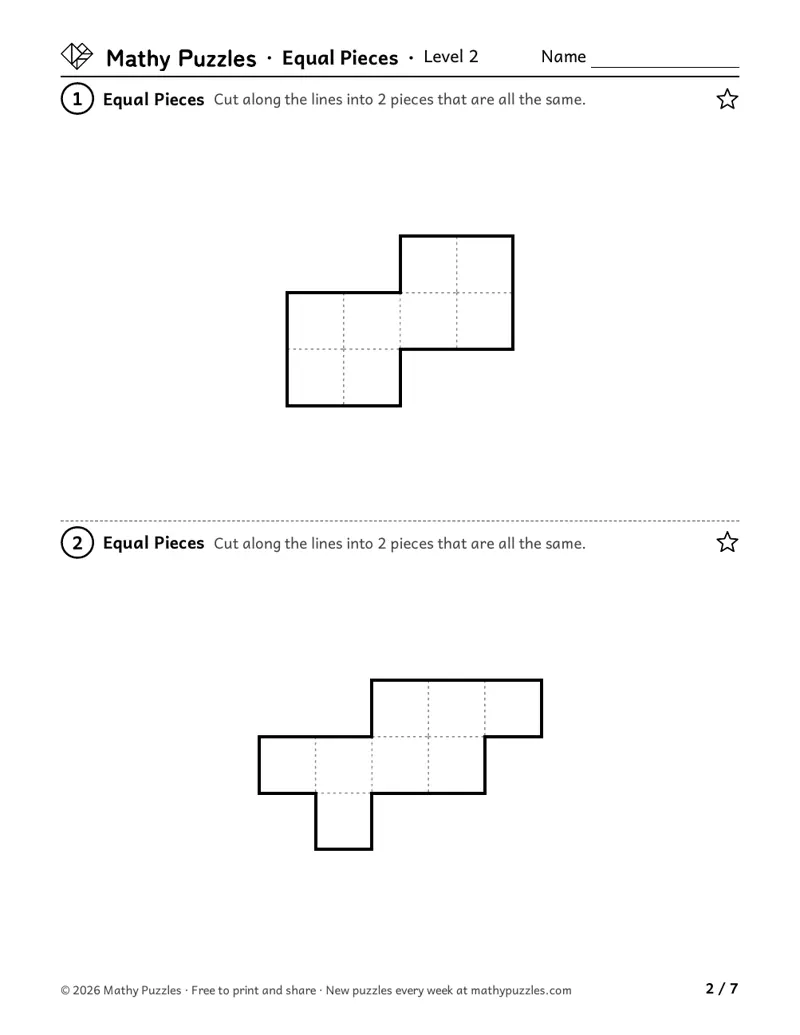 Level 2: a page from the free set
Before starting
- Count squares to about 30
- Share a small number into equal groups (12 into 3 groups of 4)
- Level 3 and up: know that a turned or flipped shape is still the same shape
What you need
Colored pencils to shade each piece, and a pencil with an eraser.
Free puzzles to print
Each set: a Learn sheet with a worked example, 10 puzzles from easiest to hardest, and the answers.
Level 2
Ages 6–8 · Grades 1–2
2 pieces of 3 to 5 squares, then 3 pieces, then 4 pieces; every piece faces the same way, so one slides onto the next.
On the sheet: “Cut the shape into pieces that are all the same.”
Print Level 2 (Letter)Other paper size: A4Level 3
Ages 8–10 · Grades 3–4
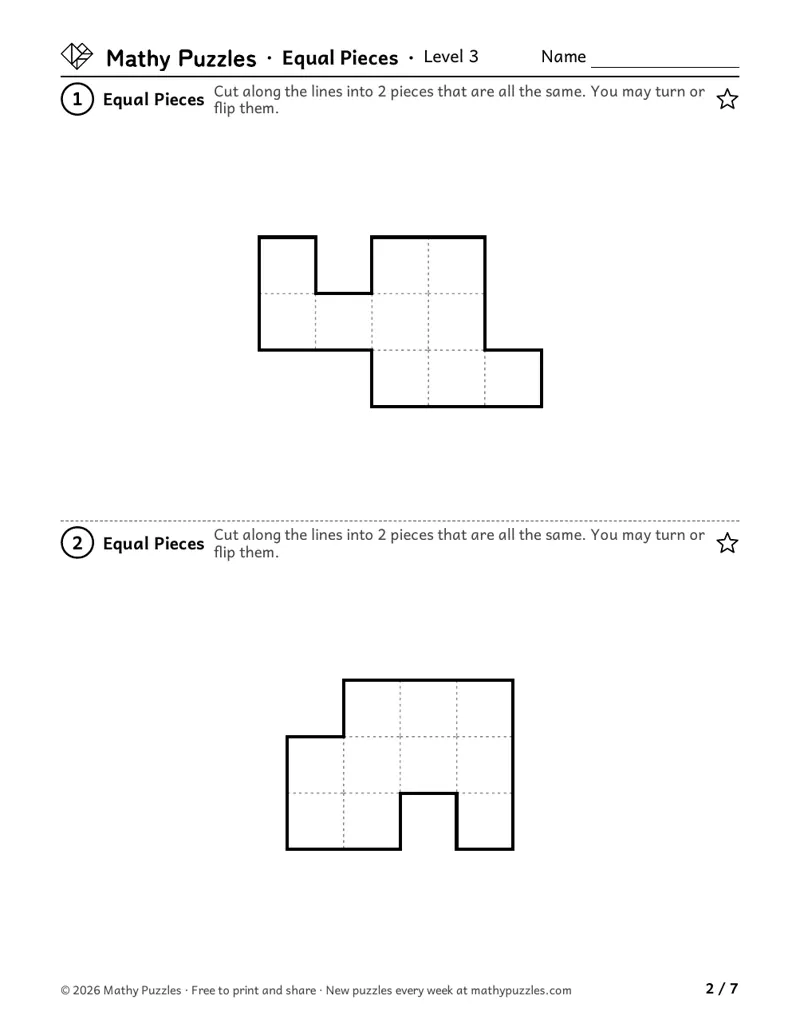
2 pieces of 4 to 6 squares, then 3 pieces, then 4 pieces where at least one is flipped. The hardest are two big halves of 8 to 10 squares, one turned or flipped.
On the sheet: “Cut the shape into pieces that are all the same.”
Print Level 3 (Letter)Other paper size: A4Level 4
Ages 10–12 · Grades 5–6
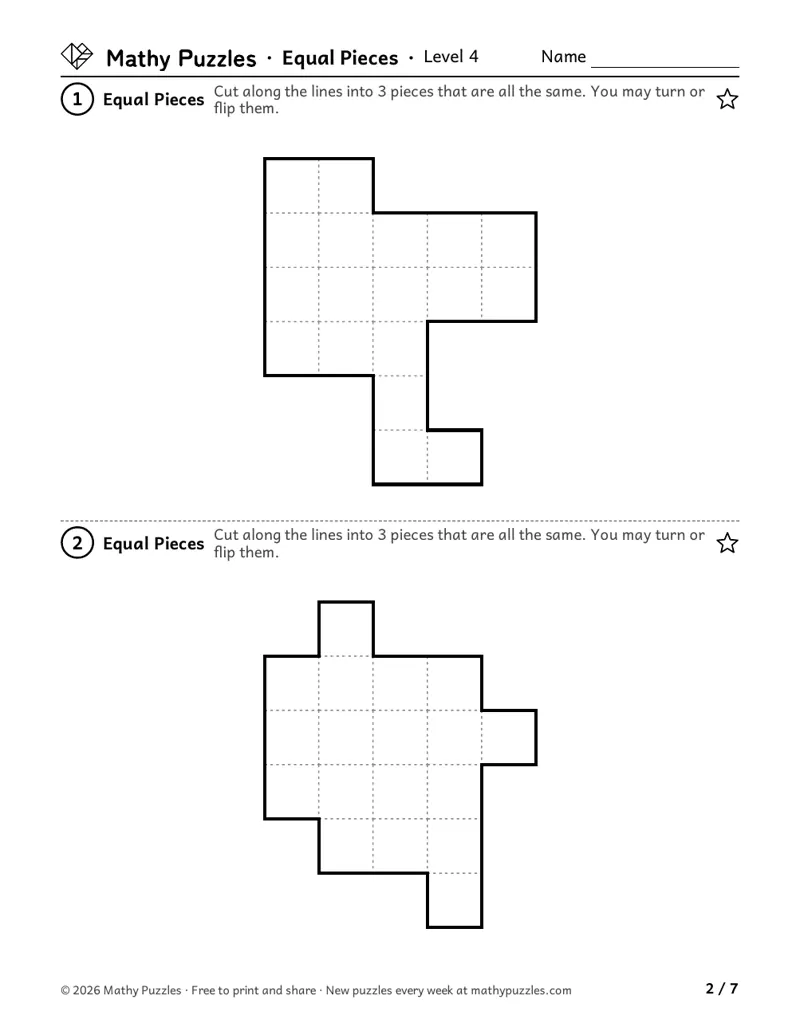
3 or 4 pieces of 6 to 7 squares, then two big halves of 11 to 14 squares. The hardest are 4 pieces of 8 squares packed tight, some flipped.
On the sheet: “Cut the shape into pieces that are all the same.”
Print Level 4 (Letter)Other paper size: A4
How it works
Each puzzle is a shape made of squares. The child draws cuts along the grid lines to split it into 2, 3 or 4 pieces that are all exactly the same shape and size. At Level 2 every piece faces the same way. From Level 3 a piece may be turned or flipped over, but it must still match the others.
How to play
- Count all the squares. Divide by the number of pieces to find each piece's size.
- Start at an awkward corner or a sticking-out square. Only a few pieces can cover it.
- Draw one piece, then look for the same shape in the squares that are left (at Level 2 it faces the same way).
- If the last pieces don't match, erase it and try a different first piece.
When it gets hard
Pieces the same size but not the same shape.
Hint: Trace one piece on scrap paper. Can you turn or flip it to cover the others?
Cutting through the middle of a square.
Hint: Cuts follow the grid lines only.
Forgetting that a piece may be flipped (Levels 3 and 4).
Hint: If no turn works, try the piece's mirror image.
Tip for grown-ups: Have your child color each piece a different color; matching shapes are much easier to compare in color.
Frequently asked questions
- My child's cut is different from the answer key.
- Check each piece against the rule: the same number of squares and the same shape (from Level 3, turned or flipped still counts). A piece that doesn't match shows where to try again; tracing one piece on scrap paper makes the check easy.
- What if it's too hard?
- Start with counting: how many squares in each piece? Then shade one piece and hunt for its twin. Cutting the pieces out of paper and laying one on top of another also helps.
Questions about printing, levels, answers or membership: see all questions.
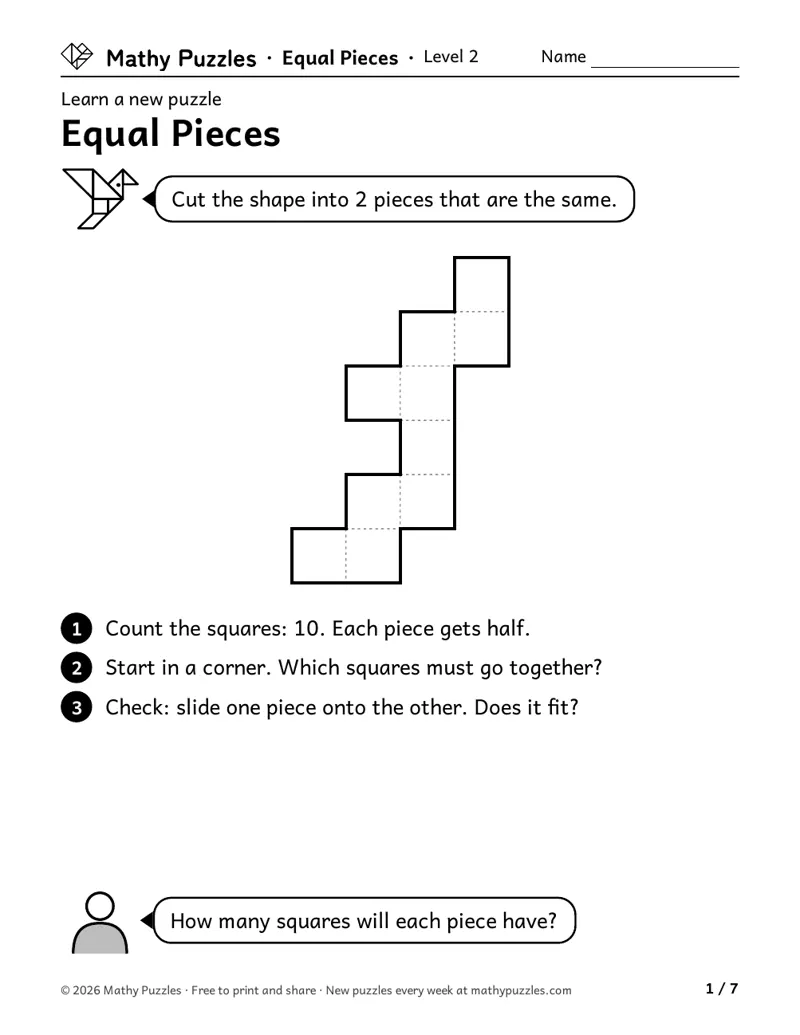
Worked example
From the Level 2 Learn sheet
- Count the squares. Each piece gets half.
- Start in a corner. Which squares must go together?
- Check: slide one piece onto the other. Does it fit?
A question to ask: “How many squares will each piece have?”
Free every Sunday A mixed bag of 20 new puzzles, all four levels. Get them by email
The thinking it works on
Seeing that a turned or flipped shape is still the same shape
Draws one piece, then hunts for the same shape turned or flipped in what's left.
Kail (1991) found that 9- and 10-year-olds told a letter from its mirror image by turning it in the mind, the same way adults did. Source
Sharing the squares out equally
Counts all the squares and divides by the number of pieces.
Outhred and Mitchelmore (2000) looked at how 115 children in grades 1 to 4 covered rectangles with squares. They found five levels, from coverings with gaps to neat rows and columns. Source
Planning ahead from the hardest spot
Starts at an awkward corner, where only a few pieces can fit.
Albert and Steinberg (2011) found that planning several moves ahead keeps developing from age 10 into the early twenties. Working memory and self-control partly explain this. Source
Checking and backtracking
Erases and tries a different first piece when the last ones don't match.
Checking one's own work (monitoring) gets stronger steadily through childhood and runs alongside self-control skills, according to a review of both research fields. Source
Taking shapes apart and putting them together
Sees one big shape as several identical smaller shapes glued together.
Clements, Wilson and Sarama (2004) mapped a path for children aged 3 to 7. It runs from fitting pieces by trial and error to joining shapes into bigger shapes made of smaller ones. Source
Sliding a shape in the mind
Slides one piece onto the next to check every square lines up.
Where is this thinking used?
- Fair shares: Cutting a cake, a pizza or fabric into equal parts.
- Tiling: Identical pieces cover a room with no gaps.
- Packing: Turning an item is often what makes it fit.
For teachers
Curriculum areas
- Common Core
- Geometry: partitioning shapes into equal shares (Grades 2–3); Measurement: area as counting unit squares (Grade 3)
- NCERT
- Halves, quarters and fair shares of shapes (Classes 3–4); fractions on a grid (Class 5)
- National Curriculum (England)
- Fractions: equal parts of a shape (Years 1–2); Measurement: area by counting squares (Year 4); Geometry: a reflected shape is unchanged (Year 5)
- Cambridge Primary Mathematics
- Fractions: splitting a shape into equal parts (Stages 2–3); Geometry and measure: area on a square grid (Stage 3)
Math practices: see the box below.
Math practices this puzzle uses
- Uses: MP1 Make sense of problems and persevere in solving them
- Not used: MP2 Reason abstractly and quantitatively
- Not used: MP3 Construct viable arguments and critique the reasoning of others
- Not used: MP4 Model with mathematics
- Not used: MP5 Use appropriate tools strategically
- Not used: MP6 Attend to precision
- Uses: MP7 Look for and make use of structure
- Not used: MP8 Look for and express regularity in repeated reasoning
From the Common Core Standards for Mathematical Practice.
More Equal Pieces puzzles for members
Members get at least 5 more worksheets at each difficulty for every puzzle, 80 new puzzles every Sunday, and the whole archive. $39 a year or $25 for 6 months.
See membershipNot ready yet?
One email, all four levels: 20 puzzles, 5 for each level.
For grown-ups (18+). One email every Sunday with the puzzles and the odd note about membership; unsubscribe any time. We never ask about your child. How we use your email