
Best Question
In a guessing game, "Is it Mia?" is a weak first question: most of the time it rules out one friend. "Is the friend wearing a hat?" can rule out half. These puzzles are about finding the question that leaves the fewest, whatever the answer.
Free sets by level, ages 6–12:
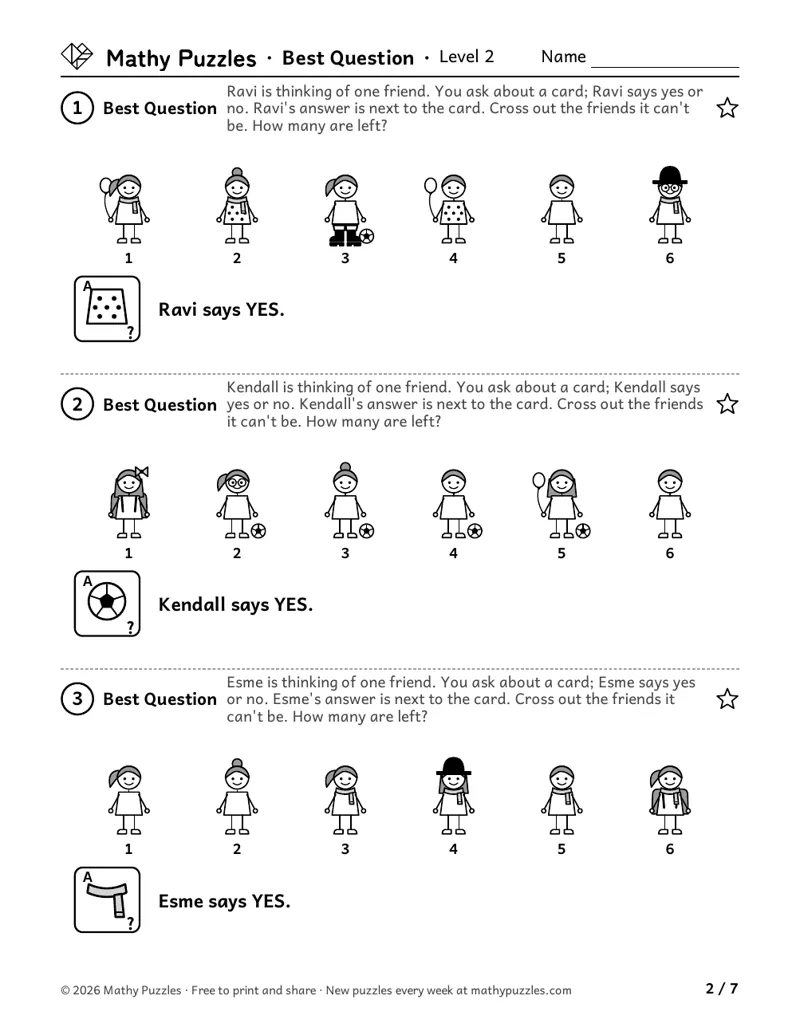 Level 2: a page from the free set
Before starting
- Count up to 16 friends
- Spot small things on a drawing (a hat, glasses, a striped shirt)
- Know that a yes keeps the friends who have it and a no keeps the friends who don't
- Level 4: follow a small yes-and-no tree (the sheet shows the boxes)
What you need
Two colored pencils (one for the yes friends, one for the no friends), and a pencil for crossing out.
Free puzzles to print
Each set: a Learn sheet with a worked example, 10 puzzles from easiest to hardest, and the answers.
Level 2
Ages 6–8 · Grades 1–2
6 friends and one card with its answer; cross out and count who is left. Then 8 friends and 3 or 4 cards, writing how many are left after a yes and after a no.
On the sheet: “A friend is hidden. Pick the question that finds them fastest.”
Print Level 2 (Letter)Other paper size: A4Level 3
Ages 8–10 · Grades 3–4
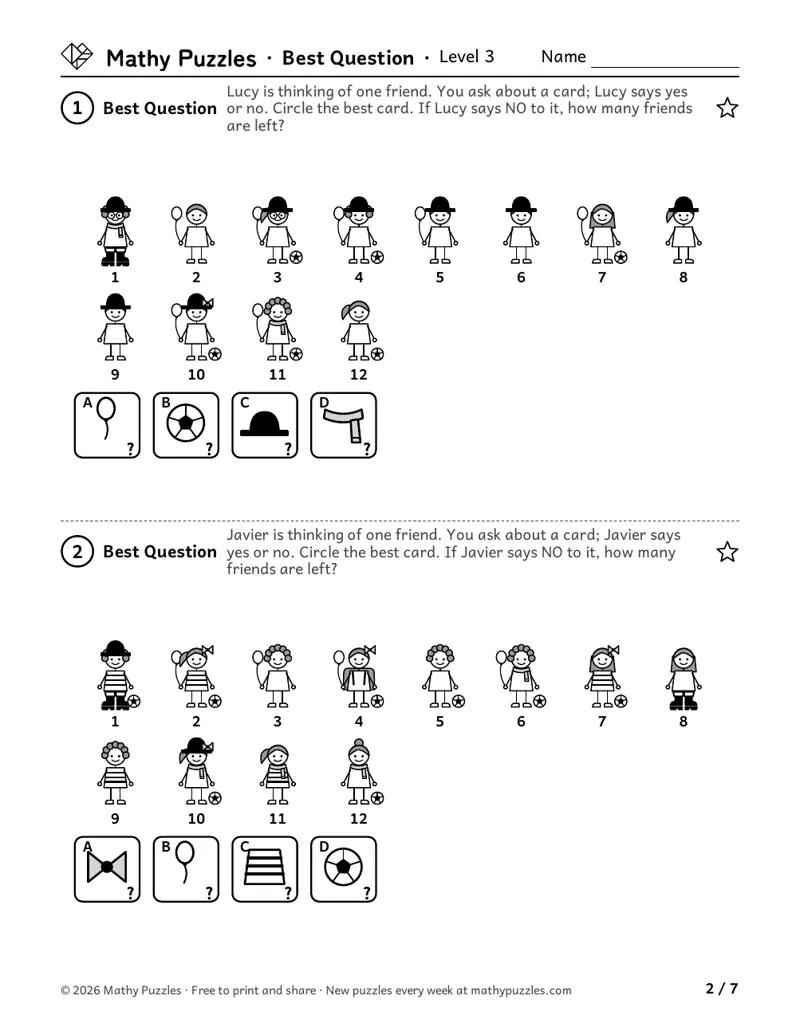
With 12 friends, find the best card and how many are left after a no. Then, with 8 friends, the best second question after each answer. The hardest ask whether 4 questions are always enough for 16 friends.
On the sheet: “A friend is hidden. Pick the question that finds them fastest.”
Print Level 3 (Letter)Other paper size: A4Level 4
Ages 10–12 · Grades 5–6
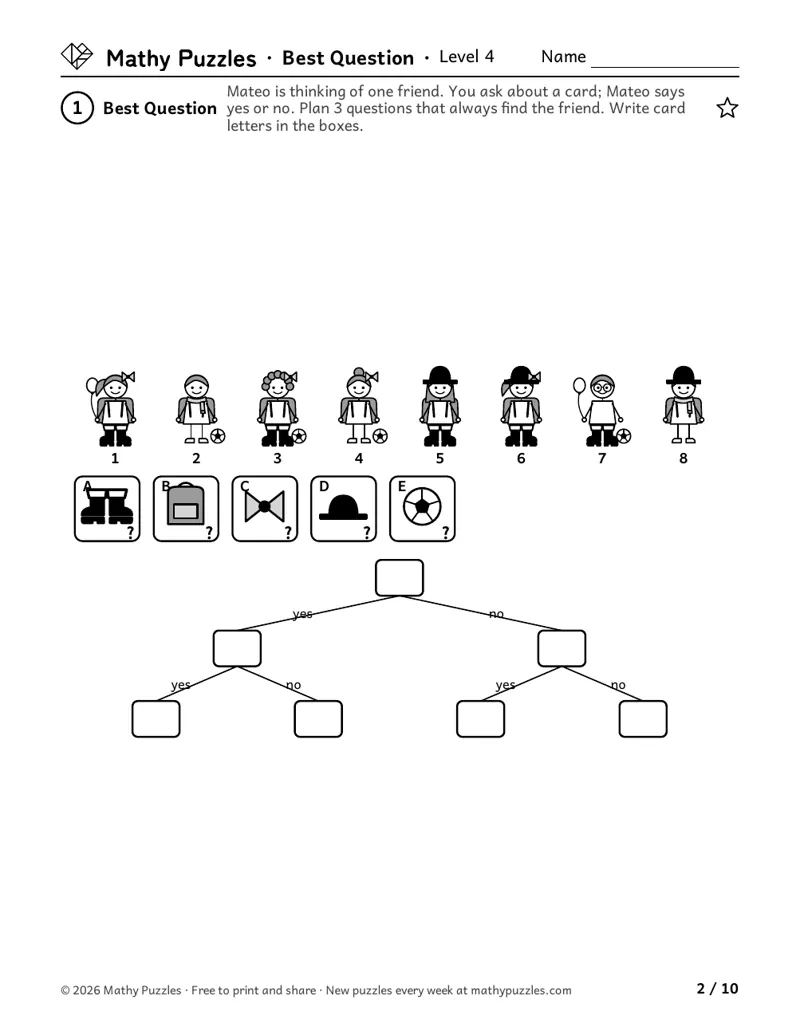
Plan 3 questions that always find one of 8 friends, written in a small tree. Any plan that always works is right. Then the same with one card that splits nobody. The hardest ask for the fewest questions that always work with 12 or 16 friends.
On the sheet: “A friend is hidden. Pick the question that finds them fastest.”
Print Level 4 (Letter)Other paper size: A4
How it works
Each puzzle shows a group of drawn friends and a few question cards, such as "Hat?" or "Glasses?". Someone is thinking of one friend and answers only yes or no. The child works out which question leaves the fewest friends, whatever the answer, and later plans a few questions in a row.
How to play
- Look at one card. Count the friends who have that thing (yes) and who don't (no).
- Write both numbers under the card.
- The bigger number is what you might be left with. The best card makes that number smallest.
- At Levels 3 and 4, plan the next question for a yes and for a no, until one friend is left.
When it gets hard
Picking the card that would cross out the most if the answer were yes.
Hint: You don't know the answer yet. Ask: what if it's no?
Counting the friends crossed out instead of the friends left.
Hint: Circle the friends still in. Count those.
Asking the same card twice in one plan.
Hint: A card already asked can't split anyone new. Pick a different one.
Tip for grown-ups: Play it out loud first: think of one friend on the sheet and let your child ask the cards. They soon feel why a half-and-half question beats a lucky guess. Two colors, one for the yes friends and one for the no friends, show at a glance who is still in.
Frequently asked questions
- My child just guesses one friend. Is that wrong?
- A guess can win fast, but it often leaves many friends. The puzzle asks for the card that always leaves only a few. Count both answers under each card together.
- How could I run this as a class game?
- Draw 8 friends on the board and think of one. Let the class vote on a card, answer yes or no, and count who is left.
- Can more than one plan be right?
- At Level 4, yes. Any plan that always ends with one friend is right. The answers show one plan as an example.
Questions about printing, levels, answers or membership: see all questions.
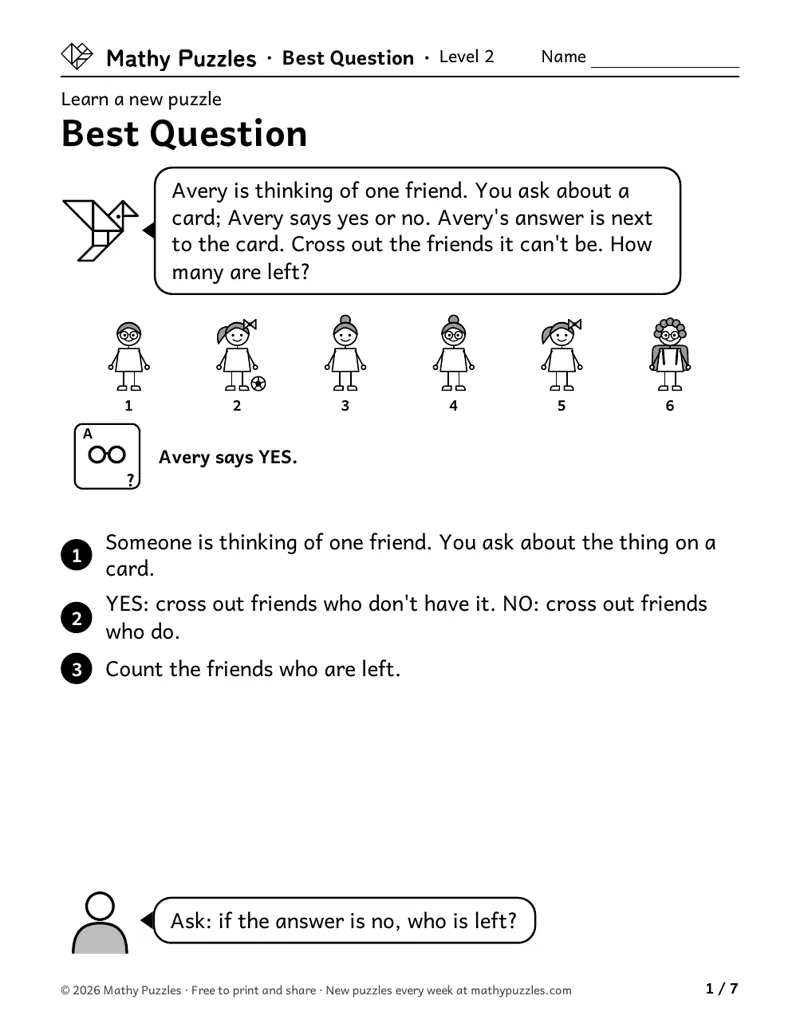
Worked example
From the Level 2 Learn sheet
- Someone is thinking of one friend. You ask about the thing on a card.
- A yes: cross out the friends who don't have it. A no: cross out the friends who do.
- Count the friends who are left.
A question to ask: “If the answer is no, who is left?”
Free every Sunday A mixed bag of 20 new puzzles, all four levels. Get them by email
The thinking it works on
Asking good questions
Judges a question by how much its answer will tell.
Ruggeri and Lombrozo (2015) found that 7- to 8-year-olds leaned on questions that test one guess at a time. Nine- to 11-year-olds asked more questions that narrow the whole group. Every age asked more narrowing questions when a lucky guess was least likely to pay off. Source
Thinking about both answers
Works out what happens after a yes and after a no.
In a yes-or-no search game, Nelson and colleagues (2014) found that fourth graders had good intuitions about which questions were most useful. They adapted their questions to how the hidden objects were spread. Source
Sorting by one feature
Splits the friends into has-it and doesn't-have-it.
Smith and Kemler (1977) found that fifth graders sorted cards by one feature at a time, such as size. Kindergartners mostly grouped by how alike cards looked overall. Source
Planning steps ahead
Plans the next question for each answer.
Seeing the halving pattern
Knows each answer can at best halve the group.
Ruggeri, Lombrozo, Griffiths and Xu (2016) found that 7- and 10-year-olds searched less efficiently than adults in a twenty-questions game. This was largely because they kept asking after only one possibility was left. Source
Where is this thinking used?
- Guessing games: In twenty questions, a smart question halves what is left.
- Looking things up: Opening a dictionary near the middle, then going left or right.
- Holiday lights: Testing half the string first to find the dead bulb.
- Help desks: Asking the one question that rules out the most problems.
For teachers
Curriculum areas
- Common Core
- Measurement and data: sorting into groups and counting each group (Grade 1); the real work is reasoning (see Math practices)Levels 3–4: No direct curricular match.
- NCERT
- Data Handling in Joyful Mathematics (Class 2): counting each group; Patterns in Mathematics in Ganita Prakash (Class 6): powers of 2Level 3: No direct curricular match.
- National Curriculum (England)
- Statistics: sorting into groups and counting each group (Year 2)
- Cambridge Primary Mathematics
- No direct curricular match.
Math practices: see the box below.
Math practices this puzzle uses
- Uses: MP1 Make sense of problems and persevere in solving them
- Not used: MP2 Reason abstractly and quantitatively
- Uses: MP3 Construct viable arguments and critique the reasoning of others
- Not used: MP4 Model with mathematics
- Not used: MP5 Use appropriate tools strategically
- Not used: MP6 Attend to precision
- Uses: MP7 Look for and make use of structure
- Not used: MP8 Look for and express regularity in repeated reasoning
From the Common Core Standards for Mathematical Practice.
More Best Question puzzles for members
Members get at least 5 more worksheets at each difficulty for every puzzle, 80 new puzzles every Sunday, and the whole archive. $39 a year or $25 for 6 months.
See membershipNot ready yet?
One email, all four levels: 20 puzzles, 5 for each level.
For grown-ups (18+). One email every Sunday with the puzzles and the odd note about membership; unsubscribe any time. We never ask about your child. How we use your email